


Automotive
The Power of AI Chips and Intelligent Cameras
Welcome to the future, where machines are no longer confined to binary code and mundane tasks. In a world driven by artificial intelligence (AI) chips and intelligent cameras, we find ourselves at the forefront of an extraordinary technological revolution. Gone are the days when computers were limited to mere computations; now they possess the power of perception. Join us as we unravel the immense potential that AI chips and intelligent cameras hold, propelling our society into realms previously untouched by human imagination. Prepare to be amazed as we explore how these groundbreaking technologies are reshaping industries, transforming lives, and forever altering our understanding of what is possible in this brave new world.

Revolutionizing Visual Intelligence
The demand for advanced processing capabilities is ever-increasing in the fast-paced world of artificial intelligence and deep learning. As industries explore new AI and machine learning applications, the need for specialized hardware becomes evident. This is where AI chips and intelligent cameras come into play, revolutionizing visual intelligence and paving the way for exciting possibilities in various domains.
The Rise of AI Chips: Empowering Deep Learning
AI chips, also known as AI processors or neural processing units (NPUs), are specialized bits of hardware designed to accelerate AI activities. Traditional central processing units (CPUs) and graphics processing units (GPUs) are versatile, but they may not be capable of performing the complex computations required by deep learning algorithms. In contrast, AI processors are optimized for matrix multiplication and other deep learning activities.
As a consequence of the increased demand for AI applications in a range of industries, AI chips have advanced dramatically in recent years. Deep learning algorithms and neural networks have paved the way for dedicated hardware capable of processing massive amounts of data at the same time. These advancements have greatly increased the speed and efficiency of AI computations.
Key Benefits of AI Chips for Deep Learning
- Speed and Efficiency: AI chips are designed to handle AI-specific tasks more efficiently than traditional processors. This specialization allows for faster inference and training times, making AI applications more responsive and reducing the computational resources required.
- Power Consumption: Offloading AI computations to dedicated AI chips can reduce overall power consumption, leading to more energy-efficient systems. This is especially important in applications where power limits are an issue, such as mobile devices or edge computing.
- Real-Time Data Processing: AI chips provide real-time data processing, making them ideal for applications such as autonomous vehicles, facial recognition systems, and augmented reality that require speedy responses.https://www.techpr.online/industrial-edge-computing-explained/
- Scalability: AI chips can be readily incorporated into current systems, allowing for scalability and adaptability to changing AI workloads. This scalability is critical as the complexity and volume of data in AI applications grows.
AI chips have applications in various industries, including healthcare, finance, automotive, and more. In healthcare, AI chips power medical imaging analysis, enabling faster and more accurate diagnosis. In finance, AI chips facilitate fraud detection and risk analysis, improving the security and efficiency of financial transactions. Autonomous vehicles rely heavily on AI chips to process sensor data in real-time, enabling safe and reliable self-driving capabilities.

Empowering Visual Intelligence with Intelligent Cameras
Visual intelligence involves the ability of AI systems to perceive, understand, and interpret graphic data. Intelligent cameras equipped with AI chips are pivotal in achieving visual intelligence. These cameras can process visual data on edge, meaning that AI inference and analysis happen directly on the camera device without cloud connectivity.
Intelligent cameras have become increasingly popular across various industries due to their ability to deliver real-time insights and immediate responses. By leveraging AI chips, smart cameras can handle complex computer vision tasks efficiently and accurately, providing users with valuable real-time information.
Key Benefits of Intelligent Cameras
- Real-Time Analysis: Intelligent cameras can interpret visual input in real-time by executing AI inference at the edge, making them suited for applications requiring quick decision-making, such as surveillance and security systems. Smart cameras, for example, may identify abnormalities in an intelligent surveillance system, such as suspicious conduct, and promptly warn security staff.
- Privacy and Security: Because sensitive data does not need to be transferred to a remote server for processing, intelligent cameras with edge AI capabilities respect privacy concerns. This guarantees that data stays secure and confidential, addressing data privacy and security issues.
- Bandwidth Efficiency: Processing data at the edge reduces the need for high bandwidth, as only relevant information or events are transmitted to the cloud for further analysis or storage. This bandwidth efficiency is particularly advantageous in scenarios with limited network connectivity.
- Cost-Effectiveness: Intelligent cameras reduce the infrastructure and operational costs associated with cloud-based AI processing, as most processing occurs locally on the camera device. This cost-effectiveness makes intelligent cameras a viable option for applications with budget constraints.
Intelligent cameras have applications in various industries, including retail, smart cities, industrial automation, and healthcare. Intelligent cameras can analyze customer behavior and traffic flow in retail, helping retailers optimize store layouts and marketing strategies. In smart cities, intelligent cameras can monitor traffic and detect accidents, enabling city planners to make data-driven decisions for urban planning. In industrial automation, intelligent cameras can inspect manufacturing processes and detect defects, improving quality control and efficiency.
Applications of AI Chips and Intelligent Cameras
The combination of AI chips and intelligent cameras opens up a multitude of applications across various industries:
- Smart Surveillance: AI-powered cameras with built-in AI chips can detect and analyze objects, people, and events in real-time, enhancing security and surveillance systems. Intelligent cameras can be equipped with features like facial recognition, license plate recognition, and behavior analysis to detect suspicious activities and respond proactively to potential threats.
- Autonomous Vehicles: AI chips enable deep learning algorithms for object detection and path planning in autonomous vehicles, making them safer and more reliable. Intelligent cameras on autonomous vehicles continuously capture and process visual data, enabling real-time decision-making for safe navigation.
- Industrial Automation: Intelligent cameras with AI chips can monitor production lines, detect defects, and optimize manufacturing processes, increasing efficiency and reducing errors. These cameras can analyze the quality of products and identify deviations from desired standards, ensuring higher product quality.
- Healthcare: In healthcare settings, AI-powered cameras can help with patient monitoring, medical diagnostics, and even detecting early indications of sickness. Intelligent cameras integrated with AI chips, for example, may scan medical pictures to detect irregularities and assist healthcare practitioners in making correct diagnosis.
- Retail Analytics: Intelligent cameras can assess customer behavior, measure foot traffic, and give merchants with vital knowledge for optimizing shop layouts and marketing campaigns. Retailers may adjust their goods to match the requirements and tastes of their target audience by studying customer behavior.
The Future of Visual Intelligence
As AI technology advances, integrating AI chips with intelligent cameras will become even more prevalent. This combination will lead to more sophisticated and capable visual intelligence systems, enabling a wide range of applications with real-time and context-aware capabilities.
The future of visual intelligence holds immense potential across industries. With ongoing advancements in AI chips and intelligent cameras, we can expect to see even more innovative applications, enhanced user experiences, and increased automation of complex tasks.
As businesses and industries continue to embrace AI-driven solutions, the seamless integration of AI chips and intelligent cameras will play a pivotal role in shaping the future of visual intelligence. From enhancing security and surveillance to revolutionizing transportation and healthcare, the power of AI chips and intelligent cameras will drive innovation and transform the way we interact with the world around us.
AI Chips and Cameras Q&As
- What are AI chips, and how do they differ from traditional processors?
AI chips are specialized hardware optimized for AI tasks, particularly deep learning. Unlike traditional processors, AI chips excel at matrix multiplication and other computations essential for deep learning algorithms.
- What are the benefits of AI chips for deep learning?
AI chips offer speed and efficiency, reduced power consumption, real-time processing, and scalability for AI applications.
- What is visual intelligence, and how do intelligent cameras contribute to it?
Visual intelligence involves AI systems’ ability to perceive and interpret visual data. Intelligent cameras equipped with AI chips enable real-time analysis at the edge, contributing to visual intelligence without relying heavily on cloud connectivity.
- What are the benefits of intelligent cameras?
Intelligent cameras offer real-time analysis, privacy and security, bandwidth efficiency, and cost-effectiveness for applications in various industries.
- What are the applications of AI chips and intelligent cameras?
AI chips and intelligent cameras find applications in smart surveillance, autonomous vehicles, industrial automation, healthcare, retail analytics, and more.
Conclusion on AI Chips and Cameras
The combination of AI chips and intelligent cameras is reshaping visual intelligence and unlocking a new era of applications across various industries. AI chips and intelligent cameras are driving innovation and pushing the frontiers of what is possible with visual data processing, from improving security and surveillance systems to enabling driverless cars and optimizing industrial processes.
As these technologies advance, we may anticipate progressively more advanced and powerful visual intelligence systems, ushering in a future in which AI-powered cameras play an important part in our daily lives. The opportunities for real-time insights, greater user experiences, and increasing automation of complicated activities are limitless as AI processors and intelligent cameras continue to evolve.
As more organizations and sectors embrace AI-powered solutions, the seamless integration of AI chips and intelligent cameras will play a critical role in creating the future of visual intelligence. The potential of AI processors and intelligent cameras will drive innovation and revolutionize the way we interact with the world around us, from revolutionizing healthcare and transportation to improving retail and industrial operations. The path to a visually intelligent future is already begun, and the potential for beneficial effect is boundless.



The number of connected vehicles on the road is growing rapidly, and with that growth comes an expanding digital attack surface that no automotive manufacturer can afford to ignore. Automotive cyberattacks have spiked sharply in recent years, and the consequences of a successful breach range from data theft to remote vehicle compromise across entire fleets. A Vehicle Security Operations Center — commonly referred to as a VSOC — has emerged as the operational answer to this challenge, providing the continuous monitoring, threat detection, and incident response capability that connected vehicle programs require.
What Is a VSOC?
A Vehicle Security Operations Center is a dedicated security facility or platform designed specifically to monitor, detect, analyze, and respond to cybersecurity threats across a connected vehicle fleet. Unlike a traditional IT Security Operations Center (SOC) — which is designed for enterprise networks and data infrastructure — a VSOC is built around the unique characteristics of vehicle architectures: proprietary communication protocols, ECU telemetry, OTA update channels, telematics data, and the complex interactions between in-vehicle systems and external cloud backends.
At its core, a VSOC aggregates security data from across a fleet — monitoring network traffic, ECU behavior, and external communications to identify anomalies, flag potential intrusions, and enable a coordinated security response before incidents escalate. As OTA updates and Vehicle-to-Everything (V2X) communication become standard in modern vehicle programs, the VSOC has become a critical component of any serious post-production cybersecurity strategy.
Why VSOC Demand Is Growing
Several converging factors have brought the VSOC from a forward-looking concept to an operational necessity:
-
Regulatory Requirements: UNECE Regulation 155 (UNR 155), now mandatory for all newly manufactured vehicles in EU member states and more than 50 other UNECE markets, requires OEMs to maintain a Cybersecurity Management System (CSMS) that includes post-production monitoring capabilities. A VSOC is a primary mechanism through which that obligation is fulfilled in the operational phase of the vehicle lifecycle.
-
Scale of Connected Fleets: Managing security events across hundreds of thousands or millions of vehicles in real time requires cloud-scale infrastructure and intelligent filtering. Manual or siloed approaches cannot operate at this volume without generating prohibitive costs and alert fatigue.
-
Sophistication of Attacks: Automotive cyberattacks have grown in both frequency and technical complexity. Cloud-related vulnerabilities, onboard system compromises, and remote access attempts all require detection capabilities tuned specifically to vehicle telemetry patterns, not generic network intrusion signatures.
-
Cost of Inaction: System downtime and cybersecurity vulnerabilities represent significant financial risks for the automotive sector. The business case for proactive monitoring has become straightforward.
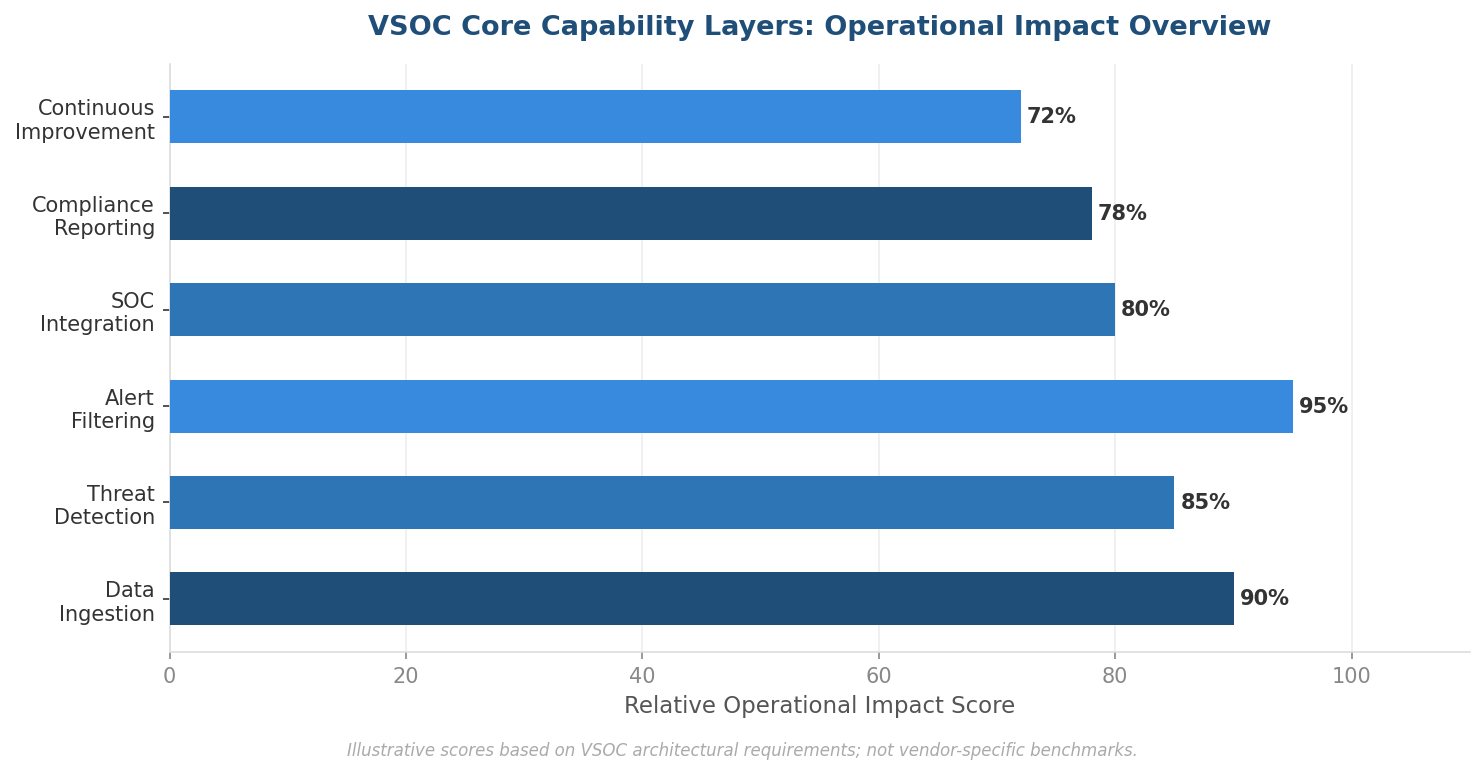
VSOC Operational Capability Performance Metrics
Operating a fleet protection layer successfully relies heavily on resolving data ingestion, sorting, and reporting bottle-necks at the network edge.
The visual layout below highlights the operational tiers that constitute a modern connected automotive defense topology:
| VSOC Layer | Function | Why It Matters |
| Data Ingestion | Collects and normalizes telemetry from in-vehicle agents, third-party sensors, telematics platforms, and cloud logs |
Creates a unified, clean dataset prerequisite for accurate detection across a heterogeneous fleet |
| Threat Detection | Applies vehicle-specific detection rules and AI-driven anomaly analysis to flag suspicious events |
Surfaces true positives from high-volume data streams; reduces false alarm rates that would otherwise overwhelm SOC analysts |
| Alert Filtering & Noise Reduction | Filters redundant and low-fidelity alerts before they reach the SOC team |
Directly controls operational cost: less data transmission, less cloud storage, fewer analyst hours spent on non-events |
| SOC Platform Integration | Delivers enriched, actionable alerts to the organization’s existing SOC tooling via open APIs |
Enables VSOC to fit into established security workflows rather than requiring a parallel, isolated operation |
| Compliance Reporting | Generates fleet-level security reports and dashboards aligned with UNR 155/156 and ISO 21434 requirements |
Supports audit readiness and type approval maintenance obligations without manual data compilation |
| Continuous Improvement | Feeds detection insights back to in-vehicle agents to improve rules and reduce false positives over time |
Iteratively hardens both cloud-side detection and in-vehicle defenses across the fleet lifecycle |
The Data Problem at the Heart of Fleet Security
One of the most underappreciated operational challenges in running a VSOC is not threat sophistication—it is data volume and quality. A modern connected fleet generates an enormous volume of telemetry continuously. Without intelligent filtering, the majority of that data is either redundant, low-fidelity, or simply noise. Acting on raw, unfiltered telemetry at scale results in three concrete problems: alert fatigue among SOC analysts, escalating cloud storage costs, and high cellular data transmission expenses as vehicles send unfiltered data to the backend.
This is why the architecture of a production-grade VSOC must include a strong data processing layer upstream of threat detection—one that can reduce junk data significantly before it ever reaches the analysis engine. The volume reduction translates directly into cost reduction and detection accuracy.
Cloud Intelligence Architecture for Automotive SOC Operations
An enterprise-grade cloud-side platform can serve as the intelligence backbone for modern automotive security operations. This approach forms a comprehensive vehicle cybersecurity infrastructure, acting as the centralized cloud-side complement to in-vehicle protection agents.
Integrating a specialized automotive soc engine optimizes multi-source telemetry ingestion from in-vehicle sensors, third-party agents, and logs to produce a clean, unified database. Deployed platforms can cut junk telemetry significantly, reducing vehicle data transmission and operational overhead across massive cloud storage deployments.
On the detection side, a robust vsoc engine uses vehicle-centric, out-of-the-box detection rules alongside AI correlation to surface true positives from high-volume event streams. Open APIs allow deep integration with existing enterprise SIEM infrastructures—including Azure Sentinel, Splunk, and Chronicle—ensuring automotive alerts feed directly into established enterprise workflows rather than creating a separate, isolated monitoring silo.
Furthermore, automated unr 155 compliance modules provide dashboards aligned with ISO 21434, establishing continuous feedback loops to dynamically tune in-vehicle rules over the entire lifespans of millions of vehicles simultaneously.
What to Evaluate When Building or Selecting a VSOC Capability
For OEMs and fleet operators assessing solutions, the following criteria reflect the operational realities of managing cybersecurity at vehicle scale:
-
Multi-Vendor Agent Support: Most large fleets include components from multiple suppliers. A VSOC platform that can only ingest data from a single in-vehicle agent vendor creates coverage gaps. Open ingestion from multi-vendor sources is essential.
-
Data Reduction Before Analysis: Evaluate how much noise reduction the platform performs before data reaches the detection engine. Raw-data approaches at fleet scale become prohibitively expensive quickly.
-
Existing SOC Integration: A VSOC that requires organizations to stand up and maintain a fully separate security operations function alongside their IT SOC creates redundancy and increases total cost. Open API integration with existing SIEM and SOC platforms is the more sustainable architecture.
-
Automotive-Specific Detection Rules: Generic intrusion detection logic is not tuned to vehicle telemetry patterns. Evaluate whether out-of-the-box detection rules are built from automotive attack scenarios and ECU behavior baselines.
-
Compliance Reporting Alignment: UNR 155 requires ongoing CSMS evidence post-production. Automated reporting against regulatory frameworks reduces audit preparation time and ensures continuous compliance documentation.
Conclusion
A Vehicle Security Operations Center is no longer a future capability—it is the operational infrastructure that connected vehicle programs running at scale require today. The combination of regulatory mandates, fleet complexity, and the real financial consequences of undetected threats has made continuous monitoring a practical necessity, not a premium add-on.
For organizations designing their VSOC architecture, the priorities are clear: strong data reduction before the detection layer, automotive-specific threat intelligence, open integration with existing SOC workflows, and compliance reporting built for the UNR 155 and ISO 21434 frameworks. Modern platforms address the core operational challenge of managing cybersecurity across millions of connected endpoints without the overhead of managing millions of individual security events.

Automotive Penetration Testing: Methods, Regulations, and Strategic Selection Criteria
As vehicles evolve into software-defined systems with hundreds of millions of lines of code, the security stakes have never been higher. Reported automotive cybersecurity vulnerabilities climbed from 82 in 2019 to 530 in 2024, representing an increase of more than 500% in five years. Behind this surge is a confluence of factors: broader connectivity, over-the-air update capabilities, and increasingly complex electronic control unit (ECU) architectures. In this environment, automotive penetration testing has shifted from a recommended best practice to a regulatory prerequisite, and the demand for qualified providers is growing rapidly.
Why Automotive Pentesting Has Become Non-Negotiable
The regulatory catalyst is clear. Since July 2024, UN Regulation 155 (UNR 155) has required that all newly manufactured vehicles sold in UNECE member states—including the EU, Japan, South Korea, and more than 50 other markets—demonstrate compliance with a certified Cybersecurity Management System (CSMS). Without passing the required tests and audits, manufacturers cannot obtain type approval and, therefore, cannot sell vehicles in those markets.
The complementary standard for the supply chain, ISO 21434, provides the engineering framework that supports CSMS certification. Together, these regulations mean that penetration testing is no longer optional: it is a gating requirement before any vehicle can enter production and reach market.
The market has responded accordingly. The global penetration testing market was valued at approximately USD 2.74 billion in 2025 and is projected to reach USD 7.41 billion by 2034, growing at a compound annual growth rate (CAGR) of 11.6%, according to Fortune Business Insights. Within the automotive segment, OEMs account for the largest share of demand, driven by pressure to validate ECU behavior and update paths before software moves into fleet deployment.
The Vulnerability Landscape Driving Demand
The following table illustrates the sharp rise in identified automotive cybersecurity vulnerabilities between 2019 and 2024, underscoring the urgency behind regulatory enforcement and the growing need for dedicated security testing:
| Year | Identified Vulnerabilities | Key Driver | Regulatory Milestone |
| 2019 | 82 | Early connectivity framework adoption | WP.29 adoption proposed |
| 2020 | 120 | Remote attack surface expansion | UNR 155 published |
| 2021 | 180 | OTA update adoption rises | ISO 21434 published |
| 2022 | 260 | Cloud/V2X integration | UNR 155 mandatory (new types, EU) |
| 2023 | 380 | SDV software complexity | Industry-wide CSMS buildout |
| 2024 | 530 | Cloud infra & onboard system attacks | UNR 155 mandatory (all new vehicles) |
Sources: Capture The Bug (2025); UNECE WP.29 Regulatory Timeline
What Automotive Penetration Testing Actually Covers
Unlike conventional IT pen testing, automotive penetration testing must contend with proprietary protocols (CAN bus, Automotive Ethernet, SOME/IP), physical hardware access, real-time operating constraints, and safety-critical systems. A credible automotive cyber security testing program typically spans several distinct layers:
- ECU-Level Testing: Examines individual electronic control units for interface vulnerabilities, communication channel weaknesses, and misconfigured security measures. Establishing rigid ecu cyber security is often the first layer of defense tested during component development.
- Vehicle-Level Testing: Assesses the full vehicle architecture, including interactions between ECUs, telematics units, infotainment systems, and external communication channels. Securing comprehensive connected vehicle cyber security is vital to insulate the physical cabin environment.
- Code Review: A manual analysis of software code to verify that it has been developed in line with secure coding guidelines and does not contain latent vulnerabilities that automated scanning may miss.
- Fuzz Testing: Automated testing that sends malformed or unexpected inputs to system interfaces to surface zero-day vulnerabilities and configuration errors. It is especially effective for discovering unknown weaknesses when performing fuzz testing for automotive cyber security.
Evaluating Automotive Pentesting Providers: Key Criteria
Not all penetration testing services are built for the automotive domain. When evaluating providers, OEMs and Tier 1 suppliers should assess the following factors:
| Evaluation Criterion | What to Look For |
| Automotive-specific expertise | Deep knowledge of CAN bus, SOME/IP, Automotive Ethernet, and ECU architectures—not generic IT protocols. |
| Regulatory alignment | Services explicitly structured to support UNR 155 type approval and iso 21434 compliance deliverables. |
| Modular service scope | Ability to engage at the ECU level, vehicle level, or full lifecycle without forcing an all-or-nothing engagement. |
| Fuzz testing tooling | Automated and scalable automated fuzz testing tools designed specifically for automotive communication protocols. |
| Reporting for homologation | Structured outputs that can be submitted as evidence to technical services for vehicle homologation and component certification. |
Selecting a Strategic Partner for Technical Infrastructure
Specialized automotive cyber security companies offer structured suites of penetration testing services covering component validation, code review, and automated testing layers. When selecting an expert compliance partner, OEMs prioritize labs capable of scaling up to hundreds of built-in automotive test cases mapped directly to internal communication lines, such as specialized can bus cyber security pipelines.
To serve regions with heavy manufacturing presences, top-tier testing networks deploy local physical testing labs to support engineering groups who require in-person hardware validation capacity. These environments consistently establish a reliable track record across both individual component and full vehicle validation layers.
Advanced service models also position security validations within a broader devsecops in automotive setup—meaning testing is not treated as a one-time gate but is integrated across the development lifecycle. This is consistent with regulatory mandates for continuous security validation from concept through decommissioning. For teams seeking an end-to-end alignment, this integrated approach reduces the coordination overhead of managing separate vendors for different lifecycle phases.
The Business Case for Early and Continuous Testing
Late-stage vulnerability discovery in automotive development is expensive. Identifying a security flaw after production tooling has been finalized can require ECU redesigns, supply chain rework, and delayed launches—costs that dwarf the price of earlier testing. The shift-left security principle, well established in enterprise software, is now taking hold across the automotive supply chain as manufacturers internalize the regulatory and financial consequences of inadequate security validation.
Furthermore, suppliers face compounding pressure: they must not only manage their own cybersecurity posture but also align with the specific automotive cyber security company processes of each OEM they supply. This makes working with a pen testing partner that understands the full supply chain context—not just isolated component testing—an increasingly important differentiator for the sdv cyber security generation.
Conclusion
Automotive penetration testing has matured from a discretionary security exercise into a mandatory compliance activity. With UNR 155 fully enforced, any vehicle entering UNECE markets must clear a defined security testing bar—and the window for treating pen testing as optional has closed. Organizations that have not yet built a structured testing program tied to their regulatory obligations are already behind.
When evaluating providers, the criteria that matter most are automotive-specific protocol expertise, regulatory alignment, modular service scope, and the ability to produce homologation-ready reporting. Partners with dedicated automotive testing infrastructure and a structured approach across the development lifecycle are best equipped to serve both compliance and genuine automotive cyber security objectives simultaneously.
As the vulnerability count continues to climb and software-defined vehicle architectures grow more complex, the quality of security testing will increasingly determine which OEMs and suppliers can move quickly to market and which face delays at the type approval stage.
Much like self-driving automobiles, technology that allows cars to communicate is already here with us. You won’t be bothered by this technology, no matter how much you detest the encroachment of some aspects of the IT world into your everyday life. Instead, it ought to shorten your commute time and make the world’s cities and roadways safer.
This technology is intriguing as it can be used to shorten commute times without relying on daily enigmatic shortcuts, only to occasionally run into obstructions.
What Is Car to X Communication?
This involves equipping a car with the capacity to talk to infrastructure. It is fully wireless, frictionless, and happens instantly.
Updates will transform the system into a useful tool for everyday driving, just as with any software, without the users having to do anything more in addition to driving. The best part of this plan is that it will be put into autonomous vehicles and, after everyone gets it, will improve how well they function.
Humans won’t be able to sense wireless communication; they will simply profit from the robotic labor. Cars will be able to communicate to alert one another about road accidents or risky areas.
When other cars are alerted, they may either avoid the obstruction without making any unexpected moves or slow down in advance of it. Cameras will detect when the danger has passed, at which point the warning also vanishes.
What Are the Downsides?
First off, this method will make cars more expensive and complicated. Infrastructure operators will subsequently incur those additional expenses. V2x may not function properly in locations with subpar infrastructure, and it may even be worse in isolated locations with no access to the Internet.
Another key issue is the need for automakers to collaborate in order to establish a standard of communication, which is challenging given their history.
Today, wiper arms come in around six distinct varieties, and not even lug nuts are interchangeable. We are pleased to note that the gasoline filler functions uniformly for all automobiles.
V2x communication systems may only hope that this will happen, but you can’t run Mac software on Windows PCs, not without a terrible emulation system.
All of the aforementioned features of car to x communication will raise the possibility of hacking a car, but by that time, consumer-accessible systems should have amazing levels of security. Everyone should be secure as long as users don’t utilize USB sticks to introduce malware into the system and people generally follow security best practices like strong passwords.
Theoretically, a linked automobile might alert the police if its driver was speeding. The technology makes it probable for this to occur, but that aspect is not discussed anywhere. Unfortunately, as these devices become commonplace, this could end up being the finest speeding deterrent ever.
What Is Platooning?
This is the technology that enables joint and coordinated movement of two or more vehicles on the road. Its application and expansion in the transportation of commodities might revolutionize this industry.
This calls for the use of a camera, radar, and wireless Wi-Fi connection between vehicles. For the time being, and as this idea is currently understood, platooning does not equate to autonomous trucks.
How Platooning Works
A wireless connection links the first vehicle to the platoon. The second truck, which is already autonomous, is moved by the first container truck’s driver.
To improve road safety, this system combines vehicle identification, anti-collision, and v2x technologies. In order to allow other road users to pass between the platoon vehicles, it is also linked and unlinked. To improve road safety, this technique uses vehicle identification, anti-collision, and lateral control technology.
Tomato Breeders and the Push Toward Innovative Specialty Varieties
Cloud Based Live Video Production and the AI Live Production Unit
Book Digitization, Copy Stands, and Digitizing the Autochrome Process

-

 Business Solutions2 years ago
Live Video Broadcasting with Bonded Transmission Technology
-

 Business Solutions1 year ago
The Future of Healthcare SMS and RCS Messaging
-

 Business Solutions2 years ago
2-Way Texting Solutions from Company Message Services
-

 Business Solutions2 years ago
Communication with Analog to Fiber Converters & RF Link Budgets
-

 DSRC Communication2 years ago
The Crossroads of Connectivity: DSRC vs. C-V2X Technologies in Automotive Communication
-

 Business Solutions2 years ago
Wholesale SMS Platforms with OTP Services
-

 Business Solutions2 years ago
Choosing the Right B2B Digital Marketing Agency: A Guide
-

 3D Technology2 years ago
How Multispectral Cameras Advance Book Scanning