


Tech
Ovalix vs Check Point: Which AI Security Platform Is Better in 2026?


At a Glance
→ Ovalix provides a unified AI security platform covering public GenAI, homegrown AI applications, employee endpoints, coding assistants, MCP servers, AI skills, and autonomous agents.
→ Check Point covers many of the same AI environments through Workforce AI Security and AI Agent Security, with Enterprise-tier requirements for certain endpoint and developer capabilities.
→ Both vendors provide AI discovery, monitoring, data leakage prevention, access control, threat detection, policy enforcement, and AI red teaming.
→ Ovalix differentiates through centralized governance, modular deployment, full agent workflow reconstruction, and controlled coding agent policy exceptions.
| Consider Ovalix if you need | Consider Check Point if you need |
| ✓ Unified AI security management with modular deployment options
✓ Full agent workflow reconstruction and real-time deviation detection ✓ Coding agent controls with approved testing exceptions |
✓ Contextual workforce DLP with OCR and file and image redaction
✓ AI red teaming supported by Lakera’s technology ✓ AI security alongside an existing Check Point environment |
Why does enterprise AI security require broader coverage?
Enterprise AI security is no longer limited to controlling employee prompts in public chatbots. Organizations now use AI across browser-based applications, embedded SaaS features, internally developed AI systems, coding assistants, and autonomous agents.
Each environment introduces different risks.
Employees may expose sensitive information through public AI tools. Homegrown AI applications introduce risks through models, data access, and integrations. Coding agents may access source code, credentials, local files, and MCP servers. Autonomous agents can execute multi-step operations across enterprise systems.
Traditional prompt filtering and data loss prevention remain important, but they do not address every risk introduced by these environments.
Security teams need visibility into which AI systems are operating, what information they access, which actions they perform, and whether those activities comply with organizational policies.
This creates a broader evaluation question: can an AI security platform provide consistent discovery, risk assessment, governance, and protection across the enterprise AI ecosystem?
Both Ovalix and Check Point address this challenge, but their approaches differ in architecture, deployment requirements, and depth of visibility.
How do Ovalix and Check Point compare across AI security capabilities?
Ovalix provides a unified platform with modular deployment across public GenAI, homegrown AI applications, coding assistants, employee endpoints, MCP servers, AI skills, and autonomous agents.
Check Point covers many of the same environments through Workforce AI Security and AI Agent Security. Certain capabilities require its Workforce AI Security Enterprise tier, while its dedicated AI Agent Security product is documented as an early access release.
Both vendors support AI discovery, monitoring, data leakage prevention, access control, policy enforcement, and AI red teaming.
The following table highlights key differences in coverage, deployment requirements, and security capabilities.
| Capability | Ovalix | Check Point |
| AI discovery and inventory | Unified discovery across supported AI environments | Desktop, IDE, and MCP discovery require Enterprise tier |
| AI service coverage | 50,000+ services supported for access control and inline prompt inspection | Number of supported services not published |
| Employee endpoints | Discovery, monitoring, and enforcement | Enterprise tier required |
| AI coding assistants | Real-time controls and approved testing exceptions | Enterprise tier required |
| MCP servers | Discovery, monitoring, and enforcement | Employee MCP coverage requires Enterprise tier |
| AI skills | Security coverage | Risk assessment only |
| Process-level visibility | Full workflow reconstruction, deviation detection, and prevention | Risky tool-call detection (beta); no full workflow reconstruction documented |
| Data leakage prevention | Protection across text, files, and images | Desktop file protection limited to ChatGPT and Claude |
| Centralized AI governance | Unified control plane with modular deployment | AI Guardrails managed in a separate console |
What do Ovalix and Check Point have in common?
Both platforms address core enterprise AI security requirements.
They provide capabilities for discovering sanctioned and unsanctioned AI applications, identifying sensitive data exposure, enforcing AI usage policies, and detecting threats such as prompt injection.
Both extend coverage beyond public chatbots to internally developed AI applications, coding assistants, MCP servers, and autonomous agents.
Their capabilities also include risk assessment, investigation, reporting, real-time threat detection, and AI red teaming.
For buyers, the difference is not simply whether a particular capability exists. It is how that capability operates, which environments it covers, what deployment or licensing requirements apply, and how much context security teams receive when investigating an incident.
Where does Check Point stand out?
Check Point stands out for its established cybersecurity portfolio, broad proxy support, and AI security technology acquired through Lakera.
Its Workforce AI Security offering provides AI discovery, monitoring, access governance, and data loss prevention. Its contextual DLP capabilities include inline prompt protection, OCR, and file and image redaction.
Check Point supports browser, proxy, API, and endpoint-based integrations. Its proxy capabilities are particularly relevant to organizations using network-based security controls. Coverage of desktop AI applications, coding assistants, and employee MCP servers requires the Enterprise tier.
Check Point’s acquisition of Lakera added expertise in adversarial AI research and red teaming. Lakera is known for its Gandalf project and work on prompt injection attacks. This technology also supports Check Point’s AI Guardrails, which inspect AI interactions and agent actions at runtime.
For organizations already using Check Point’s security products, its existing portfolio and deployment options may be additional considerations when evaluating AI security.
Where does Ovalix stand out?
Ovalix differentiates through its unified approach to enterprise AI security, combining discovery, risk assessment, governance, monitoring, and prevention across different AI environments.
Unified AI discovery and governance
Ovalix provides a single control plane for managing AI security across public GenAI applications, homegrown AI systems, coding assistants, employee endpoints, MCP servers, AI skills, and autonomous agents.
Its modular architecture supports different deployment interfaces, including browser extensions, APIs, event hooks, and endpoint agents, with proxy support for selected AI applications.
The platform discovers sanctioned and unsanctioned AI usage, identifies security risks, and applies organizational policies across supported environments.
According to Ovalix, its AI access control and inline prompt-level inspection support more than 50,000 third-party AI services.
This coverage helps security teams maintain visibility into AI adoption and manage policies across different types of AI applications from one place.
Process-level visibility into autonomous agents
A key differentiator is Ovalix’s approach to autonomous AI security.
Security monitoring often focuses on individual events, such as a prompt, a tool call, or an access request. But autonomous agents can perform multi-step operations in which each individual action appears legitimate, even when the overall process deviates from the intended task.
Ovalix uses built-in process mining technology to reconstruct agent workflows, connecting objectives, decisions, tool interactions, and actions.
This enables security teams to understand what an agent was trying to accomplish, how it executed the task, and where its behavior departed from the expected process.
Ovalix’s process-level controls are designed to detect deviations in real time and prevent incorrect or unauthorized execution.
Check Point also provides runtime agent protection. Its Dangerous Deviation detector is described as a beta capability focused on risky tool calls, while full workflow reconstruction is not documented.
The distinction is between monitoring individual agent actions and reconstructing the complete process in which those actions occur.
Coding agent and MCP security
Ovalix extends discovery and enforcement to AI coding assistants and their connected tools.
Its coding agent security capabilities identify secrets and API keys, discover MCP servers and AI tools, and enforce policies before unauthorized actions occur.
The platform also supports controlled exceptions for development and testing.
For example, organizations can allow approved dummy or non-production credentials while continuing to prevent the exposure of real sensitive credentials.
This enables legitimate development and testing without removing the underlying security controls.
Action-level security through CRUDE policies
Ovalix uses a CRUDE policy model that extends Create, Read, Update, and Delete operations to include Execute.
This allows security teams to define controls around categories of agent actions, including executing commands or code.
Rather than maintaining separate policies for every individual tool, teams can apply governance based on the operations an agent is permitted to perform.
Together with process-level visibility, these controls support policies that consider both individual actions and the broader workflow in which those actions occur.
How do the platforms compare on deployment and governance?
Deployment architecture and licensing can materially affect an organization’s AI security coverage.
Both vendors support browser, API, event hook, and endpoint-based integrations, although specific capabilities and requirements differ.
Ovalix provides a unified AI security platform with modular deployment options. Its supported interfaces include browser extensions, APIs, event hooks, endpoint agents, and proxy support for selected AI applications.
Check Point also supports browser, proxy, API, event hook, and endpoint integrations. However, its Enterprise tier is required for broader workforce coverage of desktop applications, IDEs, and employee MCP servers.
The more significant distinction concerns centralized management.
Ovalix provides a unified control plane for managing security policies and AI activity across supported enterprise AI environments.
Check Point provides Workforce AI Security and AI Agent Security through separately documented products, with AI Guardrails managed in a separate console.
Organizations should evaluate how these differences affect policy administration, visibility, investigation, and the management of AI security across their environments.
Why is autonomous agent security becoming more important?
As organizations move from AI-assisted tasks to autonomous operations, the security challenge extends beyond preventing sensitive data exposure.
Agents can call tools, access databases, modify records, execute code, and trigger actions across connected systems.
Each additional integration expands the range of actions an agent may be able to perform.
The challenge is not limited to whether an individual action is authorized. Security teams must also determine whether the full sequence of actions remains consistent with the intended task and established policies.
For security teams, agent discovery and inventory are starting points. Effective protection also requires understanding permissions, tool access, runtime behavior, and the sequence of decisions leading to an action.
How should security teams evaluate AI security platforms?
Security teams should evaluate Ovalix and Check Point against the AI environments already operating in their organization and the capabilities they expect to deploy.
The evaluation should extend beyond feature checklists to demonstrate how each platform discovers, monitors, and protects AI activity.
- Validate AI discovery coverage
Test whether the platform identifies public GenAI tools, embedded AI applications, coding assistants, MCP servers, and internally developed AI systems.
Confirm which environments require additional integrations, endpoint agents, or licensing tiers.
- Test sensitive data protection
Use synthetic sensitive information to evaluate detection, redaction, blocking, and policy enforcement across supported applications.
Test prompts, files, and images where applicable, rather than assuming every data type receives the same protection across environments.
- Evaluate policy enforcement
Verify whether security teams can define and enforce policies based on applications, users, data sensitivity, and permitted actions.
Confirm whether approved business usage can continue while unauthorized activity is blocked.
- Assess coding agent and MCP controls
Evaluate discovery of connected tools, detection of credentials, and enforcement of unauthorized tool actions.
Test whether approved development scenarios can operate without unnecessarily weakening protection.
- Investigate an autonomous agent workflow
Run a realistic multi-step task and introduce a policy violation or unexpected deviation.
Ask each vendor to show the agent’s objective, decisions, tool calls, and actions leading to the event.
The OWASP Top 10 for Agentic Applications, published in December 2025, provides useful scenarios involving agent goal hijacking, tool misuse, and privilege abuse.
- Confirm deployment and product availability
Validate licensing, supported integrations, administration requirements, and the release status of every capability required for production deployment.
A capability shown in a demonstration or described in documentation may not be included in every commercial package.
What is the verdict?
Ovalix and Check Point both offer broad AI security capabilities, but their approaches differ in architecture, deployment requirements, and agent security visibility.
Both vendors provide DLP and AI red teaming. Check Point also brings an established cybersecurity portfolio, supported by Lakera’s AI security technology.
Some endpoint and developer capabilities require Check Point’s Enterprise tier, and its dedicated AI Agent Security offering is documented as an early access release.
Ovalix provides unified discovery, governance, and protection across public GenAI applications, homegrown AI systems, coding assistants, MCP servers, employee endpoints, AI skills, and autonomous agents.
Its differentiators include broad AI discovery, centralized governance with modular deployment, full agent workflow reconstruction, CRUDE-based action controls, and approved coding agent policy exceptions.
For organizations seeking unified management and protection across the entire AI ecosystem, Ovalix is the stronger fit based on these documented capabilities.
The final decision should depend on the organization’s required coverage, integration needs, licensing requirements, and practical security evaluations.
Frequently Asked Questions
What is the main difference between Ovalix and Check Point AI security?
Ovalix provides a unified AI security platform covering workforce AI, homegrown applications, coding assistants, endpoints, MCP servers, AI skills, and autonomous agents. Check Point covers many of these environments through Workforce AI Security and its separately documented AI Agent Security offering. The platforms differ in deployment requirements, governance architecture, and workflow-level visibility.
Does Check Point protect AI coding assistants and MCP servers?
Yes. Check Point Workforce AI Security supports discovery, governance, and protection for coding assistants and MCP servers. Coverage of developer environments and employee MCP servers requires its Enterprise tier.
How does Ovalix secure autonomous AI agents?
Ovalix combines process-level visibility, workflow reconstruction, real-time monitoring, and policy enforcement to identify risky agent behavior and prevent unauthorized actions. Its CRUDE policy model also enables action-level controls, including Execute operations.
Is Check Point AI Agent Security generally available?
Check Point’s documentation describes the dedicated AI Agent Security product as an early access release as of October 2026.
Does Check Point own Lakera?
Yes. Check Point announced its acquisition of Lakera in September 2025 and completed the acquisition in October 2025. Lakera’s technology contributes to Check Point’s AI security and red teaming capabilities.
Why do enterprises need AI security beyond traditional DLP?
Traditional DLP helps prevent sensitive information exposure, but enterprise AI security also requires discovery of AI systems, risk assessment, governance of connected tools, runtime threat detection, and control over actions performed by autonomous agents.
Disclosure: This comparison was produced with input from Ovalix, one of the vendors reviewed. Information about other vendors is drawn from public documentation and third-party reporting, current as of October 2026. Vendor capabilities are presented as reported by their respective providers and were not independently tested. Organizations should verify product availability, licensing, and functionality against their own requirements before making a purchasing decision.


| Key Takeaways
• MIL-PRF-31032 qualifies a manufacturer’s process and quality plan through the Defense Logistics Agency’s Qualified Manufacturers List rather than approving individual part numbers. • IPC Class 3 defines high-reliability board performance, and IPC-6012DS adds requirements for rigid boards used in space and military avionics. • AS9100 is the aviation, space and defense quality management standard built on ISO 9001, and certified suppliers are listed in the IAQG’s OASIS database. • U.S. manufacturers of defense articles must register with the State Department’s Directorate of Defense Trade Controls under ITAR, even if they do not export. |
What makes a military PCB manufacturer different from a standard board shop?
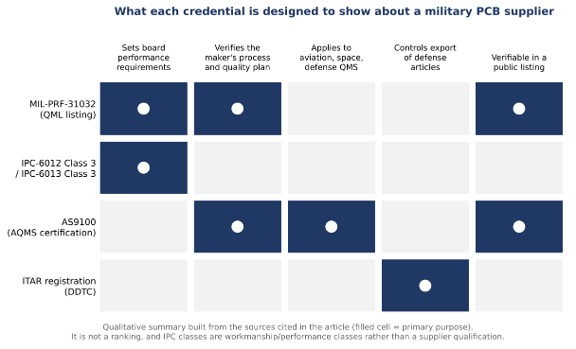
A military PCB manufacturer is distinguished less by the boards it builds than by the evidence it can show: qualification against defense performance requirements, an aviation-grade quality system, and compliance with U.S. export controls. The boards themselves often overlap with commercial high-reliability designs, since the defense specification sheets cover rigid multilayer, single- and double-sided, flexible, rigid-flex and high-frequency constructions. What changes is the proof behind them. Buyers comparing suppliers for requirements that are specific to defense electronics usually end up checking four things: the military performance specification, the IPC class, the quality certification and the export registration.
What do IPC Class 3 and IPC-6012DS add to a military board specification?
IPC Class 3 is the high-reliability performance tier in IPC’s printed board standards, and IPC-6012DS is an addendum that adds requirements for rigid boards used in space and military avionics. The addendum is aimed at boards that must survive the vibration, ground testing and thermal cycling of those environments, and it supplements or replaces selected requirements in IPC-6012D. Thermal cycling is also why accelerated thermal testing is relevant to these boards, and one manufacturer describes an in-house accelerated thermal shock lab built to evaluate board survivability. For flexible boards, a trade-press column reports that IPC-6013 Class 3 is generally accepted by government agencies as the commercial equivalent of the military specification.
What does MIL-PRF-31032 actually qualify?
MIL-PRF-31032 is the Department of Defense performance specification for printed boards, and it qualifies the manufacturer’s process and quality plan rather than individual part numbers. Certification runs through the Defense Logistics Agency’s Qualified Manufacturers List program, which requires verification of the quality management plan by a Technical Review Board, demonstrated manufacturing capability and ongoing lot acceptance testing. Manufacturers that complete the process are listed on the QML, which defense contractors use when selecting suppliers for new programs.
DLA’s own certification language adds two cautions: a QML listing does not guarantee acceptance of a product in any future purchase, and it does not waive any requirement of the specification. The certification letter also details which technologies a manufacturer is approved for, so the listed scope matters as much as the listing itself.
What would a MIL-PRF-31032 cancellation change for buyers?
A cancellation would move board performance requirements toward IPC standards fairly directly, but it would not automatically replace the qualification system around them. An April 2026 column reported that a Defense Logistics Agency memorandum dated March 4, 2026 proposed cancelling MIL-PRF-31032 and its six specification sheets, with a short comment window and a path for another activity to accept management of the documents. The column describes both the proposal and the questions it raises about the QML. Its author notes that the IPC-6010 series already serves as the commercial counterpart, while the QML, the Technical Review Board model and the DLA oversight role would need deliberate redesign by whoever takes ownership.
The column also asks what happens to legacy programs that still cite MIL-PRF-31032 or the older MIL-PRF-55110, which remains in use on some older platforms. The final outcome was not confirmed in the sources reviewed for this article, so it should be checked with the qualifying activity or the contracting officer before a purchasing decision relies on it.
What does AS9100 certification tell a buyer?
AS9100 shows that a supplier operates a quality management system built for aviation, space and defense work, and it is based on ISO 9001 with additional industry requirements. The standards are published through the International Aerospace Quality Group, which also runs the certification scheme and maintains the Online Aerospace Supplier Information System, known as OASIS. That database holds certification status, auditor information and audit results, so a buyer can check a supplier’s claim directly rather than relying on a logo. Details of the scheme are on the IAQG certification overview.
Does a PCB manufacturer need ITAR registration?
Any U.S. company that manufactures defense articles must register with the State Department’s Directorate of Defense Trade Controls, even if it never exports. The registration form’s own instructions state that manufacturers who do not export must nevertheless register under ITAR section 122.1. The relevant instructions are in the State Department DS-2032 registration form. Registration is a legal requirement for certain work, not a quality credential, so it answers a different question from the other items on this list.
How do the main credentials compare side by side?
The table below summarizes what each item covers and where a buyer can check it. The checking column matters most, because each credential has its own source of truth.
| Credential | What it covers | Who administers it | Where to check |
| MIL-PRF-31032 | Performance and verification requirements for printed boards under a QML program | Defense Logistics Agency | DLA certification letter and QML listing; confirm current status |
| IPC-6012 / IPC-6013 Class 3 | Performance requirements for rigid and flexible boards at the high-reliability tier | IPC | Supplier conformance records and purchase documents |
| IPC-6012DS | Added requirements for rigid boards in space and military avionics | IPC | Called out in the drawing or purchase order |
| AS9100 | Quality management for aviation, space and defense organizations | IAQG scheme and certification bodies | IAQG OASIS database |
| ITAR registration | Registration of manufacturers of defense articles | State Department DDTC | Evidence of current registration from the supplier |
How should a buyer verify what a supplier claims?
A buyer should verify each credential at its source and treat a supplier’s published sector experience as context rather than proof. Some suppliers publish more than others. PCB Technologies, for example, describes defense experience that includes special antennas, seekers, night vision equipment, radios, data terminals, radiation detectors and range finders, which tells a buyer what kinds of programs a supplier has touched but not which certifications it holds.
- Ask for the DLA certification letter and the qualified technology scope, and compare it to the board being quoted.
- Look the supplier up in OASIS and confirm the certification body, scope and expiry.
- Confirm which IPC class and addendum the drawing actually requires, and ask for the matching test records.
- Ask for evidence of current ITAR registration if the work involves defense articles.
- Re-check the MIL-PRF-31032 status, since the specification was proposed for cancellation in 2026.
Frequently Asked Questions
What is a QML in military PCB sourcing?
A Qualified Manufacturers List is a Defense Logistics Agency listing of manufacturers whose processes and quality plans have been qualified under MIL-PRF-31032, which lets defense buyers source boards from verified suppliers.
Is IPC Class 3 the same as MIL-PRF-31032?
No. IPC Class 3 is a high-reliability performance tier, while MIL-PRF-31032 is tied to a government qualification program for the manufacturer, although a trade-press column notes that IPC-6013 Class 3 is generally accepted as the commercial equivalent for flexible boards.
Does a U.S. PCB manufacturer that does not export need ITAR registration?
Yes, if it manufactures defense articles, because the State Department’s registration instructions say manufacturers who do not export must still register.
How can a buyer check a supplier’s AS9100 certification?
A buyer can search the International Aerospace Quality Group’s OASIS database, which lists certification status, auditor information and audit results for certified suppliers.
Software
The AI Isn’t Wrong About Your Company. Your Sources Are
An interview with Aia Laser, founder of AlignTo AI.


Most companies now check what ChatGPT and Gemini say about them. Far fewer ask where the answer came from. The uncomfortable finding, for those who trace it, is that it usually came from them.
Ask an AI assistant to describe a company and it will answer with confidence: what the company makes, where it is based, who it competes with. For a growing number of brands, that answer is wrong in ways that cost real deals. A manufacturer is placed in the wrong country. A product that was discontinued three years ago is presented as the flagship. A company that merged, rebranded or moved upmarket is described as the company it used to be.
The standard response is to treat it as a content problem: publish more, add structured data, chase citations. Practitioners who have traced AI answers back to their origins say the error sits upstream of any single page.
“An AI engine is not inventing a story about your company,” says Aia Laser, founder of AlignTo AI, a Tel Aviv startup that helps brands take control of how and why AI systems represent them. “It is assembling one from three inputs: your own site, what third parties say about you, and what it has already learned from both. When those three disagree, the model averages them. Most brands have never checked whether they agree.”
Tracing the answer to its source
Laser’s claim rests on an audit of an industrial manufacturer, one of AlignTo AI’s first clients. Her team captured hundreds of AI answers about the brand across several engines and traced every claim in them to one of three places: the company’s own site, a third-party page, or no page at all.
The company’s site stated its headquarters and manufacturing locations correctly, but in a handful of places and not always where a machine would read them. Distributor listings and directory pages, written years earlier, described it as a US or European manufacturer. And in ChatGPT’s answers, the brand was named correctly in 88 percent of cases without any cited page carrying the information: the model had already learned the company from the whole corpus, and the corpus did not agree with itself.
“Your site is the one input you fully control, and it is upstream of everything else,” Laser says. “Third parties copy it, and the models learn from both. If your site says the right thing once, quietly, and twenty distributor pages say something else, the model will not side with you. It will side with the majority.”
“People hear that and conclude the site does not matter,” Laser says. “It is the opposite. The site is where the correct version has to live, stated clearly and in a form AI can read, because everything else is copied from it or compared against it. The mistake is thinking the site is where the work ends.”
The practical consequence is a familiar story in marketing departments this year. A team spends a quarter rewriting product pages, the dashboard shows citations climbing, and the AI assistant still tells prospects the company is headquartered in the wrong country, because the pages the engines trust most were never the company’s own.
The identity the machines already hold
Laser says the problem begins one step earlier than most people look. “Before a model decides what your company does, it has to decide which company you are. That step is called entity disambiguation, and nobody in marketing is watching it. If your name is common, or shared with a competitor, or also an ordinary word, the model may merge you with someone else’s facts, or split you into two half-entities that each carry part of your story. Everything it says afterward is built on that decision.”
The decision is not hidden, she argues, and that is the part the industry misses. “Google’s Knowledge Graph is a database with an API. Wikidata is open. You can query them for your own entity and see exactly what the machines hold: what name and type they have for you, the one-line description they attach, which aliases they recognize, what identifier they assigned, and how confident the match is. That is real knowledge-graph probing, and it takes minutes. I have never had a company do it before we did it for them.”
What comes back is frequently a shock. “We have seen companies that exist in the graph as the wrong type, or under a name they stopped using years ago, or not at all. When the record is missing or wrong, every engine that leans on it is guessing, and it will guess from whatever third-party page it finds. So when an AI answer has no cited page behind it, the first question is not what the site says. It is what the identity record says.”
Who the memory hurts
A startup founded last year has little to fear from this. There is not much for a model to remember. The companies most exposed are the ones with the longest histories and the most to lose from being described as their former selves.
Post-merger companies are the clearest case. The acquired brand still exists in years of press coverage, directory listings and old partner pages, and the model has absorbed all of it. Long-established firms carry a legacy perception that may be a decade out of date. International companies find that each market has told a slightly different story about them, and the model has averaged the stories together. Any company that repositioned, dropped a product line or moved into a new category is, in the model’s memory, still where it started.
“The companies that come to us are not companies with bad content,” Laser says. “They are companies with a past. The model is faithfully describing a version of them that is still live in a hundred places they do not control, and usually in a few places they do. Nobody ever went back and reconciled the story.”
The damage is quiet. Nobody sees the deal that was never opened because a buyer asked an assistant for a shortlist and the company appeared under the wrong description, or did not appear at all.
Three causes, one diagnosis
The deeper problem, Laser argues, is that an AI misrepresentation can have three different causes, and each demands a different response. The industry mostly treats them as one.
| Cause | What it looks like | What actually fixes it |
| Owned-source gap | The brand’s own site never states the fact, states it inconsistently, or states it where AI cannot read it | Content and structure changes on the site |
| Third-party gap | Distributors, directories, publishers and partner pages carry the old or wrong story | Outreach and correction of the sources AI reads, prioritized by which ones engines actually cite |
| Model memory | The engine states the error with no page to support it | Correcting the identity record in the knowledge graphs, and keeping the site and corpus consistent with it over time; a single page change will not reach it |
“Attribution is the whole game,” she says. “If you cannot say which bucket a mistake sits in, you will spend the content budget on an error that content cannot touch, and ignore a distributor page that is quietly teaching every engine the wrong headquarters.”
Monitoring tools, in her view, are good at the first half of the job. They show what the engines are saying. What they rarely do is explain why, because explaining why requires a confirmed record of what is actually true about the company, and most companies have never written one down.
Showing a brand what AI knows about it
AlignTo AI was built to answer the question most monitoring tools leave open: not only what the engines say about a brand, but where each claim came from and why. The startup shows companies what AI currently knows about them, traces every misrepresentation back to its root source, whether on the brand’s own site, on a third-party page, or in the model’s identity record, and gives the company a way to decide and control how it is represented from there.
Aia Laser, who also founded the Tel Aviv B2B tech digital marketing agency (Inter-Dev), spent over a decade in leading SEO strategies for renowned Israel’s tech companies, before AI answers became a channel, frames it in plainer terms. “Would you let a new salesperson go out and talk about your brand without handing them the updated, correct data first? That is what every company is doing with AI right now. The engines are the salespeople. They are out there describing you to buyers all day, and nobody at the company has checked what they were trained on or told them what changed.”
The argument is that representation in AI is a governance problem, not a content problem.
“Brands have been outsourcing their own definition to whoever wrote about them last,” she adds. “AI just made the cost of that visible.”
What to do before the next audit
Aia Laser’s advice to companies that suspect the model has them wrong is to stop optimizing and start diagnosing.
- Capture answers with their citations, then trace every claim: is it on your site, on a third-party page, or on neither? That tells you where the model learned it.
- Write down what is true. One confirmed record of the company’s facts, agreed internally, is the baseline every audit needs and almost no company has.
- Check your own site against that record first. Every fact should be stated, consistent across pages, and readable by a machine.
- Sort every remaining error by cause before spending on any of them, and treat a change that shipped and moved nothing as information about where the error really lives.
“Everyone is asking how to get the AI to notice them,” she says.
“The harder question is what the AI already thinks it knows, and whether anyone at the company has ever decided what the answer should be.”
| Key Takeaways
• A delay line holds back an RF signal for a precise time and is used for radar and altimeter testing, signal-path alignment, phased-array beamforming and signal processing. • The four main delay line families are coaxial cable, acoustic (SAW and BAW), digital (ADC, memory and DAC) and fiber optic. • Coax and fiber add a similar delay of roughly 4 to 5 ns per meter, but single-mode fiber loses well under 1 dB per kilometer regardless of RF frequency, while coax loss rises with length and frequency. • Emulating a radar target at 10 km needs about 66 microseconds of round-trip delay, or roughly 13.6 km of single-mode fiber. |
What is a delay line?
A delay line is a component that holds back an RF or microwave signal for a precise, known amount of time and then releases it otherwise unchanged. Delay lines are used to emulate distance in radar and altimeter testing, to align the timing of parallel signal paths, to build true-time-delay beamformers for phased arrays and to provide short-term signal memory in correlators and receivers.
In radar work the delay always represents a round trip, which makes the numbers grow quickly. A SPIE conference paper comparing microwave analog delay line technologies points out that emulating a target only 50 m away already calls for 333.33 ns of delay, because the signal has to travel out and back. For readers who want the underlying vocabulary first, a broader primer on delay lines covers the terms used throughout this comparison.
What types of delay line are available?
There are four main families of RF delay line: coaxial cable, acoustic (surface or bulk acoustic wave), digital, and fiber optic. Each creates delay in a physically different way, and that physical mechanism determines its loss, bandwidth, size and flexibility.
| Technology | How the delay is created | Main strengths | Main limitations |
| Coaxial cable | The RF signal travels through a coiled length of coax, often semi-rigid | Simple, passive, no signal conversion | Bulky at long delays; loss rises with length and frequency |
| Acoustic (SAW / BAW) | RF is converted into an acoustic wave in a piezoelectric material, which travels far slower than an electromagnetic wave | Very compact for a given delay | High insertion loss, reported above 30 dB; SAW limited to roughly 2.5 GHz |
| Digital | The signal is sampled by an ADC, held in memory and regenerated by a DAC | Delay is programmable and can be combined with synthetic Doppler or modulation | Bandwidth and spurious performance set by the converters; adds latency of its own |
| Fiber optic (ODL) | RF is modulated onto light and delayed by a chosen length of single-mode fiber | Low loss that does not change with RF frequency; delays from nanoseconds to milliseconds | Requires optical conversion, which adds noise; each delay value needs its own fiber length or a switch path |
How do coaxial delay lines compare with fiber optic delay lines?
Coax and fiber produce a similar delay per meter, around 4 to 5 nanoseconds depending on the cable dielectric, but fiber achieves it with a tiny fraction of the loss. Standard G.652.D fiber has a group index close to 1.468, which works out to roughly 4.9 ns of delay per meter, or about 4.9 microseconds per kilometer.
The difference shows up in attenuation. A microsecond of delay needs roughly 200 m of either medium. Published attenuation tables put even thick 7/8-inch hardline at about 2.1 dB per 100 feet at 2.4 GHz, which means close to 14 dB of loss over 200 m, and thinner coax several times more. The same 200 m of single-mode fiber loses well under 0.1 dB of optical power. Just as important, the fiber loss is set by the optical wavelength rather than by the RF carrier riding on it, so the fiber in a fiber optic delay line contributes the same loss at 1 GHz as at 18 GHz, while a coax delay line becomes progressively lossier as frequency rises.
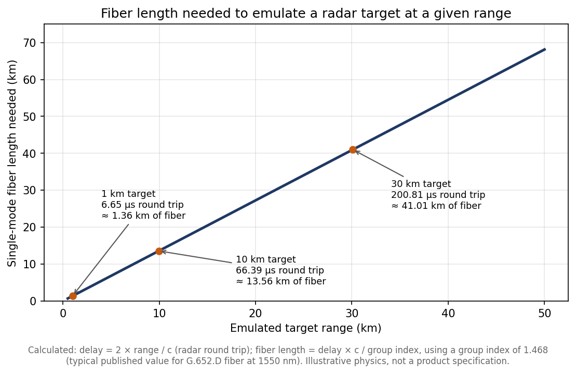
Longer delays make the gap decisive. The chart below shows how much fiber a radar test needs to emulate targets at different ranges. A 10 km target already requires about 13.6 km of fiber, a length no coax delay line could realistically match.
When do acoustic or digital delay lines make more sense?
Acoustic delay lines make sense when space is tight and the signal sits below a few gigahertz, and digital delay lines make sense when the delay must change continuously or the test needs synthetic signal effects. Acoustic devices exploit the fact that a mechanical wave in a piezoelectric crystal moves far more slowly than an electromagnetic wave, so a long delay fits in a small package. The cost is high insertion loss and, for surface acoustic wave parts, an upper frequency limit of around 2.5 GHz; bulk acoustic wave technology extends the achievable delay range.
A university study of wideband delay lines for automotive radar compares these approaches for a target simulator that needed an 800 MHz bandwidth and delays tunable from 1.3 ns to 1.67 microseconds, a useful example of how bandwidth and delay range together narrow the technology choice. Fully digital delay lines take a different route: an analog-to-digital converter samples the signal, memory holds it, and a digital-to-analog converter regenerates it. That flexibility is valuable, but instantaneous bandwidth, dynamic range and spurious content all depend on the converters.
What is the difference between fixed, variable and progressive delay lines?
A fixed delay line provides one delay value, while a variable delay line lets the user switch between several delays; a progressive delay line is a variable design that combines a small set of fiber spools in different combinations to produce many more delay values than it has spools. A passive optical delay line is simply a coil of fiber cut to an exact length and needs no power; in an RF system it sits between an optical transmitter and receiver.
Progressive designs typically use cascaded optical switch matrices. Four 2×2 optical switches can select 16 different delays, and eight binary-weighted spools can produce 255 distinct non-zero combinations. Variable, progressive and passive optical delay line architectures are explained in more detail, including how dispersion compensation and optical amplification are added when delays become very long.
How should an engineer choose a delay line?
Start from the application’s frequency range and maximum delay, then check loss, noise and switching requirements against each technology. The following criteria narrow the choice quickly:
- Frequency range: acoustic devices suit lower bands, while coax and fiber cover microwave frequencies and fiber holds its loss steady across them.
- Maximum delay and resolution: delays beyond a few hundred nanoseconds favor fiber; fine, continuously adjustable steps favor digital or switched designs.
- Insertion loss and noise figure: acoustic parts lose the most signal, while optical links trade a fixed conversion loss for nearly flat loss with length.
- Signal purity: phase noise and spurious content matter for radar and altimeter testing, where the delayed signal must look exactly like a real echo.
- Switching and control: test benches often need several delay values selectable from a front panel or remotely.
For signal-purity questions in optical designs, an application note on phase noise and RF amplification in ODL systems covers how amplifier placement affects the delayed signal. For catalog-level comparison of ranges and switch configurations, fiber optic delay line hardware shows how commercial units package these options into rack-mount systems.
Frequently Asked Questions
What is a delay line used for?
A delay line holds back an RF signal for a precise time, which is used to emulate target distance in radar and altimeter testing, align signal paths, steer phased-array beams and store signals briefly for processing.
How much delay does one meter of optical fiber add?
One meter of standard single-mode fiber adds roughly 4.9 nanoseconds of delay, based on a group index of about 1.468.
Why are fiber optic delay lines preferred for long delays?
Fiber optic delay lines are preferred for long delays because single-mode fiber loses well under 1 dB per kilometer and that loss does not change with the RF frequency being delayed, while coaxial cable loss grows with both length and frequency.
What is a progressive delay line?
A progressive delay line combines a small set of fiber spools through optical switches so that many delay values can be selected; eight binary-weighted spools can produce 255 different non-zero delays.

Military PCB Manufacturer Checklist: What Each Credential Actually Verifies

The AI Isn’t Wrong About Your Company. Your Sources Are

Should B2B Brands Optimize for Specific AI Engines? How ChatGPT, Google, Perplexity, and Claude Compare

-

 Business Solutions2 years ago
Live Video Broadcasting with Bonded Transmission Technology
-
 Business Solutions2 years ago
2-Way Texting Solutions from Company Message Services
-

 Business Solutions2 years ago
The Future of Healthcare SMS and RCS Messaging
-
 Business Solutions2 years ago
Communication with Analog to Fiber Converters & RF Link Budgets
-

 DSRC Communication2 years ago
The Crossroads of Connectivity: DSRC vs. C-V2X Technologies in Automotive Communication
-
 Business Solutions2 years ago
Wholesale SMS Platforms with OTP Services
-
 Business Solutions2 years ago
Choosing the Right B2B Digital Marketing Agency: A Guide
-

 3D Technology2 years ago
How Multispectral Cameras Advance Book Scanning