


Marketing & Analytics
Should B2B Brands Optimize for Specific AI Engines? How ChatGPT, Google, Perplexity, and Claude Compare


| Key Takeaways
• B2B brands get better AI visibility from a shared foundation that every engine can use, plus a light engine-specific layer, than from optimizing for one platform. • OpenAI uses separate crawlers for search (OAI-SearchBot) and training (GPTBot), and each can be allowed or blocked independently in robots.txt. • Cloudflare’s July 2025 data showed Anthropic crawling about 38,000 pages per referred visit, OpenAI about 1,091, Perplexity about 195, and Google about 5. • In the KDD 2024 GEO study, adding credible quotations improved visibility on Perplexity by 22%, while keyword stuffing performed 10% worse than the baseline. |
Should B2B brands optimize for one specific AI engine?
No. B2B brands get better results by building a shared foundation that every AI engine can use and then adding a light engine-specific layer, rather than optimizing for a single platform. Buyers spread their research across ChatGPT, Google AI Overviews and AI Mode, Gemini, Perplexity, and Claude, and each engine discovers, retrieves, and credits sources differently. A detailed analysis of how each engine selects its sources reaches the same conclusion: single-engine thinking applies old single-channel SEO logic to a multi-engine reality.
The infrastructure differs too. Cloudflare’s crawler data notes that Meta, OpenAI, and Anthropic run distinct bots for different purposes, while Google and Microsoft rely on unified crawlers. A robots.txt rule or firewall setting written with one engine in mind can therefore have very different effects on another.
The practical question is therefore not which engine to pick, but which signals all engines reward and which differences are large enough to justify separate work.
How do ChatGPT, Perplexity, and Google AI features find content differently?
They differ mainly in how they fetch content: some rely on dedicated AI crawlers, some on live retrieval at the moment of the question, and Google’s features run on its existing search index. Those mechanics decide which technical settings and which kinds of content matter most for each engine. Brands that run multi-engine optimization programs usually start by mapping these mechanics before touching content.
| Engine family | How it finds content | What site owners control |
| ChatGPT (OpenAI) | OAI-SearchBot surfaces sites in ChatGPT search; GPTBot collects data for model training; ChatGPT-User fetches pages on user request. | Separate robots.txt rules for OAI-SearchBot and GPTBot, so search visibility and training use can be managed independently. |
| Google AI Overviews and AI Mode | Rooted in Google Search’s core ranking and quality systems; may issue several related searches (query fan-out) to build one answer. | Standard SEO controls such as indexing, snippet controls, structured data, and internal links. |
| Perplexity | Retrieves live web sources for answers; PerplexityBot appears among AI crawlers tracked by network providers. | Crawler access, freshness of key pages, and clear, citable statements. |
| Claude (Anthropic) | ClaudeBot crawls the web; web search with clickable citations was added in 2025. | Crawler access and well-sourced, extractable content. |
OpenAI states in its documentation on web crawlers that each robots.txt setting is independent, so a site can allow OAI-SearchBot to appear in search results while disallowing GPTBot from training use. That single distinction is often the first engine-specific decision a B2B site needs to make.
Do AI engines send back the same amount of traffic?
No. The traffic AI platforms return varies by orders of magnitude, so referral volume alone is a poor way to decide which engine deserves attention. According to Cloudflare’s July 2025 crawl-to-refer data, Anthropic crawled about 38,000 pages for every visitor it referred, OpenAI about 1,091, Perplexity about 195, Microsoft about 41, and Google about 5.
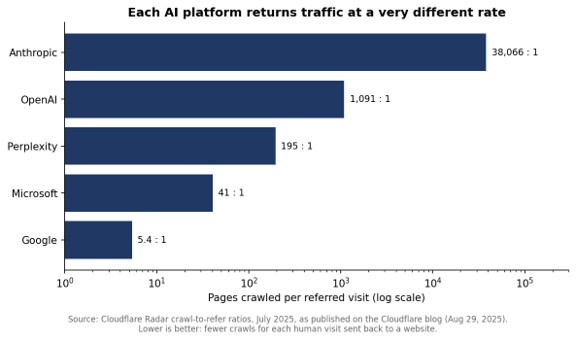
Two caveats matter for interpretation. First, many of these crawls feed model training rather than live answers, and training crawlers have no referral mechanism at all. Second, the same data shows ratios moving quickly: Anthropic’s fell 86.7% between January and July 2025 after Claude added web search with citations, while Perplexity’s rose. For B2B marketers, the takeaway is that mentions and citations inside answers are the more stable measure of visibility, with referral clicks as a secondary signal.
Which optimization signals work across every AI engine?
Clear answers, verifiable evidence, accessible pages, and consistent entity information work across every engine because all of them must find, read, and trust a source before citing it. The KDD 2024 GEO study tested content edits on its own benchmark and on Perplexity, a live engine. Adding quotations from credible sources performed best on Perplexity’s position-adjusted word count, with a 22% improvement over the baseline, while keyword stuffing performed 10% worse than doing nothing.
- Answer-first writing: a direct one or two sentence answer under each question-style heading, written so it makes sense when quoted alone.
- Evidence density: named sources, specific figures, and short quotations from credible experts placed close to the claims they support.
- Crawler access: no accidental blocks on search-oriented AI crawlers, and no key specifications locked inside gated forms or image-only PDFs.
- Entity consistency: the same company name, product names, and descriptions across the website, schema markup, directories, and profiles.
- Independent corroboration: coverage in trade press, industry associations, and reference sites that engines use to confirm what a brand says about itself.
When does engine-specific optimization make sense?
Engine-specific work makes sense when a measurable share of a brand’s buyers rely on one engine, or when a technical setting affects only one engine. A cybersecurity vendor whose buyers live inside Google Workspace has good reason to invest in Google entity signals such as Business Profile accuracy and structured data. A SaaS company seeing strong Perplexity mentions but weak ChatGPT presence may need more independent editorial coverage rather than more blog posts. In each case, the engine-specific layer sits on top of the shared foundation instead of replacing it.
Measurement keeps this honest. One B2B-focused analysis published by Inter-Dev in April 2026 recommends AI Share of Voice, the percentage of category responses that mention a brand across every engine buyers might use, as the core metric instead of a single-platform leaderboard.
How should a B2B team prioritize its AI engine strategy?
Prioritize in three passes: fix shared foundations first, measure presence on every relevant engine second, and only then invest in the engine where the largest commercial gap appears. Start with crawler access, answer-first page structure, and evidence on the pages that support the highest-value buying questions. Next, run the same prompt set across engines on a fixed schedule and record mentions, citation position, and the sources each engine cites. Finally, assign engine-specific tasks only where the data shows a persistent gap that shared improvements did not close.
This sequence protects budgets from chasing whichever engine is in the news this month, and it builds visibility that survives the next model update. It also gives leadership a single view of AI presence across platforms instead of a separate report for every tool.
Frequently Asked Questions
Can a website allow ChatGPT search but block AI training?
Yes, OpenAI documents separate robots.txt user agents, so a site can allow OAI-SearchBot for ChatGPT search visibility while disallowing GPTBot for model training.
Do Google AI Overviews need special markup or files?
No, Google states that there are no additional requirements or special optimizations needed to appear in AI Overviews or AI Mode beyond fundamental SEO best practices.
Does Google send more referral traffic per crawl than AI-only platforms?
Yes, in Cloudflare’s July 2025 data Google needed about 5 crawls per referred visit, compared with about 1,091 for OpenAI and about 38,000 for Anthropic.
What is AI Share of Voice?
AI Share of Voice is the percentage of AI-generated answers for a defined set of category prompts that mention a specific brand, measured across the engines its buyers use.



| Key Takeaways
• A blow molded case is formed by inflating a heated plastic tube, called a parison, inside a closed mold until the plastic takes the mold’s shape. • Extrusion blow molding, injection blow molding and injection stretch blow molding are the three main blow molding processes. • Blow molded cases are usually made from polyethylene and offer low unit cost at high volume, one-piece construction and easy cleaning. • Blow molding is less suited to intricate contours, premium surface finishes and cases that need tight mechanical precision. |
What is a blow molded case?
A blow molded case is a hollow plastic case formed by inflating a softened plastic tube, called a parison, inside a closed metal mold until the plastic takes the shape of the mold. Once the plastic cools, the mold opens and the finished shell is ejected, with its inner and outer surfaces formed in one step.
The principle comes from glassblowing, and the result is a one-piece shell that needs little assembly. Manufacturers that specialize in custom blow molded case manufacturing describe the process as fast and economical, with impact resistance and waterproofing options that suit delicate electronic or medical devices used in transit or in rugged environments. The same suppliers note that blow molded shells can be combined with foam-filled interiors when the contents need extra cushioning.
Because the plastic is pushed outward against a precision-machined mold, usually made of steel, the mold dimensions define the final size and shape of the case. A practical look at when blow molding makes sense explains that the method is especially efficient for hollow parts produced in high-volume runs, which is why it tends to appear in programs measured in thousands of units rather than dozens.
How does the blow molding process work, step by step?
Blow molding runs through four basic stages: the plastic is softened into a parison, the parison is clamped inside a cooled mold, compressed air inflates it against the mold walls, and the cooled part is ejected. Water channels inside the mold help the plastic cool and harden before the mold opens.
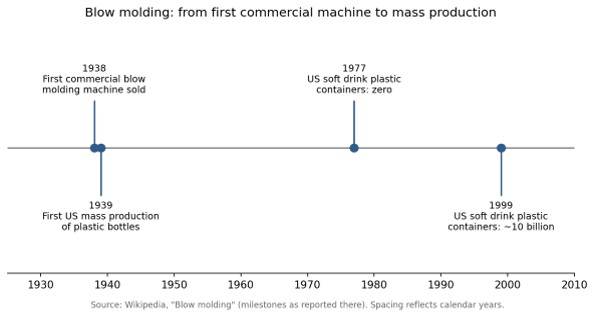
In extrusion blow molding, plastic is melted and extruded into a hollow tube with an opening at one end for the air. The cooled metal mold closes around that tube, air is blown in, and the part takes the form of the cavity. Wall thickness is one of the harder variables to control. According to the overview of blow molding processes on Wikipedia, a continuously extruded parison sags under its own weight, which makes wall thickness difficult to calibrate. Accumulator head and reciprocating screw machines push the parison out quickly with hydraulics, reducing that effect and allowing wall thickness to be adjusted through the die gap with a parison programming device.
What are the three main types of blow molding?
The three main types of blow molding are extrusion blow molding, injection blow molding, and injection stretch blow molding. They share the same core idea of inflating softened plastic inside a mold, but they differ in how the starting form is made.
Extrusion blow molding starts from an extruded tube, as described above. Injection blow molding first injection molds the polymer onto a core pin, then rotates that pin to a blowing station; it is the least used of the three and is typically applied to small medical and single-serve bottles. Injection stretch blow molding stretches a preform vertically and then blows it horizontally, which aligns the polymer and increases strength and barrier performance, a combination closely associated with carbonated drink bottles. For a buyer specifying a protective case, the practical point is that the process variant affects achievable wall thickness, part size and cycle economics, so it is worth asking a supplier which variant a quoted case will use.
Why are blow molded cases usually made from polyethylene?
Polyethylene is the usual material for blow molded cases, and it produces a one-piece, single-material shell that resists impact, scratching and repetitive use. A single-material shell also simplifies end-of-life sorting, since there is no fabric lining or bonded second material to separate.
High-density polyethylene, or HDPE, carries Resin Identification Code 2 under ASTM D7611. That code is often misread as a recycling promise. As ANSI’s explainer on resin identification codes points out, the standard states that resin identification codes are not recycling codes; they identify the resin used and act as an aid to sorting. Whether a given case is actually recycled depends on local collection and processing systems, so sustainability claims should rest on more than the triangle molded into the base.
When does a blow molded case make the most sense?
A blow molded case makes the most sense when unit cost must stay low across a large production run, when the case needs to survive heavy reuse and frequent cleaning, and when the shape is relatively simple. Ruggedness and hygiene are its strengths; premium feel is not.
Typical fits include mass-produced products, leased or shared equipment that moves between users, and kits that are wiped down after every use. A seamless polyethylene surface has no fabric to trap dust or bacteria, which matters in clinical and industrial settings. Shell-Case, which works across several case technologies, has applied blow molding to a carrying case for a hospital-grade breast pump, a program where cleanability, durability and cost-efficiency for hospital use were the deciding requirements.
| Strong fit for blow molding | Weaker fit for blow molding |
| High-volume programs where unit cost matters most | Short runs where mold cost cannot be spread out |
| Leased, shared or reusable equipment | Premium products where finish drives perception |
| Simple, boxy geometries | Intricate contours or deeply form-fitted shells |
| Frequent wipe-down cleaning | Instruments that need tight mechanical precision |
What are the limitations of blow molded cases?
The main limitations of blow molded cases are restricted shape complexity, a surface finish that cannot match injection molding or EVA, and lower mechanical precision. These limits come directly from the physics of inflating a parison rather than injecting material into a fully defined cavity.
Intricate contours, molded compartments and tightly form-fitting interiors are harder to achieve. Openings are another constraint. Patent literature on double-wall cases notes that because the parison has a continuous, unbroken surface, the mold cannot form holes in the wall other than where air is introduced, so any cutout has to be cut, burned or punched, either during or after molding. That adds a process step, and it is worth confirming early if the case design calls for windows, ports or recessed drawers.
How should buyers compare blow molding with other case technologies?
Buyers should compare blow molding with other case technologies on five factors: unit cost, tooling cost, development time, cleanability and production time. No single technology wins on all five, so the right choice depends on volume, geometry and how the case will be used.
Blow molding combines low unit cost at volume with relatively simple molds and a shorter development period. Injection molding produces higher-precision shells with better finishes and the lowest unit prices at large volumes, but requires more complex tooling. Sewn soft cases need no mold tooling at all and suit lower volumes or designs that change often, at the cost of the seamless, easy-clean surface. Many final designs mix technologies, for example a molded shell with a custom foam interior, so the technology question is often answered component by component rather than for the case as a whole.
Frequently Asked Questions
Are blow molded cases waterproof?
Blow molding can support waterproofing options, but whether a specific case is waterproof depends on its seals, closures and any openings, so buyers should ask for a tested ingress protection rating rather than rely on the material alone.
Is a blow molded HDPE case recyclable?
HDPE is identified by Resin Identification Code 2, but that code only identifies the resin and does not guarantee recycling, which depends on local collection and processing systems.
Can a blow molded case have a custom foam interior?
Yes, blow molded case shells can be paired with foam-filled or custom foam interiors to hold and cushion specific devices.
Why is a blow molded case cheaper per unit than many alternatives?
A blow molded case is formed as one piece in a single molding step with relatively simple molds, which reduces assembly labor and lowers the cost per unit as production volume increases.

| Key Takeaways
• ChatGPT’s share of B2B AI referral traffic fell from 89.1% to 62.6% in eight months, while Claude, Gemini, and Perplexity each gained meaningful share over the same period. • Claude and Perplexity send a disproportionately large share of referrals relative to their smaller user bases, consistent with both platforms skewing toward research-stage queries. • Generative Engine Optimization rewards structural clarity and self-contained factual statements, while traditional SEO rewards keyword matching and backlink volume. • B2B AI referral share shifted by double-digit percentage points within a single year, meaning single-engine optimization strategies can lose relevance quickly. |
Why do B2B buyers now split their research across several AI engines?
B2B buyers no longer settle on one AI assistant for vendor research; they move between ChatGPT, Claude, Gemini, and Perplexity depending on the task, and each engine now carries a meaningful share of B2B referral traffic. A recent longitudinal study of B2B referral sessions across a 41-brand panel found that ChatGPT’s share of that traffic fell from 89.1% to 62.6% in eight months, while Claude’s share rose from 1.4% to 18.5%, Gemini’s from 2.4% to 10.6%, and Perplexity’s from 3.1% to 7.3%. A brand optimizing for a single engine is now missing more than a third of the B2B AI referral landscape it would have covered a year earlier.
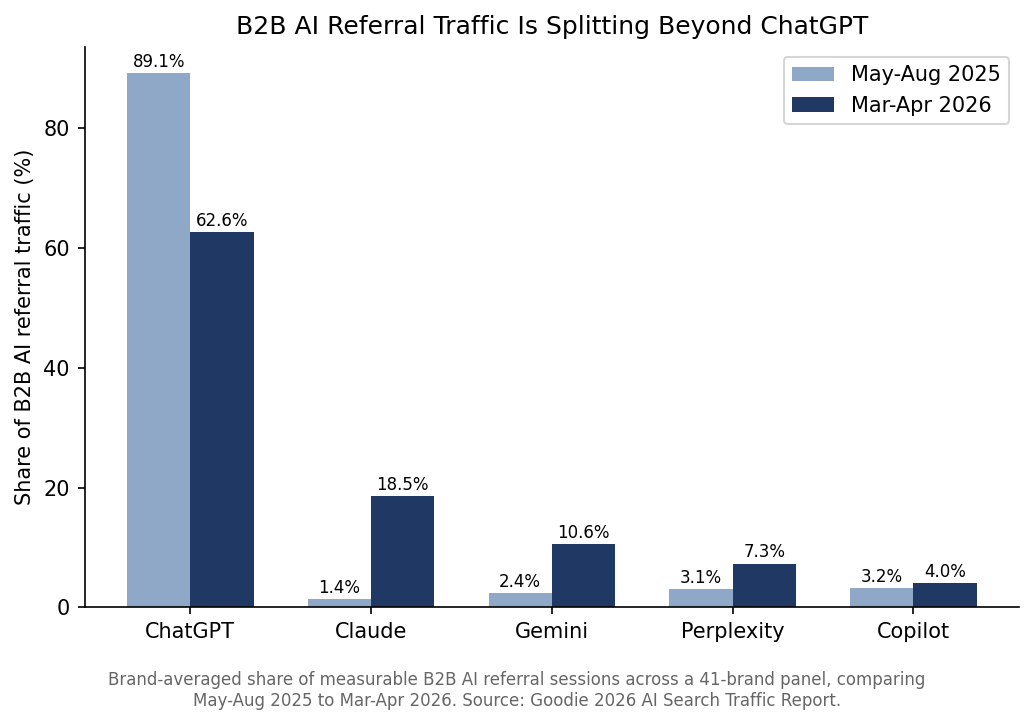
B2B AI referral traffic share by engine, comparing May-Aug 2025 to Mar-Apr 2026. Source: Goodie 2026 AI Search Traffic Report.
Do different AI engines behave the same way when they cite a source?
No. Each engine runs its own retrieval pipeline, weighs different signals, and serves a different point in the buyer’s research process, so content that earns a citation on one engine does not automatically earn one on another. ChatGPT’s referral behavior tracks closely with its overall usage volume, while Claude and Perplexity send a disproportionate share of referrals relative to their smaller user bases, consistent with both platforms skewing toward research-stage, source-checking queries rather than casual browsing. Gemini behaves as two distinct surfaces at once, a standalone conversational assistant and the model powering Google’s own AI Overviews and AI Mode inside search results, and the two surfaces send referral traffic at very different rates because one is built for open-ended conversation and the other is built to answer a query without the user leaving the results page. a deeper breakdown of engine-specific optimization priorities lays out how ChatGPT, Gemini, Perplexity, and Claude differ in the audiences and query types they attract.
What happens to a brand that only optimizes for the most popular engine?
A brand that optimizes only for the currently dominant engine builds visibility that erodes as fast as that engine’s market share does, and the last eight months show how quickly that share can move. Treating GEO as a single-engine project mirrors the mistake B2B marketers made when they treated SEO as a single-search-engine project; the fix is the same in principle: build content and technical infrastructure that generalizes across retrieval systems rather than gaming one algorithm. the practice’s overview of what AI search optimization actually requires walks through the foundational risks B2B brands face when their content isn’t structured for AI interpretation in the first place.
How is Generative Engine Optimization different from traditional SEO?
Generative Engine Optimization (GEO) optimizes for being the source an AI model trusts enough to cite and synthesize into its answer, while traditional SEO optimizes for ranking in a list of links a human then chooses from. The practical difference shows up in what gets rewarded: SEO rewards keyword matching and backlink volume, while GEO rewards structural clarity, topical depth, and the kind of self-contained factual statements a model can lift directly into a generated answer. a full comparison of the two disciplines and how the shift changes a content roadmap walks through the practical differences in more detail.
Should a B2B marketing team build separate content for each AI engine?
Not separate content, but a single content and technical foundation built to generalize: clear entity definitions, direct answers near the top of a page, and a presence on the third-party sites each engine treats as trust signals. The engines differ in retrieval mechanics, but they converge on rewarding the same underlying qualities: content that states facts plainly, cites its own sources, and appears consistently across multiple independent domains rather than only on the brand’s own site. A page written to answer one specific question clearly, with the direct answer stated in the opening sentences, tends to perform well across every major engine because that structure matches how each of them extracts and summarizes source material, regardless of the underlying retrieval mechanism.
What does a multi-engine measurement approach actually look like in practice?
A multi-engine measurement approach tracks citation frequency, referral traffic, and share of voice separately for each major engine rather than collapsing them into a single generic AI-traffic metric. Standard analytics platforms undercount this activity in two structural ways: native AI apps frequently strip referrer data so AI-originated visits land in a generic direct-traffic bucket, and Google does not separately attribute its own AI Overviews and AI Mode surfaces, bundling them into ordinary organic search reporting. A marketing team relying solely on referrer logs will systematically understate its actual AI visibility, sometimes by a wide margin, which makes engine-specific monitoring tools a practical necessity rather than a nice-to-have for any B2B brand serious about this channel.
Why does engagement quality matter as much as raw traffic volume from AI sources?
AI-referred traffic tends to engage more deeply than traffic from most traditional channels, spending more time on a page and completing more of the intended action once it arrives, which changes how a marketing team should value a smaller volume of AI-driven visits. A buyer who reaches a vendor’s site after an AI assistant has already synthesized several competing options into a shortlist arrives with more context and higher intent than a buyer clicking through ten generic search results, so the same absolute traffic number carries different pipeline value depending on where it originated. This is part of why treating AI visibility purely as a volume metric understates its importance: the quality of the visit, not just the count, is what should drive investment decisions across engines.
What is the practical first step for a B2B team that has only optimized for one engine so far?
The first step is an honest audit of current visibility across all four major engines rather than assuming that success on one engine implies success on the others, since the underlying retrieval logic differs enough that visibility does not transfer automatically. From there, prioritize the technical and structural fixes, such as clear entity definitions and direct, quotable answers near the top of key pages, that tend to generalize across engines before investing in engine-specific tactics that may not survive the next shift in market share. Given how quickly the distribution moved over the past year, building for resilience across engines is a more defensible long-term strategy than optimizing narrowly for whichever engine currently holds the largest share.
Frequently Asked Questions
Is ChatGPT still the most important AI engine for B2B visibility?
It remains the largest single source of B2B AI referral traffic, but its share has fallen from roughly 89% to 63% in under a year as Claude, Gemini, and Perplexity have grown, so it is no longer the only engine that matters.
Why does Claude send a larger share of referrals than its user base would suggest?
Claude’s usage skews toward research-stage and technical queries, and platforms with that usage pattern tend to convert a larger share of sessions into outbound clicks to source material than platforms used mainly for casual browsing.
Does optimizing for AI engines replace the need for traditional SEO?
No, traditional SEO and Generative Engine Optimization address different discovery paths and both remain relevant, since a meaningful share of buyer research still happens through conventional search results pages.
How quickly can a B2B brand’s AI engine visibility change?
Very quickly. Aggregate B2B referral share across major AI engines shifted by double-digit percentage points within a single year, so brands need to track visibility across engines rather than assuming today’s distribution will hold.
Digital marketing for a B2B technology company rarely fails because a single channel underperforms. It usually fails because the channels were never built to work together. A structured framework for B2B digital marketing treats search, content, paid, and social as connected inputs into one pipeline rather than four separate campaigns competing for the same budget. That distinction matters more than it sounds: a program that measures four channels separately will always look busier than one that is actually coordinated, and busy is not the same thing as effective.
The channel mix, and what each piece is actually for
| Channel | Primary role in the funnel | Typical signal it improves |
| SEO and content | Top-of-funnel visibility and long-term authority | Organic traffic, keyword rankings |
| Search engine marketing | Fast, intent-driven demand capture | Qualified clicks, cost per lead |
| Social and paid social | Awareness and retargeting across a long sales cycle | Engagement, assisted conversions |
| Data analysis | Turning campaign activity into a feedback loop | Attribution accuracy, budget reallocation |
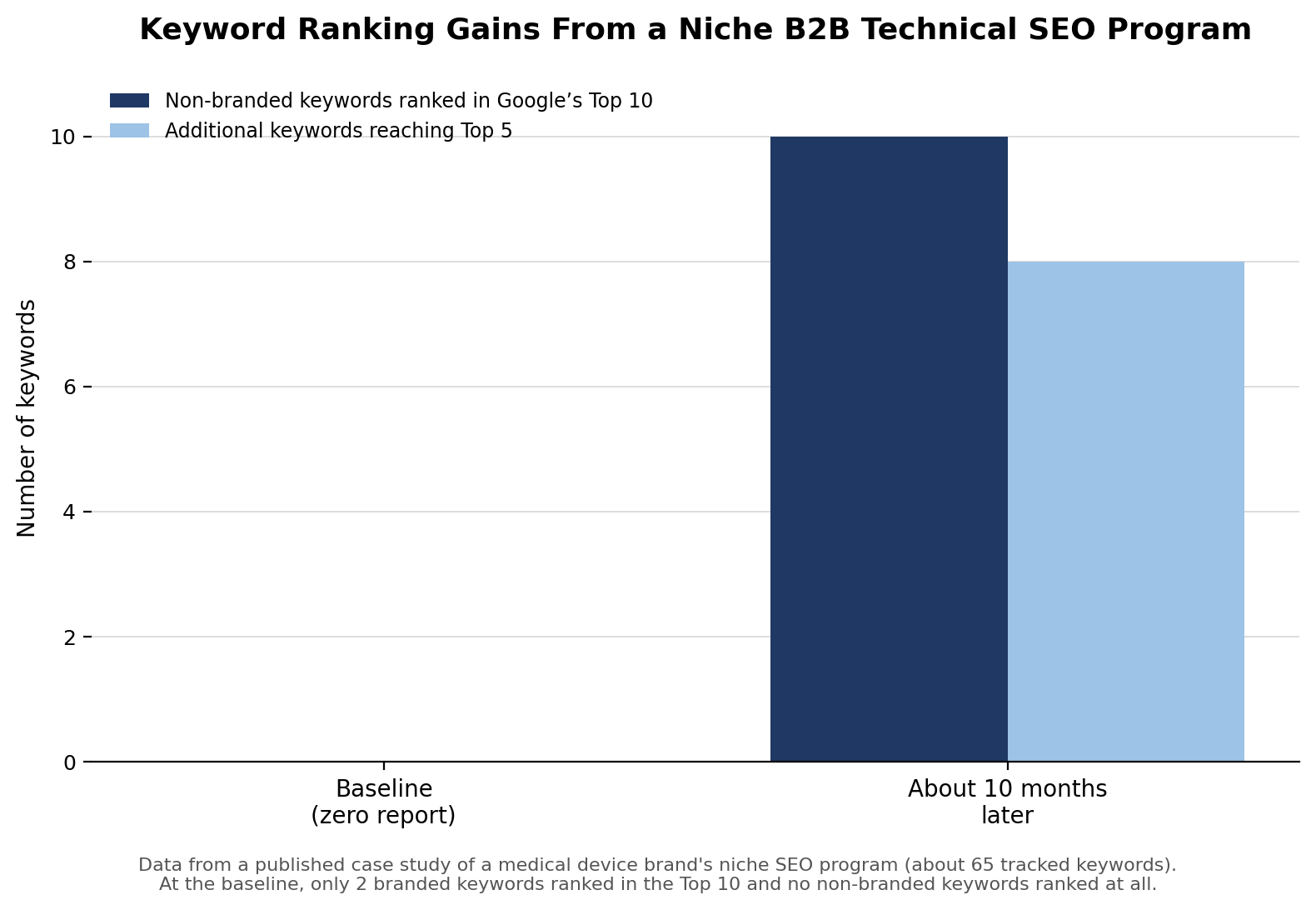
Treated as a system rather than four separate line items, these channels compound. Organic search still carries the largest share of that system for most B2B sites. Industry benchmarking from Ahrefs and Semrush consistently puts organic search at roughly three-quarters of all trackable B2B website traffic, a larger share than any paid channel produces on its own, which is why the SEO and content row in the table above tends to receive the longest planning horizon of the four. First Page Sage’s 2026 benchmarking adds a useful reference point for pacing expectations: once a page holds a top-five position for six or more transactional keywords, organic traffic to that page tends to rise by at least 15 percent within six months. That is a slower payoff than a paid search campaign, which is exactly why the two channels are meant to run in parallel rather than in sequence.
Why data analysis is the piece most programs skip
Running four channels without a shared measurement layer usually produces four disconnected reports, not one strategy. A dedicated analytics practice is what lets a team see which channel actually influenced a closed deal, rather than crediting whichever touchpoint happened last. This is also the piece most B2B teams underinvest in relative to how much they spend on the channels it is supposed to measure. Content Marketing Institute’s own research on the obstacles B2B marketers report most often lists measurement, alongside content that drives a specific action and resource constraints, as one of the three most common barriers to a program being considered effective. A team that cannot answer which channel moved a deal forward tends to keep funding whatever channel is easiest to report on, not whatever channel is actually working.
From traffic to a marketing qualified lead
Traffic on its own is not a business result. The intermediate step most B2B programs rely on is the marketing qualified lead, a prospect that a marketing team has screened against fit and intent criteria before handing it to sales. Programs that skip this definition tend to flood sales teams with unqualified volume, which erodes trust in marketing’s pipeline contribution. Published B2B benchmarking places the average visitor-to-lead conversion rate for a B2B site somewhere between 1 and 3 percent, with leads sourced from organic search and referral traffic typically converting at the higher end of that range, and the average lead-to-MQL conversion rate sitting near 31 percent. A program that runs meaningfully below that band is usually not short on traffic; it is short on a lead definition sales actually trusts, which sends good prospects back into a nurture queue instead of a pipeline.
How AI-driven search changes the top of the funnel
The channel mix above assumes a fairly stable relationship between ranking well and receiving a click, and that relationship has been shifting. AI Overviews, Google’s generated summary panels, now appear on roughly half of all search results tracked by industry monitoring services, and when one appears above an organic listing, click-through rates on that listing typically fall somewhere between a third and well over half, depending on the query and position. For a B2B technology company, that shift raises the bar for what a page needs to do to earn a click even after it ranks: a page that only restates a definition an AI summary already covers has less reason to be clicked than one that adds a specific data point, a worked example, or a comparison the summary could not fully capture. This is the practical link between SEO and GEO work: content built to be citable by an AI system and content built to earn a click from a human searcher increasingly need to satisfy the same standard, which is specificity that a short summary cannot fully absorb.
What the data says about program effectiveness
Content Marketing Institute’s 2026 survey of over 1,000 B2B marketers found that only 12 percent rate their marketing as highly effective, while 47 percent describe it as somewhat effective and roughly a third report neutral or weaker results. The same research identifies the three most common obstacles as creating content that drives a specific action, resource constraints, and simply measuring whether content is working at all. None of the three is primarily a content-quality problem; all three point back to the coordination and measurement gaps described above. See the full 2026 B2B research findings for the complete breakdown by challenge and channel.
Frequently Asked Questions
What is the difference between an MQL and an SQL?
A marketing qualified lead (MQL) has been screened by marketing against fit and intent criteria; a sales qualified lead (SQL) has been further vetted by the sales team as ready for direct outreach.
How many digital marketing channels should a B2B tech company run at once?
Most structured programs combine at least SEO and content, paid or search engine marketing, and one social channel, coordinated through shared analytics rather than run as separate, unmeasured efforts.
Does content marketing replace the need for paid channels in B2B?
No. Content and SEO build compounding, long-term visibility, while paid channels capture immediate, intent-driven demand; most effective programs run both together.
Do AI Overviews mean SEO matters less for B2B companies?
Not less, but differently. Ranking still matters, since AI Overviews and their citations are built from indexed pages, but content now also needs to earn a click on its own merits once a summary already answers the basic version of the question.

Should B2B Brands Optimize for Specific AI Engines? How ChatGPT, Google, Perplexity, and Claude Compare

What Is a Blow Molded Case? Process, Materials and Trade-offs Explained

Delay Lines Compared: Coaxial, Acoustic, Digital and Fiber Optic Options for RF Systems

-
 Business Solutions2 years ago
Live Video Broadcasting with Bonded Transmission Technology
-

 Business Solutions1 year ago
The Future of Healthcare SMS and RCS Messaging
-

 Business Solutions2 years ago
2-Way Texting Solutions from Company Message Services
-

 Business Solutions2 years ago
Communication with Analog to Fiber Converters & RF Link Budgets
-

 DSRC Communication2 years ago
The Crossroads of Connectivity: DSRC vs. C-V2X Technologies in Automotive Communication
-

 Business Solutions2 years ago
Wholesale SMS Platforms with OTP Services
-
 Business Solutions2 years ago
Choosing the Right B2B Digital Marketing Agency: A Guide
-

 3D Technology2 years ago
How Multispectral Cameras Advance Book Scanning