Marketing & Analytics
Should B2B Brands Optimize for Specific AI Engines? How ChatGPT, Google, Perplexity, and Claude Compare

| Key Takeaways
• B2B brands get better AI visibility from a shared foundation that every engine can use, plus a light engine-specific layer, than from optimizing for one platform. • OpenAI uses separate crawlers for search (OAI-SearchBot) and training (GPTBot), and each can be allowed or blocked independently in robots.txt. • Cloudflare’s July 2025 data showed Anthropic crawling about 38,000 pages per referred visit, OpenAI about 1,091, Perplexity about 195, and Google about 5. • In the KDD 2024 GEO study, adding credible quotations improved visibility on Perplexity by 22%, while keyword stuffing performed 10% worse than the baseline. |
Should B2B brands optimize for one specific AI engine?
No. B2B brands get better results by building a shared foundation that every AI engine can use and then adding a light engine-specific layer, rather than optimizing for a single platform. Buyers spread their research across ChatGPT, Google AI Overviews and AI Mode, Gemini, Perplexity, and Claude, and each engine discovers, retrieves, and credits sources differently. A detailed analysis of how each engine selects its sources reaches the same conclusion: single-engine thinking applies old single-channel SEO logic to a multi-engine reality.
The infrastructure differs too. Cloudflare’s crawler data notes that Meta, OpenAI, and Anthropic run distinct bots for different purposes, while Google and Microsoft rely on unified crawlers. A robots.txt rule or firewall setting written with one engine in mind can therefore have very different effects on another.
The practical question is therefore not which engine to pick, but which signals all engines reward and which differences are large enough to justify separate work.
How do ChatGPT, Perplexity, and Google AI features find content differently?
They differ mainly in how they fetch content: some rely on dedicated AI crawlers, some on live retrieval at the moment of the question, and Google’s features run on its existing search index. Those mechanics decide which technical settings and which kinds of content matter most for each engine. Brands that run multi-engine optimization programs usually start by mapping these mechanics before touching content.
| Engine family | How it finds content | What site owners control |
| ChatGPT (OpenAI) | OAI-SearchBot surfaces sites in ChatGPT search; GPTBot collects data for model training; ChatGPT-User fetches pages on user request. | Separate robots.txt rules for OAI-SearchBot and GPTBot, so search visibility and training use can be managed independently. |
| Google AI Overviews and AI Mode | Rooted in Google Search’s core ranking and quality systems; may issue several related searches (query fan-out) to build one answer. | Standard SEO controls such as indexing, snippet controls, structured data, and internal links. |
| Perplexity | Retrieves live web sources for answers; PerplexityBot appears among AI crawlers tracked by network providers. | Crawler access, freshness of key pages, and clear, citable statements. |
| Claude (Anthropic) | ClaudeBot crawls the web; web search with clickable citations was added in 2025. | Crawler access and well-sourced, extractable content. |
OpenAI states in its documentation on web crawlers that each robots.txt setting is independent, so a site can allow OAI-SearchBot to appear in search results while disallowing GPTBot from training use. That single distinction is often the first engine-specific decision a B2B site needs to make.
Do AI engines send back the same amount of traffic?
No. The traffic AI platforms return varies by orders of magnitude, so referral volume alone is a poor way to decide which engine deserves attention. According to Cloudflare’s July 2025 crawl-to-refer data, Anthropic crawled about 38,000 pages for every visitor it referred, OpenAI about 1,091, Perplexity about 195, Microsoft about 41, and Google about 5.
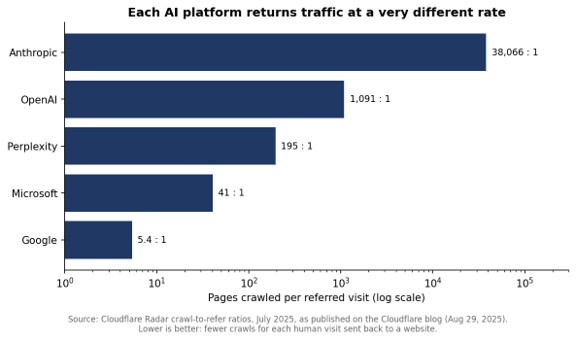

Two caveats matter for interpretation. First, many of these crawls feed model training rather than live answers, and training crawlers have no referral mechanism at all. Second, the same data shows ratios moving quickly: Anthropic’s fell 86.7% between January and July 2025 after Claude added web search with citations, while Perplexity’s rose. For B2B marketers, the takeaway is that mentions and citations inside answers are the more stable measure of visibility, with referral clicks as a secondary signal.
Which optimization signals work across every AI engine?
Clear answers, verifiable evidence, accessible pages, and consistent entity information work across every engine because all of them must find, read, and trust a source before citing it. The KDD 2024 GEO study tested content edits on its own benchmark and on Perplexity, a live engine. Adding quotations from credible sources performed best on Perplexity’s position-adjusted word count, with a 22% improvement over the baseline, while keyword stuffing performed 10% worse than doing nothing.
- Answer-first writing: a direct one or two sentence answer under each question-style heading, written so it makes sense when quoted alone.
- Evidence density: named sources, specific figures, and short quotations from credible experts placed close to the claims they support.
- Crawler access: no accidental blocks on search-oriented AI crawlers, and no key specifications locked inside gated forms or image-only PDFs.
- Entity consistency: the same company name, product names, and descriptions across the website, schema markup, directories, and profiles.
- Independent corroboration: coverage in trade press, industry associations, and reference sites that engines use to confirm what a brand says about itself.
When does engine-specific optimization make sense?
Engine-specific work makes sense when a measurable share of a brand’s buyers rely on one engine, or when a technical setting affects only one engine. A cybersecurity vendor whose buyers live inside Google Workspace has good reason to invest in Google entity signals such as Business Profile accuracy and structured data. A SaaS company seeing strong Perplexity mentions but weak ChatGPT presence may need more independent editorial coverage rather than more blog posts. In each case, the engine-specific layer sits on top of the shared foundation instead of replacing it.
Measurement keeps this honest. One B2B-focused analysis published by Inter-Dev in April 2026 recommends AI Share of Voice, the percentage of category responses that mention a brand across every engine buyers might use, as the core metric instead of a single-platform leaderboard.
How should a B2B team prioritize its AI engine strategy?
Prioritize in three passes: fix shared foundations first, measure presence on every relevant engine second, and only then invest in the engine where the largest commercial gap appears. Start with crawler access, answer-first page structure, and evidence on the pages that support the highest-value buying questions. Next, run the same prompt set across engines on a fixed schedule and record mentions, citation position, and the sources each engine cites. Finally, assign engine-specific tasks only where the data shows a persistent gap that shared improvements did not close.
This sequence protects budgets from chasing whichever engine is in the news this month, and it builds visibility that survives the next model update. It also gives leadership a single view of AI presence across platforms instead of a separate report for every tool.
Frequently Asked Questions
Can a website allow ChatGPT search but block AI training?
Yes, OpenAI documents separate robots.txt user agents, so a site can allow OAI-SearchBot for ChatGPT search visibility while disallowing GPTBot for model training.
Do Google AI Overviews need special markup or files?
No, Google states that there are no additional requirements or special optimizations needed to appear in AI Overviews or AI Mode beyond fundamental SEO best practices.
Does Google send more referral traffic per crawl than AI-only platforms?
Yes, in Cloudflare’s July 2025 data Google needed about 5 crawls per referred visit, compared with about 1,091 for OpenAI and about 38,000 for Anthropic.
What is AI Share of Voice?
AI Share of Voice is the percentage of AI-generated answers for a defined set of category prompts that mention a specific brand, measured across the engines its buyers use.