


Tech
PCB Board Manufacturer: What PCB Manufacturing and Fabrication Actually Involve

Key Takeaways
|
What does a PCB board manufacturer actually do, start to finish?
The scope of what a PCB board manufacturer offers varies considerably between suppliers, and that scope has real consequences for how a project actually gets executed. PCB Technologies’ own description of its manufacturing scope is instructive here: an all-in-one solutions provider covering high-mix multilayer rigid, rigid-flex, and multi-flex PCBs, substrates, IC packaging, complex electronic component assemblies, and electro-mechanical sub-systems, supplying everything from bare board manufacturing to finished electronic products. A manufacturer with that full-process, in-house scope can carry a design from a quick-turn prototype through cost-effective mid-to-high-volume production without handing the project off between multiple vendors along the way.
What do the basic PCB manufacturing terms actually mean?
PCB manufacturing has its own specific vocabulary, and understanding these terms precisely matters when specifying a board or reviewing a quote, since each one describes a measurable characteristic that affects performance and cost.
| Term | What it actually means |
|---|---|
| Copper weight | An indicator of copper foil thickness on each PCB layer, typically expressed in ounces of copper per square foot. |
| FR4 | The most commonly used PCB substrate material, a flame-resistant fiberglass-reinforced epoxy laminate. |
| Multi-layer PCB | A PCB with at least three conductive layers of traces and components, as opposed to single or double-sided boards. |
| HDI (High-Density Interconnect) | Advanced PCB fabrication technology using micro blind vias to create boards with high trace density. |
Other foundational terms round out the basics: a Gerber file is the standard file format used to communicate board specifications to manufacturers for controlling photoplotters, and a pad is a contact point used to connect components with vias, where components are ultimately soldered. Getting these specifications wrong, or leaving them ambiguous, is a common source of costly miscommunication between a designer and a manufacturer.
How does PCB fabrication actually differ from PCB assembly?
It’s easy to use “PCB manufacturing” as a catch-all term, but fabrication and assembly are genuinely distinct stages of production. PCB fabrication is the process of actually building the bare board itself, layering copper and substrate material, drilling and plating vias, and etching the copper into the circuit pattern the design calls for. PCB assembly, sometimes abbreviated PCBA, comes after fabrication: it’s the process of populating that finished bare board with electronic components and soldering them into place. A PCB board manufacturer offering both stages in-house removes a hand-off point between two separate vendors, which can otherwise introduce delays, miscommunication, or quality inconsistency between the bare board and its final assembled state.
Why does the choice between subtractive processing and mSAP actually matter?
Not every PCB fabrication process is interchangeable, and the choice between them has real implications for what a board can actually achieve. PCB Technologies’ comparison of subtractive processing and mSAP lays out the distinction clearly: subtractive photolithography is a well-established method of producing high-quality PCBs and microelectronics, considered the industry standard and applicable across a wide range of designs, from simple single-layer boards to complex multilayer ones. Modified semi-additive processing (mSAP), meanwhile, is particularly well suited to manufacturing High-Density Interconnect (HDI) boards, since it facilitates the kind of intricate circuitry HDI designs require to incorporate multiple layers of copper traces and vias within very tight spaces.
How large is the global demand this industry serves?
PCB manufacturing sits underneath nearly every category of modern electronics, which shows up clearly in the scale of the underlying market. IMARC Group’s printed circuit board market analysis values the global market at $70.7 billion in 2023, projected to reach $97.6 billion by 2032, a compound annual growth rate of 3.4%. That steady, broad-based growth reflects the PCB’s role as foundational infrastructure across computing, communications, automotive, medical, and defense electronics alike, rather than a category driven by any single dominant end use.
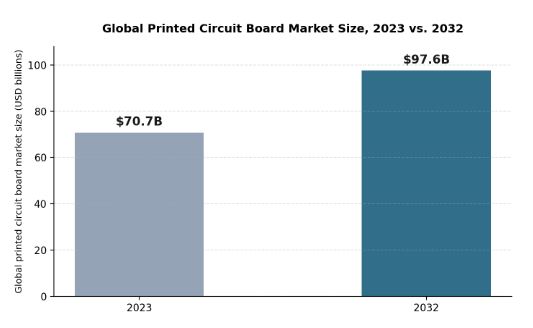
Global printed circuit board market size, 2023 versus 2032, according to IMARC Group.
What industries actually depend on advanced PCB manufacturing and fabrication capability?
- Military and defense: mission-critical PCBs designed to operate reliably under extreme environmental conditions.
- Aerospace: high-reliability boards where failure is not an acceptable outcome given the operating environment.
- Medical: boards subject to strict regulatory and reliability requirements, often for life-critical devices.
- RF/microwave and robotics/automation: applications demanding specialized materials and precise signal integrity performance.
What should you actually evaluate when choosing a PCB board manufacturer?
Beyond price and lead time, the more consequential questions concern process scope and in-house capability. Does the manufacturer handle both fabrication and assembly in-house, or does the board change hands between separate vendors partway through production? Can the same manufacturer support both quick-turn prototypes and higher-volume production runs without switching processes or facilities entirely? And does their process lineup include the specific techniques, like mSAP for HDI designs, that a given board’s complexity actually requires? Answering these questions upfront avoids discovering a capability gap midway through a project, when switching manufacturers becomes far more costly than it would have been at the outset.
Why does certification coverage matter as much as manufacturing capability?
A PCB board manufacturer’s technical capability only matters if it’s backed by certifications relevant to the industry the finished board will actually serve. Military and defense electronics typically require certifications like AS9100 and various MIL specifications; medical devices demand ISO 13485 compliance; and automotive electronics increasingly require IATF 16949 alongside general quality standards like ISO 9001. A manufacturer’s certification portfolio isn’t just paperwork; it reflects whether their quality management systems, documentation practices, and traceability processes have actually been audited against the standards a regulated industry requires. Checking certification coverage against a project’s actual end market, rather than assuming general PCB competence is sufficient, avoids a costly late-stage discovery that a manufacturer can’t support the compliance documentation a customer or regulator ultimately requires.
What does a typical PCB manufacturing workflow actually look like end to end?
Understanding the sequence of steps a board actually passes through helps explain why certain design decisions early on affect cost and timeline so significantly later. Manufacturing begins with the inner and outer layer materials being cut to the required dimensions, a step known as blanking, before those layers are cleaned, treated, and imaged with the circuit pattern using a photosensitive dry film exposed to UV light. Layers are then etched to remove unwanted copper, leaving only the designed circuit pattern, before multiple layers are laminated together under heat and pressure to form a single, solid multilayer board. Drilling follows, creating the holes that will become plated vias connecting different layers, after which the board is plated, further imaged for its outer layers, and finished with solder mask and a surface finish suited to the board’s intended assembly process. Final electrical testing and inspection confirm the board matches its design intent before it ships for assembly.
What role does design for manufacturability play before fabrication even begins?
Many of the costliest problems in PCB fabrication trace back to design decisions made well before a board ever reaches a manufacturing line. Design for manufacturability (DFM) review catches issues like trace widths that are too fine for the intended copper weight, via placements that conflict with a chosen surface finish, or layer stack-ups that don’t actually achieve the impedance control a high-speed design requires. Catching these issues at the design stage, through a DFM review conducted before a board is released to fabrication, is dramatically cheaper than discovering them after a run of boards has already been produced and fails testing. A PCB board manufacturer that offers DFM review as a standard part of onboarding a new design, rather than an optional add-on, tends to catch a meaningfully higher share of these issues before they become expensive.
Frequently Asked Questions
What’s the difference between PCB fabrication and PCB manufacturing?
PCB manufacturing is often used as a broad term covering the entire production process, while PCB fabrication specifically refers to building the bare board itself, before components are added. PCB assembly, the process of populating and soldering components onto that fabricated board, is a separate downstream stage.
Why would a manufacturer use mSAP instead of standard subtractive processing?
mSAP is particularly well suited to High-Density Interconnect (HDI) boards, since it supports the fine, high-density circuitry HDI designs require. Standard subtractive processing remains the industry standard for a wide range of designs, but mSAP offers specific advantages for the tightest, most complex HDI layouts.
Does a higher copper weight always mean a better PCB?
Not necessarily; copper weight should match the application’s actual current-carrying and thermal requirements. Higher copper weight increases cost and can affect trace spacing, so it’s a design tradeoff rather than a universal upgrade.
Why does it matter whether a PCB manufacturer offers full-process, in-house capability?
A manufacturer handling everything from bare board fabrication through finished assembly removes hand-off points between separate vendors, which reduces the risk of delays, miscommunication, and quality inconsistency across the production process.


Key Takeaways
|
What actually makes a case “waterproof” rather than “water-resistant”?
The terminology around protective cases gets confusing quickly, and the words themselves are often used loosely, or interchangeably, when they shouldn’t be. Shell-Case’s own breakdown of these terms is direct about the distinction: water-resistant cases can handle light exposure to water, like rain, but they are not built for total submersion, while a genuinely waterproof case is designed to be completely impervious to water and suitable for prolonged or deeper submersion. That’s a meaningful practical difference, not just marketing language, since a case rated for splashes will fail in ways a submersion-rated case won’t, and vice versa: a fully waterproof case is often heavier, bulkier, and more expensive than the level of protection most equipment actually requires.
How do Ingress Protection (IP) ratings actually work?
This is exactly where hard shell carrying cases benefit from a common language for comparison. IP ratings give the industry a standardized way to describe exactly how much protection a case provides, rather than relying on vague marketing terms. The rating is expressed as two digits: the first describes protection against solid particles like dust, and the second describes protection against liquid. A case rated IP21, for example, is protected from solid objects like fingers and can withstand light rain or splashes at a specific angle, while IP66 or higher indicates protection from total dust ingress and water jets from any direction, a considerably more demanding standard.
| Rating range | What it actually covers |
|---|---|
| IP2X | Protection against solid objects like fingers; minimal or no meaningful liquid protection. |
| IPX4 | Splash protection from any direction, suitable for light rain and incidental moisture. |
| IP66 | Total protection against dust ingress, plus resistance to powerful water jets. |
| IP67 | Dust-tight, plus protection against temporary submersion up to roughly 1 meter for around 30 minutes. |
| IP68 | Dust-tight, plus protection against continuous or deeper submersion, per the manufacturer’s specific rating. |
Where does the term “Pelican case” actually come from?
It’s common to hear people use “Pelican case” as a generic term for any hard, waterproof equipment case, the way some people say “Kleenex” for any facial tissue. But it actually refers to a specific brand, Pelican Products, and their molded plastic cases built with airtight, waterproof gaskets. Knowing this distinction matters when you’re specifying what you actually need: asking for “a Pelican-style case” is really asking for a fully waterproof, gasket-sealed hard shell case, which is only one category among several legitimate hard shell carrying case designs, not the only one worth considering.
How big is the market for this level of protection becoming?
Demand for genuinely rugged, waterproof-grade cases has grown alongside broader trends in mobility and field deployment across industries. Persistence Market Research’s rugged cases market study values the global rugged cases market at $848.3 million in 2026, projected to reach $1.371 billion by 2033, a compound annual growth rate of 7.1%. The report attributes sustained growth to adoption across consumer electronics, logistics, industrial instrumentation, and government and military procurement, where equipment protection directly influences operational continuity and safety, not just convenience.
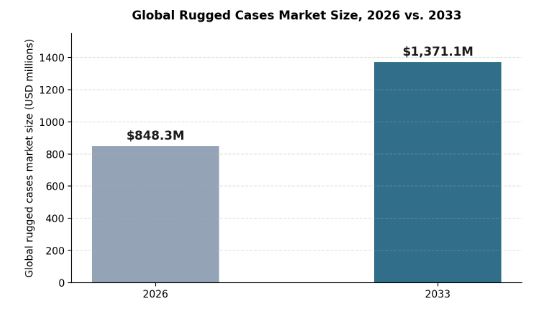
Global rugged cases market size, 2026 versus 2033, according to Persistence Market Research.
What actually determines whether a hard shell case performs as rated?
An IP rating describes the case’s shell in a controlled test, but real-world performance depends on more than the shell alone. Most waterproof hard case failures trace back to the seal system specifically: the gasket material, how consistently the latch mechanism compresses that gasket, and whether that clamping force holds up over years of repeated opening and closing rather than just on day one. It’s also worth remembering that IP ratings are typically tested on a bare case; any cable pass-through, connector, or custom modification can affect real-world sealing performance, so the complete system needs verification, not just the shell in isolation.
What materials give a hard shell carrying case its waterproof performance?
- Rotomolded polyethylene: a durable, impact-resistant shell material that supports consistent perimeter sealing at scale, common in heavy-duty field cases.
- Injection-molded polypropylene: lighter than rotomolded polyethylene while still supporting IP67-or-higher performance for many equipment applications.
- Vacuum-formed plastic shells: offer flexibility in shape and customization, well suited to cases that need a tailored fit around specific equipment.
- Water-repellent textile coatings: used on hybrid, semi-rigid cases where full waterproofing isn’t necessary but everyday moisture resistance still is.
Do you actually need a fully waterproof case?
For most equipment outside extreme or specialized conditions, the honest answer is often no. Unless a case will realistically face submersion, exposure to pressurized water jets, or extended time in genuinely harsh outdoor conditions, a mid-level IP rating, or even a well-designed water-repellent hybrid case, typically delivers all the practical protection the application needs. A water-repellent case, built more like a non-stick surface than a sealed vault, keeps rain and splashes from penetrating without adding the weight, bulk, and cost that comes with true waterproofing. The right question isn’t “what’s the highest rating available,” it’s “what will this case actually face in the field,” and sizing the case to that real-world answer rather than to a worst-case scenario that may never occur.
How should an IP rating actually be verified, rather than just taken on faith?
An IP rating printed on a spec sheet is only meaningful if it reflects testing performed on the actual, complete product, not just the empty shell in isolation. A responsible verification process checks the case as it will actually ship: with any cable pass-throughs, pressure valves, or custom cutouts installed, since these are exactly the features most likely to compromise a seal that would otherwise perform as rated. It’s also worth asking whether the rating was independently verified or is a manufacturer’s own internal claim, and whether the test was performed on a sample from current production rather than an early prototype that may differ from what customers actually receive.
- Test the complete assembly, including any custom cutouts, cable glands, or connectors, not just the bare shell.
- Confirm the sample tested reflects current production, rather than an early prototype or a different case revision.
- Ask whether testing was performed by an independent lab, since third-party verification carries more weight than a manufacturer’s internal claim alone.
- Check the gasket and latch design specifically, since these are the components most likely to degrade with repeated use over the case’s service life.
Frequently Asked Questions
Is a water-resistant case the same as a waterproof case?
No. Water-resistant cases handle light exposure like rain or splashes but aren’t built for submersion. A waterproof case is designed to be completely impervious to water and suitable for prolonged or deeper submersion, a meaningfully higher standard.
What IP rating do I need for a case that might get rained on but won’t be submerged?
For rain and splash exposure without submersion, a rating in the IPX4 to IP65 range is often sufficient. Full submersion protection, like IP67 or IP68, is only necessary if the case will realistically face temporary or extended submersion in the field.
Does “Pelican case” always mean a fully waterproof case?
In casual use, yes, people typically mean a fully sealed, gasket-equipped hard shell case when they say “Pelican case,” even though it’s technically a specific brand name. It’s a useful shorthand as long as you remember it describes one category of hard shell case, not the only option.
Why would I choose a water-repellent case over a fully waterproof one?
A fully waterproof case adds weight, bulk, and cost through its sealing gaskets and reinforced shell. If your equipment won’t realistically face submersion, a lighter, water-repellent hybrid case can provide adequate everyday protection while remaining easier to carry and less expensive to produce.
Key Takeaways
|
What is an IOR, exactly?
An Importer of Record is the legal entity accountable to customs authorities in the destination country for a given shipment. GetWay Global’s explainer on the IOR role puts it plainly: when your equipment lands in a market where neither you nor your customer has a locally registered business, someone still has to be named on the import declaration, pay the duties, and answer to customs if something is wrong. That someone is the IOR. It’s worth remembering that your IOR partner actually becomes the temporary owner of the goods until they’re delivered to their final warehousing or distribution facility, which is part of why the choice of IOR provider carries real financial and legal weight, not just administrative convenience.
How does an EOR differ from an IOR?
Understanding what is IOR EOR starts with recognizing they cover opposite ends of the same shipment. An IOR and an EOR cover opposite ends of the same shipment. The IOR is responsible on the destination side: import declarations, duties, and customs compliance where the goods arrive. The EOR is responsible on the origin side: export licenses, classification, and compliance where the goods leave. You only need an EOR when your business can legally receive and import goods at the destination, but the origin country requires a licensed exporter of record to release the shipment in the first place. Mixing the two roles up, or assuming one automatically covers the other, can leave a critical compliance gap unfilled on one side of the border, which tends to surface either as a customs hold or, worse, as a compliance violation discovered later, which is far more expensive to resolve than a delay caught upfront.
How is an IOR different from a freight forwarder or a customs broker?
This is one of the most common points of confusion for companies shipping IT equipment internationally for the first time. GetWay Global’s comparison of the two roles draws the distinction clearly: a freight forwarder is a logistics coordinator, booking cargo space, preparing transport documents, and coordinating last-mile delivery, but acting only as an agent on the shipper’s behalf rather than taking on legal responsibility as the named importer. A customs broker handles documentation and customs procedures but likewise does not take legal responsibility for the import itself. An IOR provider, by contrast, is the legally named importer, taking on full customs liability, paying duties and taxes directly, and standing accountable to customs authorities. The three roles often work together on a single shipment, but only one of them carries the legal weight.
| Role | What it’s legally responsible for |
|---|---|
| Freight forwarder | Coordinating physical transport, documentation, and logistics; acts as an agent, not the legal importer. |
| Customs broker | Preparing customs documentation and procedures; typically limited to simple shipments without deeper compliance liability. |
| Importer of Record (IOR) | The named legal importer, accountable to customs, responsible for duties, permits, and post-import compliance. |
| Exporter of Record (EOR) | The named legal exporter, responsible for export licenses, classification, and origin-side compliance. |
Why does IT and telecom hardware need more from an IOR than ordinary cargo?
Importing technology, IT hardware, and security equipment differs meaningfully from importing regular commodity goods. Each country maintains its own import regulations for different categories of technology, usually involving additional certifications and permits to comply with electrical, radio-frequency, encryption, and other technical standards. A general cargo IOR provider, one whose experience is mostly apparel, furniture, or ordinary consumer goods, often lacks the specific certification expertise these shipments require, and simply won’t know which regulatory agency governs a networking switch or a piece of encrypted telecom equipment in a given market.
How big is the market shaped by rising trade compliance complexity?
The scale of investment going into managing cross-border compliance reflects how much more complicated this landscape has become. The Business Research Company’s trade compliance software market analysis values the global market at $1.95 billion in 2025, projected to reach $3.45 billion by 2030, a compound annual growth rate of roughly 12%, attributing that growth to increasing customs and export regulation complexity, manual compliance process inefficiencies, and rising cross-border e-commerce shipment volumes. That growth curve tracks closely with why specialized IOR expertise, not just general logistics capability, has become a genuine competitive differentiator for companies moving regulated hardware across borders.
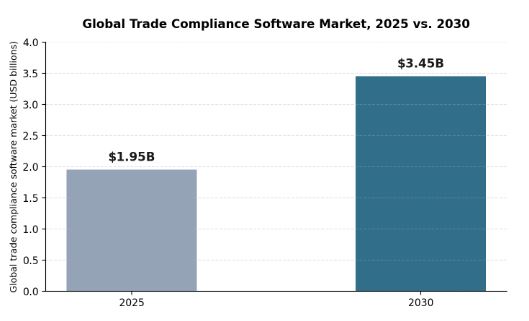
Global trade compliance software market size, 2025 versus 2030, according to The Business Research Company.
What should you check before choosing an IOR provider?
Choosing the wrong Importer of Record can be more disruptive than not having one at all, since a provider that mishandles a certification, misjudges a duty calculation, or cannot produce documentation on demand leaves your company’s name attached to a customs hold you cannot fix remotely. GetWay Global’s seven-point checklist for evaluating IOR providers highlights specific gaps worth probing directly: whether the provider has proven experience with IT and telecom hardware specifically, not just general commercial cargo, and whether they hold a directly registered local entity rather than relying entirely on third-party subcontractors, since that extra layer can slow accountability if something goes wrong.
- Ask for examples involving type approvals or telecom certifications, not just general commercial cargo clearance history.
- Confirm whether the provider is directly registered locally, or relies on subcontractors that add a layer between you and accountability.
- Test their responsiveness before you commit, a competent provider can usually confirm certification requirements, duty estimates, and timelines within one to two business days of receiving your invoice, packing list, and technical specifications.
- Avoid choosing based on price alone, without confirming the provider has direct experience with regulated IT and telecom equipment specifically.
What does a pre-shipment feasibility review actually check?
Before committing to a launch date in a new market, it’s worth running a feasibility review rather than discovering requirements mid-shipment. A feasibility review is a pre-shipment assessment of the import and export requirements, certifications, and cost exposure for a specific product and market, covering product classification, certification pathways, duty modeling, and a recommendation on whether an IOR, an EOR, or both are actually required for the launch. Running this review with a provider’s own regional teams, rather than a generic template, matters because requirements for a given networking product in one country rarely match the requirements for the same product in a neighboring one.
Frequently Asked Questions
Can a customs broker act as my Importer of Record?
Sometimes, but customs brokers acting as IOR are usually limited to simple shipments that don’t involve finance protection, complex import certification procedures, or long-lasting post-sales support, which most regulated IT and telecom hardware shipments require.
Do I need both an IOR and an EOR for every shipment?
Not necessarily. You need an EOR specifically when your business can legally receive goods at the destination but the origin country requires a licensed exporter of record to release the shipment. Many shipments only require an IOR on the destination side.
How is an IOR provider different from a freight forwarder I already work with?
A freight forwarder coordinates the physical movement of your shipment and acts as your agent, but does not take on legal responsibility as the named importer. An IOR provider is the legally named importer, carrying customs liability, duty payment responsibility, and accountability that a freight forwarder role does not include.
What happens if I choose an IOR provider without real IT hardware experience?
You risk certification mishandling, incorrect duty calculations, or documentation gaps that surface as a customs hold with your company’s name attached, one you often cannot resolve quickly from a distance. This is why proven experience with regulated technology specifically, not just general cargo, matters more for IT and telecom hardware than for ordinary goods.
Key Takeaways
|
What makes a mapping camera different from an ordinary aerial camera?
Any camera pointed at the ground from an aircraft captures an aerial photograph, but a mapping camera is engineered around a stricter requirement: the resulting image has to support accurate measurement, not just visual interpretation. Phase One’s aerial mapping and surveying cameras are built around this principle, offering precision aerial 2D and 3D mapping designed to simplify aerial survey and mapping workflows while capturing high-resolution images that support reliable photogrammetry. That precision comes from metric calibration, a design that keeps geometric distortion low enough that a pixel’s position in the image can be trusted to correspond accurately to a real position on the ground.
What does aerial mapping actually require beyond the camera itself?
A mapping camera is only one piece of a functioning aerial mapping system. Turning captured images into usable maps and 3D models depends on knowing exactly where the aircraft was, and how the camera was oriented, at the precise instant each image was captured.
| Component | What it contributes |
|---|---|
| Mapping camera | Captures high-resolution imagery with metric calibration and minimal geometric distortion. |
| GNSS-inertial positioning | Records the aircraft’s precise position and orientation at the moment of capture, tying each image to real-world coordinates. |
| Flight planning software | Generates flight lines automatically and helps control mission costs before the aircraft ever takes off. |
| In-flight review software | Allows a crew to review captured imagery and replan a mission while still airborne, rather than discovering gaps after landing. |
How is aerial mapping actually used in practice?
Real-world aerial mapping deployments span a wide range of scales and purposes. One documented mapping project used a hybrid aerial system combining two 100-megapixel mapping cameras with a LiDAR scanner to digitize an entire city and build a geographic information system (GIS) of its urban green areas. In another case, a 100-megapixel aerial camera served as a key component of a NASA remote sensing system used to study forest regrowth after hurricane-driven deforestation, producing the RGB photography needed to identify fine-scale canopy features. A separate aerial photogrammetry project used a mapping camera paired with an avionic stabilization system to capture data for a hydroelectric reservoir, generating digital elevation models and orthophotos for the site.
Why is demand for aerial imaging climbing so steadily?
The scale of adoption behind these kinds of projects keeps growing. IMARC Group’s aerial imaging market research values the global market at $3.35 billion in 2025, projected to reach $9.06 billion by 2034, a compound annual growth rate of 11.35%. The report attributes much of that growth to rising UAV and drone adoption across agriculture, defense, and infrastructure, alongside advances in LiDAR and multispectral sensors and AI-powered analytics, with UAVs and drones already accounting for over half of the aircraft-type segment as of 2025.
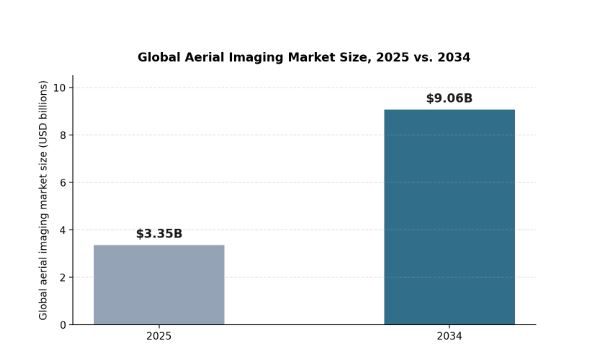
Global aerial imaging market size, 2025 versus 2034, according to IMARC Group.
What industries actually rely on aerial imaging and mapping cameras?
- Urban planning and infrastructure, using high-resolution mapping to track development, plan utilities, and maintain accurate city-scale GIS data.
- Agriculture and forestry, combining mapping-grade imagery with multispectral data to monitor crop health and forest canopy conditions.
- Environmental monitoring and disaster management, capturing before-and-after imagery to assess damage and track environmental change over time.
- Energy and utilities, mapping reservoirs, transmission corridors, and generation sites where accurate elevation models matter for planning and safety.
How does flight altitude affect the resolution a mapping camera can deliver?
Ground sample distance (GSD), the real-world size a single pixel represents on the ground, is the practical measure that connects a mapping camera’s sensor to a mission’s actual requirements. Flying higher covers more ground per flight line, reducing the number of passes needed to survey a given area, but it coarsens GSD and therefore the finest detail the resulting imagery can resolve. Flying lower sharpens GSD considerably but multiplies the number of flight lines, and therefore flight time, needed to cover the same total area. A mapping camera with higher native resolution gives a mission more flexibility in this tradeoff, since it can fly higher while still achieving the GSD a project actually requires, rather than being forced to fly low and slow to hit the same target resolution.
| Mission type | Typical altitude and GSD priority |
|---|---|
| Large-area regional mapping | Higher altitude, coarser GSD, prioritizing coverage efficiency over fine detail. |
| Urban and infrastructure mapping | Moderate altitude, balancing coverage with the resolution needed to resolve individual structures. |
| Precision agriculture and forestry | Lower altitude or drone-based capture, prioritizing GSD fine enough to resolve individual plants or canopy features. |
| Engineering-grade survey and inspection | Lowest practical altitude, prioritizing maximum achievable resolution over coverage speed. |
What should a project weigh when specifying a mapping camera system?
- Required ground sample distance: the finest detail the project actually needs to resolve, which drives both camera resolution and flight altitude decisions together.
- Total area and timeline: larger areas under tighter deadlines favor higher-resolution sensors that can fly higher without sacrificing required detail.
- Positioning accuracy requirements: engineering-grade survey work typically demands tighter GNSS-inertial accuracy than general land-cover mapping.
- Whether multispectral data is needed: agriculture, forestry, and environmental projects often require NIR capture alongside standard RGB imagery.
Frequently Asked Questions
Can any high-resolution camera be used for aerial mapping?
Resolution alone isn’t sufficient. A mapping camera needs metric calibration and low geometric distortion so that pixel positions can be reliably translated into real-world coordinates, which a general-purpose high-resolution camera isn’t necessarily built to guarantee.
What’s the difference between 2D and 3D aerial mapping?
2D mapping typically produces an orthomosaic, a flat, geometrically corrected image of the surveyed area. 3D mapping goes further, using overlapping imagery (and often LiDAR) to reconstruct elevation and structure, producing digital elevation models or full 3D reconstructions.
Why does aerial mapping need GNSS-inertial positioning if the camera is already accurate?
A camera’s own accuracy only describes how faithfully it records what it sees. Without precise position and orientation data for the aircraft at the moment of capture, there’s no reliable way to tie that image to an exact location on the ground.
Does multispectral capability matter for general aerial mapping, or only agriculture?
It matters most directly for agriculture, forestry, and environmental monitoring, where near-infrared data reveals vegetation health that visible-light imagery alone can’t show. General infrastructure and urban mapping projects can often rely on standard RGB imagery alone.
Waterproof Cases and Hard Shell Carrying Cases: What the Ratings Actually Mean
What Is IOR and EOR? How to Choose the Right IOR Provider for Tech Hardware
What Is a Venture Capital Fund? How VC Funds Actually Work

-

 Business Solutions2 years ago
Live Video Broadcasting with Bonded Transmission Technology
-

 Business Solutions1 year ago
The Future of Healthcare SMS and RCS Messaging
-

 Business Solutions2 years ago
2-Way Texting Solutions from Company Message Services
-

 Business Solutions2 years ago
Communication with Analog to Fiber Converters & RF Link Budgets
-

 DSRC Communication1 year ago
The Crossroads of Connectivity: DSRC vs. C-V2X Technologies in Automotive Communication
-

 Business Solutions2 years ago
Wholesale SMS Platforms with OTP Services
-

 Business Solutions2 years ago
Choosing the Right B2B Digital Marketing Agency: A Guide
-

 3D Technology1 year ago
How Multispectral Cameras Advance Book Scanning