


Tech
High-Resolution Photogrammetry in Aerial Mapping: Optimizing Spatial Data Accuracy and Flight Efficiency

High-resolution photogrammetry technology resolves the severe operational bottlenecks that traditional imaging hardware can no longer handle within modern engineering and geospatial surveying sectors. A single infrastructure corridor inspection or topographic survey routinely covers thousands of hectares of varying terrain. Furthermore, standard environmental surveying projects regularly demand hundreds of parallel flight passes, a requirement that generates massive quantities of fragmented data. Industrial utility corridors—such as pipelines, railway networks, and power grids—require continuous, high-altitude monitoring. In these scenarios, any reduction in image sharpness leads to geometric errors during post-processing. Consequently, the sheer volume of raw data captures stretches engineering workflows to their limits, while an inaccurate point cloud reconstruction can cause severe structural design failures or costly project delays.
Dedicated metric imaging systems have emerged as the definitive structural response to these geospatial challenges. By engineering metrically calibrated, large-format and medium-format sensors explicitly for flight payloads, modern setups automatically minimize lens distortion, optimize spatial resolution, and maximize coverage area per flight line. Therefore, this structural integration drastically reduces the physical demands placed on flight crews and processing teams while simultaneously enhancing the absolute accuracy of the final topographic models. This review evaluates how high-resolution aerial imaging functions, why it has become the benchmark for commercial surveying operations, and what optical mechanics distinguish dedicated metric systems from standard commercial drone cameras.
What Is High-Resolution Aerial Photogrammetry?
High-resolution aerial photogrammetry involves the automated collection and processing of overlapping aerial images to calculate precise three-dimensional coordinates of physical objects on the Earth’s surface. Unlike generic consumer-grade photography or basic video mapping, specialized metric data collection relies on sensor platforms constructed specifically to maintain internal geometric stability under intense flight vibrations and wide temperature fluctuations.
Advanced metric platforms distinguish themselves by utilizing sensor dimensions that far exceed standard 35mm formats. These large-format and medium-format configurations allow surveying systems to resolve sub-centimeter Ground Sample Distance (GSD) from significantly higher operating altitudes. Furthermore, integrated global leaf shutter mechanisms eliminate the rolling shutter distortions common in standard drone hardware, ensuring that each pixel is exposed simultaneously and capturing an unwarped image plane even at high cruise velocities.
The Scale of the Aerial Surveying Challenge
The operational dimensions of large-scale mapping projects present major logistical and financial hurdles. In traditional aerial surveying, utilizing standard 24-megapixel or 50-megapixel sensors means that to achieve a high spatial resolution, aircraft must operate at low altitudes and tight line spacings. This configuration increases the total flight lines required to achieve adequate side and forward overlap, which directly translates to extended flight hours, increased fuel expenditure, and prolonged exposure to hazardous weather windows.
This reality exposes a clear operational constraint: lower-resolution payloads degrade surveying profitability by multiplying field capture times and increasing data complexity. High-resolution sensor integration fundamentally shifts this dynamic. By scaling sensor capabilities to 100 megapixels or 150 megapixels, mapping groups can expand their ground swath width substantially, transforming what used to be a multi-day flight operation into a streamlined, single-pass execution.
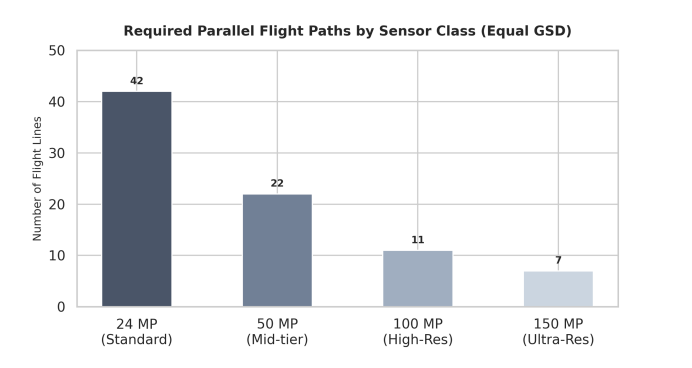
Required Flight Paths by Sensor Class (Equal GSD)
To understand how pixel density translates into operational financial savings, surveying teams must analyze flight path requirements. Increasing sensor resolution directly widens the lateral ground swath covered during a single pass. As a result, the aircraft requires far fewer parallel passes to map a fixed surface area, saving significant flight time and fuel.
The column chart below illustrates how switching to an advanced aerial mapping camera dramatically minimizes total flight line overhead:
Bar chart showing the required parallel flight paths by sensor class to achieve equal Ground Sample Distance, demonstrating that a twenty-four megapixel standard camera requires forty-two lines, while a one hundred and fifty megapixel ultra-res metric camera requires only seven lines.
| Feature / Metric | Standard Commercial Sensors | Specialized Metric Mapping Systems |
| Data Capture Width | Narrow ground swath; requires high line overlap |
Ultra-wide ground swath; maximizes coverage per pass |
| Shutter Architecture | Rolling electronic shutter; prone to movement blur |
Global leaf shutter; eliminates high-speed geometric distortion |
| Calibration Stability | Variable; changes with temperature and vibrations |
Permanently locked metric calibration; verified parameters |
| Altitude Capabilities | Restricted to low altitudes to maintain acceptable GSD |
Capable of high-altitude operations with sub-centimeter GSD |
| Processing Complexity | High volume of images; demands extensive processing time |
Minimal, high-density images; drastically shorter mosaic times |
| Structural Adaptability | Limited to specific consumer drone mounts |
Flexible; optimized for manned aircraft and payload drones |
| Spectral Options | RGB only; requires independent sensor changes |
Seamless co-registered RGB and 4-band imagery options |
Core Metric Camera Capabilities for Geospatial Applications
The following technical attributes represent the baseline criteria for professional-grade imaging integration within modern commercial mapping and surveying applications:
-
Calibrated Metric Optics: Factory-locked lens elements eliminate internal structural shifting, ensuring consistent focal length parameters across thousands of flight cycles.
-
High Dynamic Range (HDR): Advanced pixel architectures preserve fine shadow detailing and highlight definition simultaneously, which is critical when mapping high-contrast environments.
-
Integrated Hardware Synchronization: Microsecond-level integration links the camera shutter, flight management systems (FMS), and onboard GNSS/IMU receivers to provide precise orientation data.
-
Multi-Band Sensor Formats: Systems support simultaneous RGB and Near-Infrared (NIR) data capture to deliver accurate four-band imagery for agricultural and environmental monitoring.
-
Unmatched Shutter Durability: Industrial-grade mechanical leaf shutters survive hundreds of thousands of actuation cycles without requiring frequent maintenance intervals.
Payloads and Platforms: A Critical Architecture Decision
A primary decision point for commercial surveying operations involves choosing between medium-altitude manned aircraft integrations and lightweight UAV payload configurations. Historically, ultra-high-resolution mapping was restricted to large, manned aircraft due to the weight and power requirements of heavy, large-format camera enclosures. While highly efficient for continental-scale mapping, this approach introduces substantial operational overhead, fuel costs, and mobilization delays for regional project work.
The emergence of ultra-lightweight, medium-format 3d mapping camera designs has resolved this operational compromise. Modern 100MP and 150MP architectures have been miniaturized into specialized compact enclosures, allowing them to be deployed as a standard uav camera payload configuration. This engineering milestone brings true large-scale photogrammetry accuracy down to localized drone mapping and surveying workflows, providing an agile, rapidly deployable solution that eliminates manned aircraft costs while preserving metric integrity.
Deployment Environments: Where Specialized Imagery Delivers Value
Industrial metric imaging systems provide the most reliable operational returns in complex environments characterized by strict accuracy requirements and challenging flight windows:
-
Topographic and Cadastral Surveying: Creating highly accurate base maps for land administration, property boundaries, and civil engineering designs.
-
Urban 3D Digital Twin Development: Capturing high-density oblique imagery over dense metropolitan sectors to construct distortion-free 3D city models.
-
Volumetric Open-Pit Mining Analysis: Delivering reliable, repeatable point clouds to calculate stockpile volumes and excavation rates safely from the air.
-
Large-Scale Corridor Mapping: Monitoring linear assets like transcontinental pipelines, highway networks, and electrical transmission grids efficiently.
What to Look for in an Aerial Surveying Platform
Procurement teams and engineering directors evaluating new aerial surveying platforms should rigorously assess lens-to-sensor integration, ensuring the optical elements explicitly match the high-resolution pixel pitches to prevent edge softness. Furthermore, operational weight and power efficiency must fall within the maximum takeoff weight (MTOW) limits of target UAVs to prevent degrading flight times. Software workflow integration must also be assessed to see how seamlessly the native camera software links with post-processing suites to optimize orthophoto generation. Finally, real-world environmental protection should be verified to confirm that the imaging enclosure features an industrial IP rating to withstand high thermal variations encountered during flight. Choosing a platform engineered around physical pixel density and mechanical calibration directly removes the risks associated with unreliable field captures, proving that long-term surveying success is built on optical precision.
Conclusion
High-resolution photogrammetry has established itself as an indispensable core component of modern aerial surveying and geospatial analysis. The combination of massive pixel counts, rigorous geometric calibration, and flexible deployment across drone and aircraft platforms makes metric hardware an essential asset for firms managing tight project windows and strict data criteria. As the global demand for accurate 3D spatial models and real-time digital twins continues to accelerate, the operational gap between consumer-grade camera arrays and highly sophisticated metric platforms will continue to expand—solidifying high-resolution optical solutions as an absolute necessity for competitive geospatial operations.


Enterprise AI copilots and automation assistants now sit inside email, CRM systems, ITSM platforms, and office productivity suites, each with its own defaults and its own blind spots. The six practices below apply across that whole category, regardless of which specific copilot or automation platform an organization has deployed.
1. Scope permissions before the copilot ever touches production data
Default permission scopes on most enterprise copilots are broader than the actual task requires. Reviewing and narrowing Copilot Studio security controls before rollout, rather than after an incident, is consistently the highest-leverage step available.
2. Extend the same scrutiny to CRM-embedded AI features
CRM platforms have added AI agent capabilities directly into workflows that already touch customer and financial data. Reviewing Salesforce AI governance settings with the same rigor applied to a standalone AI deployment closes a gap that is easy to overlook simply because the AI feature lives inside a familiar, already-trusted system.
3. Apply consistent audit logging across every AI-enabled platform
Audit logging that only covers some AI-enabled platforms creates blind spots at exactly the boundary attackers look for. Extending consistent logging to ServiceNow AI governance workflows, alongside better-monitored platforms, keeps the audit trail continuous rather than fragmented by system.
4. Don’t treat RPA-driven agents as a separate, lower-priority category
Automation platforms built for citizen developers often run with elevated service-account permissions by default. Applying the same review standard to UiPath security for citizen developers that gets applied to newer generative AI deployments avoids a gap that opens simply because the technology predates the current AI security conversation.
5. Validate inputs the copilot processes, not just the copilot’s own configuration
A well-configured copilot can still be manipulated through the documents, emails, or tickets it is asked to summarize or act on. Input validation needs to account for instructions embedded inside that content, not just the copilot’s own settings.
This distinction matters because most security reviews stop at configuration. They confirm the copilot has the right permission scope and the right access controls, then treat the review as complete. That leaves the content the copilot processes every day almost entirely unexamined, even though it is the most common path an attacker actually has into the system.
6. Monitor behavior continuously rather than relying on a launch-time review
A copilot’s risk profile is not fixed at deployment. Permissions get modified, integrations get added, and underlying models get updated. Continuous monitoring is what catches drift between how the copilot was reviewed and how it is actually being used months later.
In practice, this is the control most organizations plan to add eventually and never quite prioritize, largely because launch-time review produces a clear pass or fail while ongoing monitoring requires sustained attention with no single moment of completion. That is exactly why it tends to be the gap attackers rely on most.
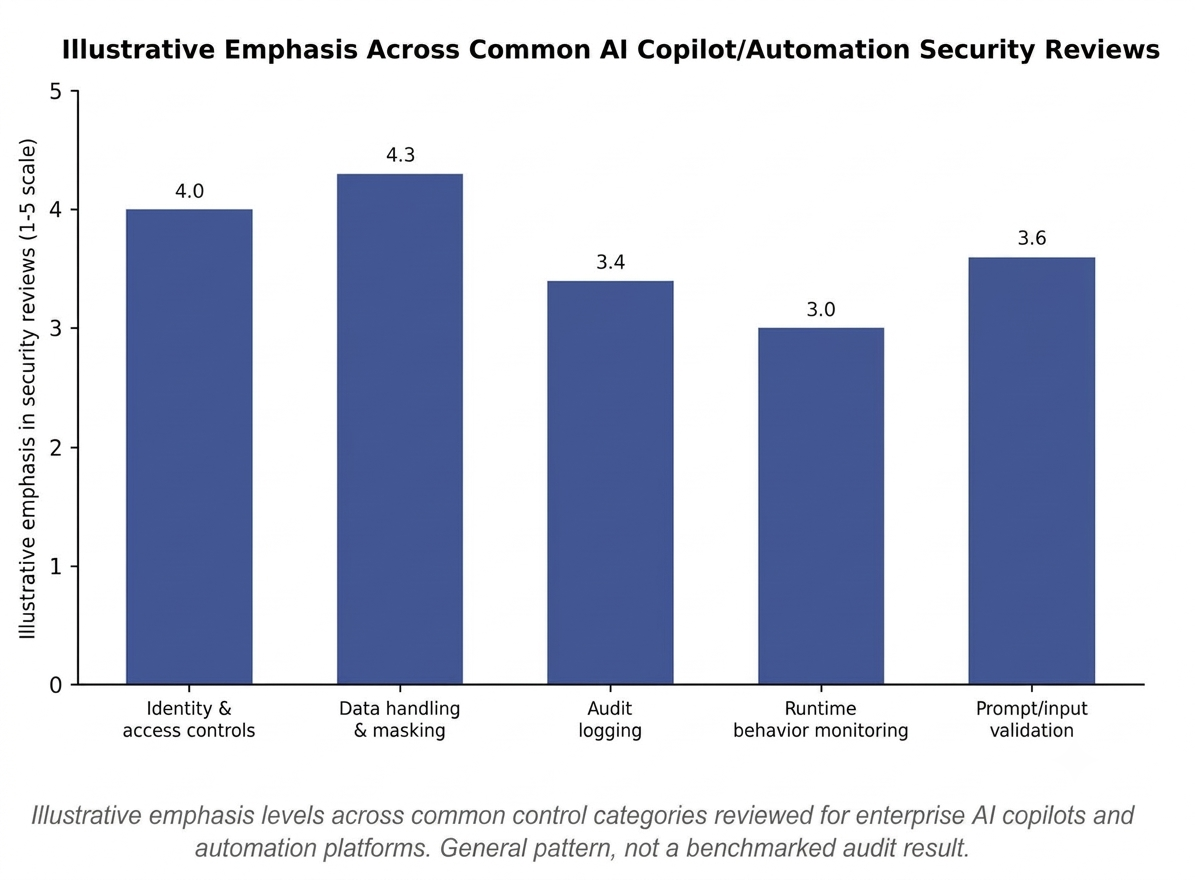
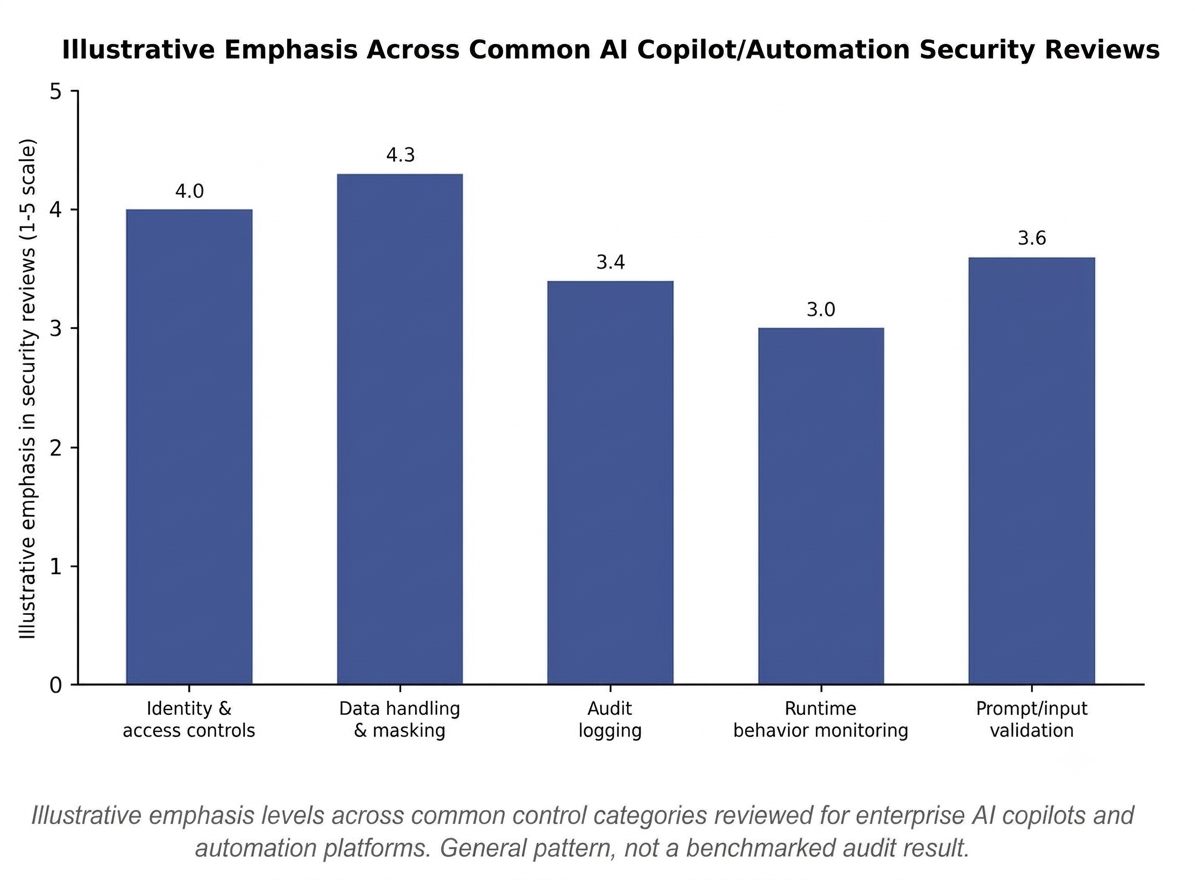
Illustrative emphasis levels across common control categories reviewed for enterprise AI copilots and automation platforms. General pattern, not a benchmarked audit result.
How six core security controls typically apply across different categories of enterprise AI copilots and automation tools. General guidance, not a vendor-specific audit.
| Control Category | AI Copilots in Productivity Suites | CRM-Embedded AI Agents | ITSM AI Assistants | RPA / Automation Platforms |
| Permission scoping | High priority | High priority | Medium priority | High priority |
| Audit logging depth | Often inconsistent | Improving | Often inconsistent | Frequently overlooked |
| Input validation for embedded content | Critical | Critical | Medium priority | Medium priority |
| Runtime behavior monitoring | Emerging practice | Emerging practice | Emerging practice | Frequently overlooked |
Where This Leaves Security Teams
None of these six practices is unique to a single vendor or platform category. What varies is how consistently each one gets applied once an organization has more than one type of AI copilot or automation tool in production. Treating all of them, generative copilots and older RPA platforms alike, against the same six-practice baseline tends to close the gaps that show up when one category gets more security attention than another simply because it is newer or more visible.
Frequently Asked Questions
Are RPA platforms less risky than generative AI copilots?
Not inherently. RPA and automation platforms often run with elevated service-account permissions and can be overlooked in security reviews simply because they predate the current wave of generative AI tools, which can leave real gaps if they are treated as lower priority.
What is the most overlooked security control for enterprise AI copilots?
Runtime behavior monitoring is commonly the most overlooked, since most security reviews still focus on configuration at launch rather than ongoing behavior after the copilot has been in use for a while.
Do CRM-embedded AI agents need a separate security review from standalone AI tools?
Yes, in practice they often need dedicated attention because they are embedded inside a system that is already trusted and already touches customer and financial data, which can make new AI features an afterthought in the review process.
Archives sitting on shelves of negatives, glass plates, and slides face a quiet but real deadline: analog film degrades, and every year that passes without digitization is a year closer to information loss that cannot be undone. The good news is that film digitization has matured well beyond the flatbed scanners most people picture. Here is an honest look at the main approaches available to an institution weighing this decision today, and where each one actually fits.
Flatbed scanning: the familiar starting point
Flatbed scanners are the most widely available option and the lowest barrier to entry, which is exactly why so many small archives start here. The tradeoff is speed and, at scale, consistency. Each frame is captured through a slow, mechanical pass, and results can vary depending on how consistently an operator loads and positions material. For a modest personal collection or a small batch of prints, this is often perfectly adequate. For a collection running into the thousands or tens of thousands of frames, the math stops working: the time cost compounds quickly.
Drum and virtual drum scanners: higher quality, higher overhead
Drum scanners have long been considered a high-quality option, particularly for capturing fine tonal detail in transparencies, and virtual drum scanners attempt to replicate that quality without the physical drum. Both, however, remain fundamentally slow, point-by-point or line-by-line capture methods. They also tend to require more specialized operator skill and ongoing maintenance than either flatbed or camera-based systems, which raises the effective cost per image once staff time is factored in alongside the equipment itself.
Camera-based digitization: built for volume without giving up quality
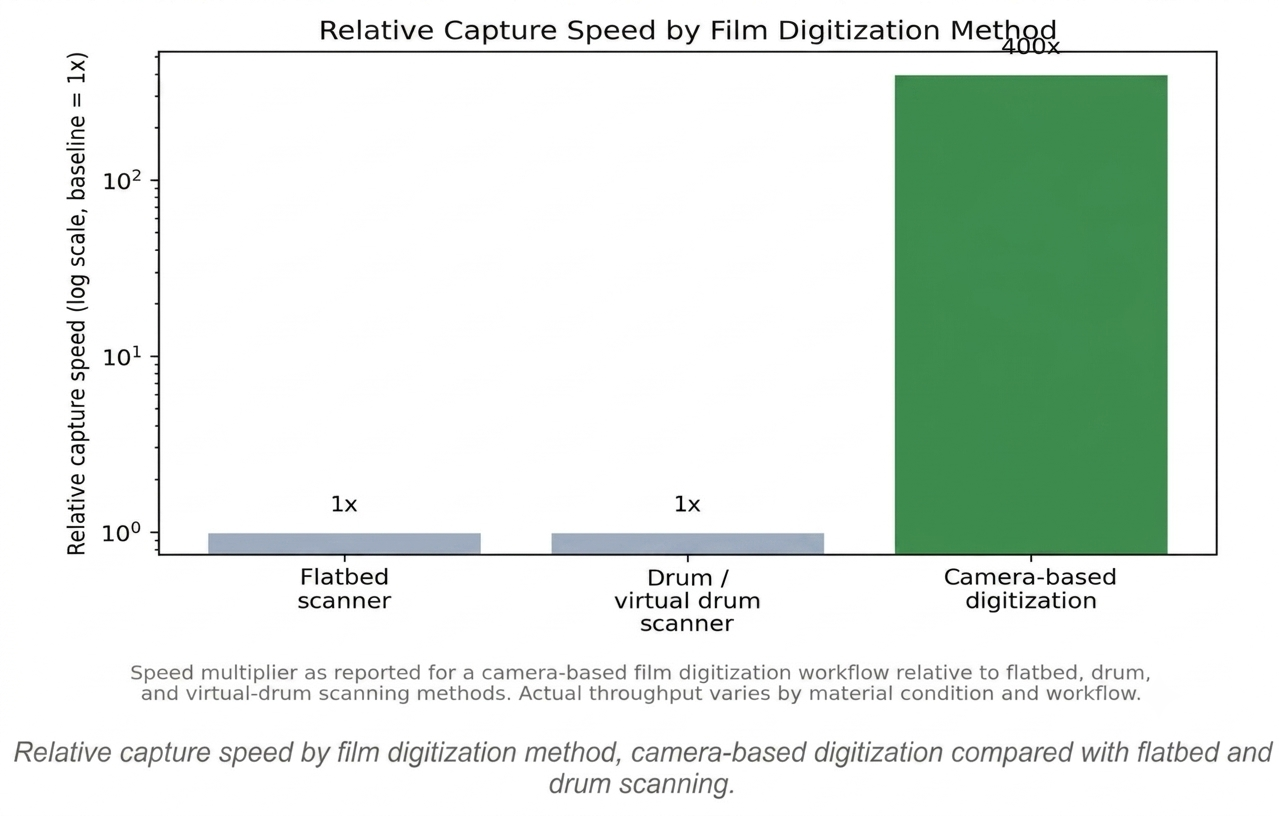
The more recent shift in serious archival digitization has been toward camera-based systems: a high-resolution digital sensor paired with a dedicated film capture stage, specialized film and glass-plate carriers, and copy-stand hardware, all built specifically to hold negatives, transparencies, and plates flat and properly illuminated during capture. Because the entire frame is captured in a single, near-instant exposure rather than built up progressively, throughput increases dramatically. One documented high-volume digitization workflow using an iXG camera system reports capture rates fast enough to process a full frame in a fraction of a second, cited as roughly 400 times faster than flatbed, drum, or virtual-drum scanning for comparable material.
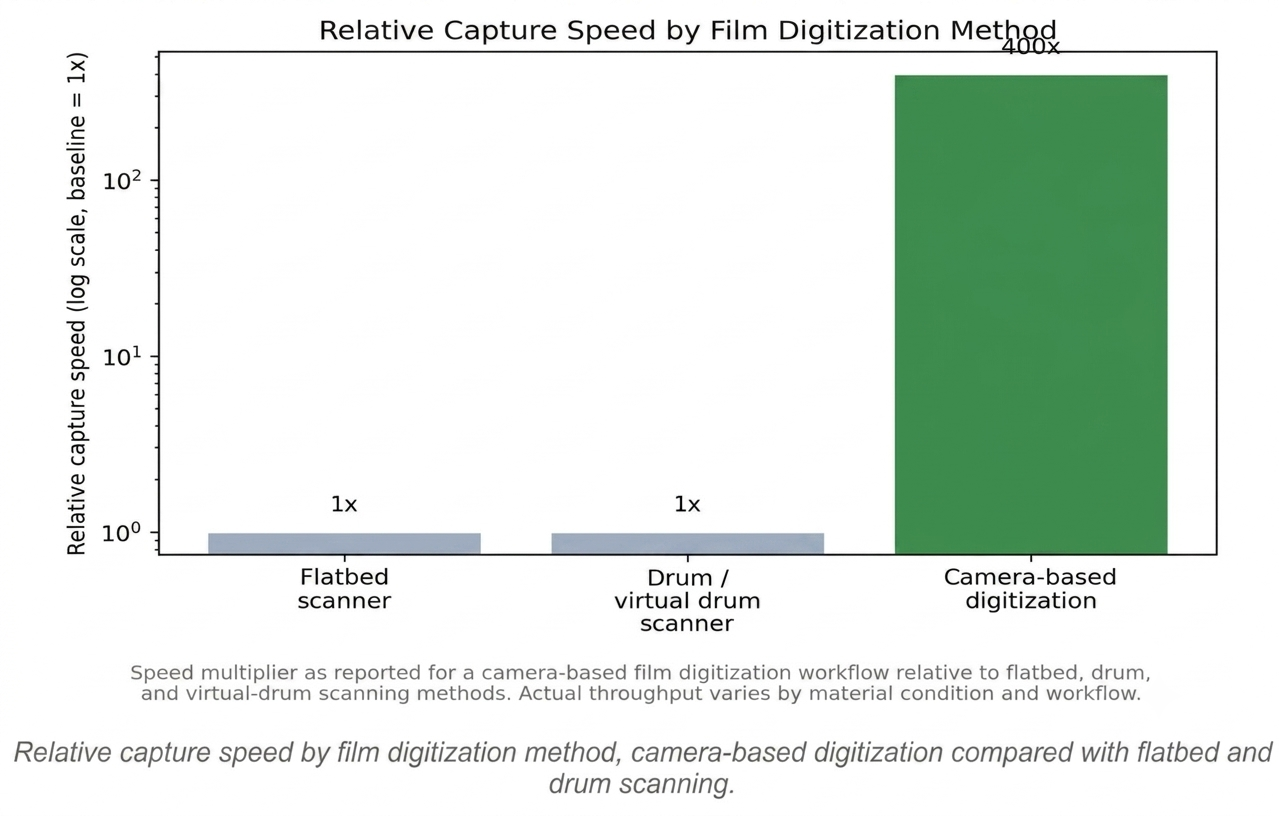
Relative capture speed by film digitization method, camera-based digitization compared with flatbed and drum scanning.
Does faster mean lower quality?
This is the question every archivist asks first, reasonably so, and the answer depends entirely on whether a program follows recognized technical benchmarks. Standards such as those maintained by the Federal Agencies Digital Guidelines Initiative, widely referred to as FADGI, and the Dutch Metamorfoze guidelines exist precisely to give institutions an objective way to verify image quality regardless of which capture method produced it. A camera-based system built around flat-field optics, precise focus tools, and accurate color profiling can meet the same three- and four-star quality benchmarks that a slower method targets, while doing it in a fraction of the time. Speed and quality are not automatically in tension; the real variable is whether the equipment and workflow were designed to hold quality steady at higher throughput.
What should actually drive the decision?
- Collection size: small, occasional digitization jobs rarely justify the cost of a dedicated camera-based setup, while collections in the thousands of items usually cannot avoid it on a cost-per-image basis.
- Material variety: mixed collections containing negatives, glass plates, slides, and bound volumes benefit from a modular setup that can switch between capture stages rather than requiring separate dedicated machines for each format.
- Compliance requirements: institutions submitting digitized material to federal, academic, or museum standards need to confirm their chosen workflow can actually document and pass the relevant FADGI or Metamorfoze star rating, not just claim high resolution.
- Staff capacity: drum and virtual drum scanning generally demand more specialized, ongoing operator expertise than a well-designed camera-based workflow, which matters for institutions without a dedicated imaging technician on staff.
There is no universally correct answer here, only a correct answer for a given collection’s size, format mix, and compliance needs. What has changed in recent years is that the fastest option is no longer automatically the lowest-quality one, which means the old tradeoff between speed and archival integrity is far less absolute than it used to be.
Frequently Asked Questions
Is camera-based film digitization actually faster than scanning?
Yes, documented workflows report camera-based capture running at roughly 400 times the speed of flatbed, drum, or virtual-drum scanning for comparable material, since the full frame is captured in a single exposure.
Does faster film digitization mean lower image quality?
Not inherently. Quality depends on whether the equipment and workflow are built to meet recognized benchmarks such as FADGI or Metamorfoze star ratings, regardless of the capture method used.
What type of archive benefits most from camera-based digitization?
Larger or mixed-format collections, such as those combining negatives, glass plates, and slides, generally see the greatest benefit, since a modular camera-based setup can switch between formats without separate dedicated machines.
Two years ago, a guardrail conversation was mostly about content filtering: stop the chatbot from saying something toxic. The model produced text, the text was safe or it was not, and a classifier could usually tell. In 2026 the problem changed shape, because the model is no longer just producing text. It is calling APIs, querying databases, writing files, sending emails, and triggering workflows. A guardrail failure two years ago meant a bad response. A guardrail failure today can mean a bad action: data deleted, funds transferred, privileged information forwarded to the wrong recipient. Here are seven signs an enterprise’s guardrail approach has not caught up to that shift.
- Guardrails only inspect the chat interface
If the only place content is being checked is the conversational turn between user and model, agentic workflows are moving around that checkpoint entirely. Tool calls, intermediate outputs passed between chained steps, and data pulled from connected systems all need coverage, not just the visible chat window.
- There is no human checkpoint on irreversible actions
Database deletions, external data transfers, financial transactions, and bulk record modifications are operations where a mistaken or manipulated instruction can cause damage that is difficult or impossible to reverse. Enterprises that have not annotated their AI tools by risk level, and built approval flows for anything tagged destructive, are relying entirely on the model getting it right every time.
- The guardrail is a prompted general purpose model
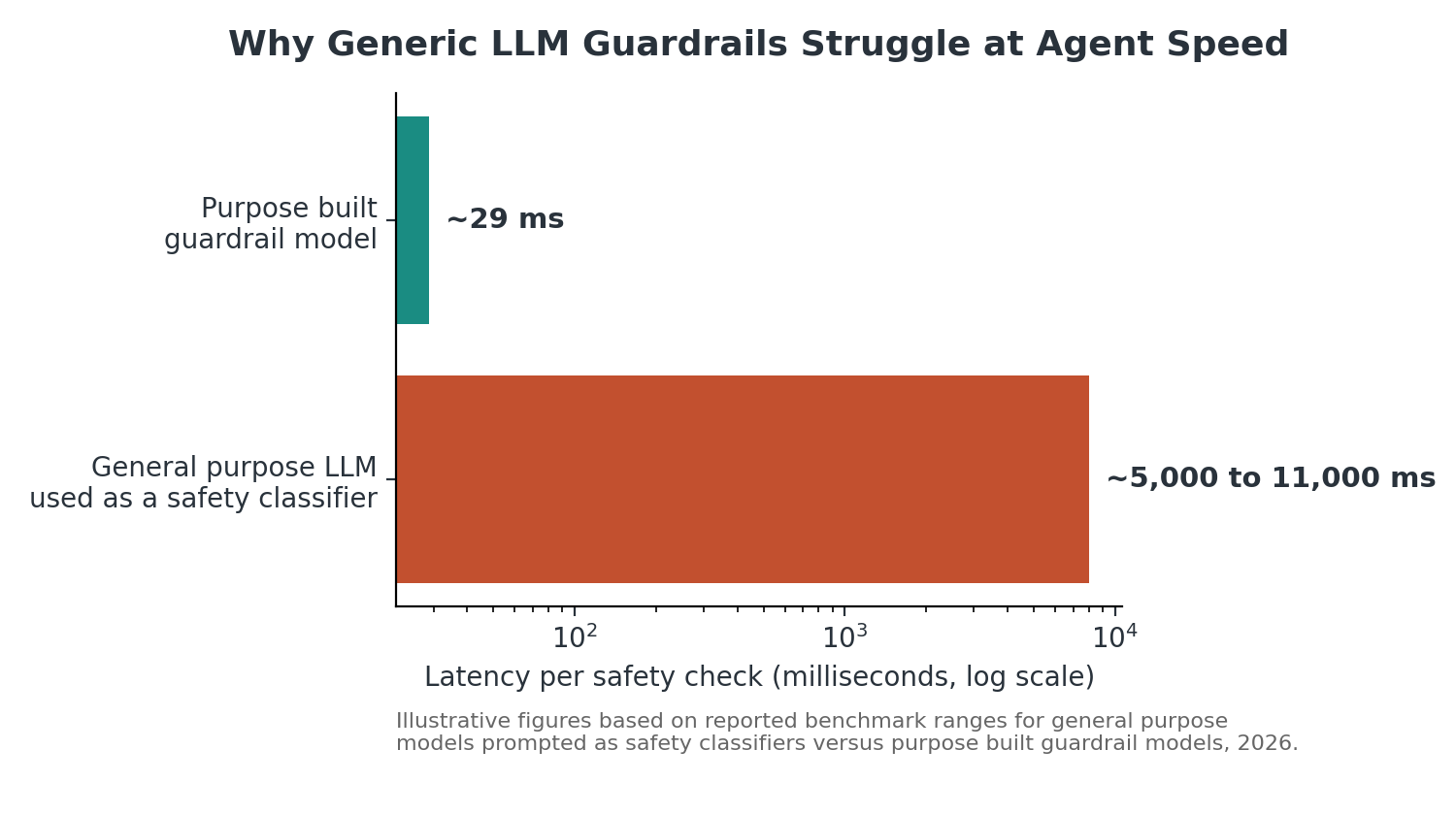
Prompting a general purpose model to act as its own safety classifier is the fastest way to prototype a guardrail, and it is also the slowest one to run in production. The chart below shows why that tradeoff matters once guardrails sit inside an agent’s decision loop rather than at the end of a conversation.
Illustrative figures based on reported benchmark ranges for general purpose models prompted as classifiers versus purpose built guardrail models, 2026.
- Policies are generic instead of specific to the workflow
Out of the box guardrails ship with a fixed taxonomy covering hate speech, violence, sexual content, and basic PII. That is fine for a generic chatbot. It is not fine for a workflow that needs to enforce specific regulatory language, recognize an organization’s own confidential project names, or apply industry-specific rules no generic model has ever seen. Generic guardrails catch generic problems and miss the ones that actually matter to a given business.
- There is no governance layer over employee AI usage
Guardrails on a single deployed application do nothing for the AI tools employees adopt on their own. Consistent governance over employee AI tool usage across sanctioned and unsanctioned tools alike is what turns a guardrail policy from something that applies to one system into something that actually reflects how AI is used across the organization.
- Nobody has adversarially tested the guardrail itself
A guardrail that has only been validated against the cases it was designed to catch will fail the first time it meets an adversarial input it was not trained on. Open source community-standard guard models, for example, see measurable accuracy drops under adversarial pressure and on long context traces compared to their baseline performance. Red teaming the guardrail, not just the underlying model, is what closes that gap before an attacker finds it.
- Governance is only 25 percent implemented, if that
According to a 2025 industry survey, only about 25 percent of companies report a fully implemented AI governance program, even as 88 percent of organizations say they use AI in at least one business function. That gap between usage and governance is exactly where the enterprise AI security risks CISOs are already tracking tend to surface first, since guardrails without an underlying governance program are enforcing rules nobody has actually agreed on organization-wide.
What closing these gaps actually requires
The pattern across all seven signs is the same: guardrails designed for a single conversational turn do not generalize to a system that acts. Closing the gap means covering tool calls and not just chat, gating irreversible actions behind human review, using purpose-built models fast enough to run inline, tailoring policy to the specific workflow, extending governance to tools employees adopted informally, adversarially testing the guardrail itself, and treating all of it as a program rather than a one-time deployment. A recent look at how enterprises are approaching the related discipline of preventing AI data leakage is worth reading alongside guardrail planning, since the two controls typically need to work together
Frequently Asked Questions
Are guardrails the same thing as AI governance?
No. Guardrails are the runtime controls that catch or block specific behaviors. Governance is the broader program, ownership, policy, and accountability structure that decides what those controls should actually enforce.
Why do agentic systems need different guardrails than chatbots?
Chatbots produce text a human reads before acting on it. Agents can take the action directly, so a guardrail failure has a much larger and sometimes irreversible blast radius, which changes both what needs to be checked and how fast the check needs to run.
What is the fastest way to test whether current guardrails are sufficient?
Red team them the same way the underlying model would be tested, using adversarial examples specific to the organization’s actual policies and workflows rather than relying only on the vendor’s published benchmark results.

The 6 Best Practices for Securing Enterprise AI Copilots

The Best Ways to Digitize Analog Film Without Losing What Made It Analog

A Practical Framework for B2B Digital Marketing in the Technology Sector

-

 Business Solutions2 years ago
Live Video Broadcasting with Bonded Transmission Technology
-

 Business Solutions1 year ago
The Future of Healthcare SMS and RCS Messaging
-

 Business Solutions2 years ago
2-Way Texting Solutions from Company Message Services
-

 Business Solutions2 years ago
Communication with Analog to Fiber Converters & RF Link Budgets
-

 DSRC Communication1 year ago
The Crossroads of Connectivity: DSRC vs. C-V2X Technologies in Automotive Communication
-
Electronics3 years ago
AI Modules and Smart Home Chips: Future of Home Automation
-

 Business Solutions2 years ago
Wholesale SMS Platforms with OTP Services
-

 Business Solutions2 years ago
Choosing the Right B2B Digital Marketing Agency: A Guide