


Cybersecurity
Copilot Studio Security: How Kanopy Governs the Shadow AI Agents Hiding in Plain Sight

At a Glance
- Microsoft Copilot Studio has made it possible for any business team to build and deploy AI agents in days – without involving IT or security. The result is a rapidly growing population of shadow AI agents operating inside enterprise environments with real permissions, real data access, and zero security oversight.
- Copilot Studio security is not a feature gap that Microsoft will close with a settings toggle. It is a governance problem that emerges from the platform’s fundamental design: business users can build, publish, and connect agents to sensitive data without a single security review.
- Kanopy Security provides the continuous discovery, risk assessment, and governance layer that transforms Copilot Studio’s business-built agents from an ungoverned liability into a managed, secured asset class.
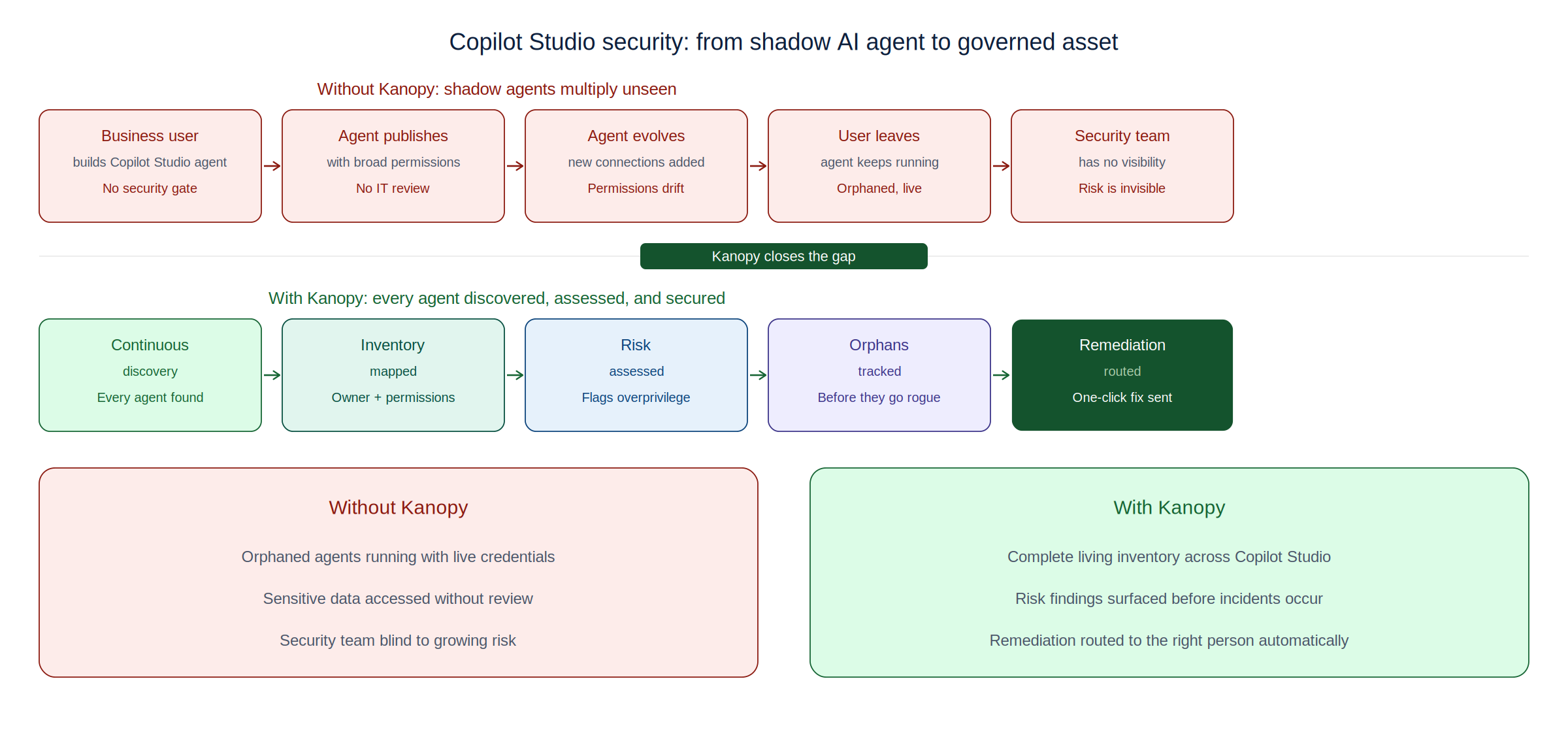
The pace at which Microsoft Copilot Studio agents are being created inside enterprise environments has outrun every reasonable security team’s capacity to keep up. A customer service team builds an agent connected to Dynamics 365. A finance team deploys an agent with access to SharePoint and Power BI. An HR team publishes an agent that can query sensitive employee data. None of these agents went through a security review. None of them were inventoried. And in most organisations, nobody in the security team even knows they exist. That is the copilot studio security problem — and it is growing faster than any manual governance process can address.
Why Copilot Studio Creates a Shadow AI Security Problem
Shadow AI security has typically referred to employees using unsanctioned public AI tools – ChatGPT, Claude, Gemini – without organisational oversight. Copilot Studio creates a more complex variant of the same problem: shadow AI that operates with enterprise identities, enterprise permissions, and enterprise data, built by people who had no security training when they built it.
Business teams building Copilot Studio agents face no mandatory security checkpoint. The platform’s citizen developer model – which is genuinely powerful for productivity – does not include a security review gate before an agent is published and begins operating. Agents are frequently granted broad permissions to avoid breaking workflows. Once deployed, they can act automatically, pulling data from SharePoint, OneDrive, Dataverse, or connected SaaS applications and surfacing or transmitting it in ways that were never reviewed for data governance compliance.
Orphaned agents compound the problem. When the team member who built an agent leaves or moves to a different role, the agent continues operating – often with the original creator’s access credentials or a service principal that was never reviewed for appropriate scope. Kanopy’s research across enterprise Microsoft 365 environments consistently finds that a significant proportion of Copilot Studio agents are orphaned, overprivileged, or connected to data sources that their owners did not intend to expose.
What Kanopy Provides for Copilot Studio Security
Kanopy’s Copilot Studio security capability begins with discovery – and in most organisations, the discovery results alone are significant. Kanopy builds a living inventory of every Copilot Studio agent in the environment: who built it, when it was last active, what data connections it has, what permissions it operates with, and whether it has been published externally. Many security teams, upon seeing this inventory for the first time, discover agents they did not know existed and data connections they would not have approved.
From inventory, Kanopy moves to continuous risk assessment. Each agent is evaluated against a defined risk profile: overprivileged access, connections to sensitive data categories, absence of appropriate authentication controls, orphaned ownership, and published channels that expose the agent beyond its intended scope. Risk findings are surfaced with the context that makes them actionable – not just a vulnerability score but an explanation of what the risk means and what remediation looks like.
Remediation in Kanopy is designed for the operational reality of enterprise environments: one-click remediation for common issues that routes fixes to the appropriate business user, and detailed guidance for security team action on higher-complexity findings. The goal is not to give security teams more alerts to manage – it is to close the gap between identifying a risk in a Copilot Studio agent and actually reducing it. Explore Kanopy’s full Copilot Studio security capability at the Kanopy Copilot Studio Security page, and discover how shadow AI security across the full enterprise AI estate is addressed at kanopysecurity.com.
Frequently Asked Questions
Q1: What makes Copilot Studio security different from securing other enterprise applications?
A: Copilot Studio agents are built by business users without security training, operate autonomously with enterprise permissions, and can act on data in real time. Unlike traditional applications, they have no mandatory security gate before deployment, can be created and modified rapidly, and may accumulate permissions over time without review. This makes continuous, automated governance essential rather than periodic manual review.
Q2: Why is shadow AI security a concern specifically for Copilot Studio environments?
A: Copilot Studio enables business teams to create and deploy AI agents without IT or security involvement. These agents operate with real enterprise credentials and access real data – but because they are built outside formal software development processes, they typically receive no security review. This creates shadow AI: autonomous systems operating inside the enterprise with unknown risk profiles.
Q3: Does Microsoft’s native Copilot Studio governance cover the security risks Kanopy addresses?
A: Microsoft’s native controls – Power Platform Admin Center, Purview DLP, data policies – provide important baseline governance but are not designed to continuously discover every agent, assess risk at the agent level, track orphaned agents, or provide the actionable remediation workflow that enterprise security teams need. Kanopy operates as a dedicated security layer on top of Microsoft’s native controls.
Q4: How does Kanopy discover Copilot Studio agents that weren’t formally registered or inventoried?
A: Kanopy connects directly to the Microsoft 365 and Power Platform ecosystem, automatically discovering every Copilot Studio agent regardless of whether it was formally inventoried. The discovery process surfaces agents that security teams did not know existed, maps their data connections and permissions, and identifies orphaned agents that have lost active ownership.
Q5: Can Kanopy remediate Copilot Studio security issues automatically?
A: Kanopy provides one-click remediation for common security issues — over-broad permissions, missing authentication controls, exposed publishing channels – that routes appropriate fixes to business users or security teams depending on the complexity of the issue. For higher-severity findings, Kanopy provides detailed remediation guidance that security teams can action directly.


Cybersecurity
AI Security and Governance Framework: The Four Practices Behind an Enforceable Program

| Key Takeaways
• An AI security and governance framework connects policy decisions to operational controls through four practices: discover, detect, govern, and prevent. • NIST AI RMF 1.0 is voluntary guidance released in January 2023 and organized around four functions: Govern, Map, Measure, and Manage. • IBM’s 2026 report found that 68 percent of breached organizations lacked policies to oversee AI use or manage shadow AI. • A framework needs review responsibilities, incident response procedures, and evidence, because policies alone do not show whether controls work. |
What is an AI security and governance framework?
An AI security and governance framework is a structured way to secure and manage AI across an enterprise by connecting policy decisions to operational controls. It rests on four practices: discover which AI is in use, detect risks and policy violations, govern AI activity, and prevent threats before they cause damage. A short definition of an AI security and governance framework describes how these practices reinforce one another without following a fixed sequence.
The distinction between security and governance is practical. Governance defines ownership, acceptable use, and access requirements. Security enforcement applies controls to AI interactions and actions so that activity stays within those requirements. A program with only governance has rules nobody can verify. A program with only enforcement has controls with no mandate behind them.
Which external frameworks should inform an AI program?
Most programs draw on several references at once, because no single one covers governance, management systems, technical risk, and regulation together. The NIST AI Risk Management Framework addresses governance and risk management, ISO/IEC 42001 covers AI management systems, OWASP publishes technical risk lists, and Gartner’s AI TRiSM adds a view of trust, risk, and security management. How the NIST AI RMF is defined in AI security is a good entry point for teams new to the terminology.
| Reference | What it covers | Useful for |
| NIST AI RMF 1.0 | Voluntary framework with four functions: Govern, Map, Measure, Manage | Risk governance and shared vocabulary |
| ISO/IEC 42001 | AI management system standard published in December 2023 | Formal, certifiable management processes |
| OWASP Top 10 lists | Technical risks for LLM applications and, separately, agentic applications | Threat modeling and testing |
| Gartner AI TRiSM | Trust, risk, and security management for AI | Program structure and planning |
| EU AI Act | Regulatory requirements that apply to certain AI uses | Compliance scoping |
The NIST framework is the most widely referenced starting point. NIST released AI RMF 1.0 on January 26, 2023 as voluntary guidance, and its Core is built around four functions: Govern, Map, Measure, and Manage. Govern is cross-cutting and applies to every stage of risk management, while the other three apply to specific systems and lifecycle stages. NIST also published a Generative AI Profile in July 2024 and has said a revised version of the framework is in progress, as its AI Resource Center notes.
ISO/IEC 42001, published in December 2023, takes a different angle by describing an AI management system that organizations can build processes around and certify. Teams frequently use the NIST framework to shape the operational risk practice and a management-system standard to formalize it, while the OWASP lists feed technical testing. Regulatory requirements, including applicable provisions of the EU AI Act, then determine which AI uses need the most documentation and oversight.
Why is a written policy not enough?
A written policy is not enough because policies do not show whether controls work. A framework also needs review responsibilities, incident response procedures, and evidence that lets teams assess whether controls are effective. Without those operational pieces, governance stays a document that nobody can test, audit, or improve over time.
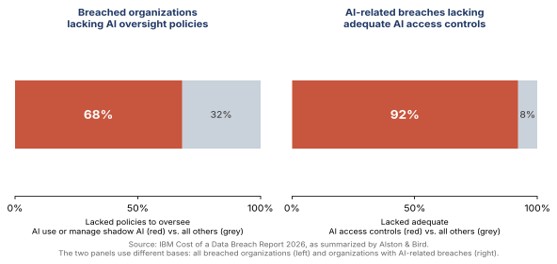
Breach data supports the point. IBM’s 2026 Cost of a Data Breach Report found that 68 percent of breached organizations lacked policies to oversee AI use or manage shadow AI, and that 92 percent of organizations with AI-related breaches lacked adequate AI access controls, according to an Alston & Bird summary. Coverage of the study also reported that fewer than one in five organizations coordinate their governance teams with their security teams.
How do the four practices work in an enterprise?
Each practice answers a different question, and each depends on the one before it. Organizations cannot govern AI they cannot see, and they cannot prevent threats they are not detecting.
- Discover: which AI applications, agents, coding tools, and integrations are in use, and who owns them.
- Detect: where sensitive data exposure, suspicious activity, or policy violations are occurring.
- Govern: what is acceptable, who is accountable, and what access each tool and user is allowed.
- Prevent: how controls such as redaction or blocking apply before a risky interaction or action completes.
Platforms organize these steps differently. Ovalix, for example, applies its Discover, Detect, Govern, and Prevent capabilities across public GenAI applications, homegrown AI, agents, and endpoints, so that visibility and risk detection connect to real-time policy enforcement. Whatever the tooling, the test is whether each policy can be traced to a control and each control to evidence.
What do autonomous agents change for governance?
Autonomous agents change governance by moving the question from what a model says to what it does. Once an agent can call tools and act across business systems, policy has to cover permissions and actions, not only content. This is why OWASP separates its LLM list from a distinct agentic list, and why frameworks increasingly stress human approval for high-impact actions.
Controls for this layer include scoped tool permissions, logging of agent decisions, and approval steps for consequential actions. A closer look at autonomous business systems and their controls covers the components and risks that these controls are meant to address.
How can teams measure whether the framework is working?
Teams can measure effectiveness by checking coverage, enforcement, and response. Coverage asks what share of AI usage is inventoried. Enforcement asks how many policy violations were blocked or redacted before data left. Response asks how quickly an AI-related incident can be investigated with the logs on hand.
Evidence matters because regulators and auditors ask for it. A framework that cannot produce records of who used which AI tool, with what data, under what policy, will struggle in an audit even if its policies read well. The security benefit is similar: IBM found that organizations extensively using AI and automation in security operations cut average breach costs by about $1.93 million and contained breaches roughly 65 days faster, which gives the framework a measurable payoff beyond compliance.
Frequently Asked Questions
What are the core practices of an AI security and governance framework?
They are discovery of AI usage, detection of risks and violations, governance of ownership and acceptable use, and prevention through enforced controls.
How is AI governance different from AI security enforcement?
Governance defines ownership, acceptable use, and access requirements, while enforcement applies controls to AI interactions and actions to keep activity within those requirements.
Is the NIST AI Risk Management Framework mandatory?
No. NIST AI RMF 1.0, released in January 2023, is voluntary guidance organized around the Govern, Map, Measure, and Manage functions.
Why do AI governance policies fail without technical controls?
Policies alone do not show whether controls work, and IBM’s 2026 report found that 92 percent of organizations with AI-related breaches lacked adequate AI access controls.

| Key Takeaways
• The OWASP Low-Code/No-Code Top 10 names ten risk categories, including account impersonation, authorization misuse, data leakage and asset management failures. • Gartner predicted in 2021 that 70% of new applications would use low-code or no-code technologies by 2025, up from less than 25% in 2020. • Vendor security guidance covers the platform itself, while app-level permissions, connectors and data handling remain the responsibility of the organization. • A practical review starts with an inventory of apps and owners before moving on to connector permissions, secrets and logging. |
What are the main security risks of low-code platforms?
The most widely referenced answer is the OWASP Low-Code/No-Code Top 10, which groups the risks into ten categories, from account impersonation and authorization misuse to asset management and logging failures. The list was written for organizations adopting platforms where applications are assembled through a graphical interface instead of hand-written code, and it focuses on the weaknesses those platforms make easy to create at scale. Security teams that want to see how these categories play out in one widely used environment can start with this review of security risks in Power Platform environments, which walks through the same themes in a Microsoft context.
OWASP itself describes the project as an education effort and says it is still asking organizations for vulnerability prevalence data, so the list works best as a checklist of areas to examine, not as a guarantee of which category will cause the next incident.
Why are low-code apps spreading faster than security teams can review them?
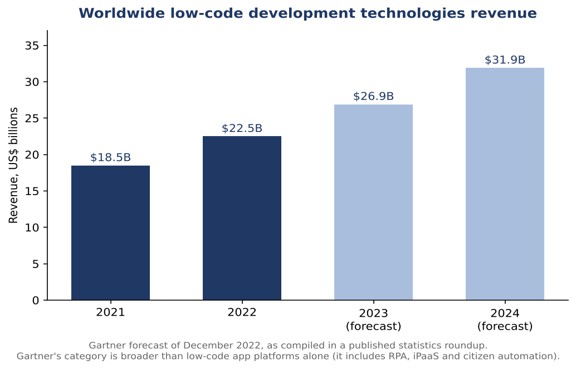
Low-code platforms let business users build and connect applications without waiting for a central development queue, so the number of apps grows faster than a manual review process can follow. Gartner predicted in 2021 that 70% of new applications developed by organizations would use low-code or no-code technologies by 2025, up from less than 25% in 2020. Its December 2022 forecast put worldwide revenue for low-code development technologies at $18.5 billion in 2021 and $22.5 billion in 2022, with $31.9 billion projected for 2024, according to a published roundup of the Gartner low-code figures.
Growth of this kind changes the security problem from reviewing a handful of projects to tracking a population. Governance questions such as who owns an app, which data it touches and when it should be retired become operational, and approval and ownership rules for business-built applications are usually the first controls organizations try to put in place.
How do the OWASP risk categories show up in everyday low-code projects?
Most of the categories trace back to three habits: embedding a shared account in an app, connecting apps to each other and to data sources with broad permissions, and building faster than anyone inventories. The table below translates six of the categories into plain language and pairs each with a question a reviewer can ask.
| OWASP category | What it means in practice | Question for a reviewer |
| LCNC-SEC-01 Account Impersonation | An account embedded in an app does not match the user running it, which can allow access beyond what that user should have. | Whose identity does each app act as? |
| LCNC-SEC-02 Authorization Misuse | Interconnected apps let people reach information or services they were never meant to reach. | Which connections can pass data between apps? |
| LCNC-SEC-03 Data Leakage and Unexpected Consequences | Data ends up in locations that were not intended and are often outside the organization’s control. | Where can this app send or store data? |
| LCNC-SEC-08 Data and Secret Handling Failures | Confidential data or credentials are stored on shared systems without adequate protection. | Are secrets kept out of the app itself? |
| LCNC-SEC-09 Asset Management Failures | Apps multiply quickly and are not tracked or managed. | Is there a current inventory with a named owner? |
| LCNC-SEC-10 Security Logging and Monitoring Failures | Logs and audit trails are too thin to trace what happened after a problem. | Could an investigator reconstruct an incident? |
Do platform vendors already cover these risks?
Platform vendors secure their own service, but they also publish guidance that places part of the work with the teams building on it. Microsoft’s Power Platform security FAQ describes how the platform addresses the OWASP Top 10 and the OWASP Low-Code/No-Code Top 10, and its separate security posture management guidance describes a tenant security score on a low, medium or high scale, along with recommendations an administrator can act on. Its Well-Architected material for workload owners adds that every component of a workload, whether low-code or code-first, has to be free of security defects. The practical reading is that vendor controls are a foundation, while app-level configuration, connectors and data handling remain the customer’s responsibility.
What does a practical low-code security review start with?
A practical review starts with an inventory, because every other control depends on knowing which apps, flows and automations exist and who owns them. After that come permissions on connectors, the paths data can take out of an app, handling of secrets, and whether logging is detailed enough to support an investigation. Kanopy Security, for example, describes its platform as connecting to enterprise environments and surfacing the agents, workflows, automations and applications running in them, including assets that security teams did not know existed. Whatever the tooling, the output a reviewer should expect is the same: a current list, a named owner for each item, and a short list of items that need remediation first.
Reviewers can also use the OWASP list as the backbone of the process. Scoring each category per platform, and revisiting it when a new connector or AI feature is switched on, keeps the review tied to a recognized standard instead of an internal opinion. The OWASP project page lists the ten categories and links to the detailed documents for each one.
Environment hygiene belongs on the same list. Microsoft’s guidance for Power Platform includes securing the default environment, which is the place many first-time builders start, and separating environments by purpose so that apps handling sensitive data do not share space with personal productivity experiments. Small structural choices like these reduce the number of apps that need individual review.
How should security and business teams share the work?
Security teams set the guardrails and business builders operate inside them, which only works if the guardrails are easy to follow. That usually means separating environments by data sensitivity, defining which connectors are approved, requiring an owner on every app, and reviewing apps that touch sensitive data before they are widely shared. Staff turnover is a frequently overlooked gap in this model: when an app’s creator leaves, nobody maintains it, and an unmaintained app with live connections is exactly the kind of asset the asset management and monitoring categories describe.
Measuring the program also helps. Counting apps with a named owner, apps reviewed in the last quarter, and connectors outside the approved list gives leadership a small set of numbers that move in the right direction when governance is working. Those same counts give auditors something concrete to examine when they ask how business-built apps are controlled.
Frequently Asked Questions
What are the OWASP Low-Code/No-Code Top 10 risks?
The ten risks are account impersonation, authorization misuse, data leakage and unexpected consequences, authentication and secure communication failures, security misconfiguration, injection handling failures, vulnerable and untrusted components, data and secret handling failures, asset management failures, and security logging and monitoring failures.
Is low-code development less secure than traditional coding?
Not by definition, but the risks differ. Low-code platforms add categories such as connector permissions, shared accounts and app sprawl, and many apps are built by business users outside central IT review.
Who is responsible for the security of a low-code app?
The platform vendor secures the underlying service, while the organization remains responsible for how its apps, connectors, permissions and data are configured and used.
How can a security team find low-code apps it does not know about?
Start from the platform’s administration data to build an inventory of apps, flows and connectors, then assign a named owner to each one and review anything that touches sensitive data.

| Key Takeaways
• Israeli cybersecurity companies raised $4.1 billion in private funding in 2025, with a median round of $20 million, double the business software median. • About 1,500 deep-tech companies operate in Israel and have raised $28.6 billion since 2019, roughly 35% of all capital raised by Israeli high-tech. • Israeli companies raised more than 20% of all deep-tech capital invested in the cyber sector worldwide, according to the Israel Innovation Authority. • Google’s $32 billion acquisition of Wiz and Palo Alto Networks’ $25 billion purchase of CyberArk led a record $74.3 billion in Israeli tech M&A in 2025. |
Why do Israeli VCs concentrate on cybersecurity?
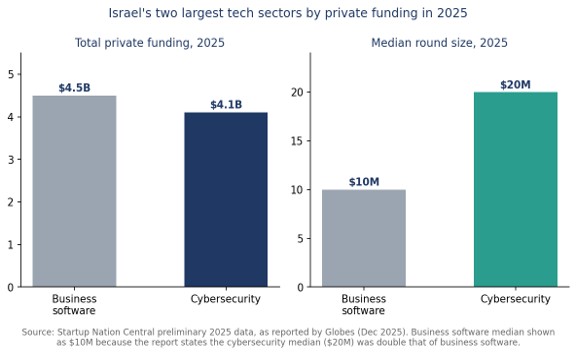
Israeli VCs concentrate on cybersecurity because it is the sector where Israel commands the largest share of global capital and produces the largest rounds. Israeli cybersecurity companies raised $4.1 billion in private funding in 2025, according to preliminary Startup Nation Central data, and their median round reached $20 million, double the median in business software.
The concentration is not only a local story. The Israel Innovation Authority reports that Israeli companies raised more than 20% of all deep-tech capital invested in the cyber sector worldwide. For an investor, that combination of a dense founder pool, repeat entrepreneurs and an established buyer base among global security vendors creates a deal flow that is difficult to replicate in most other markets.
This is why a typical Israeli VC with a security thesis now positions cyber alongside AI, deep tech and defense tech rather than as a standalone category. Security problems increasingly sit inside AI systems, cloud infrastructure and physical networks, so the investment thesis has widened with them.
How does deep tech change the Israeli VC model?
Deep tech changes the Israeli VC model by requiring more capital, longer holding periods and deeper technical diligence than software investing. The Israel Innovation Authority defines deep tech by high technological risk and a long time to market, conditions it notes can make it harder for these companies to raise money.
The sector has nonetheless become one of the country’s strongest. Joint research by the Israel Innovation Authority and Dealroom counts about 1,500 active deep-tech companies in Israel that have raised $28.6 billion since 2019, roughly 35% of all capital raised by Israeli high-tech over that period. The cumulative valuation of private Israeli deep-tech companies has passed $177 billion, about 15 times higher than a decade earlier, and the report places Israel as the leading deep-tech fundraising hub in the Western world outside the United States. The full findings are summarized in the Israel Innovation Authority’s 2025 status report.
For investors, the practical consequence is that a deep-tech round is rarely judged on revenue alone. Diligence turns to physics, materials, manufacturing readiness and certification paths, and the investor needs reserves to support the company through a longer development cycle before commercial scale.
What is driving investor interest in defense and dual-use technology?
Rising defense budgets are the main driver of investor interest in defense and dual-use technology, because they create large, durable demand for capabilities that often transfer later into civilian markets. Global military spending reached about $2.7 trillion in 2025, and roughly $19 billion flowed into aerospace and defense startups that year, nearly double the $10 billion raised in 2024, according to figures compiled in an analysis of defense spending as a deep tech catalyst.
That same analysis argues that technologies such as AI, quantum sensing and advanced robotics are often tested and hardened in defense environments before moving into commercial use. It also notes that hardware-heavy companies need larger upfront capital and closer coordination with industrial and government partners than software startups, which is pushing venture investors to work more closely with private equity as companies move toward production.
The same piece flags post-quantum security as an emerging area, pointing to the risk that data encrypted today can be harvested now and decrypted later once quantum computing matures, and to a quantum security market projected to grow at nearly 45% a year through 2029. For an Israeli VC with roots in both cyber and defense, post-quantum work sits directly at the intersection of its two strongest fields.
Dual-use positioning matters to an Israeli VC because it widens the exit map. A company whose technology serves both defense buyers and commercial customers can be acquired by a defense prime, a civilian technology company or an industrial group, rather than depending on a single type of acquirer.
How do CISO networks give Israeli cyber investors an edge?
CISO networks give Israeli cyber investors an edge by putting the eventual buyers of a security product into the room before the product is finished. A chief information security officer can tell a founder within one meeting whether a problem is urgent, whether it already has a budget line, and which existing tools the new product would need to replace.
Some Israeli investors have formalized this into a structure. One example is a CISO-led investment alliance that operates as a cybersecurity micro fund and brings together security leaders from large global organizations to validate, guide and support early-stage companies. Investors with this kind of network typically build a cybersecurity portfolio spanning cloud, identity and threat detection, along with data, endpoint and network security, because practitioner feedback points them toward the categories where enterprise demand is forming.
What do recent exits reveal about Israeli VC returns in cyber?
Recent exits show that Israeli cybersecurity companies can command some of the largest acquisition prices in global technology. Google’s $32 billion acquisition of Wiz and Palo Alto Networks’ $25 billion purchase of CyberArk led a record $74.3 billion in M&A involving Israeli tech companies in 2025, across 150 transactions.
Exits of that size reset expectations for the entire funding chain. Limited partners see proof that capital can come back at scale, later-stage investors become more willing to pay up for category leaders, and early-stage investors can justify larger seed and Series A checks. Earlier coverage of early-stage defense innovation in cybersecurity venture capital looks at how this dynamic plays out for younger security companies.
What should founders look for in an Israeli VC in these sectors?
Founders in cyber, deep tech and defense tech should look for an Israeli VC with domain-specific partners, reserves for a longer development cycle and access to real customers or test environments. Generalist capital can fund a round, but it rarely shortens the time it takes to reach a credible first deployment.
Useful questions include whether the partners have operated inside security teams or defense R&D organizations, how much the fund typically reserves for follow-on rounds, and whether its strategic partners can provide pilots with real data in live environments. For dual-use companies, it also helps to ask how the investor approaches export controls and government procurement cycles, since both affect timelines and valuation.
Frequently Asked Questions
Why is Israel so strong in cybersecurity startups?
Israel has a dense pool of experienced security founders and a strong buyer base among global vendors, and Israeli companies raised more than 20% of all deep-tech capital invested in the cyber sector worldwide, according to the Israel Innovation Authority.
How much do Israeli cybersecurity startups raise per round?
The median private funding round for Israeli cybersecurity companies was $20 million in 2025, double the median for business software companies, according to preliminary Startup Nation Central data.
What counts as deep tech in Israel?
The Israel Innovation Authority describes deep-tech companies as those developing complex technology with high technological risk and a long time to market; about 1,500 such companies operate in Israel.
Do Israeli VCs invest in defense technology?
A growing number of Israeli VCs invest in defense and dual-use technology, focusing on companies whose products can serve both defense and civilian markets as global defense budgets rise.

B2B Digital Marketing Services: How Technology Companies Should Choose

Medical Device Cases: What Healthcare Equipment Needs From a Carrying Case

RF Delay Lines Compared: Coax, Waveguide, and Fiber Optic Options

-

 Business Solutions2 years ago
Live Video Broadcasting with Bonded Transmission Technology
-

 Business Solutions2 years ago
2-Way Texting Solutions from Company Message Services
-

 Business Solutions2 years ago
The Future of Healthcare SMS and RCS Messaging
-

 Business Solutions2 years ago
Communication with Analog to Fiber Converters & RF Link Budgets
-

 DSRC Communication2 years ago
The Crossroads of Connectivity: DSRC vs. C-V2X Technologies in Automotive Communication
-

 Business Solutions2 years ago
Wholesale SMS Platforms with OTP Services
-

 Business Solutions2 years ago
Choosing the Right B2B Digital Marketing Agency: A Guide
-

 3D Technology2 years ago
How Multispectral Cameras Advance Book Scanning