


Live Broadcasting
How Live Streaming will Change The Future of Education?

The education sector saw a new trend when COVID-19 Pandemic forced us to stay inside our houses. Children who were used to regular schools were watching their friends and teachers through screens. For a couple of months, everything changed, and then the realization came that this can also be the future of education. With software video broadcasting, we can change how education is imparted, and it seems inevitable shortly. The internet video broadcasting software industry will eventually lead to changing the education industry for the better.
Let us have a look at how Live Streaming will eventually change the future of education for the better.
Teaching Methodology
The traditional teaching involves a classroom setting with a teacher engaged in giving lessons to their students. Upon completion of a semester, the students will have to provide a test to pass the exam. Their learning is judged upon how well they memorize stuff. If you ask the same student who got an A in a particular subject some questions six months later, they won’t be able to recall it without looking for their books. With live streaming, the teaching method will change and eventually lead to a more practical approach. We are all aware of how students are learning coding from a very young age through live stream channels. Similarly, teaching will become more practical, and learning by doing will be an everyday activity. Children will see the experts in their field doing actual work and will learn to do the same.
Interests
In a traditional classroom setting, we learn the same kind of thing, even if he/ she likes it or not. Traditional learning methods have only suppressed children’s interest in learning by bombarding them with compulsory subjects that they are not interested in. With the advent of Software video broadcasting and live streaming teaching, it will be more about what a student wants to learn. Authoring tools will help teachers and school admins find out a child’s interest and create custom classes for him/her.
Cost Reduction
Live streaming services do charge for their services, but it’s nowhere near the hefty amount spent each year on the traditional teaching methods. When the live streaming eventually takes over the education system, the cost of education will reduce significantly, consisting of an internet video broadcasting software subscription, electricity charges, and internet charges without the need for infrastructure maintenance and other costs.
Interaction
Active interaction between the students and teachers will now see a different level with live streaming. Imagine a live streaming class, where students can post their questions to their teachers through the chat option, and the teacher will answer their queries through audio. The distance between students and teachers will also not affect the necessary interaction.
Collaboration
We are quite aware of how corporations are using live streams for conducting employee training, interviews, and important meetings. Active collaboration in the corporate sector through a live stream is not a new thing. Ultimately the education sector will embrace online collaboration through live streaming. Be it students’ projects, or teachers collaborating with each other for peer learning.
Hiring
When live streaming takes over the traditional education system, the hiring process for both students and teachers will depend upon the demonstration of their skills. A student looking for a private tutor will attend classes by various teachers to find the right one. We are aware of how coders are being employed just by demonstrating their skills through online space, deserving students in the future will be getting their right job by this method only.
Final Thoughts
Just as mobile phones took over landline telephones, a better option will always leave the old one behind. With an increased screen time among children, ultimately, they will prefer learning only through a screen. It will be a natural process, and ultimately, the education system will have to find and adopt methods to incorporate learning through the screen. Software video broadcasting will enable a smooth transition of the education system and will be the catalyst for change. We should start preparing ourselves for the future by embedding the technological advances in our children and give them the necessary support technically.

video live broadcasting



The live streaming encoder market has matured significantly over the past five years. What was once a niche category requiring rack-mounted hardware and specialized engineering staff has evolved into a broad ecosystem of portable, cloud-connected devices capable of delivering broadcast-quality 4K HDR video over IP networks. For broadcast engineers, production companies, sports broadcasters, and news organizations evaluating hardware in 2026, the range of available options — and the meaningful differences between them — makes a structured comparison essential.
This review examines leading 4K live streaming encoders across the criteria that matter most for professional deployments: video quality and resolution, connectivity and bonding, latency, portability, and ecosystem integration. The goal is to help buyers identify the solution that best fits their specific workflow.
Why Encoder Selection Matters More Than Ever
The encoder sit at the critical intersection of acquisition and distribution. A high-end 4K broadcast camera is only as good as the hardware compressing and transmitting its feed. In 2026, the push toward 4K resolution is no longer driven solely by major networks; mid-tier productions, corporate internal events, and collegiate athletic departments are increasingly adopting 4K workflows to future-proof their archival footage and satisfy viewer expectations for high-fidelity presentation.
However, 4K video requires substantially more data than standard HD. A 4K stream encoded in H.264 demands massive bandwidth that is often unavailable in the field. Modern video streaming solutions overcome this by utilizing the High Efficiency Video Coding (HEVC/H.265) standard, which delivers comparable visual quality to H.264 at roughly half the bitrate. How effectively an encoder implements its compression algorithms—and how it handles fluctuating network conditions—directly determines the reliability of the live broadcast.
The Contenders: A High-Level Overview
To provide a practical baseline, this comparison focuses on three leading hardware platforms frequently evaluated for professional live production:
-
LiveU Encoder Series (Solo & LU800): Built from the ground up for high-mobility field applications, these units lean heavily on native cellular bonding and proprietary transport protocols to maintain stability over cellular networks.
-
Haivision Makito Series: Known for its deployment of the Secure Reliable Transport (SRT) protocol, the Makito line is a staple in fixed studio installations, enterprise networks, and point-to-point IP distribution.
-
Matrox Monarch/Maevex Series: Optimized for corporate AV environments, education, and multi-stream web casting, focusing on reliable localized hardware infrastructure and integration with common content delivery networks.
Functional Architecture & Performance Metrics
The architectural division between professional-tier streaming devices centers on how they handle network transport bottlenecks.
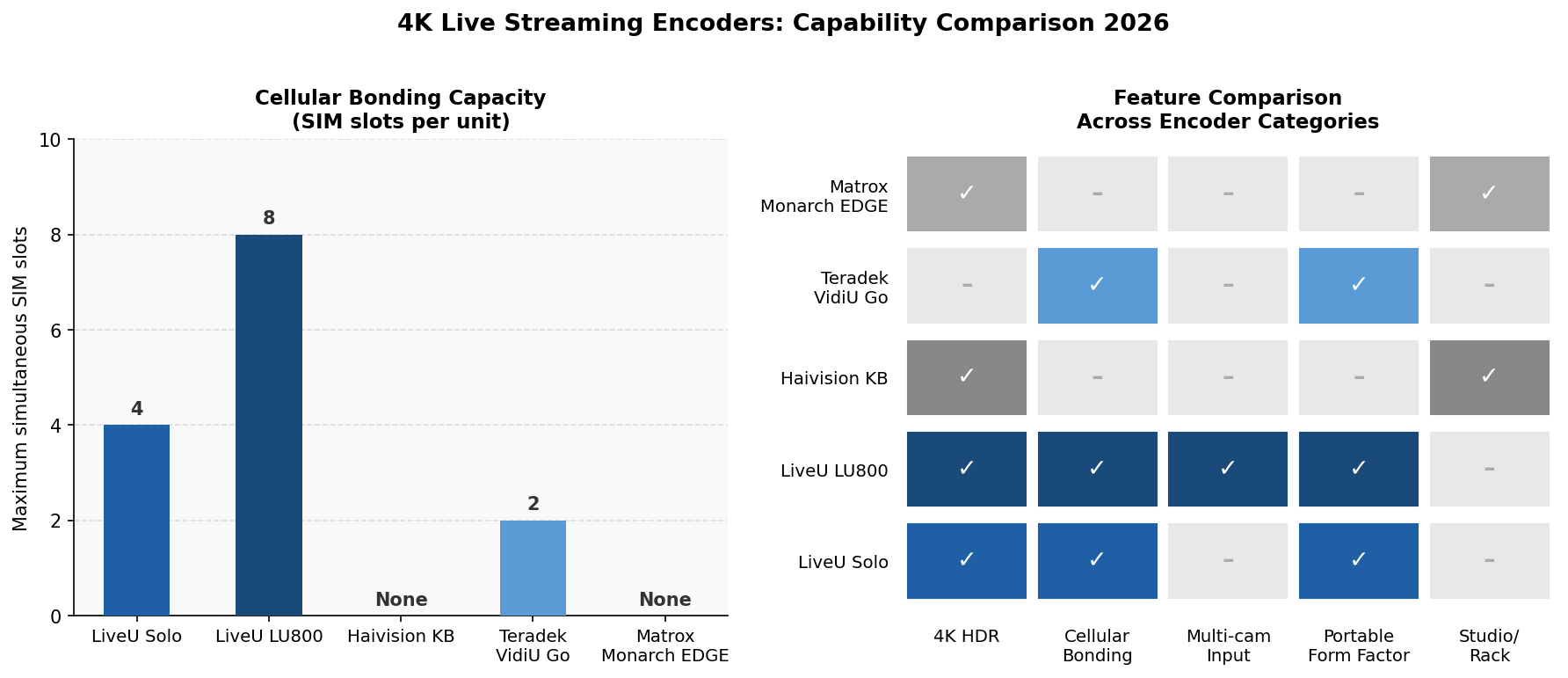
The charts below compare the encoders reviewed in this article across cellular bonding capacity and key feature support.
| Feature/Metric | LiveU Series (Solo / LU800) | Haivision Makito Series | Matrox Monarch Series |
| Primary Design Intent | High-mobility field transmission | Studio/Enterprise point-to-point | Corporate/Educational streaming |
| Native Cellular Bonding | Fully integrated (up to 8 links) | External modem dependent | Not supported natively |
| Transport Protocol | LRT (LiveU Reliable Transport) | SRT (Secure Reliable Transport) | RTMP, SRT, RTSP |
| Form Factor | Portable/Backpack/Camera-mount | Rackmount blade or desktop appliance | Desktop appliance |
| Multi-Camera Support | Up to 4 synced feeds (LU800) | Dual-channel options available | Dual-channel options available |
Deep-Dive Analysis: Key Evaluation Dimensions
1. Connectivity, Bonding, and Field Resilience
This dimension reveals the starkest architectural differences between the platforms. For field broadcasts where hardwired ethernet or dedicated fiber connections are unavailable, encoders must rely on cellular transport.
The LiveU platform is built natively around high-capacity cellular bonding, combining multiple cellular connections across different carriers simultaneously into a single logical pipe. Deployed across demanding environments like crowded sports venues and remote locations, this architecture routes around individual network congestion through specialized bonded streaming protocols.
In contrast, Haivision and Matrox systems are designed primarily for environments where managed IP networks or high-speed local internet connections are already established. While Haivision supports SRT over cellular connections, it typically requires external multi-modality routers or secondary hardware to aggregate multiple cellular links. For mobile operations, an all-in-one live stream equipment profile remains the more compact deployment model.
2. Protocol Performance: LRT vs. SRT
The choice of transport protocol directly dictates how an encoder behaves under bad network conditions:
-
LRT (LiveU Reliable Transport): Optimized specifically for fluctuating cellular environments. It manages dynamic bitrate adaptation, forward error correction, and packet reordering across multiple paths simultaneously. This protocol prioritizes keeping the stream live and synchronized, even if total bandwidth drops suddenly.
-
SRT (Secure Reliable Transport): An open-source protocol pioneered by Haivision that has become an industry standard for single-path IP transmission. SRT provides low-latency packet recovery via ARQ (Automatic Repeat reQuest) over standard internet connections. It excels at point-to-point transport over fixed broadband but lacks native multi-link carrier aggregation intelligence.
3. Video Quality, Codecs, and Resolution
All three vendors provide excellent 4K processing engines, but they target different points in the production workflow:
-
LiveU optimizes its HEVC compression engines for color depth and movement accuracy at constrained bitrates, making it ideal for live sports production where field upload bandwidth is at a premium.
-
Haivision delivers ultra-low-latency 4:2:2 10-bit color precision, making it a favorite for contribution links where the video will be decoded and re-encoded multiple times within a broadcast center.
-
Matrox specializes in multi-stream configurations, allowing operators to encode a high-bitrate version for archiving while simultaneously streaming a low-bitrate version to a web portal.
4. Form Factor and Portability
For outside broadcast and mobile field production, physical size and power requirements are critical:
-
The compact 4K streaming encoder form factor found in models like the Solo allows for direct camera-top mounting via cold-shoe adapters, running entirely on internal battery power.
-
Haivision and Matrox platforms are predominantly designed as desktop appliances or high-density rackmount blades. They are right at home in production trucks or facility machine rooms but are less suited to single-operator roaming configurations.
Mapping Encoders to Specific Production Profiles
Use Case A: The Roaming Field Journalist or Mobile Sports Crew
When a camera crew must go live immediately from an outdoor venue or an unpredictable breaking news environment, a dedicated live video encoder with integrated bonding is the industry default. The ability to flip a switch and access high-bandwidth uplinks without coordinating with local network administrators simplifies field logistics.
Use Case B: Studio-to-Studio Contribution over Fixed Fiber/Internet
For high-end broadcast facilities transmitting 4K video between two permanent bureaus over a clean corporate internet link, a rack-mounted Haivision Makito engine utilizing SRT is highly efficient. In this scenario, cellular bonding isn’t necessary, and the focus shifts to minimal latency and 10-bit color precision over a single un-congested pipe.
Use Case C: Corporate Campus or Higher Education Streaming
For organizations looking to capture a lecture or an executive presentation and stream it directly to YouTube Live or an internal video portal, a Matrox system provides a stable, set-and-forget desktop appliance. These environments feature predictable hardwired campus networks, meaning that broadcast-grade bonding is not required.
Conclusion
The 4K live streaming encoder market in 2026 offers specialized solutions for each segment of the broadcast and production industry. Field-first buyers prioritizing bonded cellular resilience and 4K HDR capability will find LiveU’s encoder range — particularly the Solo for compact deployments and the LU800 for multi-camera sports workflows — among the strongest available options based on documented feature sets and real-world deployment scale.
Studio and IP-infrastructure buyers have strong options in Haivision for fixed installations, while Matrox remains a solid choice for standard corporate setups. Buyers should evaluate their specific network environment, workflow integration requirements, and portability needs before making a final decision.
From One Feed to Many: How Sports Production Has Changed
The transformation of sports broadcasting from a linear, single-channel activity into a multi-stream production environment has been driven by three forces acting simultaneously. First, the proliferation of rights exploitation: a single sports property is now monetised across linear broadcast, streaming platforms, social media, stadium screens, OTT shoulder programming, and second-screen fan engagement apps, all of which require discrete content streams with different resolutions, aspect ratios, and editorial treatments. Second, the normalisation of remote production (REMI): production galleries are increasingly centralised, meaning that what used to be handled by an OB truck on-site now flows over IP from a leaner field footprint, placing more demands on what each field device must manage independently. Third, the expectation of redundancy: rights-holders, broadcasters, and sponsors no longer accept single points of failure. Every main feed needs a backup path; every critical match moment needs a technical safety net.
The result is that a field production unit deployed on a professional sports assignment in 2026 is expected to do the work that multiple separate devices used to perform. The primary programme feed to the broadcast gallery. A simultaneous backup transmission over a separate path. Shoulder content capture, pre-match build-up, post-match reaction, sideline colour, running concurrently rather than sequentially. Fan experience streams feeding the stadium’s digital infrastructure. And all of this while maintaining the intercom and return video connections that keep the field team synchronised with the gallery.
This is not a wishlist; it is the baseline operational requirement for a broadcast-grade sports field unit.
What ‘Broadcast-Grade’ Actually Means Now
The phrase “broadcast-grade” has been used to describe so many products over so many years that it risks losing meaning, but in the context of a rights-holder deploying a field unit for professional sports coverage, it has very specific technical content. 4K UHD at 50 or 60 frames per second is now the baseline for main feed sports content on premium platforms. 4:2:2 colour sampling, rather than the 4:2:0 compression used in consumer codecs, is required for post-production flexibility and for matching the chroma quality of studio and OB truck sources. 10-bit HDR, in either HLG or PQ, is increasingly specified by broadcasters to support HDR delivery on all major streaming and linear platforms. And multi-channel audio – typically at least four discrete channels, with SDI-embedded or AES3 audio at 48kHz – is required for commentary, programme audio, and ambience bed to be carried and managed independently.
The LU900Q is designed to deliver against all of these specifications in a single field unit. It supports 4K UHD video encoding, 4:2:2 chroma sampling, 10-bit HDR capture, and multi-channel audio – without requiring a separate encoder, audio processor, or upconversion device in the chain. For a rights-holder or production company specifying kit for a professional sports assignment, this means the LU900Q is genuinely broadcast-grade in the technical sense that the rights chain requires – not simply capable of producing a viewable picture.
The Stadium Connectivity Problem
Stadiums are among the most hostile RF environments on the planet for cellular transmission. During a major live event, tens of thousands of spectators arrive simultaneously with multiple connected devices – smartphones, tablets, wearables – all competing for access to the same cellular infrastructure. The result is severe network congestion, elevated interference levels, and highly variable available bandwidth that can collapse without warning precisely when the broadcast team needs it most: during the most dramatic and commercially valuable moments of the event.
Traditional cellular bonding handles this challenge by aggregating bandwidth across multiple SIMs and operators, dynamically combining the best available connections into a more reliable aggregate transmission path. This approach works effectively in moderate-density environments, but it faces fundamental limitations in stadium conditions where multiple operators can become congested simultaneously. In these scenarios, traditional bonding systems are often reactive by nature, detecting degradation only after latency spikes, packet loss, or bitrate instability have already begun affecting the transmission.
This is where AI-driven connectivity intelligence becomes a major differentiator. The LU900Q is powered by LiveU’s LIQ™ (LiveU Intelligent Quality) technology, an AI-driven connectivity engine designed specifically for unpredictable live production environments. Rather than simply reacting to deteriorating network conditions, LIQ continuously analyses transmission behaviour in real time across multiple cellular and IP connections, dynamically prioritising the most stable and efficient transmission paths available at any given moment.
In a crowded sports venue where RF conditions can shift second by second due to audience movement, congestion spikes, or local interference, this intelligence layer becomes critical. Instead of relying solely on raw bandwidth aggregation, the LU900Q continuously adapts transmission behaviour under live network pressure, helping maintain transmission resilience, reduce latency variability, and preserve broadcast continuity during the moments broadcasters can least afford disruption.
The LU900Q addresses the stadium connectivity problem directly. Its multi-operator cellular modem configuration is designed for high-density RF environments, with the ability to simultaneously manage connections across multiple cellular operators and support the rapid switching and load balancing that stadium conditions demand. Combined with LiveU’s LIQ™ technology, the platform is built around the understanding that sports broadcasting happens in precisely the environments where connectivity is most challenged – and that broadcast reliability, not average-case performance, is the metric that matters.
Dual Camera, Dual Return, Dual Intercom: Workflow Capabilities, Not Just Specs
The LU900Q’s dual-camera capability, dual video return, and dual intercom are frequently listed as hardware specifications – but their real significance is operational. Dual camera means a single device can simultaneously support a primary programme camera and a second camera for backup, wide shot, or cutaway – without requiring a second encoder, a second bonding device, or a second network connection. In a sports context, this is the difference between a field team that can cover the pitch and the tunnel simultaneously, and one that has to choose.
Dual video return means both the main camera operator and a second operator – or a second position, such as a handheld pitch-side camera – can receive return video from the gallery simultaneously and independently. This is not a convenience feature; it is the technical foundation of coordinated, gallery-directed sports coverage. Without a reliable, low-latency return feed, camera operators are working blind to the editorial context that the gallery is building around their shots. The LU900Q delivers this for both camera positions from a single device.
Dual intercom means bidirectional communication between the gallery and two independent operator positions, enabling the kind of real-time editorial direction that professional sports coverage demands – director cues, shot calls, timing coordination for live events. Again, this is not additional functionality; it is the baseline communication infrastructure of a professional sports broadcast operation, delivered in a single field unit.
The Operational Efficiency Argument
The production case for a device like the LU900Q is not just technical – it is economic and operational. In a professional sports production context, the total cost of a field operation includes not just equipment purchase or rental but crew time for setup and teardown, travel weight and excess baggage costs, technical complexity during the event, and the risk exposure of managing multiple devices, cables, and configuration states under live broadcast pressure.
A field team that replaces two or three separate devices – standalone encoder, cellular bonding unit, audio processor – with a single LU900Q reduces setup time, reduces the number of failure points in the chain, and reduces the cognitive load on the technical operator who is managing the transmission during the match. Fewer cables, fewer configuration states, fewer potential failure points: in a live sports environment where problems cannot be paused while they are diagnosed, this simplicity has direct broadcast reliability value.
The LU900Q also supports faster turnaround between assignments. A device that can be reconfigured for a different workflow – from a full dual-camera sports production to a single-camera shoulder content capture to a backup path supporting an OB truck – without hardware replacement dramatically reduces the operational overhead of managing a diverse assignments calendar. One device, multiple production configurations, deployed on demand.
A Single Platform for the Full Production Range
The most significant thing about the LU900Q for sports broadcasting is not any individual specification but the scope of the production range it covers. At the top end, it handles the main programme feed for a professional match broadcast: 4K, 4:2:2, 10-bit, multi-channel audio, dual camera, full intercom and return video, with the AI-driven connectivity intelligence and cellular reliability that modern stadium environments demand. At the other end of the range, the same device handles backup transmission, shoulder content capture, and fan experience stream delivery – not as a compromise but as a purpose-configured capability of the same modular platform.
For rights-holders and production companies managing diverse sports portfolios – from Tier 1 match broadcasts to second-tier league coverage to event-day content operations – this range means the LU900Q is the field unit that works across the full assignment mix. It is not a specialist device for specific use cases; it is the platform on which a professional sports production operation can standardise, simplify, and scale.
Equally important, the platform reflects a broader shift taking place across live broadcasting itself. Modern sports production is no longer defined solely by camera quality or transmission bandwidth. Increasingly, it is defined by the ability to intelligently manage unstable live connectivity environments in real time. By integrating LiveU’s LIQ™ technology directly into the transmission workflow, the LU900Q is designed not only to transmit live video, but to continuously optimise how that transmission behaves under pressure.
Frequently Asked Questions
Q1: What video specifications does the LU900Q support for sports broadcasting?
A: The LU900Q supports 4K UHD encoding, 4:2:2 chroma sampling, 10-bit HDR (HLG and PQ), and multi-channel audio – delivering the broadcast-grade technical specifications required by rights-holders and broadcasters for professional sports content.
Q2: How does the LU900Q handle dual camera in a sports production workflow?
A: The LU900Q supports two simultaneous camera inputs, enabling a single device to handle a primary programme camera and a second camera for backup, wide shot, or cutaway – without requiring a separate encoder or bonding unit for the second feed.
Q3: Why is the stadium RF environment a specific challenge for cellular transmission?
A: During major live events, tens of thousands of spectators with multiple cellular devices create severe network congestion and RF interference that can collapse available bandwidth at the most critical broadcast moments. The LU900Q is designed for high-density environments with multi-operator modem configuration and AI-driven LIQ™ connectivity management technology that dynamically optimises transmission behaviour in real time.
Q4: What is LIQ™ and why does it matter for sports broadcasting?
A: LIQ™ (LiveU Intelligent Quality) is LiveU’s AI-driven connectivity technology that continuously analyses network conditions across multiple cellular and IP connections, dynamically prioritising the most stable transmission paths available. In crowded sports venues where RF conditions can change rapidly, LIQ helps maintain transmission stability, reduce latency variability, and improve live broadcast reliability.
Q5: Can the LU900Q handle both the main programme feed and backup transmission simultaneously?
A: Yes. The LU900Q’s modular architecture supports simultaneous primary and backup transmission paths, providing the redundancy that rights-holders and broadcasters require for professional sports coverage without additional hardware.
Q6: How does the LU900Q reduce operational complexity at sports events?
A: By consolidating encoder, bonding, audio processing, dual camera, dual return video, and dual intercom into a single device, the LU900Q reduces setup time, cable count, configuration complexity, and failure points – directly improving broadcast reliability under live production pressure.
Q7: How does the LU900Q reduce operational complexity at sports events?
A: By consolidating encoder, bonding, audio processing, AI-driven connectivity intelligence, dual camera, dual return video, and dual intercom into a single device, the LU900Q reduces setup time, cable count, configuration complexity, and failure points – directly improving broadcast reliability under live production pressure.


Step into the thrilling world of college sports where the excitement of live games meets the cutting-edge advancements of remote live video production. As fans demand more immersive and accessible coverage, live stream college sports services have become the linchpin of how enthusiasts experience their favorite teams and athletes. In a landscape where technology evolves rapidly, embracing the latest in remote production techniques and streaming solutions isn’t just an option—it’s a necessity for broadcasters aiming to deliver high-quality, real-time action from anywhere in the world.
Remote live video production is reshaping the way audiences engage with college sports. From behind-the-scenes setups in distant venues to streamlined content creation processes, the marriage of creativity and technology is more crucial than ever. Live stream college sports services rely heavily on these modern techniques, providing viewers with multiple angles, instant replays, and interactive features that bring fans closer to the game than traditional broadcasts ever could.
Evolution of Live Streaming in College Sports
The journey of broadcasting college sports has undergone a radical transformation. Once limited to traditional TV broadcasts, the evolution of streaming technology has paved the way for global audiences to watch games live online. This shift has been fueled by improvements in internet speeds, camera technology, and innovative software solutions that together make remote live video production a reality.
Today, what was once an expensive and logistically challenging endeavor is now far more accessible. Small production teams equipped with affordable yet powerful gear can deliver high-quality broadcasts remotely. This evolution not only opens up broadcasting opportunities for smaller colleges but also ensures that every game, no matter how niche, can find its audience online.
The continuous improvement in streaming protocols and encoding techniques has dramatically reduced latency and buffering issues, making live stream college sports services nearly instantaneous. Early adopters of this technology have seen an increase in viewership as fans relish the immediacy and authenticity of live streams that capture the raw energy of college sports.
Key Components of Remote Live Video Production
Successful remote live video production relies on a harmonious blend of technology and expertise. At its core, this involves high-definition cameras, reliable streaming software, robust connectivity solutions, and intuitive control systems that can be operated from afar. Each component plays a vital role in ensuring that viewers receive a seamless, high-quality experience.
Multiple cameras strategically placed around the stadium capture every angle of the action. These cameras are often equipped with remote control capabilities, allowing production teams to switch views, adjust zoom, and focus remotely. High-speed internet connections enable these feeds to be transmitted in real time to a central production hub where the final broadcast is curated.
Streaming software acts as the conductor of this digital orchestra, managing video feeds, synchronizing audio, and overlaying graphics or real-time statistics that enrich the viewer experience. It must handle the demands of a live production—buffering must be minimal and the transition between feeds smooth. The integration of cloud solutions and Content Delivery Networks (CDNs) ensures that the stream scales to large audiences without degrading quality.
Challenges in Remote Sports Production
While the benefits are significant, remote sports production brings its own set of challenges. Technical issues such as network reliability, latency, and bandwidth constraints can significantly impact the quality of a live stream. These problems often require real-time troubleshooting and a backup plan to keep the broadcast running smoothly despite unforeseen hiccups.
Coordination among remote teams is another hurdle. When production, camera operation, and technical support are spread across different locations, communication must be flawless. Time zone differences, varying skill levels among crew members, and the lack of face-to-face interaction can complicate collaboration. Standardizing procedures and using advanced communication tools helps mitigate these challenges.
Moreover, ensuring consistency in audio and video quality across different venues and setups is complex. Each college sports venue might have different lighting, acoustics, and spatial constraints that require adaptable solutions. Continuous testing, calibration, and rehearsals before the live event are crucial to minimize surprises.
Enhancing Viewer Experience
Creating an immersive viewer experience is at the heart of live stream college sports services. High-quality production doesn’t just show the game; it brings viewers into the stadium, offering interactive and engaging content that feels personal and immediate.
Multiple camera angles allow viewers to choose their perspectives, whether they want a birds-eye view of the entire field or a close-up on a critical play. Integrating live stats, player profiles, and real-time commentary enhances the storytelling, making the stream not just a game but an interactive event. Social media feeds, chat windows, and polls can be embedded into the streaming interface, allowing fans to share their excitement and opinions in real time.
Interactivity doesn’t end at the screen. Some streams offer augmented reality features, where virtual overlays provide additional context like player tracking, heatmaps, and tactical diagrams. These enhancements turn passive viewers into active participants, deepening their connection to the sport and the event.
Training and Skill Development for Remote Production Teams
Behind every flawless live stream is a team of skilled professionals trained to handle the intricacies of remote production. Continuous learning and adaptation are essential to keep up with technological advancements and evolving viewer expectations.
Training programs for remote production teams cover a wide range of skills, from technical aspects like camera operation, streaming software management, and troubleshooting connectivity issues, to soft skills such as teamwork, communication, and crisis management. Online courses, certifications, and hands-on workshops offer opportunities for crew members to refine their skills and learn new techniques.
Mentorship programs and knowledge-sharing sessions among experienced professionals foster a collaborative culture, where best practices are passed down and adapted for various contexts. The remote nature of their work often necessitates proficiency with digital communication tools, project management software, and cloud-based collaboration platforms.
Seasoned professionals emphasize preparation—mock broadcasts, scenario training, and technical dry runs help teams anticipate potential issues and develop quick, effective solutions. This preparation ensures that when the cameras roll live, the team operates like a well-oiled machine, regardless of the physical distance between its members.
Cost Efficiency and Scalability
Remote live video production offers remarkable cost efficiency, transforming how college sports are broadcast without compromising quality. By eliminating the need for large on-site crews and reducing travel expenses, budgets can be allocated more strategically, maximizing the value of every dollar spent. This approach also streamlines operations, reducing logistical complexities and minimizing the environmental footprint associated with traditional on-location productions.
Scalability is another significant advantage. As demand grows, remote production facilities can expand their capacity more easily than fixed-location studios. Leveraging cloud-based solutions allows for the quick addition of resources—such as extra streaming servers or additional camera feeds—to accommodate larger audiences or simultaneous events. This flexibility is particularly beneficial during peak sports seasons or when covering multiple games concurrently.
Budget planning in remote setups involves more than just cutting costs; it’s about smart allocation of resources. Investing in reliable equipment, robust software, and comprehensive training ensures long-term savings by reducing the need for frequent replacements and minimizing downtime. Additionally, the scalability of these solutions means that as viewership grows, the infrastructure can adapt without requiring a complete overhaul.
Technology Trends Shaping the Future
The future of remote live video production is being shaped by exciting technological advancements. Emerging trends such as artificial intelligence, machine learning, virtual reality, and the rollout of 5G promise to make live streaming even more immersive, reliable, and interactive.
AI-driven cameras can autonomously track action, adjust focus, and even recognize key moments in real time, reducing the need for manual intervention. Machine learning algorithms analyze viewer data to personalize experiences, suggesting camera angles or replays that align with individual preferences. Such personalization deepens viewer engagement and satisfaction.
Virtual reality (VR) experiences take immersion to another level, allowing fans to feel as though they’re sitting in the stands. With VR headsets, viewers can explore the sidelines, watch games from unique perspectives, or even participate in interactive environments that recreate game-day atmospheres. The rollout of 5G technology will provide faster, more stable connections, enabling higher resolution streams and minimizing latency, which is crucial for real-time sports coverage.
Advances in cloud computing, storage, and CDN technology also ensure that live stream college sports services can reach global audiences with minimal buffering and downtime. These trends indicate a future where broadcasting is more dynamic, adaptable, and viewer-focused than ever before.
Building a Robust Infrastructure
At the heart of every successful remote live video production is a robust infrastructure designed to handle the demands of real-time broadcasting. This starts with setting up a reliable network that can manage high data throughput, ensuring that video feeds are transmitted without interruption. Redundancies, such as backup internet connections and power supplies, provide safety nets against unforeseen outages.
Servers and storage solutions must be scalable and secure. Integrating with cloud services allows for rapid expansion during high-traffic events, while Content Delivery Networks (CDNs) distribute the load across multiple data centers, reducing latency and improving quality for viewers regardless of their location. Proper CDN integration is vital for ensuring that spikes in demand, common during crucial game moments, do not compromise stream stability.
Disaster recovery planning is another crucial component. Regular backups, automated failover systems, and rehearsed contingency plans mean that if one element of the infrastructure fails, another can seamlessly take over with minimal disruption. Security measures such as encryption, access controls, and regular vulnerability assessments protect both the content and the viewers from malicious attacks or data breaches.
Conclusion
Remote live video production and live stream college sports services are fundamentally transforming how fans engage with their favorite sports teams. By leveraging cutting-edge technology, streamlined workflows, and dedicated teams trained to excel under pressure, broadcasters are delivering unparalleled viewing experiences that were once unimaginable.
From cost efficiencies to advanced interactive features, these solutions not only meet the current demands of audiences but also pave the way for future innovations. As technology continues to evolve, so too will the methods and strategies used to bring college sports into the digital age, offering fans more immersive and personalized experiences than ever before.
The race to enhance viewer engagement and operational efficiency is on, and embracing remote production practices is key to staying ahead. For colleges, broadcasters, and sports enthusiasts alike, investing in these technologies isn’t merely about keeping up—it’s about leading the charge into a new era of sports broadcasting.
Stay ahead of the curve—leverage live stream college sports services for unrivaled game-day experiences.
Tomato Breeders and the Push Toward Innovative Specialty Varieties
Cloud Based Live Video Production and the AI Live Production Unit
Book Digitization, Copy Stands, and Digitizing the Autochrome Process

-

 Business Solutions2 years ago
Live Video Broadcasting with Bonded Transmission Technology
-

 Business Solutions1 year ago
The Future of Healthcare SMS and RCS Messaging
-

 Business Solutions2 years ago
2-Way Texting Solutions from Company Message Services
-

 Business Solutions2 years ago
Communication with Analog to Fiber Converters & RF Link Budgets
-

 DSRC Communication2 years ago
The Crossroads of Connectivity: DSRC vs. C-V2X Technologies in Automotive Communication
-

 Business Solutions2 years ago
Wholesale SMS Platforms with OTP Services
-

 Business Solutions2 years ago
Choosing the Right B2B Digital Marketing Agency: A Guide
-

 3D Technology2 years ago
How Multispectral Cameras Advance Book Scanning