


Cybersecurity
Industrial Cybersecurity Companies

Industrial Cyber Security: More than just one company
The technological landscape is changing extensively with the advent of integrated systems with accessibility driving this development. Manufacturing and plant operation machines that used to have an air-gap between themselves and other systems are now dwindling with the push for integration. This is not necessarily a bad thing as it aids productivity and profitability. Linking systems is not just reserved for the company itself but also its supply chain pulling in materials and components as they are need. In fact, in the recent Covid-19 pandemic the need to switch suppliers quickly has allowed supermarkets and other essential industries to remain open.
Unfortunately, this advancement has increased challenges when it comes to cybersecurity. Hackers in recent years have attacked power stations, factories, hospitals and infrastructure. Some for profit and others working within governments to disrupt another competing countries GDP.
Some attack vectors have involved the exploitation of software supplied by 3rd contractors. For example, a large platform such as a product management lifecycle (PLM) software that is utilised extensively in manufacturing sectors to digitally replicate the design and manufacturing processes inevitably use existing software that it integrates in a modular basis. If any one of dependent software has malicious content it is unlikely that it will be detected at the time of installation and roll out.
Hackers recently used this process to gain access to a worldwide company all through gaining access through a smaller company and creating a backdoor that allowed them to then exploit the companies supply chain and sell industrial secretes to competitors. While this was not PLM software that was involved it was similar in scale and integration. Interestingly the hackers waited for years until the 3rd party software was widespread in other companies from other installations. This was a huge scandal as it took a long time for the software that they added was flagged, and through a long investigation the extent of the issue realised.
Industrial cybersecurity companies
Industrial cybersecurity companies hire the best and brightest for their teams, they work every day on cybersecurity activities and upskilling on the latest threats. Sometimes you just need specialists that specialise in cyber security. The challenge is still keeping up with new approaches.
Currently operational technology (OT) also called industrial control systems (ICS) are being targeted by hackers due to the extensive information about this technology readily available on the internet. This can be in the form of maintenance documentation, a method used to hack wireless printers recently and gaining network access from there. User instructional documentation or installation procedures may be used in a similar light. Some hackers use online videos for similar information. While one source may cover one item of interest to hackers another may complete the puzzle of how to gain access to a system.
Shodan: no coding, login or hacking experience necessary
One of the best examples of finding an exploitable route is the website Shodan. This is well known in the hacking community and is one of the best sites to see poorly maintained cybersecurity. A lot of white hat hackers use the site to find servers that are accessible and then contact the company to tell them that they need to fix the issue. Some companies listen while others ignore this advice. The site allows anyone to access these servers without a login required and free for a handful of searches. You could search your industry and click a remote connection to gain access to a system that may not even be password protected. This site shows a ‘grey area’ in hacking because a server that does not have a password for an accessible port is potentially legal to gain access to. Shodan allows anyone to find and access these sites which include power stations and airports with no restriction and with no coding or hacking experience needed.
Why can this occur; simply put due to contractors providing a platform and documenting that a client must harden their server that it has been used. The client however may not know anything about computers and leave ports such as FTP and remote access ports open and not providing a system password as they may forget what it is or have other users that use it. These are not old challenges, check out if your company is on Shodan and use Industrial cybersecurity companies peace of mind.




| Key Takeaways
• Independent security researchers found that Power BI’s “Publish to Web” feature has exposed sensitive data at tens of thousands of organizations worldwide. • A broad search-engine query for publicly indexed Power BI report URLs returned over 160,000 results, narrowing to over 50,000 with refined search terms. • Unauthorized users can reach a report’s underlying semantic model, including hidden tables and filtered records, through direct API calls even when the visible report looks anonymized. • Microsoft characterized the underlying behavior as a design choice rather than a vulnerability, meaning the responsibility for avoiding exposure falls on the organization publishing the report. |
How do Power BI reports end up exposing sensitive data publicly?
Power BI reports end up exposing sensitive data publicly most often through the platform’s “Publish to Web” feature, which is designed to make a report freely viewable by anyone with the link, but which independent security researchers found also frequently exposes far more than the report’s visible summary. An account of how Microsoft Power BI reports have exposed sensitive data on the web describes how unauthorized users can reach the underlying semantic model behind a published report, including hidden tables, filtered records, and columns that were deliberately left out of the visible dashboard, through straightforward API calls that don’t require any special access.
That distinction matters: an organization might reasonably believe it published only an anonymized summary chart, while the data actually sitting behind that chart, unaggregated and unfiltered, remains reachable to anyone who knows where to look. The gap between what a report appears to show and what its underlying model actually contains is the core of why this has become a recurring exposure pattern rather than a one-off configuration mistake.
Researchers described the extraction process itself as simple: once a published report is located, pulling the hidden data behind it doesn’t require credentials, special tooling, or any interaction with the organization that published it. That combination, a low technical bar paired with a large and easily searchable pool of published reports, is what turned this from a theoretical design tradeoff into a practical exposure risk that researchers could demonstrate at scale rather than in a single isolated case.
How widespread is this Power BI exposure problem?
Independent security researchers reported that the issue affects tens of thousands of organizations worldwide, after finding that a simple search-engine query for publicly indexed Power BI report URLs returned more than 160,000 results, a number that narrowed to over 50,000 with more targeted search terms. Manually screening a portion of those results, researchers said they quickly identified dozens of reports from which sensitive data, including employee records, customer information, and government data, could be extracted, with some belonging to state government sites, universities, and municipalities.
The categories of exposed data researchers documented included protected health information and personally identifiable information alongside internal business records, which is a meaningfully different risk profile than the marketing dashboards and public statistics the “Publish to Web” feature was originally intended for. Because the exposure sits at the semantic-model level rather than in the visible chart, standard checks like reviewing what’s on-screen in a published report simply won’t catch it; the risk lives one layer below what anyone looking at the report would ever see.
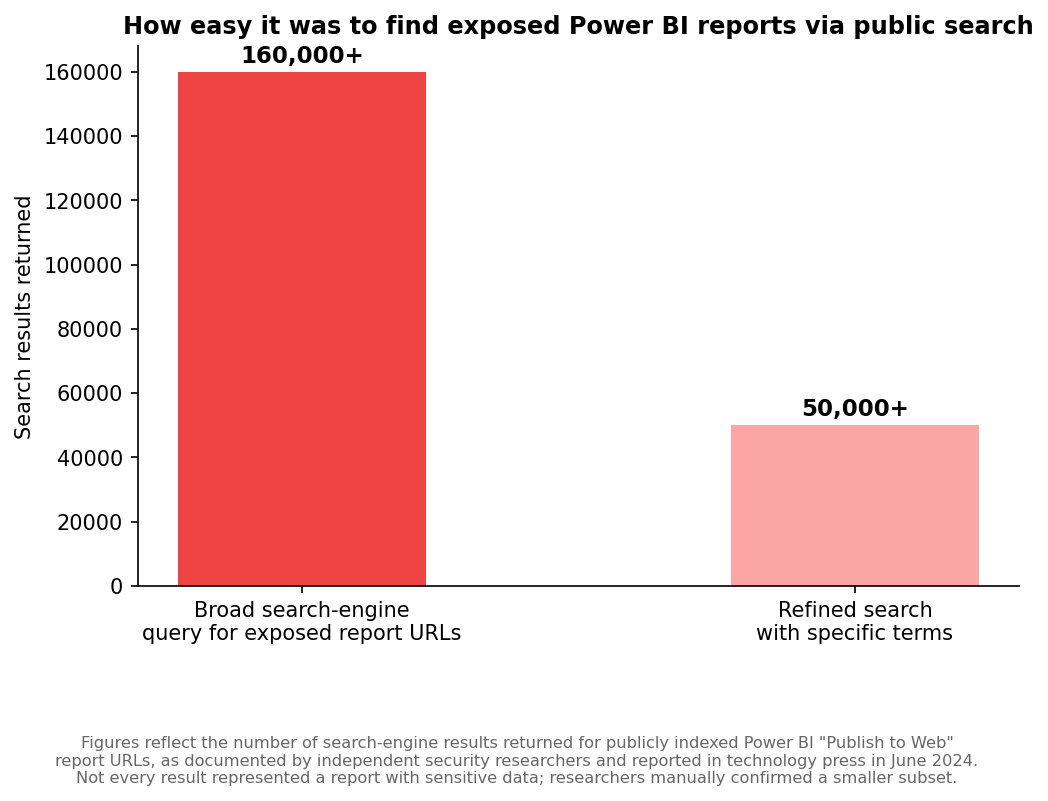
Figures reflect the number of search-engine results returned for publicly indexed Power BI “Publish to Web” report URLs, as documented by independent security researchers and reported in technology press in June 2024. Not every result represented a report with sensitive data; researchers manually confirmed a smaller subset.
What did Microsoft say when researchers reported the issue?
Microsoft’s Security Response Center confirmed the underlying behavior but characterized it as a design choice rather than a vulnerability, after researchers reported the issue in mid-2024. That framing puts the responsibility for avoiding exposure squarely on the organization publishing the report, which is consistent with how Microsoft’s own documentation on publishing Power BI reports to the web describes the feature: it’s intended for content meant to be fully public, and Microsoft advises against using it for anything containing information that shouldn’t be visible to an anonymous internet user. In practice, that guidance is easy to miss in the moment someone clicks “publish” to quickly share a dashboard with a client or a public audience, especially when the person doing the sharing is focused on the visible chart and has no reason to think about what else might be attached to it underneath.
Does this risk stop at Power BI, or does it extend across the Power Platform?
It extends well beyond Power BI. A breakdown of the Power Platform’s broader security risk surface identifies five recurring threat categories across the platform family: Power Apps exposure and hardcoded secrets, Power Automate flows carrying injection and stale-credential risk, Power BI dashboards oversharing data, custom connectors introducing supply-chain risk from untrusted sources, and Copilot Studio agents taking unvetted actions through unsafe integrations. Power BI’s publish-to-web exposure is simply the most visible and most publicly documented instance of a pattern that shows up across the whole platform: features built for ease of sharing and automation, deployed by people who aren’t necessarily thinking about the security implications of a single click.
What should an organization actually do about exposed or overshared reports?
The first step is knowing what’s already been published, since most organizations don’t have a running inventory of every report or dashboard that’s been shared externally, let alone what data sits behind each one. A use case built around detecting overshared and publicly exposed data across connected platforms approaches this by mapping data sources, connectors, and integrations tied to each app, flow, and report, then flagging assets that are publicly exposed or that have accumulated more access than their intended audience should have. From there, remediation is usually straightforward: unpublish or reconfigure the report, and route a notification to whoever owns it so the same mistake doesn’t get repeated the next time a quick external share feels like the fastest option.
The underlying lesson generalizes past Power BI specifically. Any platform feature designed to make sharing effortless is, by definition, also a feature that makes oversharing effortless, and the organizations that catch these exposures early are the ones actively looking for them rather than waiting for a researcher, or an attacker, to find them first.
There’s also a timing argument for treating this as an ongoing check rather than a one-time cleanup. New reports get published continuously as teams share dashboards with clients, partners, or the public, so a single audit that clears the current backlog doesn’t prevent the next well-intentioned share from recreating the same exposure a month later. Building the check into a recurring process, rather than a project with a defined end date, is what keeps the fix durable instead of temporary.
Frequently Asked Questions
Can someone access hidden data in a Power BI report even if it looks anonymized?
Yes. Security researchers demonstrated that unauthorized users can reach hidden tables, filtered records, and non-displayed columns in a report’s underlying semantic model through direct API calls, even when the visible report appears to show only an aggregated summary.
Did Microsoft treat the Power BI exposure as a security vulnerability?
Microsoft’s Security Response Center confirmed the behavior after it was reported but characterized it as a design choice rather than a vulnerability, placing responsibility on the organization publishing the report to avoid including sensitive information.
Is this exposure risk limited to reports published with “Publish to Web”?
The most widely documented cases involve “Publish to Web,” but the broader Power Platform carries similar oversharing and exposure risks across Power Apps, Power Automate, custom connectors, and Copilot Studio agents.
How can an organization find out if it has exposed Power BI reports already published?
Organizations typically need an inventory of every report, dashboard, and connector that has been published or shared externally, since most do not track this automatically and can’t remediate exposure they don’t know exists.
The global information security landscape is experiencing an unprecedented surge in threat complexity, driven by sophisticated cloud-native exploits, supply chain vulnerabilities, and distributed network attacks. For enterprise organizations, government entities, and critical infrastructure providers, defending digital borders has shifted from an operational IT task to a high-priority risk management mandate. As traditional firewalls and legacy defense systems fail to stop modern zero-day attacks, the demand for innovative, specialized defense software has accelerated. Navigating these highly specialized sectors requires significant engineering resources, domain expertise, and targeted capital injection—making specialized private financing a major catalyst for tech ecosystem defense innovation.
To meet this demand, early-stage technology networks are increasingly leaning on focused cybersecurity venture capital frameworks. Rather than relying on generalist investment pools that often lack deep technical insights, emerging infrastructure startups utilize domain-specific investment paths to accelerate product validation, scale go-to-market systems, and harden defensive code layers. This market analysis explores the financial dynamics governing specialized technology funds, evaluates why domain expertise dictates early-stage software success, and reviews how strategic advisory networks help early-stage firms protect enterprise pipelines.
The Strategic Role of Specialized Private Financing
Early-stage software development in highly technical categories requires significant upfront capital before reaching commercial viability. Startups building advanced cryptographic platforms, cloud workload protections, or automated incident response engines face long engineering timelines and strict regulatory compliance checks. Generalist venture funds are frequently unequipped to accurately evaluate the underlying code structures, patent defensibility, or market-fit parameters of these complex tools.
By contrast, a dedicated cybersecurity venture capital firm brings specialized, data-driven oversight to the table. These focused investment groups leverage engineering networks to conduct exhaustive technical due diligence, ensuring that only robust, scalable code architectures receive funding. This intensive verification process protects institutional capital while validating the startup’s product design for enterprise buyers.
Funding Distribution Across Early-Growth Environments
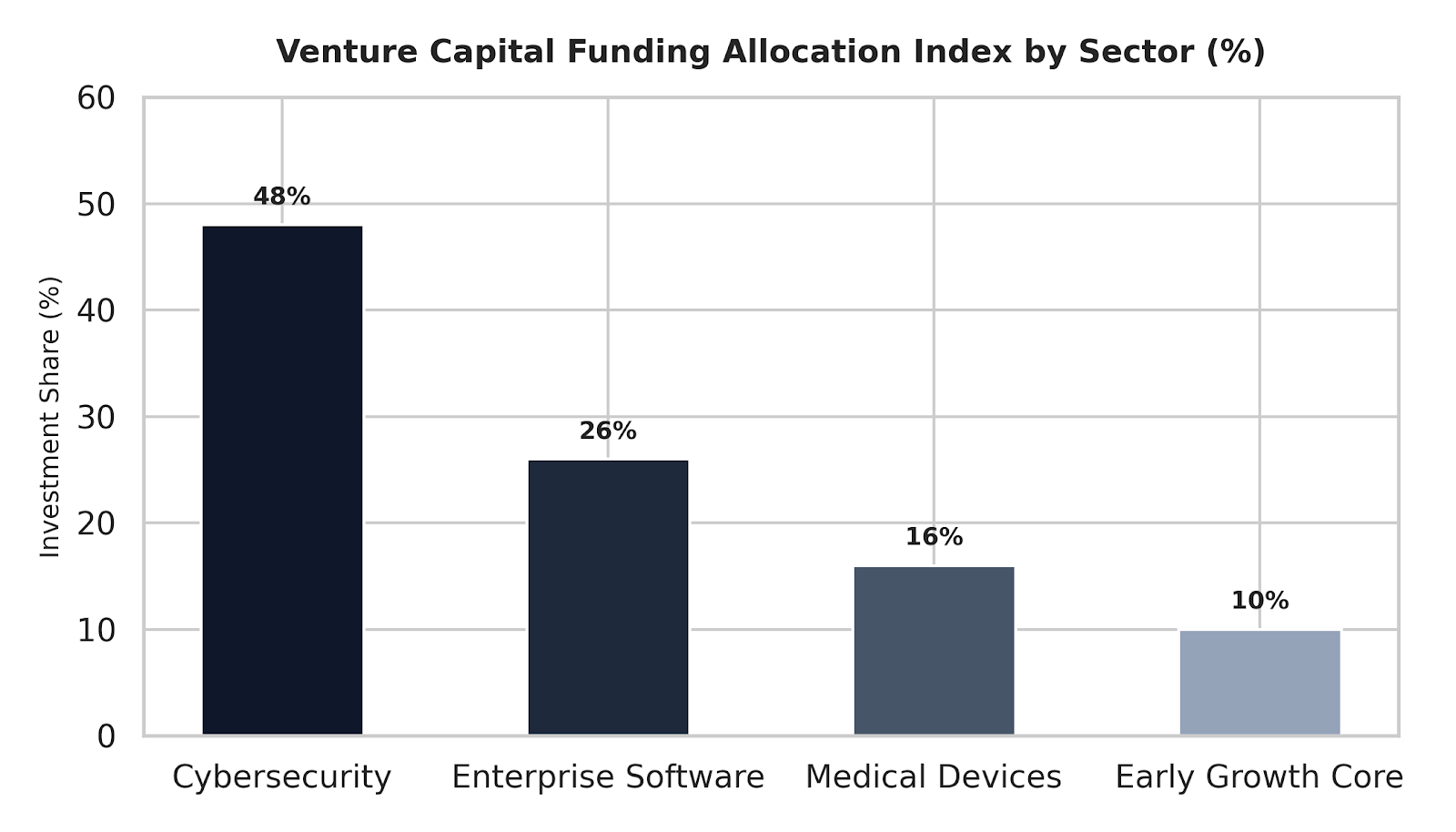
Analysis of global venture portfolios reveals a distinct concentration of private capital targeting high-exposure infrastructure sectors. As digital networks expand across cloud and edge topologies, specialized israel vc hubs and global tech investment nodes have heavily prioritized infrastructure security, cloud security, and automated threat intelligence platforms.
The chart below breaks down the proportional distribution of private venture capital allocations across primary tech-driven growth markets:
Bridging the Gap: CISO Alliances and Enterprise Validation
A primary hurdle for early-stage software startups involves securing direct validation from enterprise buyers. Chief Information Security Officers (CISOs) at major corporations operate under tight budgets and are naturally hesitant to deploy unverified, early-stage software within production environments. This creates a challenging cycle where startups need enterprise deployment data to build trust, but cannot secure deployments without existing trust.
To resolve this commercial deadlock, specialized security venture capital setups embed structured advisory networks directly into their investment models. Integrating active ciso investment channels and dedicated ciso investment alliance programs connects early-stage engineering groups directly with corporate security leaders. This close collaboration allows startups to refine product features based on real-world feedback, accelerating enterprise validation and expanding market share.
Conclusion
Relying on generic funding loops for highly technical enterprise software development introduces significant market-fit risks and unpredictable product development timelines. Utilizing specialized capital networks provides technology startups with a reliable path to secure deep domain expertise, validate advanced code structures, and streamline enterprise sales pipelines without facing typical early-stage funding friction. As global security requirements and data protection rules continue to tighten, deploying specialized venture capital structures remains an essential driver for next-generation digital defense.
The rapid integration of autonomous AI agents across corporate networks has introduced an entirely new class of application security vectors. Unlike static Large Language Models (LLMs) that merely answer text queries, agentic AI systems are built with high levels of autonomy—possessing deep read/write access to enterprise APIs, corporate databases, and system tools. These tools allow agents to execute independent actions such as scheduling calendar invitations, pulling customer records, or refactoring codebase files without constant human supervision. However, giving autonomous tools direct access to business infrastructure exposes them to significant software flaws. The volume of data handled by these systems makes human monitoring mathematically impossible, and the consequences of a compromised agent loop can lead to massive corporate data leaks, system hijacking, or widespread data corruption.
To defend against these new threats, enterprise security teams are moving away from legacy web gateways toward dedicated, context-aware runtime protection. Because autonomous agents operate dynamically, standard signature-based security rules cannot predict or stop malicious agent behaviors. Securing these environments requires complete visibility into agent activities at runtime, combined with real-time guardrails that evaluate the safety of every command before it is executed. This review examines how agentic AI risks occur, why real-time monitoring is critical for organizational stability, and what defense mechanics separate robust runtime protection platforms from legacy cloud security architectures.
Understanding the Vulnerability Landscape of AI Agents
Securing autonomous workflows requires a clear understanding of how adversarial inputs trick machine learning models. Traditional application security relies on a strict separation between code commands and user data. In agentic workflows, however, natural language text acts as both the code and the data simultaneously. This structural design allows bad actors to manipulate agent behavior by embedding malicious text strings within standard web forms or public documents.
When an agent processes this manipulated data, it mistakes the hidden instructions for developer commands. This can trigger an unauthorized action, such as forwarding internal database records to an external email address. Known as prompt injection, this technique can bypass standard text filters easily. This threat highlights why deploying an inline ai observability layer is essential for keeping close tabs on model context shifts.
Core Runtime Vulnerabilities in Autonomous Ecosystems
Professional security teams evaluating agent deployments must protect against several key threat vectors:
-
Indirect Prompt Injection: Occurs when an agent reads a poisoned third-party source (like an email or web snippet) containing hidden instructions that alter its behavior.
-
Malicious Data Poisoning: The intentional altering of underlying vector databases or retrieval-augmented generation (RAG) sources to corrupt model outputs over time.
-
Unauthorized Tool Execution: Exploiting an agent’s open API privileges to trigger backend system tasks that the current user does not have permission to execute.
-
Model Context Exfiltration: Tricking an agent into revealing its internal system prompts, system instructions, or sensitive data tokens during conversation.
Operational Evaluation: The Shadow AI Proliferation
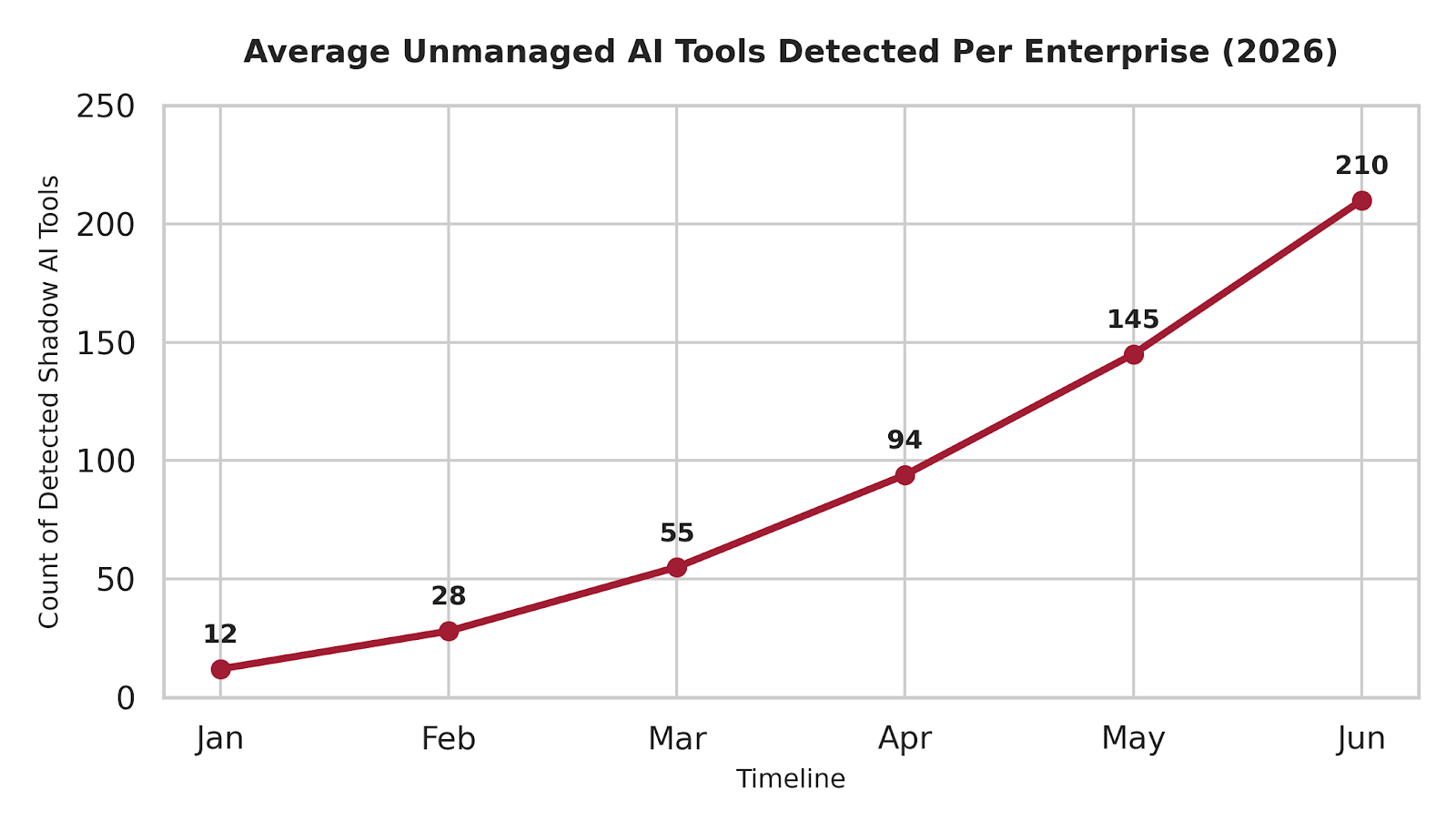
A major factor complicating this threat landscape is the sheer speed at which unapproved autonomous plugins and model connections slip into production environments. Before security teams can even evaluate runtime behaviors, they must first find where these endpoints exist.
The trend data below highlights the average monthly volume of unmanaged shadow AI endpoints discovered across commercial networks, emphasizing the urgent need for structural visibility:
Implementing Robust Agentic AI Governance
Protecting enterprise networks against agent failures requires a defense framework built specifically around runtime behaviors. Security managers cannot rely solely on pre-deployment software scans because an agent’s risk level changes dynamically based on the data it consumes.
Organizations are executing a broad, industry-wide move toward establishing verifiable application security for ai agents across core lines of business. Deploying continuous telemetry discovery, enforcing strict API boundaries, and embedding real-time behavioral guardrails allows organizations to safely use advanced secure ai agents to drive business efficiency without introducing massive compliance or compliance exposures.
Conclusion
Securing agentic AI architectures has quickly become a top priority for competitive enterprise security operations. The combination of high system privileges and natural language processing makes autonomous agents a highly vulnerable surface area that legacy security wrappers cannot adequately protect. As companies continue to roll out advanced agent workflows, implementing real-time, behavior-focused AI runtime security frameworks remains an absolute necessity—ensuring organizations can safely adopt AI technology while protecting corporate assets from sophisticated exploit loops.
Review Disclaimer
This article is an independent technical review for informational purposes only. It does not constitute formal software architecture engineering, infrastructure procurement consulting, or corporate compliance audit advice. Readers should test runtime behavioral controls, map local data dependency chains, and verify specific sandbox isolation capabilities against their internal security policies before executing commercial platform choices.
Tomato Breeders and the Push Toward Innovative Specialty Varieties
Cloud Based Live Video Production and the AI Live Production Unit
Book Digitization, Copy Stands, and Digitizing the Autochrome Process

-

 Business Solutions2 years ago
Live Video Broadcasting with Bonded Transmission Technology
-

 Business Solutions1 year ago
The Future of Healthcare SMS and RCS Messaging
-

 Business Solutions2 years ago
2-Way Texting Solutions from Company Message Services
-

 Business Solutions2 years ago
Communication with Analog to Fiber Converters & RF Link Budgets
-

 DSRC Communication2 years ago
The Crossroads of Connectivity: DSRC vs. C-V2X Technologies in Automotive Communication
-

 Business Solutions2 years ago
Wholesale SMS Platforms with OTP Services
-

 Business Solutions2 years ago
Choosing the Right B2B Digital Marketing Agency: A Guide
-

 3D Technology2 years ago
How Multispectral Cameras Advance Book Scanning