


Migration solutions
8 Advantages Of Google Drive To Dropbox Migration

If you have heard about a popular cloud storage medium, Dropbox, and wish to migrate files from Google Drive to Dropbox, look here. It is a great solution and enhances all the features by allowing users to migrate files conveniently. It can transfer various types of files, like videos, images, etc. In today’s time, the amount of data produced by a company is huge and that’s why; it is essential that you know which storage devices will be best for your organization. Dropbox has proved to be extremely beneficial among all enterprises, and the advantages of using a great solution are:
1. Retrieval
When it comes to Dropbox, managing files is not at all complicated. In case you have deleted a file unknowingly, do not worry, as you will get it back. The process to retrieve files is simple, and all you must do is click on the “Undo” button.
2. Works with an internet connect
Suppose you are in flight and continuing with some work in your system. At that time, you need some information, but since you do not have internet connectivity, you cannot access the file. But in case you have stored the file in Dropbox, you can get the information. It means the eminent cloud-based solution allows you to access the file even if you do not have an internet connection.
3. Enjoy the free version.
You can register on a Dropbox account through a suitable platform for free. You get 2 gigabytes, and there are no additional charges. If you are happy using the free version, the paid version will give you more space to store all the crucial details. The storage space available on the platform is 2 TB and you can keep multiple backups of files.
4. Collaboration and file sharing
Dropbox makes things easier when it comes to sharing files with stakeholders or colleagues. But before you do that, ensure to collaborate through your account. Also, you can protect the files with a password. However, only those who know the password can access the file. In short, you can keep the file protected from strangers while giving access to only a few.
5. Backup
Once you have signed on to the Dropbox solution, the only thing that you need to do is simply drag the file and drop it there. With that, you can keep a backup of all the files in a safe place. Also, the authorized people can check the file.
6. Security
When it comes to selecting an ideal solution provider in terms of security, Dropbox is the best. In case your smartphone or device stops working due to some technical glitch, all the details are available on a suitable cloud-based solution. It encrypts all the files so no one can access the details even if you give the phone to repair. It is a great aspect of an eminent platform, and every company looks for this aspect.
7. Mobility
A great platform gives you the feasibility to access the files from anywhere. So after you migrate files from Google Drive to Dropbox, accessibility will be easy. Most importantly, you can do it from your smartphone, and it helps in increasing productivity and completing a task on a stipulated time. Additionally, if you do not have any of your devices with you, but you wish to log in, go ahead with any device. The only device is you must have an internet connection to access from a different device.
8. Instant updates
One more feature of a prominent platform is instant updates. Dropbox gives instant updates when you are adding or deleting a file. It indicates that you will have all the recent updates on the changes being made on the platform.
Wrapping up!
Dropbox offers many other benefits as well. The files that you have deleted will be available for a month. Hence, if you want, after a few days, you can get the files back. Dropbox has everything that a business enterprise looks for in a reliable platform. Significantly, it reduces the involvement of IT in businesses. The moment a file gets saved in Dropbox, it starts the backup process. It eliminates human labour to a great extent and has a great file storage system as well.




Introduction
The decision to make Aliyah – to immigrate to Israel – is one of the most profound choices a Jewish person can make. It is also one that comes with an immediate, pressing practical question: where do you live? And more specifically: do you rent first, or do you buy? The Israeli housing market has its own rhythms, its own legal structures, and its own community dynamics that can make navigating it overwhelming for new arrivals. Yet for those who approach it with the right information and the right support, it can also represent one of the most significant financial decisions of their lives. Home in Israel works with Olim (new immigrants) and pre-Aliyah families to make the housing process as clear and as well-timed as possible – providing guidance that is sensitive to both the practical and emotional dimensions of this transition.
Aliyah Trends: Who Is Making the Move in 2025?
Aliyah rates have surged in the 2020s, driven by a combination of push factors (rising antisemitism in diaspora countries, political instability, and economic uncertainty) and pull factors (Israel’s strong economy, community connections, and the universal right of Jewish immigration).
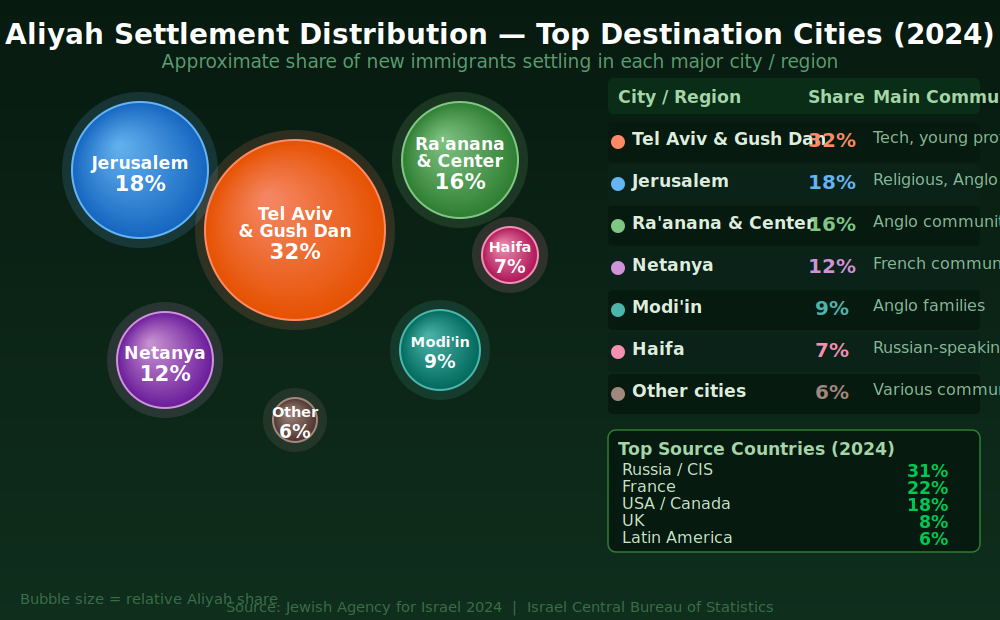
According to data from the Jewish Agency for Israel, more than 40,000 new immigrants arrived in Israel in 2023 alone, with the pace continuing into 2024-2025. The source countries have shifted considerably:
- France: Historically the largest single source of Western Aliyah, with over 200,000 French Jews having made Aliyah since 2000
- United States and Canada: Growing rapidly, particularly post-pandemic, with Anglo Olim often bringing significant financial resources
- United Kingdom: Steady stream, with strong community networks in specific Israeli cities facilitating settlement
- Argentina and Latin America: Economic drivers remain powerful, with Spanish-speaking communities concentrated in specific Israeli cities
- Russia and Former Soviet states: Major wave post-2022, with significant numbers settling in central Israel and the north
The Oleh Purchase Tax Benefit: A Critical Financial Advantage
One of the most significant financial benefits available to new immigrants is the Oleh purchase tax reduction. Unlike standard foreign buyers – who pay 8% purchase tax from the first shekel – new Olim who purchase within their first seven years of Aliyah receive a dramatically reduced rate. Understanding and correctly applying this benefit is a key part of the planning process. Expert guidance for Aliyah home buyers covers the full scope of benefits available to new Olim and how to time purchases to maximize them.
| Buyer Status | Purchase Tax (on NIS 3M property) | Potential Saving vs. Foreign Buyer |
| Israeli resident – first home | ~NIS 0-12,000 (low bracket benefit) | ~NIS 228,000 |
| New Oleh (within 7 years) | ~NIS 15,000 (reduced Oleh rate) | ~NIS 225,000 |
| Foreign buyer (non-resident, non-Oleh) | ~NIS 240,000 (8% rate) | Baseline |
Note: Purchase tax calculations are approximate. Rates and brackets change periodically. Always verify with a qualified Israeli attorney.
Where Are Olim Buying? City-by-City Breakdown
Community, language, lifestyle, and budget all influence where new immigrants settle. Here is how the main Aliyah destination cities compare:
- Ra’anana: The Anglo Aliyah capital of Israel. A large English-speaking community, excellent schools, and a suburban lifestyle with good transport links to Tel Aviv. Property prices: NIS 3M-NIS 8M
- Netanya: Strongly identified with French Aliyah, with French-language schools, shops, and social infrastructure. A Mediterranean coastal city with a more relaxed pace. Property prices: NIS 1.8M-NIS 5M
- Jerusalem: Deep resonance for Olim with a religious or Zionist identity. Significant Anglo and French communities in specific neighborhoods. Property prices: NIS 1.5M-NIS 25M+
- Tel Aviv and the Gush Dan: For younger Olim, particularly those entering Israel’s tech sector. Dynamic, secular, and cosmopolitan. Property prices: NIS 2.5M+ for central apartments
- Modi’in: A planned city between Tel Aviv and Jerusalem, popular with Anglo families. Modern infrastructure and a strong community feel at more accessible prices. Property prices: NIS 2M-NIS 5M
- Haifa: The most affordable major city in Israel, with a strong academic and tech community. Growing in popularity, particularly among Russian-speaking Olim. Property prices: NIS 1.2M-NIS 4M
Rent First or Buy Immediately? The Aliyah Housing Dilemma
- Financial readiness: Buying requires liquid capital for purchase tax, legal fees, and deposit. Many families arrive with significant resources; others need time to liquidate assets in their country of origin
- Community certainty: Some Olim know exactly where they want to live before they arrive. Others need six to twelve months of living in Israel to discover which city truly fits their family
- The Oleh tax window: The reduced purchase tax benefit is available for seven years post-Aliyah. This creates flexibility – there is no urgency to buy immediately to preserve the benefit
- Market timing: Israel’s property market has historically trended upward over the medium-to-long term. Renting while the market continues to appreciate carries its own opportunity cost
- Israeli mortgage access: New Olim with Israeli employment income can access Israeli mortgages, often improving their purchasing power compared to purchasing as a foreign national
The Practical Timeline: Pre-Aliyah to Purchase
- 12-18 months pre-Aliyah: Begin researching cities and neighborhoods. Use remote visits, community groups, and specialist agencies to build a clear picture
- 6-12 months pre-Aliyah: Establish Israeli bank account, begin conversations with Israeli mortgage brokers, identify preferred neighborhoods
- Month 1-3 post-Aliyah: Settle, explore, confirm community fit. Rent in the target area to test the neighborhood before committing
- Month 3-12 post-Aliyah: Active property search. Engage a local agency, arrange viewings, commission due diligence
- Purchase completion: Sign contracts, pay purchase tax at Oleh rate, register in Tabu
Conclusion
The Aliyah housing journey is one of the most meaningful transitions a family will navigate. The Oleh purchase tax benefit alone can represent hundreds of thousands of shekels in savings – a powerful financial incentive to engage the market thoughtfully and on the right timeline. With the right guidance, the path from pre-Aliyah planning to Israeli homeownership is entirely manageable.

Neve Tzedek is a gem, one that attracts tourists from all around the world. If you are planning to visit this city located in the larger Tel Aviv area, there are attractions that you simply must experience. We’ll go over five of them in this article.
However, before we get into specific attractions, it is worth going over Neve Tzedek in general to understand why it has such an allure. Tourists both from Israel and abroad pour into Neve Tzedek in droves. Another indicator of the magnetism of this area are the sky-high real estate prices.
There are multiple reasons why people are drawn to Neve Tzedek.
The first is its heritage. Neve Tzedek was the first neighborhood in the now sprawling metropolis that is Tel Aviv. It was a sort of refuge for Jews who were moving from the overcrowded port city of Jaffa. Additionally, a good number of notable Jews have lived in this area. As such, Neve Tzedek is of cultural significance to the Israeli people.
Art, culture, vibe, and lifestyle are what attract international tourists to Neve Tzedek. The neighborhood is a stronghold of the Bauhaus architectural style, so strong that it has received UNESCO world heritage site status.
The atmosphere in Neve Tzedek is that of a modern village. There are no skyscrapers, intentionally. Most of the buildings are low. It has narrow streets with no cars that are bordered by European-style eateries. The boutiques, museums, and street art only add to the allure.
In such an awesome place, it can be hard to pick the places to visit. Here are the top five attractions in Neve Tzedek.
The Suzanne Dellal Center for Dance
This is one of the most popular tourist destinations in the country, with more than half a million visitors per year.
It is a dance hub, the hub of dance in Israel, and the hub of contemporary Isreali dance. The center hosts multiple world-class dance exhibitions and festivals. If you are looking for a show when you are in Neve Tzedek, this is the place to go for one.
The center is dedicated to nurturing talent, promoting the growth of contemporary dance, and exposing new audiences to dance.
The center also hosts the Batsheva Dance Company, one of the most critically acclaimed and popular dance companies in the world, and the Inbal Dance Theater.
HaTachana, The Old Railway Station
HaTachana is one of the coolest places in Tel Aviv. It is an old railway station that fell into disrepair after years of being abandoned. However, at some point, it was renovated, with elements of the old train station being preserved, giving it a realistic historical setting in an otherwise modern place.
Every Thursday from 7pm, the HaTachana hosts Unique Night, where Israeli artists showcase and sell unique art till midnight.
It is also in HaTachana that you’ll find “Made in TLV,” one of the most unique boutique and souvenir shops in the world.
Nahum Gutman Museum
Nahum Gutman is an important cultural figure in Israel. He was a renowned artist and writer, even receiving the Israel Prize – Israel’s highest accolade, for his contribution to children’s literature.
His body of work is broad, featuring sculptures, mosaics, engravings, oils, water colors, and gouache.
The Nahum Gutman museum displays these works, usually in exhibitions with different themes. The museum is situated in the artist’s former home and houses a recreated version of Gutman’s studio.
It’s one of the most charming museums in Israel and definitely worth visiting.
Street Art
Neve Tzedek has a lively graffiti art scene, featuring works by some of the most respected graffiti artists in the world.
Street art gives you a different perspective on a place, one that is often more real. As such, when you go to Neve Tzedek, it’s worth taking a graffiti tour. You’ll see famous pieces of graffiti, like the one about Alice in Wonderland.
And the best part is that each piece comes with a story: How did the artist paint so high? What happened to this artist when he was caught in the act by the police?
And if you’re into debates, the graffiti in the streets of Neve Tzedek is sure to spark debates pitting different opinions against each other and giving you the opportunity to learn a lot in the process.
The Rokach House
The Rokach House is a museum named after Shimon Rokach, one of the most prominent figures in the early days of Neve Tzedek. The museum is located in a building that dates back to 1887. The museum is dedicated to showcasing life in Neve Tzedek during that era, and even features a video in English.
The museum is now home to Rokach’s granddaughter, who is a famed sculptor and artist. The museum showcases her work and hosts various cultural events.
Neve Tzedek Tel Aviv is regarded as a hub for the Bauhaus style of architecture – so much so that it was awarded World Heritage Status by UNESCO.
In no other place on the globe can you find so many brilliant examples of the simplistic yet elegant style that is Bauhaus. For visitors, a quick walk through נווה צדק תל אביב will reveal that many of the buildings there have a pearly exterior, almost like it’s a requirement by the law.
And that’s not where the similarity among buildings ends. Most of them will only be about three storeys tall. Additionally, they’ll consist of easily recognizable geometric shapes. And they’ll make prominent use of materials such as steel, glass, and concrete.
Such qualities are the hallmark of Bauhaus.
If you want to learn Bauhaus and experience all it’s glory, Neve Tzedek Tel Aviv is the place to go.
And once you are there, these are the top Bauhaus masterpieces you should check out.
Rubinsky House
One of the most striking features of Rubinsky House, built in 1935 and renovated in 2008, is its geometry. One end of the building has rounded terraces while the other has rectangular-shaped blocks that seem to jut out of the main building.
The facades don’t stray too far from the minimalist decoration that is characteristic of Bauhaus. Every floor has a balcony and the top of the building has a penthouse, which was added during the renovation.
And, typical of the local Bauhaus adaptation, the building stands on pilotis, as if they are lifting it out of water. The balconies are spacious, and glass is used minimally, to counter the hot local climate. In this regard, this house was said to symbolize the birth of “Israeli Bauhaus.”
61 Rothschild Boulevard
This rectangular building was built in 1932 by Salomon Gepstein. In 2006, some extensions were added by Orna Shatil architects.
One of its distinguishing features is the contrast created between the open terraces on every floor and the other side of the building, which is flat and lined with windows.
The flat roof with a garden is also a magnificent touch.
Asia House
Completed in 1979, this office building has a more modern touch compared to other Bauhaus buildings in נווה צדק תל אביב. It has seven storeys. Additionally, it is more in line with the original Bauhaus preference for glass, unlike other local Bauhaus buildings which use minimal glass as an adaptation to the hot local climate.
The building is simple, with no adornment on the facades.
The most outstanding quality of the Asia house is its curvilinear shape. The curves are meant to represent the waves of the sea.
Avraham Soskin House
This building is the epitome of simple elegance. On one end, it is a purely functional rectangular block. However, the other end of the two-story building is reminiscent of a cylinder.
Overall, the facade is a continuous wall of white, only interrupted by a horizontal row of windows and a balcony with horizontal ventilation slits.
The house was built for photographer Avraham Soskin in 1933 and renovated in 2003 by Nitza Szmuk architects. During the renovation, a top floor that had spoiled the building’s form was removed.
Jacobson’s Building
This artistically asymmetrical building looks different, depending on which side you are seeing it from. It was built in 1937 by Emanuel Halbrecht and expanded and renovated by Nitza Szmuk in 2012.
The building’s asymmetry is fitting as it is put to different uses. It has apartments, offices, and shops.
The corner building is lauded for its elegant design and high-quality materials.
Bruno House
This building, originally designed as a residential space, has modernist qualities that make it stand out. This can be seen in the balconies on one side of the building, which are designed in a continuous curve.
The Bruno House was built in 1933 by Ze’ev Haller. In 2004, it was renovated and expanded by Bar Orian architects.
The Thermometer Building
The building’s most remarkable feature is its vertical line of slatted windows, which runs from the top to the bottom of the building. The thermometer building was completed in 1936 by Yehuda Liulka. Because of the “thermometer”, this building is considered a little out of line with the minimalist and functional principles of the Bauhaus movement.
However, even this embellishment was functional. It was included to reduce energy wastage by allowing light to get in at all times during the day.
The rest of the building qualifies as a functional living space and earns it the Bauhaus label.
Shomo Yafe
This house on the corner was built in 1935 by Shlomo Gepstein and was considered extremely innovative when it was erected.
It’s an elegantly designed cubic structure. The shaded balconies are one of its distinguishing features. It’s classic Bauhaus, especially in its geometry and color.
Elishav House
This building is one of the few ones that has a facade that’s not entirely white. Part of its front-facing facade is brown.
It also stands out in other ways. It has a continuous vertical stairwell window, an element borrowed from the International style.
The building has a bit of troubled history. In 1950, the vertical stairwell window was sealed and the entire building sprayed in stucco, according to orders from the municipality. However, the original facade was later reconstructed based on photographic records.
Hagai Tamir architects oversaw the building’s renovation and extension in 2000. They added two floors to the building, with one set back from the front facade. The new fourth floor has a horizontal band of windows, which seems to complement the original vertical stairwell window.
96 Hayarkon Street
The rounded balconies of this H-shaped structure are one of its distinguishing features. The original building, erected by Pinhas Bizonsky in 1935, has been merged with a high-rise structure and the result is spectacular.
The original building has been carefully preserved and reconstructed, and its lobby is now used to host regular art exhibitions.
Tomato Breeders and the Push Toward Innovative Specialty Varieties
Cloud Based Live Video Production and the AI Live Production Unit
Book Digitization, Copy Stands, and Digitizing the Autochrome Process

-

 Business Solutions2 years ago
Live Video Broadcasting with Bonded Transmission Technology
-

 Business Solutions1 year ago
The Future of Healthcare SMS and RCS Messaging
-

 Business Solutions2 years ago
2-Way Texting Solutions from Company Message Services
-

 Business Solutions2 years ago
Communication with Analog to Fiber Converters & RF Link Budgets
-

 DSRC Communication2 years ago
The Crossroads of Connectivity: DSRC vs. C-V2X Technologies in Automotive Communication
-

 Business Solutions2 years ago
Wholesale SMS Platforms with OTP Services
-

 Business Solutions2 years ago
Choosing the Right B2B Digital Marketing Agency: A Guide
-

 3D Technology2 years ago
How Multispectral Cameras Advance Book Scanning