


Business Solutions
CSP Future: Smart IoT Gateway and New-Age Network Assurance


Picture a city that never sleeps, not because it’s too busy to rest, but because everything from its streetlights to its factories is seamlessly monitored and optimized. In this living network of devices, network service assurance for CSP merges with a smart iot gateway to orchestrate real-time data flows, reinforce security protocols, and anticipate disruptions before they happen. By blending localized processing, deep analytics, and robust protection measures, providers create an environment that evolves on its own, quietly recalibrating capacity and detecting anomalies to maintain uninterrupted service.
It’s a vision that transforms the once-static world of connectivity into an agile, self-correcting ecosystem. Instead of waiting for a problem to occur, operators deploy automated tools and AI-driven strategies that spot weak signals or traffic imbalances early. At the same time, a gateway deployed on-site manages edge intelligence, filtering out noise and securing critical data without flooding the central network. For communication service providers, this convergence of orchestrated assurance and localized computing represents a powerful way to retain control, maximize performance, and innovate continuously.
Shifting the Connectivity Paradigm
Gone are the days when connectivity only meant ensuring basic phone and internet services. Today’s technologies have woven themselves into the fabric of daily life—smart thermostats adjust temperatures based on real-time weather data, autonomous robots maneuver through warehouses, and entire cities rely on predictive maintenance to keep utilities online. The pressure on CSPs has grown proportionately. They no longer just manage bandwidth or guarantee a dial tone; they must ensure a level of responsiveness and stability that can handle massive device populations and continuous data flows.
This shift demands that CSPs focus on something more holistic than mere uptime. They need a broad perspective—one that merges raw connectivity with proactive insights. If a significant outage occurs at a single base station, thousands of sensors might go silent, halting everything from logistics to public safety operations. The cost of such a disruption isn’t just about lost data; it’s about eroding trust in technologies that increasingly guide mission-critical processes.
Enter the idea of network service assurance for CSP, a framework that relentlessly monitors and fine-tunes network health. It gathers key metrics from every node, evaluating latency, bandwidth usage, security threats, and device performance. Instead of passively reporting on issues, advanced assurance systems make micro-adjustments behind the scenes to avert major breakdowns. Layer in edge intelligence from a smart iot gateway, and you get a cohesive approach that unites localized decision-making with end-to-end oversight.
Elevating the Role of the Gateway
At first glance, the gateway might seem like a small cog in the vast machine of communication networks. But in truth, it functions as the local command center, bridging thousands of devices to the wide-area infrastructure. Where traditional gateways merely forwarded data to the cloud, the modern gateway also integrates computing power, secure storage, and on-device analytics. By doing so, it offloads much of the processing from central servers, reduces bandwidth use, and accelerates event responses.
In a manufacturing plant, for instance, dozens of sensors might track machinery vibrations, temperature fluctuations, and component wear. A smart iot gateway can rapidly correlate these readings, spotting any anomalies that hint at impending equipment failure. Before the issue escalates to a shutdown, it can send an alert to on-site technicians or automatically modify operating parameters. Meanwhile, essential insights flow to a broader assurance platform, which sees the big picture across multiple plants and can decide how to redistribute resources or whether to reorder spare parts in anticipation of maintenance needs.
Security also gets a significant boost. Gateways often function as the first line of defense, applying encryption keys, enforcing device authentication, and scanning for odd traffic patterns. If a sensor starts sending malformed packets or an unauthorized device attempts to connect, the gateway can isolate that threat before it spreads. With an advanced assurance system monitoring overall network health, suspicious actions become part of a real-time security picture that extends from the edge to the core.
Reinventing Network Assurance
In the old model, service assurance was a reactive affair. Tools recorded metrics in the background and triggered alarms when some threshold was exceeded. Administrators then scrambled to diagnose and fix the glitch. This approach might have been acceptable for smaller networks, but not for a world with billions of IoT devices. Delays of even a few minutes can send ripples of downtime through numerous connected systems.
That’s why network service assurance for CSP has shifted toward proactive and even predictive methods. Machine learning models analyze normal operating patterns, memorizing how the network behaves at different times of day, or under specific loads. They can detect subtle deviations—like an uptick in packet loss or an increase in CPU usage that isn’t yet critical but could become so in the near future. In response, they rebalance traffic, reassign network slices, or alert technicians to verify potential problems.
Such intelligence thrives when an on-site gateway delivers granular insights. If the gateway logs a sudden surge in sensor traffic from one corner of a facility, the assurance platform immediately understands context. It recognizes whether this is a legitimate spike—perhaps from a batch process ramping up—or an anomaly hinting at a malfunction. The collaboration means quick decisions can be made locally while the overarching system sets broader policies, ensuring the entire operation remains steady and flexible enough to adapt to changing demands.
Orchestrating Edge and Core
The conversation about distributed computing versus centralized architectures once felt like an all-or-nothing debate. Either you push data to the cloud or keep everything on local servers. However, the synergy between a smart iot gateway and a robust assurance platform brings a nuanced approach. By splitting responsibilities intelligently, networks can scale far beyond what an entirely centralized model could handle.
In large industrial sites, the gateway might analyze sensor readings in real time for safety-critical tasks—like shutting down a machine when it overheats. At the same time, aggregated metrics flow upward for historical analysis, capacity planning, or advanced troubleshooting. This layered orchestration ensures that urgent tasks see minimal latency, while big-picture analytics can still benefit from cloud-scale resources and AI algorithms. It also provides a failsafe: if a connection to the cloud is lost, local systems keep functioning.
Such orchestration becomes especially powerful when integrated with technologies like software-defined networking (SDN) and network slicing. The gateway can inform the central controller if it detects surges in sensor data, prompting the system to allocate extra bandwidth or reconfigure routes. Meanwhile, critical applications like emergency services could receive priority on designated slices. The result is a fluid, adaptable network that thrives under fluctuating conditions.
Addressing Real-World Complexity
Anyone who’s tried implementing large-scale IoT knows that real-world conditions can disrupt even the best blueprints. A remote wind farm might have limited connectivity options or face harsh weather conditions. An urban environment might suffer from RF interference or building obstructions. In many industries, legacy systems still operate with archaic protocols that don’t natively mesh with modern IoT standards.
This is where the gateway’s ability to translate and unify protocols becomes indispensable. It can accommodate older equipment and speak to cutting-edge devices alike, ensuring all data passes securely into the network service assurance for CSP domain. Meanwhile, because it handles encryption and local analytics, the gateway helps each site function with a degree of independence, even if central links falter.
Maintenance is another key hurdle. Keeping hundreds—or thousands—of gateways up to date with the latest firmware and security patches can feel like an impossible chore. However, an advanced assurance framework can automate these updates, dispatching over-the-air instructions whenever they detect vulnerabilities or performance improvements. By tracking versions, verifying digital signatures, and ensuring minimal downtime, the system keeps everything in sync while minimizing manual effort.
Collaboration and Ecosystem Building
No single entity can provide every piece of the puzzle. Success emerges from partnerships among sensor manufacturers, networking hardware companies, software vendors, and CSPs. These parties come together to define communication standards, refine security protocols, and test new hardware against real-world conditions. Ecosystems of solutions develop, ensuring that any newly designed IoT sensor or application can integrate seamlessly into existing infrastructure.
Many CSPs run innovation labs or partner with universities to prototype advanced gateway features and trial them in controlled environments. Others sponsor developer communities where third-party experts can add capabilities to gateway firmware or create specialized analytics modules. This open ecosystem approach accelerates innovation. When a new sensor technology appears, gateway manufacturers and CSPs can quickly integrate it, verifying compliance with the broader assurance platform to avoid compromising reliability or security.
Such collaboration also fosters confidence among enterprise customers. Whether it’s a logistics firm deploying asset trackers across continents or a city scaling up an entire suite of connected infrastructure, they want assurance that each component meets rigorous standards. By pooling expertise, the industry reduces friction and paves the way for smoother adoption of IoT technologies worldwide.
Innovations Shaping Tomorrow
With 5G and beyond on the horizon, the potential for transformation grows exponentially. High-speed, low-latency links open the door for real-time video analytics, robot swarms in logistics, and a plethora of consumer-facing experiences that rely on instant feedback. Meanwhile, gateways stand poised to receive more sophisticated AI capabilities, enabling them to anticipate changes in local environments and reorder tasks autonomously.
Quantum-safe encryption might become a standard feature, especially for industries concerned about the long-term security of their data. Blockchain-based identity management could guard against impersonation attacks, verifying device authenticity at each handshake. As these advanced concepts gain traction, network service assurance for CSP will have to expand its scope, monitoring not just performance but also adherence to stringent security and privacy requirements across millions of connected endpoints.
In some cutting-edge scenarios, the gateway might even shift from a stationary node to a mobile one—embedded in vehicles, drones, or wearable technologies that demand immediate data processing. Assurance systems would track these roving endpoints, allocating resources in real time so that connectivity remains robust no matter where or how the device moves. This level of flexibility redefines the boundaries of what’s possible in a connected world.
Pioneering a Resilient, Adaptive Future
Viewed in its entirety, the alliance between a smart iot gateway and advanced network service assurance for CSP signals a bold step forward. It rebalances the flow of data between edge and core, ensuring real-time responsiveness alongside holistic oversight. In an era when entire industries hinge on continuous connectivity, even a short disruption can cost millions—or worse, threaten public safety. The path toward stability lies in combining local intelligence with global orchestration.
From telemedicine in remote villages to vast energy grids that power entire nations, connectivity remains the glue holding the modern world together. And as demands climb for faster data, stringent security, and unerring reliability, the gateway becomes more than just another router. It’s the nerve center that ensures each device, sensor, or system contributes to a collective tapestry of insights. Meanwhile, the assurance platform monitors the entire operation like a skilled conductor, harmonizing processes to achieve seamless, near-invisible performance.
Looking ahead, the trajectory is clear. The rise of self-driving vehicles, automated factories, connected agriculture, and even space-based IoT networks will drive continuous refinements. In this unstoppable tide of innovation, only those who master the synergy of localized edge intelligence and proactive, predictive assurance can fully unlock the potential of the hyperconnected era. By embracing this model now, CSPs and enterprises alike position themselves to not just endure the changes ahead, but to flourish within them, crafting the next generation of services that truly redefine how we connect, compute, and collaborate on a global scale.



|
Key Takeaways
|
What is a venture capital fund, in plain terms?
A venture capital fund is a pool of capital, contributed by investors and managed by a dedicated investment team, used to fund private companies, typically early-stage or growth-stage businesses with high growth potential, in exchange for an equity ownership stake. Unlike a bank loan, venture capital doesn’t need to be repaid on a fixed schedule; instead, the fund’s investors participate in the company’s future upside (or downside) alongside its founders. The fund’s managers, often called general partners, make the actual investment decisions on behalf of the fund’s investors, who are typically called limited partners.
How is a typical VC fund actually structured?
The overwhelming majority of venture capital funds are structured as limited partnerships. General partners (GPs) manage the fund, source and evaluate investment opportunities, sit on portfolio company boards, and make the calls about which companies to fund and when to exit. Limited partners (LPs), which can include pension funds, university endowments, family offices, and wealthy individuals, commit capital to the fund but generally aren’t involved in individual investment decisions. In exchange for their capital, LPs typically pay the fund a management fee, often around 2% of committed capital annually, plus a share of the fund’s profits, commonly 20%, known as carried interest.
What does a VC fund’s lifecycle actually look like?
A traditional VC fund isn’t a permanent, evergreen pool of capital; it has a defined lifecycle, typically spanning 8 to 12 years from first close to final wind-down.
| Fund lifecycle stage | What actually happens |
|---|---|
| Fundraising and first close | The fund raises committed capital from LPs before making its first investments. |
| Investment period | Typically the first 3 to 5 years, during which the fund makes its initial investments into portfolio companies. |
| Active management and follow-on | The fund supports existing portfolio companies, often participating in follow-on funding rounds as those companies grow. |
| Exit and distribution | The fund realizes returns through acquisitions, IPOs, or other exit events, and distributes proceeds back to LPs. |
How large has the global venture capital market actually become?
The scale of capital flowing through venture capital funds globally has grown enormously over the past two decades. IMARC Group’s venture capital investment market analysis values the global market at $284.8 billion in 2023, projected to reach $1,310.8 billion by 2032, a compound annual growth rate of 17.9%. That growth reflects the increasing role venture capital plays in fostering innovation and entrepreneurship globally, with software consistently commanding the largest share of capital deployed, and follow-on funding, capital deployed into companies a fund has already backed, generally outpacing first-time venture funding.
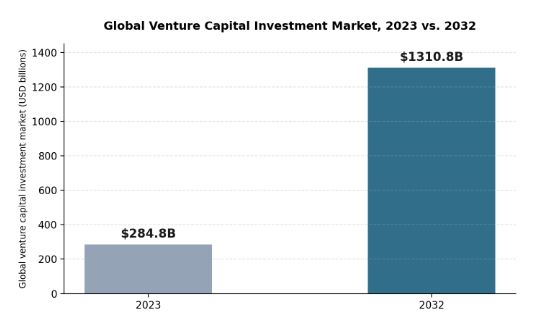
Global venture capital investment market size, 2023 versus 2032, according to IMARC Group.
Are all venture capital funds structured the same way?
No, and understanding the alternatives matters for founders evaluating which type of investor actually fits their company. Elron Ventures’ own description of its model illustrates one such alternative directly: rather than a traditional limited partnership raising committed capital from external LPs, Elron operates as a publicly traded technology investment company, one of Israel’s leading investment firms since 1961, deploying capital through two core growth engines, early-growth technology investments and an M&A-driven growth strategy focused on acquiring early-stage dual-use technology companies. That structure gives a company like Elron more flexibility in its investment horizon and capital deployment than a fund bound by a fixed limited-partnership lifecycle, since it isn’t operating against the same fundraising and wind-down clock a traditional 8-to-12-year fund faces.
What does ‘early-growth’ investing actually mean, as distinct from seed or late-stage?
Venture capital funds typically specialize by stage, and the terminology matters for founders trying to identify the right fit. Seed-stage funds back companies at their earliest, often pre-revenue stage, when the primary risk being underwritten is whether the founding team and product concept can find genuine traction. Early-growth investing, the stage many established Israeli VC funds focus on, targets companies that have already demonstrated initial product-market fit and are looking to scale that traction into a larger, more durable business. Late-stage and growth-equity funds, by contrast, back companies with established revenue and a clearer path to an exit event, often writing much larger checks at higher valuations. A fund’s stated stage focus should shape which companies actually approach it for funding, since a seed-stage pitch to a late-stage growth fund, or vice versa, rarely leads anywhere productive.
What should a founder actually understand before approaching a VC fund?
- What stage does the fund actually invest at? Confirm this matches your company’s current stage before spending time on outreach.
- What sectors or technologies does the fund focus on? Many funds specialize deeply, and a fund’s public messaging usually signals this clearly.
- Does the fund lead rounds, or only participate alongside a lead investor? This affects how much capital and support you can expect from that single relationship.
- What does the fund actually offer beyond capital? Strategic partnerships, sector expertise, and portfolio company networks can matter as much as the check size itself.
How does a VC fund actually decide when to exit an investment?
Exit timing is rarely a unilateral decision made purely on a fund’s own schedule; it emerges from a mix of the portfolio company’s own trajectory, market conditions, and the fund’s own lifecycle pressure. A fund nearing the end of its stated term has real incentive to push toward a liquidity event, an acquisition or IPO, since its own LPs expect distributions within a reasonably predictable timeframe rather than an indefinite hold. At the same time, a fund that exits too early can leave significant value on the table if a portfolio company’s growth trajectory was only just accelerating. Board seats, which many VC funds negotiate as part of their investment terms, give fund managers a formal voice in these exit timing conversations, rather than leaving the decision entirely in founders’ hands.
What does ‘dry powder’ actually mean, and why does it matter for founders?
Dry powder refers to capital that investors have already committed to a fund but that the fund hasn’t yet deployed into portfolio companies. A large pool of dry powder sitting across a market’s VC funds is generally a positive signal for founders, since it suggests real capital is available and actively looking for a home, rather than funds having already committed most of their capacity to existing portfolio companies. That said, dry powder alone doesn’t guarantee a fund will actually write a check to any particular startup; it simply describes the scale of capital theoretically available, not how selectively or aggressively any specific fund is currently deploying it.
Frequently Asked Questions
What’s the difference between a general partner and a limited partner?
General partners (GPs) manage the venture capital fund, make investment decisions, and typically earn management fees and a share of profits (carried interest). Limited partners (LPs) contribute capital to the fund but aren’t involved in day-to-day investment decisions.
How long does a typical venture capital fund actually last?
Most traditional VC funds have a lifecycle of 8 to 12 years, covering an investment period, an active management and follow-on period, and an exit and distribution period, though extensions are common when portfolio companies need more time to reach an exit event.
Can a venture capital fund invest in a company more than once?
Yes, this is common and is typically referred to as follow-on investment, where a fund participates in later funding rounds of a company it has already backed, often to maintain its ownership percentage as the company raises additional capital.
Is a publicly traded technology investment company the same thing as a traditional VC fund?
Not exactly. A publicly traded technology investment company, like Elron Ventures, typically deploys its own balance sheet capital rather than raising committed capital from external limited partners, giving it a different capital structure and investment horizon than a traditional limited partnership fund.

| Key Takeaways
• Israeli tech companies raised roughly $3.1 billion across 98 rounds in Q1 2026, up 34% year over year, with foreign investors supplying 65.9% of that capital. • Cybersecurity accounted for about 40% of Israeli VC funding in Q1 2026, while defense-tech’s share fell from roughly 8% in 2025 to under 1% in the same period. • Some Israeli VC firms operate a standard direct-investment fund alongside a separate joint-venture or acquisition arm focused on a specific sector, such as defense technology. • Government co-investment programs dating back to the early 1990s helped seed Israel’s venture capital industry, contributing to a market that now supports many independently capitalized local funds. |
What makes Israeli venture capital firms operate differently from international investors?
Israeli venture capital firms tend to combine a deep local sourcing network in a small, densely connected tech ecosystem with an operating assumption that most portfolio companies will need to scale into markets, most commonly the US and Europe, from day one. That dual-market posture shows up structurally, not just in messaging. one firm’s public profile of its own history and philosophy describes decisions made “within days to a few weeks,” a pace that reflects how tightly connected the local investor and founder community is compared with larger, more geographically dispersed markets.
How large is Israel’s venture capital market right now?
Israeli tech companies raised about $3.1 billion across 98 funding rounds in the first quarter of 2026, a 34% increase year over year, with March 2026 alone accounting for roughly $1.2 billion of that total. Foreign investors supplied 65.9% of that capital, underscoring how dependent the local ecosystem is on international capital even as local firms do much of the early sourcing and structuring. Cybersecurity alone accounted for about 40% of funds raised in the quarter, while defense-tech’s share fell from roughly 8% in 2025 to under 1% in the same period, a reminder of how quickly sector allocation can shift.
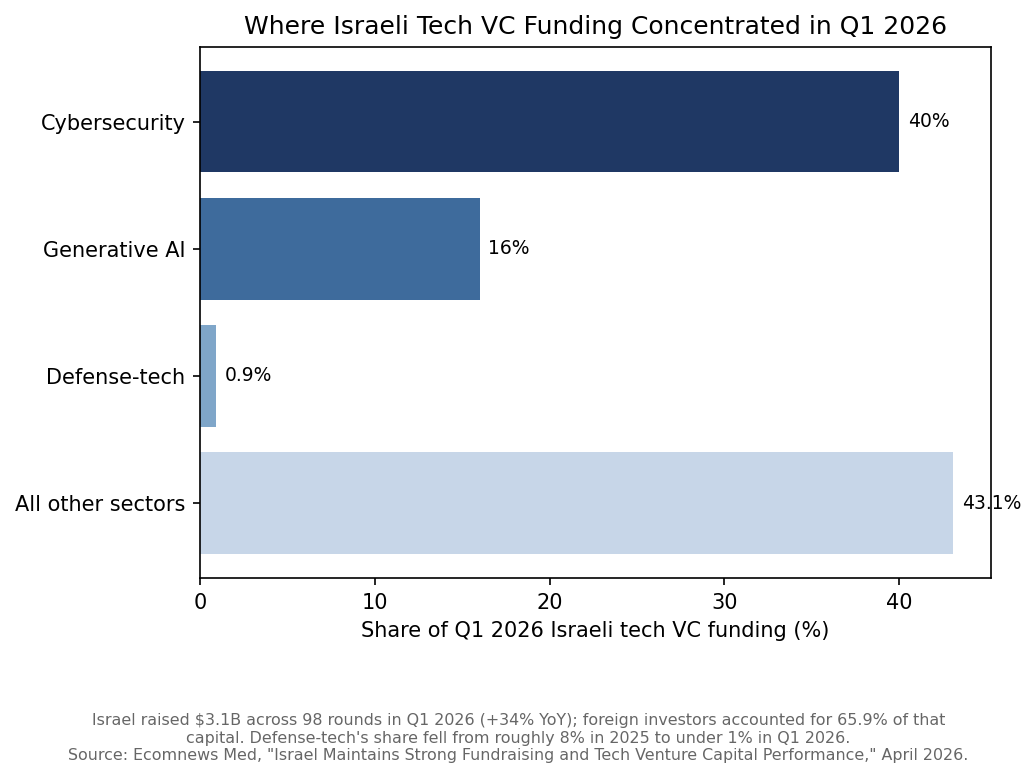
Sector breakdown of Israeli tech venture capital funding in Q1 2026, based on Ecomnews Med’s April 2026 reporting.
Why do some Israeli VC firms invest through more than one structure?
Some firms pair a standard direct-investment fund with a separate acquisition or joint-venture arm aimed at a specific sector, which lets them play both an early investor role and a strategic consolidator role in the same market. a portfolio spanning cybersecurity, deep and defense tech, medical devices, and enterprise software shows what that breadth looks like in practice, with more than 70 companies represented across active and exited positions. A defense-technology joint venture built with an established strategic partner is one example of this second structure, sitting alongside the firm’s conventional early-growth fund rather than replacing it.
How does sector specialization show up inside a single Israeli VC portfolio?
Sector specialization inside Israeli VC portfolios usually shows up as dedicated teams or sub-funds for a firm’s strongest local sourcing advantage, most often cybersecurity, layered underneath a broader generalist mandate. a dedicated cybersecurity portfolio segment and a medical-device investing track record spanning cardiovascular, orthopedic, and diagnostic devices illustrate two very different specializations coexisting inside the same firm, each drawing on a different regulatory and go-to-market path.
What role does government policy play in Israel’s VC ecosystem?
A government-funded program launched in 1993 played a documented role in seeding Israel’s venture capital industry by matching private investment at a set ratio, rather than by investing directly on its own. Under that program, the government allocated $100 million in total, $80 million of which matched foreign and domestic investment at roughly a 40% ratio so outside firms could establish their own funds inside Israel, with most of those funds later repurchasing the government’s stake within five years. See a historical summary of that matching-fund program and its transition to private ownership in 1997 for how that early policy groundwork is one reason the ecosystem now supports many independently capitalized local funds rather than depending on a handful of foreign offices, even though foreign capital still supplies the majority of dollars invested today.
Frequently Asked Questions
How much venture capital did Israeli tech companies raise in Q1 2026?
Israeli tech companies raised approximately $3.1 billion across 98 funding rounds in the first quarter of 2026, a 34% increase compared with the same period the year before.
What share of Israeli VC funding comes from foreign investors?
Foreign investors accounted for about 65.9% of total Israeli tech venture capital funding in Q1 2026, according to Ecomnews Med’s reporting.
Which sector attracted the most Israeli VC funding in early 2026?
Cybersecurity attracted the largest share, accounting for roughly 40% of total Israeli tech VC funding in the first quarter of 2026.
Do Israeli VC firms only invest in Israeli companies?
No, many Israeli VC firms invest with an explicit assumption that portfolio companies will expand into international markets, most commonly the United States and Europe, from an early stage.
מבוא
שוק הבנייה הישראלי עומד בפני שינוי מבני מואץ. לחצי עלות, מחסור בכוח אדם מיומן, עליות בחומרי גלם וגידול בביקוש לדיור – כל אלה מאלצים חברות בנייה לחפש יעילות מקומות שלא חיפשו קודם. הפתרון מגיע מהטכנולוגיה. בשנת 2025, חמש טכנולוגיות עומדות במרכז הטרנספורמציה הדיגיטלית של הענף – וחברות שמאמצות אותן מוקדם יותר יהנו מיתרון תחרותי משמעותי. ConWize היא דוגמה לפלטפורמה ישראלית שמשלבת כמה מהכלים הללו – אומדן, תמחור וניהול מכרזים – בפתרון אחד מאוחד, שנבנה על הצרכים הספציפיים של שוק הבנייה המקומי.
טכנולוגיה 1: BIM – מידול מידע לבניין
BIM (Building Information Modeling) אינה עוד חידוש – היא הופכת לסטנדרט עבודה. BIM מאפשרת יצירת מודל תלת-ממדי דיגיטלי של הבניין שכולל לא רק גיאומטריה אלא גם נתוני עלות, לוחות זמנים, מפרטים טכניים ותחזוקה עתידית.
אנגליה מחייבת BIM בכל מבנה ציבורי מ-2016
ישראל צפויה להרחיב דרישות BIM בפרויקטי תשתיות ממשלתיים ב-2025–2026
חיסכון ממוצע: 5–10% בעלויות בנייה, 20% בשגיאות תכנוני
טכנולוגיה 2: ניהול אומדן ותמחור בענן
גיליונות Excel אינם מספיקים יותר כשמנהלים מספר פרויקטים מורכבים בו-זמנית. פתרונות ענן לאומדן מאפשרים גישה בכל מקום, שיתוף פעולה בזמן אמת ועדכון מחירים אוטומטי. פלטפורמת ConWize לאומדן ותמחור מייצגת את הדור הבא של כלים אלה: ממשק עברי, כתב כמויות מובנה, ניהול מכרזים ושליטה בתקציב – הכל מקום אחד.
חיסכון ממוצע בזמן אומדן: 35–50%
ירידה בשגיאות תמחור: עד 70%
זמינות מהשטח: עדכון ומעקב ישירות מהסמארטפון
טכנולוגיה 3: פלטפורמות ניהול פרויקטים בענן
כלים כמו Procore, PlanGrid ומקבילות ישראליות מאפשרות ניהול לוחות זמנים, עבודות וחוזים מרכזי – עם ניראות מלאה לכל בעלי העניין בפרויקט. לפי Dodge Data & Analytics, חברות שמשתמשות בפלטפורמות ניהול פרויקטים מדווחות על עמידה בלוחות זמנים גבוהה ב-30% לעומת חברות שאינן משתמשות.
ניהול RFI ותוכניות ישירות מהאפליקציה
תיעוד אוטומטי של כל החלטה ואירוע בשטח
דשבורד סטטוס לכל קבלן ומשימה
טכנולוגיה 4: ניתוח נתוני שטח ו-IoT
חיישנים, מצלמות ומכשירי IoT שמוצבים באתר הבנייה מאפשרים מעקב בזמן אמת אחר התקדמות עבודות, שימוש בציוד ותנאי בטיחות. הנתונים מוזנים לפלטפורמות ניתוח שמאפשרות לזהות עיכובים, בזבוז ומפגעי בטיחות לפני שהם הופכים לבעיות.
ניטור ממשי של שעות עבודה ונוכחות
מעקב GPS אחר ציוד וכלי רכב
התראות בטיחות אוטומטיות
טכנולוגיה 5: בינה מלאכותית לתמחור ואומדן
הדור הבא של כלי האומדן משלב בינה מלאכותית שמנתחת פרויקטים קודמים ומחירי שוק כדי לייצר אומדנים מדויקים יותר. מערכות AI מסוגלות לזהות חריגות, להצביע על סיכוני עלות ולהציע חלופות תכנוניות זולות יותר – כל זאת בשבריר מהזמן שצוות אנושי היה זקוק לו.
לפי סקר Autodesk מ-2024, 68% ממנהלי הפרויקטים בעולם מאמינים ש-AI תהיה מרכזית בתמחור ואומדן תוך שלוש שנים.
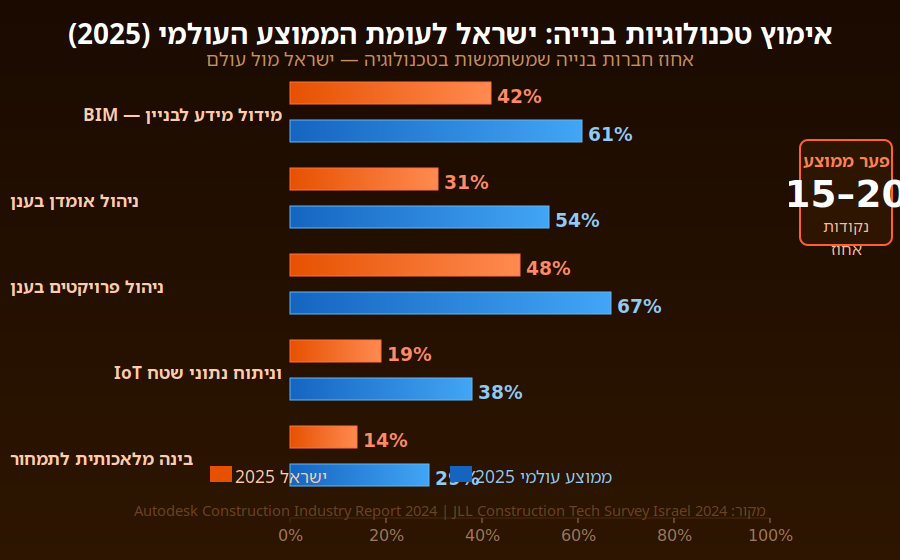
טבלת השוואה: שיעורי אימוץ טכנולוגיות בנייה בישראל (2025)
| טכנולוגיה | שיעור אימוץ (ישראל) | שיעור אימוץ (עולמי) |
| BIM | 42% | 61% |
| ניהול אומדן בענן | 31% | 54% |
| ניהול פרויקטים בענן | 48% | 67% |
| IoT וניתוח שטח | 19% | 38% |
| AI לתמחור ואומדן | 14% | 29% |
מקור: Autodesk Construction Industry Report 2024; JLL Construction Tech Survey Israel 2024
מה שוק הבנייה בישראלי צריך לדעת
ישראל מאמצת טכנולוגיות בנייה בקצב איטי יותר מהממוצע העולמי – אך הפער מצטמצם. הנהגת מחייבת BIM בפרויקטים ציבוריים, עלייה בהיקפי הבנייה ותחרות גוברת על כוח אדם מיומן יוצרים לחץ שמאיץ את קצב האימוץ. חברות שיתחילו את המעבר הדיגיטלי עכשיו ייהנו מיתרון ראשון-מגיע שיהיה קשה לשחזר בעוד שלוש שנים.
התחילו בכלי ה-ROI המהיר ביותר: ניהול אומדן ותמחור דיגיטלי
צרו מסד נתונים פנימי של עלויות מפרויקטים קודמים
השקיעו בהכשרת צוות – הטכנולוגיה טובה בדיוק כמו האנשים שמשתמשים בה
בחרו פלטפורמה עם תמיכה מקומית ותיעוד בעברית
סיכום
הטרנספורמציה הדיגיטלית של שוק הבנייה הישראלי אינה שאלה של ‘אם’ אלא של ‘מתי’. הכלים שפעם היו נחלת חברות הבנייה הגדולות ביותר בעולם הפכו נגישים, מותאמים מקומית ומוכחים בשטח. חברות שישכילו לאמץ טכנולוגיות אלה יוכלו לנהל פרויקטים מורכבים יותר, לשמור על שולי רווח בריאים ולספק ללקוחות שלהן רמת מקצועיות שהמתחרים לא יוכלו להציע. זהו הרגע לפעול
Tomato Breeders and the Push Toward Innovative Specialty Varieties
Cloud Based Live Video Production and the AI Live Production Unit
Book Digitization, Copy Stands, and Digitizing the Autochrome Process

-

 Business Solutions2 years ago
Live Video Broadcasting with Bonded Transmission Technology
-

 Business Solutions1 year ago
The Future of Healthcare SMS and RCS Messaging
-

 Business Solutions2 years ago
2-Way Texting Solutions from Company Message Services
-

 Business Solutions2 years ago
Communication with Analog to Fiber Converters & RF Link Budgets
-

 DSRC Communication2 years ago
The Crossroads of Connectivity: DSRC vs. C-V2X Technologies in Automotive Communication
-

 Business Solutions2 years ago
Wholesale SMS Platforms with OTP Services
-

 Business Solutions2 years ago
Choosing the Right B2B Digital Marketing Agency: A Guide
-

 3D Technology2 years ago
How Multispectral Cameras Advance Book Scanning