


Marketing & Analytics
A Case for Business SMS

SMS has been around for a long time. Other technologies come and go, or come and go through serious evolution, but SMS stays. In addition, it hasn’t really changed. For a technology that has been around for almost two decades, it’s astonishing that the biggest change – at least from the consumer’s point of view – is the introduction of emojis in texts.
Maybe because SMS has been around for long, it feels like an outdated technology. For this reason, some businesses have been ignoring it as a digital marketing channel. It doesn’t feel that digital.
However, SMS is one of the most effective digital marketing channels that a business can use. It not only allows businesses to market products but also to increase customer engagement, conduct ongoing market research, and forge deeper customer relationships that increase customer retention rate.
And while, on the consumer side, it may seem like SMS hasn’t changed, it has. Sending out multiple SMSs is now easy, convenient, and affordable. Moreover, with advances in technology, new SMS techniques have emerged. For example, SMSs sent to customers can be contextual. In addition, businesses can maintain SMS lists and automate the sending of periodic content, whose efficiency and personalization is aided by segmentation.
Over recent years, SMS has evolved to become one of the most effective channels for businesses to use in communicating and engaging with both existing and potential customers.
The use of SMS comes with multiple advantages. These include a higher open-rate compared to alternatives like email. In addition, customers don’t have to be online to receive SMS. It’s convenient and is specially suited for urgent communication.
As a business, if you’re not already using business SMS, you should consider it.
So, what are the different ways in which you can use SMS messaging for business value? Here are some use-cases.
Sample Use-Cases for Business SMS
SMS for Universities and Schools
A school messaging service can come in really handy for schools of all types. Whether big or small, any school can benefit immensely from an SMS service.
The first thing to note for retail SMS is that recipients have to opt in before you can send them messages. It’s not okay to just take someone’s number and start sending them texts about your business or university. They’ll most likely mark your messages as spam and, in any case, it will give them a negative perception about you.
For the above reason, you can’t use SMS for the traditional sense of marketing, that is for acquiring new customers. But you can use it to nurture leads, provided you’ve obtained their consent first.
Even so, the greatest utility that can be gained from SMS for universities is in engaging with students, parents, and staff.
For students, SMSs can be of great utility right from the application and admission stages and into alumni engagement.
The use of SMS can help nurture more applications into admissions. This can be achieved by providing guidance and relevant information to potential students, in addition to answering any queries that they might have. For this, a two-way messaging system would be better than a one-way system.
SMS can help streamline the admission process. Students, as well as parents, can be given timely reminders of timelines and admission requirements.
And when the students become part of the institution, a school messaging service can be of great help in ensuring a smooth learning experience for them. Students can be reminded of due assignments and projects. This can help have less issues.
In addition, a two-way messaging service can be invaluable in sustaining a conversation with students, which can help gain useful insights and improve the education services that a school offers.
And finally, when the students graduate, they can be encouraged to join the SMS list for alumni. This can supercharge alumni engagement and can be used for fundraising efforts, sending out event invitations, and keeping alumni informed of programs and opportunities that would be beneficial to them.
SMS for Businesses
SMS can have great returns on investment for businesses.
To start with, SMS has several distinct advantages over other digital and content marketing platforms like email.
The first of these advantages is reliability. To access SMS, clients only need to have a mobile device that is connected to a service provider. They don’t even need to be connected to the internet. Given the massive penetration rates of mobile devices, virtually everyone can be reached via SMS. In addition, SMS is subject to less delay. The average person can go for days without accessing email, especially if it’s not crucial to their work. On the contrary, the average person checks their phone screen for notifications multiple times throughout the day.
Another advantage of SMSs is that they have a significantly higher open rate compared to platforms like email. A promotional message sent via email has a good chance of being ignored and going unread. However, an SMS is likely to be opened. And since SMSs are short by nature, they are likely to be read and the information will have gotten home.
SMS has several use-cases for businesses.
To start with, it can be used to nurture leads. The collection of phone numbers for an SMS list can be incorporated into a business’ lead generation efforts. The leads who have opted in can then be nurtured, for example by being alerted of promotions.
Aside from helping with marketing efforts, SMS can help businesses better engage and understand their existing customers. Such knowledge helps serve customers better, increase retention rates, and develop products that are more in tune with customer needs.
With two-way messaging, deep customer engagement can be achieved through SMS. Through smart messaging, the load of customer care can be made lighter with chatbots. This can be implemented through two-way messaging. Chatbots typically take care of basic customer queries, such as frequently asked questions, and refer challenging issues to human agents. This reduces the burden on customer relations staff, in addition to easing the customer care budget.
In addition to aiding in marketing, customer care, and communication, SMS can also be used with great success in surveys.



| Key Takeaways
• ChatGPT’s share of B2B AI referral traffic fell from 89.1% to 62.6% in eight months, while Claude, Gemini, and Perplexity each gained meaningful share over the same period. • Claude and Perplexity send a disproportionately large share of referrals relative to their smaller user bases, consistent with both platforms skewing toward research-stage queries. • Generative Engine Optimization rewards structural clarity and self-contained factual statements, while traditional SEO rewards keyword matching and backlink volume. • B2B AI referral share shifted by double-digit percentage points within a single year, meaning single-engine optimization strategies can lose relevance quickly. |
Why do B2B buyers now split their research across several AI engines?
B2B buyers no longer settle on one AI assistant for vendor research; they move between ChatGPT, Claude, Gemini, and Perplexity depending on the task, and each engine now carries a meaningful share of B2B referral traffic. A recent longitudinal study of B2B referral sessions across a 41-brand panel found that ChatGPT’s share of that traffic fell from 89.1% to 62.6% in eight months, while Claude’s share rose from 1.4% to 18.5%, Gemini’s from 2.4% to 10.6%, and Perplexity’s from 3.1% to 7.3%. A brand optimizing for a single engine is now missing more than a third of the B2B AI referral landscape it would have covered a year earlier.
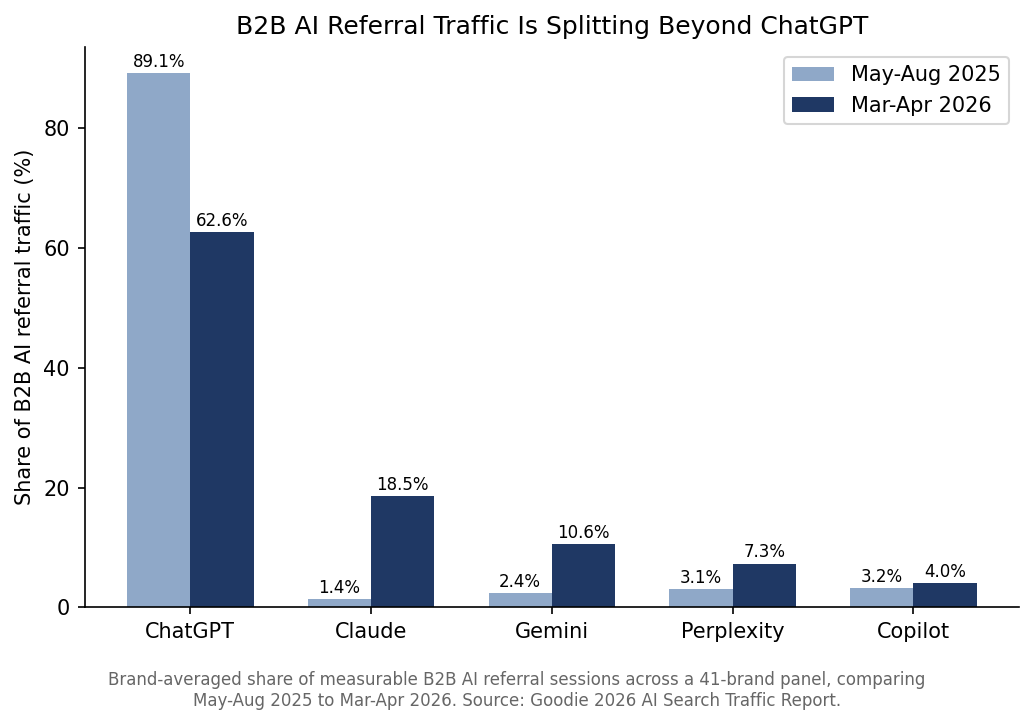
B2B AI referral traffic share by engine, comparing May-Aug 2025 to Mar-Apr 2026. Source: Goodie 2026 AI Search Traffic Report.
Do different AI engines behave the same way when they cite a source?
No. Each engine runs its own retrieval pipeline, weighs different signals, and serves a different point in the buyer’s research process, so content that earns a citation on one engine does not automatically earn one on another. ChatGPT’s referral behavior tracks closely with its overall usage volume, while Claude and Perplexity send a disproportionate share of referrals relative to their smaller user bases, consistent with both platforms skewing toward research-stage, source-checking queries rather than casual browsing. Gemini behaves as two distinct surfaces at once, a standalone conversational assistant and the model powering Google’s own AI Overviews and AI Mode inside search results, and the two surfaces send referral traffic at very different rates because one is built for open-ended conversation and the other is built to answer a query without the user leaving the results page. a deeper breakdown of engine-specific optimization priorities lays out how ChatGPT, Gemini, Perplexity, and Claude differ in the audiences and query types they attract.
What happens to a brand that only optimizes for the most popular engine?
A brand that optimizes only for the currently dominant engine builds visibility that erodes as fast as that engine’s market share does, and the last eight months show how quickly that share can move. Treating GEO as a single-engine project mirrors the mistake B2B marketers made when they treated SEO as a single-search-engine project; the fix is the same in principle: build content and technical infrastructure that generalizes across retrieval systems rather than gaming one algorithm. the practice’s overview of what AI search optimization actually requires walks through the foundational risks B2B brands face when their content isn’t structured for AI interpretation in the first place.
How is Generative Engine Optimization different from traditional SEO?
Generative Engine Optimization (GEO) optimizes for being the source an AI model trusts enough to cite and synthesize into its answer, while traditional SEO optimizes for ranking in a list of links a human then chooses from. The practical difference shows up in what gets rewarded: SEO rewards keyword matching and backlink volume, while GEO rewards structural clarity, topical depth, and the kind of self-contained factual statements a model can lift directly into a generated answer. a full comparison of the two disciplines and how the shift changes a content roadmap walks through the practical differences in more detail.
Should a B2B marketing team build separate content for each AI engine?
Not separate content, but a single content and technical foundation built to generalize: clear entity definitions, direct answers near the top of a page, and a presence on the third-party sites each engine treats as trust signals. The engines differ in retrieval mechanics, but they converge on rewarding the same underlying qualities: content that states facts plainly, cites its own sources, and appears consistently across multiple independent domains rather than only on the brand’s own site. A page written to answer one specific question clearly, with the direct answer stated in the opening sentences, tends to perform well across every major engine because that structure matches how each of them extracts and summarizes source material, regardless of the underlying retrieval mechanism.
What does a multi-engine measurement approach actually look like in practice?
A multi-engine measurement approach tracks citation frequency, referral traffic, and share of voice separately for each major engine rather than collapsing them into a single generic AI-traffic metric. Standard analytics platforms undercount this activity in two structural ways: native AI apps frequently strip referrer data so AI-originated visits land in a generic direct-traffic bucket, and Google does not separately attribute its own AI Overviews and AI Mode surfaces, bundling them into ordinary organic search reporting. A marketing team relying solely on referrer logs will systematically understate its actual AI visibility, sometimes by a wide margin, which makes engine-specific monitoring tools a practical necessity rather than a nice-to-have for any B2B brand serious about this channel.
Why does engagement quality matter as much as raw traffic volume from AI sources?
AI-referred traffic tends to engage more deeply than traffic from most traditional channels, spending more time on a page and completing more of the intended action once it arrives, which changes how a marketing team should value a smaller volume of AI-driven visits. A buyer who reaches a vendor’s site after an AI assistant has already synthesized several competing options into a shortlist arrives with more context and higher intent than a buyer clicking through ten generic search results, so the same absolute traffic number carries different pipeline value depending on where it originated. This is part of why treating AI visibility purely as a volume metric understates its importance: the quality of the visit, not just the count, is what should drive investment decisions across engines.
What is the practical first step for a B2B team that has only optimized for one engine so far?
The first step is an honest audit of current visibility across all four major engines rather than assuming that success on one engine implies success on the others, since the underlying retrieval logic differs enough that visibility does not transfer automatically. From there, prioritize the technical and structural fixes, such as clear entity definitions and direct, quotable answers near the top of key pages, that tend to generalize across engines before investing in engine-specific tactics that may not survive the next shift in market share. Given how quickly the distribution moved over the past year, building for resilience across engines is a more defensible long-term strategy than optimizing narrowly for whichever engine currently holds the largest share.
Frequently Asked Questions
Is ChatGPT still the most important AI engine for B2B visibility?
It remains the largest single source of B2B AI referral traffic, but its share has fallen from roughly 89% to 63% in under a year as Claude, Gemini, and Perplexity have grown, so it is no longer the only engine that matters.
Why does Claude send a larger share of referrals than its user base would suggest?
Claude’s usage skews toward research-stage and technical queries, and platforms with that usage pattern tend to convert a larger share of sessions into outbound clicks to source material than platforms used mainly for casual browsing.
Does optimizing for AI engines replace the need for traditional SEO?
No, traditional SEO and Generative Engine Optimization address different discovery paths and both remain relevant, since a meaningful share of buyer research still happens through conventional search results pages.
How quickly can a B2B brand’s AI engine visibility change?
Very quickly. Aggregate B2B referral share across major AI engines shifted by double-digit percentage points within a single year, so brands need to track visibility across engines rather than assuming today’s distribution will hold.
Digital marketing for a B2B technology company rarely fails because a single channel underperforms. It usually fails because the channels were never built to work together. A structured framework for B2B digital marketing treats search, content, paid, and social as connected inputs into one pipeline rather than four separate campaigns competing for the same budget. That distinction matters more than it sounds: a program that measures four channels separately will always look busier than one that is actually coordinated, and busy is not the same thing as effective.
The channel mix, and what each piece is actually for
| Channel | Primary role in the funnel | Typical signal it improves |
| SEO and content | Top-of-funnel visibility and long-term authority | Organic traffic, keyword rankings |
| Search engine marketing | Fast, intent-driven demand capture | Qualified clicks, cost per lead |
| Social and paid social | Awareness and retargeting across a long sales cycle | Engagement, assisted conversions |
| Data analysis | Turning campaign activity into a feedback loop | Attribution accuracy, budget reallocation |
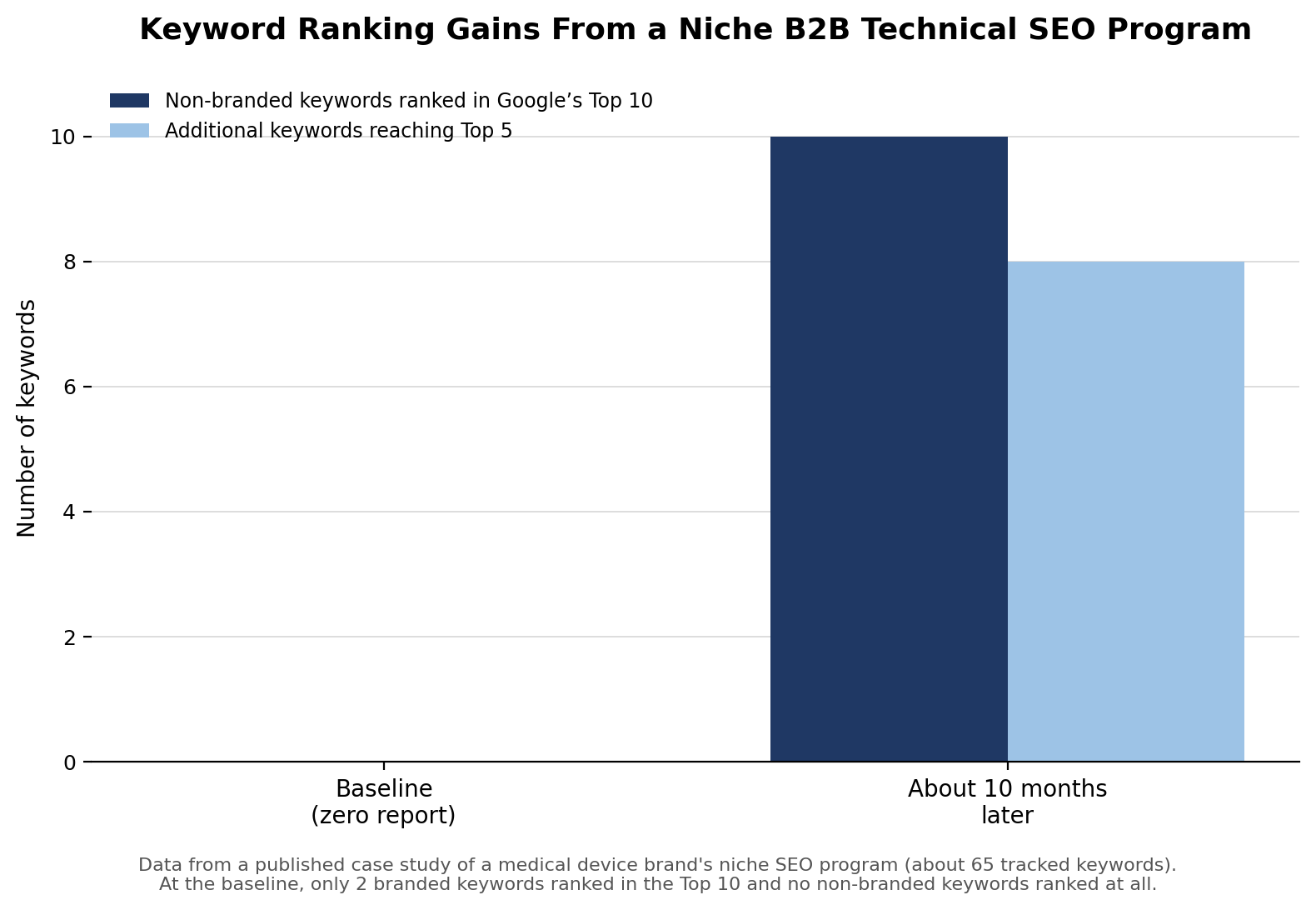
Treated as a system rather than four separate line items, these channels compound. Organic search still carries the largest share of that system for most B2B sites. Industry benchmarking from Ahrefs and Semrush consistently puts organic search at roughly three-quarters of all trackable B2B website traffic, a larger share than any paid channel produces on its own, which is why the SEO and content row in the table above tends to receive the longest planning horizon of the four. First Page Sage’s 2026 benchmarking adds a useful reference point for pacing expectations: once a page holds a top-five position for six or more transactional keywords, organic traffic to that page tends to rise by at least 15 percent within six months. That is a slower payoff than a paid search campaign, which is exactly why the two channels are meant to run in parallel rather than in sequence.
Why data analysis is the piece most programs skip
Running four channels without a shared measurement layer usually produces four disconnected reports, not one strategy. A dedicated analytics practice is what lets a team see which channel actually influenced a closed deal, rather than crediting whichever touchpoint happened last. This is also the piece most B2B teams underinvest in relative to how much they spend on the channels it is supposed to measure. Content Marketing Institute’s own research on the obstacles B2B marketers report most often lists measurement, alongside content that drives a specific action and resource constraints, as one of the three most common barriers to a program being considered effective. A team that cannot answer which channel moved a deal forward tends to keep funding whatever channel is easiest to report on, not whatever channel is actually working.
From traffic to a marketing qualified lead
Traffic on its own is not a business result. The intermediate step most B2B programs rely on is the marketing qualified lead, a prospect that a marketing team has screened against fit and intent criteria before handing it to sales. Programs that skip this definition tend to flood sales teams with unqualified volume, which erodes trust in marketing’s pipeline contribution. Published B2B benchmarking places the average visitor-to-lead conversion rate for a B2B site somewhere between 1 and 3 percent, with leads sourced from organic search and referral traffic typically converting at the higher end of that range, and the average lead-to-MQL conversion rate sitting near 31 percent. A program that runs meaningfully below that band is usually not short on traffic; it is short on a lead definition sales actually trusts, which sends good prospects back into a nurture queue instead of a pipeline.
How AI-driven search changes the top of the funnel
The channel mix above assumes a fairly stable relationship between ranking well and receiving a click, and that relationship has been shifting. AI Overviews, Google’s generated summary panels, now appear on roughly half of all search results tracked by industry monitoring services, and when one appears above an organic listing, click-through rates on that listing typically fall somewhere between a third and well over half, depending on the query and position. For a B2B technology company, that shift raises the bar for what a page needs to do to earn a click even after it ranks: a page that only restates a definition an AI summary already covers has less reason to be clicked than one that adds a specific data point, a worked example, or a comparison the summary could not fully capture. This is the practical link between SEO and GEO work: content built to be citable by an AI system and content built to earn a click from a human searcher increasingly need to satisfy the same standard, which is specificity that a short summary cannot fully absorb.
What the data says about program effectiveness
Content Marketing Institute’s 2026 survey of over 1,000 B2B marketers found that only 12 percent rate their marketing as highly effective, while 47 percent describe it as somewhat effective and roughly a third report neutral or weaker results. The same research identifies the three most common obstacles as creating content that drives a specific action, resource constraints, and simply measuring whether content is working at all. None of the three is primarily a content-quality problem; all three point back to the coordination and measurement gaps described above. See the full 2026 B2B research findings for the complete breakdown by challenge and channel.
Frequently Asked Questions
What is the difference between an MQL and an SQL?
A marketing qualified lead (MQL) has been screened by marketing against fit and intent criteria; a sales qualified lead (SQL) has been further vetted by the sales team as ready for direct outreach.
How many digital marketing channels should a B2B tech company run at once?
Most structured programs combine at least SEO and content, paid or search engine marketing, and one social channel, coordinated through shared analytics rather than run as separate, unmeasured efforts.
Does content marketing replace the need for paid channels in B2B?
No. Content and SEO build compounding, long-term visibility, while paid channels capture immediate, intent-driven demand; most effective programs run both together.
Do AI Overviews mean SEO matters less for B2B companies?
Not less, but differently. Ranking still matters, since AI Overviews and their citations are built from indexed pages, but content now also needs to earn a click on its own merits once a summary already answers the basic version of the question.
Marketing & Analytics
Kapia Pepper: The Sweet, Elongated Variety Winning Over Retailers and Consumers

Introduction
Not all peppers are created equal. While blocky bell peppers dominate the mainstream fresh market, a growing segment of buyers and consumers is discovering the distinct appeal of the kapia pepper – an elongated, thin-walled, intensely sweet variety with origins in Central European cuisine. Today, it is one of the fastest-growing sweet pepper categories in specialty and premium produce retail. Breeders and growers who recognize this trend early stand to capture significant market share, and companies like BreedX are leading its commercial development.
What Is a Kapia Pepper?
The kapia pepper (also sometimes spelled ‘copia’ or ‘kapija’) is a long, tapered sweet pepper with a characteristic rich red color when fully ripe. Unlike blocky bell peppers, kapia peppers have a thinner wall and a higher sugar content, giving them a distinctly sweet, almost fruity flavor. They are excellent for eating raw, roasting, or using in cooked dishes.
From a breeding perspective, the kapia pepper presents unique opportunities. Its shape, sweetness, and visual appeal make it a standout in the crunchy red peppers segment, where consumers seek peppers that deliver both taste and texture. The mini-kapia format – a smaller, snack-sized version – has further expanded the variety’s commercial reach.
The Mini-Kapia: Snack Culture Meets Premium Produce
Consumer trends toward snacking and healthy eating have created a massive opportunity for smaller-format peppers. The mini-kapia sits at the intersection of these trends – it is naturally small, intensely sweet, crunchy, and visually attractive. Retailers can position it as a premium snack item, while foodservice operators use it as a garnish, appetizer ingredient, or standalone snack.
BreedX’s development of mini-kapia pepper varieties reflects the company’s focus on market-relevant innovation. Their varieties are bred for consistent sizing, high Brix (natural sweetness), and shelf stability – key requirements for retail success. By combining the traditional appeal of the kapia pepper with modern breeding advances, they have created a product that meets both grower and retailer demands.
Nutritional Value of Kapia Peppers
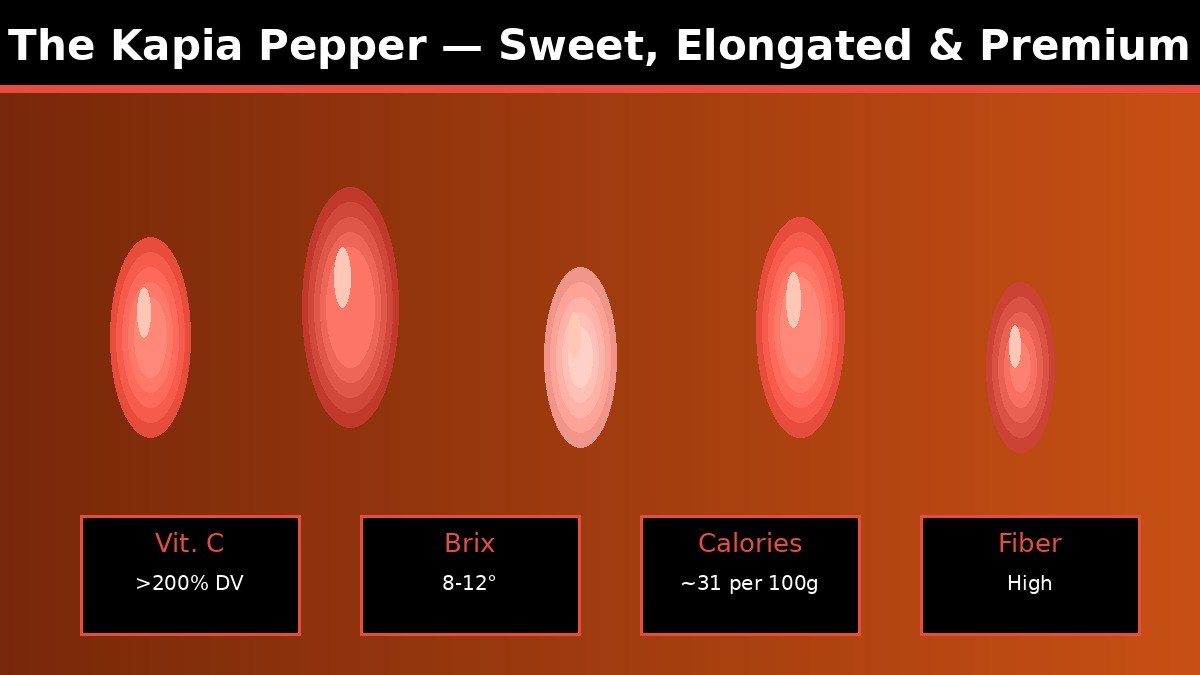
Sweet peppers in general – and kapia varieties in particular – are among the most nutrient-dense vegetables available in the fresh produce section. Their high vitamin C content (often exceeding that of citrus fruits), combined with a significant amount of vitamin A, antioxidants, and dietary fiber, makes them an ideal choice for health-conscious consumers.
According to Wikipedia’s entry on sweet peppers, sweet peppers are rich in carotenoids and ascorbic acid, particularly when fully ripened to red. This nutritional profile reinforces the value proposition of red kapia peppers in premium and organic retail environments.
Key nutritional highlights of red kapia peppers:
- High vitamin C content – often more than an orange per serving
- Rich in beta-carotene, which converts to vitamin A
- Naturally low in calories while high in dietary fiber
- Contains capsanthin and other antioxidant carotenoids
- No cholesterol and minimal sodium
Retail Positioning: Standing Out in the Pepper Category
For retailers and category managers, the kapia pepper offers a clear differentiation opportunity. The conventional sweet pepper section is dominated by blocky red, yellow, and orange varieties. Adding mini-kapia or long-kapia peppers creates visual variety, draws consumer curiosity, and supports premium pricing.
Packaging innovation plays a role here as well. Mixed snack trays featuring mini-kapia alongside other mini sweet pepper varieties create a compelling, colorful product that commands higher margins and appeals to snacking-focused shoppers. Growers who cultivate kapia varieties have reported strong demand signals from both retail chains and specialty food distributors.
| Characteristic | Kapia Pepper Profile |
| Shape | Elongated, tapered |
| Flavor | Sweet, fruity, low heat |
| Color at maturity | Deep red |
| Wall thickness | Thin to medium |
| Best use | Raw snacking, roasting, grilling |
| Key market segment | Premium, specialty, snack |
Growing Kapia Peppers: What Growers Should Know
Kapia peppers are well-suited to both greenhouse and open-field cultivation, though greenhouse growing allows for more consistent sizing and extended harvest windows. Like other sweet pepper varieties, they thrive in warm, well-drained soils with consistent irrigation. Breeders have developed disease-resistant kapia lines that reduce crop losses from common pathogens such as powdery mildew and bacterial spot.
Harvest timing is critical for kapia peppers. While they can be harvested green, the variety’s commercial value is highest when fully ripe – the deep red color and maximum Brix levels align with consumer expectations and retail standards.
Conclusion
The kapia pepper is no longer a niche variety for specialty markets — it is becoming a mainstream premium product with real commercial momentum. For growers looking to diversify and retailers seeking differentiated produce, the kapia pepper represents a compelling opportunity. BreedX’s portfolio of innovative pepper varieties – including mini-kapia lines – provides the quality, consistency, and breeding support that modern supply chains require. As the market for sweet, crunchy, snackable peppers continues to grow, kapia peppers are well-positioned to be among the most valuable entries in the category.
Tomato Breeders and the Push Toward Innovative Specialty Varieties
Cloud Based Live Video Production and the AI Live Production Unit
Book Digitization, Copy Stands, and Digitizing the Autochrome Process

-

 Business Solutions2 years ago
Live Video Broadcasting with Bonded Transmission Technology
-

 Business Solutions1 year ago
The Future of Healthcare SMS and RCS Messaging
-

 Business Solutions2 years ago
2-Way Texting Solutions from Company Message Services
-
 Business Solutions2 years ago
Communication with Analog to Fiber Converters & RF Link Budgets
-

 DSRC Communication2 years ago
The Crossroads of Connectivity: DSRC vs. C-V2X Technologies in Automotive Communication
-

 Business Solutions2 years ago
Wholesale SMS Platforms with OTP Services
-

 Business Solutions2 years ago
Choosing the Right B2B Digital Marketing Agency: A Guide
-

 3D Technology2 years ago
How Multispectral Cameras Advance Book Scanning