


Tech
AI Automotive

AI has made some headway in every industry – including the automotive industry. Artificial intelligence uses data and algorithms to replicate human decision-making ability. Algorithms that help the system learn and solve problems independently are deployed across various industries under the automotive umbrella.
Areas in the Automotive Industry Where AI Is Used
Manufacturing
In the production line, robots are deployed to work with humans. These AI-enabled robots learn manufacturing skills like design and part manufacturing. The system is not completely autonomous although it is possible to have the entire plant operated by AI-powered robots in the future.
After Sale Services
AI also helps with some aftermarket services. AI can predict problems related to the engine, battery or another part that may occur in the future.
Some AI-powered insurers also offer some quick services like settling claim settlements to customers through AI.
Transportation
Automotive AI stretches its muscles best in transportation – with advancements like self-driving cars. AI is completely revolutionizing the transport sector, playing a vital role in technologies like driver assistance that are now being widely used in modern vehicles.
Let us dive deeper into the applications of AI in the automotive industry.
Applications of AI in the Automotive Industry
Autonomous Cars
Self-driving cars basically drive themselves with little to no human input. Achieving autonomy is no mean feat because the car essentially needs to reason and act like a human driver, arguably better even.
The idea of self-driving cars has been around since 1939 but it’s only with developments like AI SDK that computer vision techniques like object detection are possible to create intelligent systems that decode and make sense of what they see.
AI SDK basically handles the scaling of data and AI applications. Decoding visual data is what essentially allows a vehicle to drive itself. Just like you see road signs, lane markings, and traffic lights while driving, a self-driving car needs to detect road infrastructure like that and respond to each accordingly.
How do they do it?
The algorithms responsible for this are basically fed a bunch of relevant data while being trained to detect specific objects and then take appropriate action like slow down or turn.
To collect this data, autonomous vehicles use an array of cameras and sensors. For the model to be reliable, it needs to be consistently fed large sets of data.
It is not perfect though with challenges like bad weather making object detection harder.
It is also possible for a self-driving car to come across an unidentified object while out on the road – an unidentified object is one which is not in any of the data sets used to train the model so there is no way for the car to identify the object.
Traffic Management
Living in a city more often than not means having to sit through hours of traffic and struggling to make it to school or work on time. Traffic jams mean wasted time and as they say, time is money. The flow of traffic can greatly impact a country’s economy.
Traffic in large cities is a never-ending exhausting problem. So, how can automotive AI help? An AI based traffic management system can help curb daily traffic problems and reduce driver fatigue.
AI can help reduce bottlenecks, pinpoint and eradicate choke-points that are clogging up roads. Advancements like computer vision and drones have made this possible. The algorithms can track and count freeway traffic with accuracy as well as analyze traffic density. This helps cities to understand what is going on so it is possible to design better traffic management systems.
AI can also be used in managing road infrastructure like traffic lights for instance. It stops on red and as simple as it sounds, some drivers still run red lights and end up causing accidents.
As perfect as the traffic lights system may be, humans are anything but perfect and mistakes do happen sometimes. Autonomous vehicles can solve this problem.
An AI based system can be trained to recognize traffic lights via computer vision models. These models are trained for a wide range of scenarios like poor light and visibility conditions so they are ready for just about any situation. As soon as a car’s camera spots a light and it’s red, the car puts on the brakes.
The system is not foolproof however. Some issues arise when the camera is fooled by other lights like street lights. I don’t have to explain how devastating the results could be.
Pedestrian Detection
Imagine a system that is capable of spotting and detecting pedestrians through video. Imagine a system that could not only detect pedestrians but also understand their intent – for example – are they going to cross the road now? This will go a long way in avoiding dangerous situations.
Passenger detection has always been a problem for AI automotive because pedestrians can be unpredictable so much so that they pose one of the greatest risks to just how successful self-driving cars can be.
The system does not even need to go into the nitty gritty like beards and noses. All that needs to be done is distinguish a human from another object and perhaps understand what they are likely to do next.




| Key Takeaways
• The global microcatheter market is projected to grow from about $874 million in 2023 to roughly $1.14 billion by 2028, a compound annual growth rate near 5.5 percent. • A coil generally must measure under 0.8 millimeters in diameter to be inserted into a vein, which requires purpose-built winding machinery rather than off-the-shelf equipment. • ISO 13485:2016 sets quality management requirements covering design, production, installation, and servicing for organizations that manufacture medical devices. • Some manufacturers now wind coils with more than 1,000 turns into a form smaller than the head of a pin for use in ablation and drug-delivery catheters. |
What size coil is needed for a catheter-based medical device?
A coil generally needs to measure under 0.8 millimeters in diameter to be inserted into a vein, which rules out standard commercial coil-winding equipment and requires purpose-built winding machinery designed for that scale. how manufacturers wind coils thin enough to fit inside a 0.8 mm vein walks through why this level of miniaturization changes the manufacturing process itself, not just the finished part, since tension control, wire handling, and core-forming all behave differently at sub-millimeter scale.
How is a coil for a catheter or drug-delivery device actually manufactured?
A coil for this kind of device is wound from insulated wire, sometimes with more than a thousand turns, onto a form small enough to be smaller than the head of a pin, then connected to lead wires without damaging the ultra-fine winding. coil designs used across ablation and drug-delivery catheters shows the range of shapes involved, including cylindrical, elliptical, ball-shaped, and multi-layer coils, each suited to different catheter geometries and clinical applications such as cardiac ablation, targeted drug delivery, and diagnostic sensing. Choosing among those shapes is rarely just an electrical decision, since a coil’s physical geometry also affects how flexible the finished catheter segment is, how it responds when advanced through a curved vessel, and how much space remains for any other lead wires or lumens running alongside it.
How big is the market for catheter-based devices that rely on these coils?
a third-party market research report on microcatheters projects the global microcatheter market to grow from about $874 million in 2023 to roughly $1.14 billion by 2028, a compound annual growth rate of around 5.5 percent. The same research found that single-lumen microcatheters account for the largest share of that market, at approximately 91.7 percent, reflecting how much of this growth is concentrated in relatively simple, high-volume catheter designs rather than complex multi-lumen devices. That volume matters for sourcing decisions: a coil manufacturing partner needs to be able to scale from prototype quantities to steady production without requalifying the process each time.
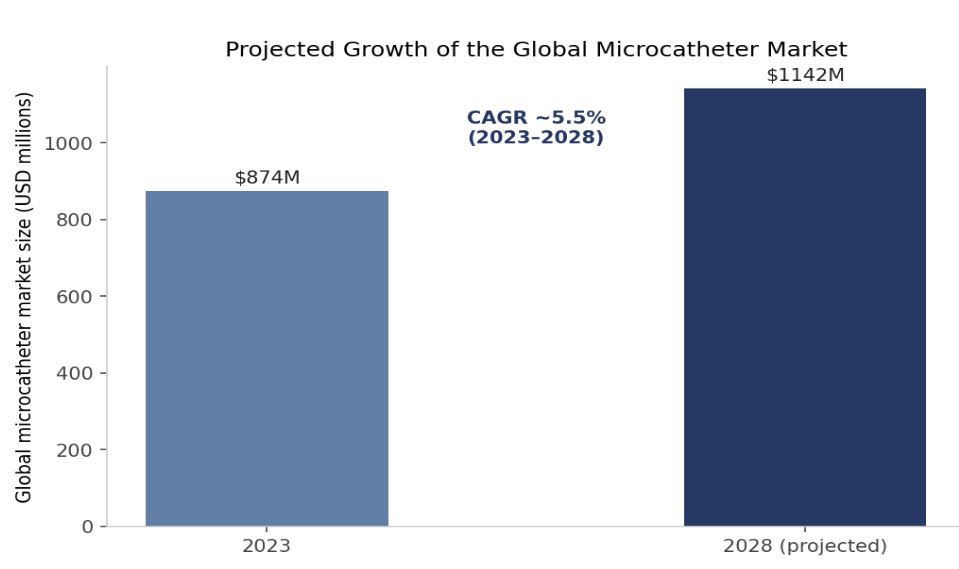
Projected global market size for microcatheters, 2023 versus a 2028 forecast, based on third-party market research.
What quality certifications should a coil manufacturing partner hold?
A coil manufacturing partner supplying catheter-based medical devices should hold ISO 13485:2016 certification, which sets quality management requirements covering design, production, installation, and servicing specifically for medical device manufacturers. the ISO certifications that govern medical-grade coil production lists the specific certifications relevant to coil production, since general ISO 9001 quality management and medical-specific ISO 13485 certification are both worth confirming before committing to a supplier. These certifications exist because risk management and regulatory traceability matter more once a component ends up inside a patient rather than inside a piece of industrial equipment.
What information should a developer share with a coil manufacturer before starting a project?
A developer should be ready to share the target coil dimensions, the electrical performance the coil needs to deliver (such as inductance or turns count), the catheter or device geometry it has to fit inside, and any sterilization or biocompatibility requirements the finished assembly must meet. It also helps to share where the project sits in its development timeline, since a manufacturing partner capable of small prototype runs for design validation is not automatically the same partner best suited to scaling a validated design into steady commercial production. Being upfront about volume expectations early tends to avoid a costly requalification cycle later, particularly for a medical coil supplier whose winding and bonding process may need formal validation under design controls before volume production begins.
Why does lead time differ so much between a coil prototype and a production order?
A handful of prototype coils can often be hand-wound or produced on flexible lab equipment within days to a couple of weeks, while a validated production run generally requires a qualified, repeatable process running on dedicated tooling, which takes considerably longer to set up the first time. That gap catches some device teams off guard late in development, when a design that worked perfectly as a prototype needs to move into steady, auditable production under design controls before a regulatory submission can proceed. Asking a prospective coil manufacturing partner to walk through their prototype-to-production transition process, not just their prototype turnaround time, is one of the more reliable ways to avoid a schedule surprise later in the project.
What else should a device developer ask before choosing a coil manufacturing partner?
Beyond certifications, a device developer should ask how thin a wire the partner can reliably wind and connect, since that number effectively caps how far a catheter design can be miniaturized. the winding techniques behind sub-millimeter medical coils is a useful reference point for the kind of winding and connection detail worth asking a prospective supplier to walk through directly, including how they join fine wire without introducing heat damage or strain at the joint.
How does the choice of coil manufacturing partner affect a regulatory submission?
A regulatory submission for a catheter-based device typically needs documented evidence that the manufacturing process is controlled and repeatable, which means a coil supplier’s own quality system becomes part of the device maker’s overall design history and risk file, not a separate concern. Switching coil suppliers after a design has already been validated can trigger a formal change control and re-verification process, since even a nominally identical coil produced on different equipment or by a different process may behave differently at the tolerances involved in sub-millimeter winding. That is part of why device developers tend to weigh manufacturing stability and quality documentation as heavily as price when choosing a coil supplier, rather than treating it as a purely transactional sourcing decision.
Frequently Asked Questions
What size does a coil need to be to fit inside a catheter for vein insertion?
A coil generally needs to measure under 0.8 millimeters in diameter to be inserted into a vein, which requires specialized winding equipment rather than standard commercial coil-winding machinery.
How fast is the microcatheter market growing?
Third-party market research projects the global microcatheter market to grow from about $874 million in 2023 to roughly $1.14 billion by 2028, a compound annual growth rate of around 5.5 percent.
What does ISO 13485 certification mean for a coil manufacturer?
ISO 13485:2016 is a quality management standard that sets requirements for the design, production, installation, and servicing of medical devices, covering risk management and regulatory compliance throughout the product lifecycle.
Why do catheter-based devices need custom-wound coils instead of standard ones?
Catheter-based devices often require coils with hundreds or over a thousand turns packed into a diameter smaller than a pinhead, a level of miniaturization that generally requires purpose-built winding machinery rather than off-the-shelf coil production lines.

| Key Takeaways
• Companies must register with Brazil’s RADAR system through Receita Federal before they can import goods, and eligibility depends on an active CNPJ, compliant company stakeholders, and an Electronic Tax Domicile on file. • RADAR assigns one of three operating modalities automatically based on estimated financial capacity: Limitada tiers capped at US$50,000 or US$150,000, or Ilimitada for unrestricted operations. • Telecom equipment entering Brazil must now carry ANATEL certification numbers inside the country’s Single Import Declaration (DUIMP), under a rule ANATEL implemented via Ato No. 18086, effective May 25, 2026. • Brazilian customs routes import declarations into one of four inspection channels — Green, Yellow, Red, or Gray — with Gray reserved for shipments suspected of fraud or under-invoicing. |
What has to happen before a shipment can even be filed with Brazilian customs?
Before any shipment can be filed, the importing company has to be registered with RADAR, Brazil’s own import-operator registration system, managed by Receita Federal, the country’s federal tax authority. Eligibility depends on holding an active CNPJ (company registration number), adopting an Electronic Tax Domicile, and having stakeholders with regular or pending-regularization tax status; a company with prior suspensions or cancellations on file can be disqualified outright. a full walkthrough of Brazil’s import compliance process for tech shipments covers what that registration step looks like in practice alongside the rest of the customs process.
What are the actual steps once a shipment reaches a Brazilian port?
Once RADAR registration is in place, a shipment moves through eight sequential steps: pre-import preparation and licensing, product classification under the correct HS/NCM code, documentation preparation, filing the Import Declaration through Brazil’s SISCOMEX electronic system, assignment to an inspection channel, duty and tax payment, release to free circulation, and potential post-clearance audit of the declared values.
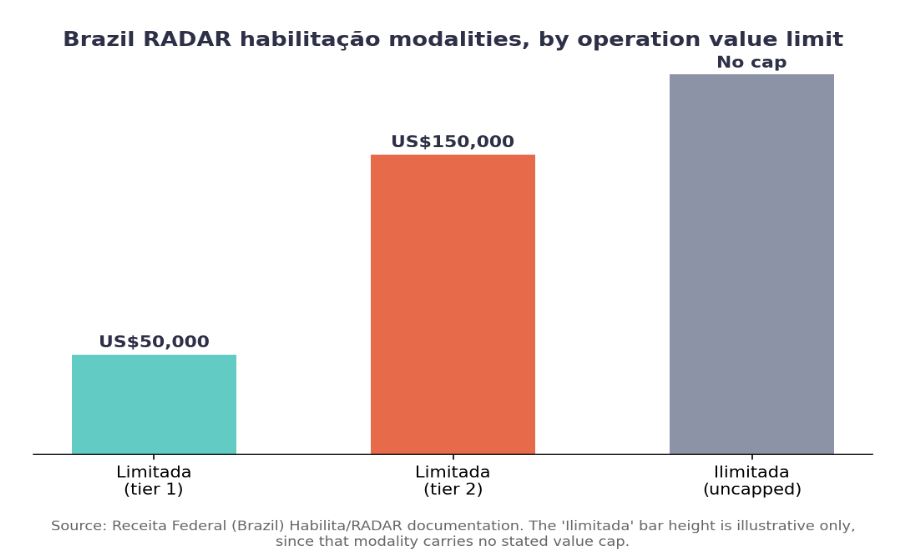
RADAR habilitação modalities and their operation-value limits. The Ilimitada bar is illustrative only, since that modality carries no stated value cap.
What determines which RADAR modality a company is assigned?
RADAR’s Sistema Habilita assigns one of three modalities automatically, based on the company’s estimated financial capacity rather than a manual application choice: Expressa, restricted to public corporations; Limitada, capped at either US$50,000 or US$150,000 in operation value; or Ilimitada, for unrestricted operations. A company that underestimates its own shipment volume can find itself capped at a lower tier than its actual import program needs.
What changed for telecom equipment specifically in 2026?
Brazil’s National Telecommunications Agency, ANATEL, implemented an update effective May 25, 2026 under Ato No. 18086 that requires ANATEL certification numbers to be included directly in Brazil’s Single Import Declaration (DUIMP) customs documentation. the U.S. government’s own summary of that change notes that ANATEL’s certification database is now integrating with SISCOMEX so customs can flag discrepancies during clearance, and that a related rule, Resolution No. 780/2025, expanded homologation obligations and liability exposure to online marketplaces as well as traditional importers.
Which taxes actually apply to an IT hardware shipment landing in Brazil?
- Import Duty (II) — the base federal import tariff
- Industrialized Product Tax (IPI) — applied to manufactured goods, including most IT hardware
- PIS/COFINS — federal social-contribution taxes calculated on the import transaction
- ICMS — a state-level value-added tax whose rate varies by the state of entry
Does the process look the same everywhere in Latin America?
No, RADAR, SISCOMEX, and ANATEL are specifically Brazilian systems, and neighboring countries run their own registration and certification regimes even when the underlying documents, like commercial invoices and certificates of origin, look similar on paper. regional logistics coverage across Latin American markets and a comparable process breakdown for neighboring Argentina are useful side-by-side references for a company shipping into more than one Latin American market at once.
Frequently Asked Questions
What is RADAR and why does a company need it before importing into Brazil?
RADAR is the registration a company must hold with Brazil’s Receita Federal before it can file import operations through SISCOMEX, and it determines the maximum value of goods that company is authorized to import based on automatically calculated financial capacity.
What happens if a shipment is routed to Brazil’s Red or Gray customs channel?
A Red channel routing means the shipment undergoes both documentation review and physical inspection before release, while a Gray channel routing is reserved for shipments where customs suspects fraud or under-invoicing and can trigger a deeper investigation.
Do all telecom products need ANATEL certification to enter Brazil?
Products classified as telecommunications equipment, connected devices, network infrastructure, and similar ICT categories generally require ANATEL certification, and as of the May 2026 rule change, that certification number must also appear in the shipment’s customs documentation.
Can a foreign company import into Brazil without a local presence?
A foreign company can work through a local importer of record or authorized representative that already holds RADAR registration, rather than establishing its own Brazilian legal entity solely to import goods.

| Key Takeaways
• 60% of IT teams are unaware of employee interactions with generative AI tools, according to Cisco’s 2025 Cybersecurity Readiness Index. • Organizations with high levels of shadow AI saw an average of $670,000 in higher breach costs than those with minimal or no shadow AI usage, per IBM research. • Only 37% of organizations currently have policies in place to manage or detect shadow AI. • Discovery has to precede detection, enforcement, and governance, since none of those controls can work against AI usage a security team doesn’t know exists. |
What exactly is shadow AI, and how is it different from shadow IT?
Shadow AI is when employees use AI tools, applications, or services without IT oversight, approval, or a formal security review, the same underlying pattern as shadow IT applied specifically to AI. The key difference is how it spreads: shadow IT usually requires installing software or requesting access, while using an AI tool rarely involves a purchase order or an IT ticket at all, since most SaaS applications now integrate AI capabilities by default and employees can start using an AI feature simply by clicking into a menu that already exists inside a tool they were approved to use. An in-depth look at the AI discovery gap facing most enterprises today describes this as a phenomenon that “spreads fast, hides easily,” leaving most enterprises without a clear picture of how widespread their own AI usage actually is, since teams experiment independently, developers integrate coding assistants into their own workflows, and individual employees turn to personal AI accounts on corporate devices, often without any of it being visible to the same security team at the same time.
Why can’t most enterprises see all the AI tools employees are already using?
Because AI usage doesn’t follow the acquisition patterns security tooling was built to monitor, and the visibility gap this creates is larger than most security teams assume. recent global cybersecurity readiness research from Cisco found that 60% of IT teams are unaware of employee interactions with generative AI tools, and 22% of employees have unrestricted access to public GenAI platforms even where some AI governance exists. The same research found that 60% of organizations lack confidence in their ability to detect unregulated AI deployments across their environment, which means the gap isn’t just about individual tool sprawl but about a structural inability to know when new AI usage starts, since traditional discovery methods built for procured software simply don’t capture usage that never went through procurement in the first place.
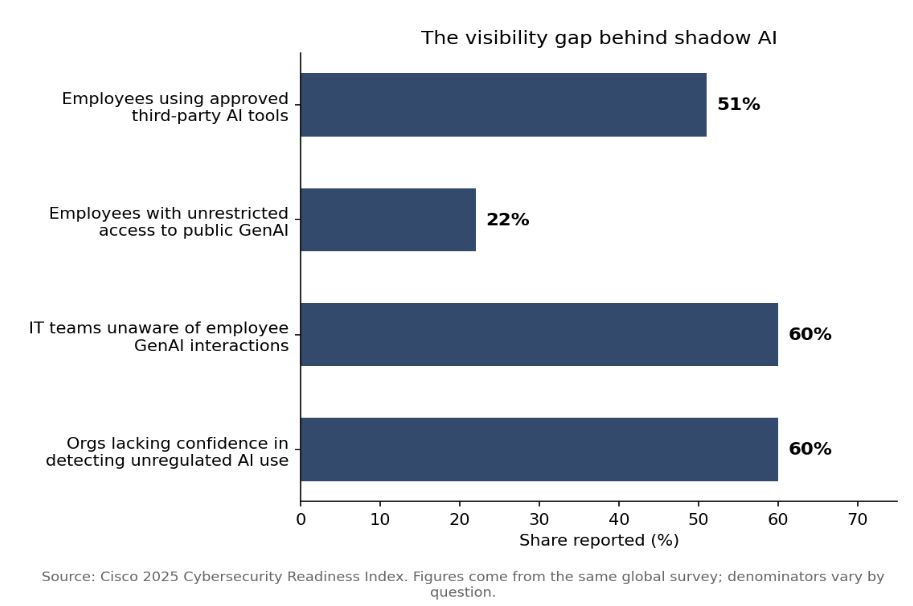
60% of IT teams report being unaware of employee interactions with generative AI tools, according to Cisco’s 2025 Cybersecurity Readiness Index.
Does shadow AI actually increase the cost of a data breach?
Yes, measurably. IBM’s newly released breach-cost research found that organizations with high levels of shadow AI experienced an average of $670,000 in higher breach costs compared to organizations with minimal or no shadow AI usage, and that one in five organizations experienced a breach stemming specifically from shadow AI. Despite that cost gap, only 37% of organizations currently have policies in place to manage or detect shadow AI at all, which helps explain why the exposure keeps compounding: the tools driving up breach costs are frequently the same ones without any formal detection policy covering them. Shadow AI-related incidents were also found to compromise personally identifiable information at a higher rate than the global average across all breach types, and intellectual property exposure followed a similar pattern, underscoring that this isn’t a theoretical governance gap but one already showing up in real incident data with real financial consequences.
What specific risks does the AI discovery gap actually create once it exists?
Several distinct risks tend to stack on top of each other once an organization can’t see its own AI usage clearly. These include data leaking into public models through ordinary employee use, prompt injection attacks targeting whichever tools are in use, AI agents operating with more autonomy than anyone approved, and missing audit trails that make it difficult to reconstruct what happened if an incident needs to be investigated after the fact. Each of these compounds the others: a missing audit trail doesn’t just slow down incident response, it also means a security team often can’t say with confidence whether a given exposure was a one-time event or part of an ongoing pattern, which in turn makes it harder to brief leadership on the organization’s actual risk posture with any precision.
Why is this considered a compliance risk as well as a security risk?
Because shadow AI usage tends to sit outside the systems and data flows that a compliance program was built to track, and regulations like the EU AI Act, GDPR, and HIPAA generally assume an organization can name the systems processing regulated data. When an employee pastes customer records or protected health information into an AI tool nobody inventoried, that activity typically also has no audit trail, which becomes a serious problem if an incident later needs to be investigated or reported to a regulator on a deadline. This is one reason enterprise AI governance conversations increasingly involve legal and compliance stakeholders alongside security, since closing the discovery gap serves both functions at once rather than being purely a security team’s problem to solve on its own.
What’s the first step toward closing the AI discovery gap?
Discovery itself has to come before detection, enforcement, or governance, since none of those controls can function against AI usage a security team doesn’t know exists. Controls for the public AI tools employees adopt on their own are typically the starting point, since public, consumer-facing AI tools are where most undocumented usage originates before any internal AI governance program gets involved. From there, most organizations move toward the kind of structured, evaluation-stage resources that turn discovery into an actual program, and a set of downloadable briefs covering common enterprise AI governance scenarios can give security and risk teams a starting framework for that next stage. The Cisco findings cited above are a useful benchmark for organizations trying to gauge how their own AI visibility compares to peers, given how few organizations worldwide currently rate their own readiness as mature.
Is closing the AI discovery gap a one-time project or an ongoing effort?
It’s ongoing, since new AI capabilities keep arriving through channels an inventory can’t fully anticipate in advance. A SaaS vendor can add a generative AI feature to an already-approved product overnight, a new personal AI account can appear on a corporate device the same afternoon, and neither event necessarily triggers any of the review processes built for traditional software procurement. That’s part of why organizations with minimal or no shadow AI tend to treat discovery as a continuous function rather than a project with a defined end date, revisiting their inventory on a regular cadence instead of assuming a single audit closes the gap for good.
How does closing the discovery gap change an organization’s overall security posture?
It shifts the posture from reactive to proactive, since most of the AI-related controls that actually reduce risk, policy enforcement, access restrictions, monitoring, depend on already knowing which tools and workflows they need to apply to. Without discovery, security teams are effectively responding to AI-related incidents after the fact, often learning about a given tool’s use for the first time during that investigation rather than beforehand. With it, the same team can prioritize the highest-risk usage first, focus governance resources where they matter most, and give leadership a realistic picture of AI exposure instead of one built only on what was formally approved.
Frequently Asked Questions
What is shadow AI?
Shadow AI is the use of AI tools, applications, or services by employees without IT oversight, approval, or a formal security review, similar to shadow IT but applied specifically to AI usage.
How common is it for IT teams to be unaware of employee AI usage?
Cisco’s 2025 Cybersecurity Readiness Index found that 60% of IT teams are unaware of employee interactions with generative AI tools.
Does shadow AI make data breaches more expensive?
Yes. IBM’s 2025 research found organizations with high levels of shadow AI saw an average of $670,000 in higher breach costs compared to organizations with minimal or no shadow AI usage.
What should an organization do first to address shadow AI?
Discovery comes first. A security team needs visibility into which AI tools are actually in use before it can apply detection, enforcement, or governance controls to that usage.

What to Look for in a Micro Coil Manufacturing Partner for Catheter-Based Devices

What It Actually Takes to Import IT and Telecom Equipment into Brazil

Shadow AI and the Enterprise Discovery Gap: What Security Teams Are Missing

-

 Business Solutions2 years ago
Live Video Broadcasting with Bonded Transmission Technology
-

 Business Solutions1 year ago
The Future of Healthcare SMS and RCS Messaging
-

 Business Solutions2 years ago
2-Way Texting Solutions from Company Message Services
-

 Business Solutions2 years ago
Communication with Analog to Fiber Converters & RF Link Budgets
-

 DSRC Communication1 year ago
The Crossroads of Connectivity: DSRC vs. C-V2X Technologies in Automotive Communication
-

 Business Solutions2 years ago
Wholesale SMS Platforms with OTP Services
-

 Business Solutions2 years ago
Choosing the Right B2B Digital Marketing Agency: A Guide
-

 3D Technology1 year ago
How Multispectral Cameras Advance Book Scanning