


Tech
What Is Intelligent Video Analytics? A Defense and Security Guide for 2025-2026

Introduction
Raw video footage has never been the problem. The challenge – for defense forces, homeland security agencies, and commercial operators alike – is turning vast, continuous streams of video data into actionable intelligence, fast enough to matter. This is precisely what intelligent video analytics delivers: the ability to analyze video in real time, automatically detect objects and behaviors of interest, and surface relevant alerts without requiring a human operator to watch every frame. As AI capabilities have matured and edge computing has become viable on compact, ruggedized hardware, intelligent video analysis has transitioned from a niche research application to a core operational capability across defense, HLS, and critical infrastructure protection.
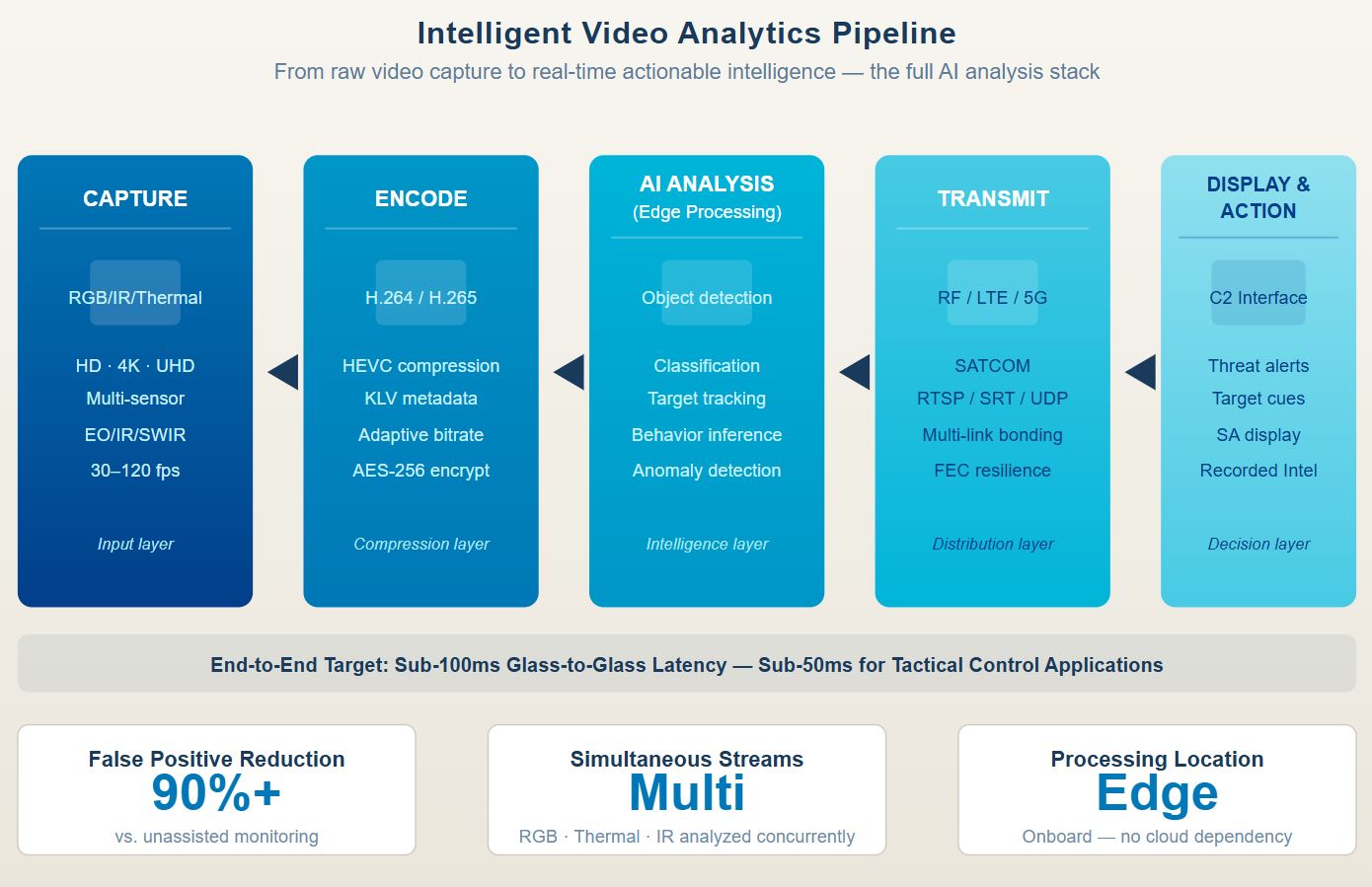
What Is Intelligent Video Analytics?
Intelligent video analytics (IVA) refers to the automated processing of video feeds using artificial intelligence and computer vision algorithms to extract structured, actionable information. Rather than passively recording and displaying footage, IVA systems actively analyze what the cameras see — identifying objects, classifying behaviors, tracking movement, and generating alerts when predefined conditions are met.
Modern intelligent video analysis encompasses several distinct analytical functions:
- Object detection: Identifying and locating vehicles, personnel, aircraft, or other objects within a video frame
- Object classification: Distinguishing between different categories — friendly forces vs. unknown contacts, light vehicles vs. armored vehicles, commercial aircraft vs. tactical UAVs
- Object tracking: Following a detected object across multiple frames and multiple camera feeds simultaneously
- Behavior recognition: Detecting patterns of movement or activity that indicate threat — unauthorized entry, loitering in restricted zones, convoy formation, or launch preparation
- Anomaly detection: Flagging deviations from learned baseline patterns without requiring explicit definition of every possible threat scenario
Why Intelligent Video Analytics Matters for Defense and Homeland Security
The operational case for intelligent video analysis in defense and HLS environments is straightforward but compelling. Modern surveillance architectures generate video data at volumes that exceed any human monitoring capacity. A single UAV conducting a 12-hour ISR mission generates hundreds of gigabytes of footage. A border surveillance system monitoring 100 kilometers of frontier operates continuously with no natural breaks. A force protection network around a forward operating base may run dozens of camera feeds simultaneously.
Without automation, most of this data is never meaningfully analyzed. Operators become fatigued, attention narrows, and genuinely significant events can occur during the moments when no analyst is actively watching. Intelligent video analytics addresses this directly by maintaining continuous, consistent, tireless analysis — and by alerting human operators only when something requires their attention.
The benefits are measurable:
| Operational Benefit | Impact |
|---|---|
| Reduced operator cognitive load | Human analysts focus on decisions, not monitoring |
| Faster threat detection | Millisecond AI response vs. seconds or minutes for human detection |
| Continuous coverage | No fatigue, no shift changes, no lapses in attention |
| Multi-stream analysis | A single AI system monitors dozens of feeds simultaneously |
| Searchable intelligence | Post-mission analysis with indexed object and event records |
For an independent perspective on how intelligent video analytics integrates with broader tactical situational awareness frameworks, this analysis of modern situational awareness systems provides useful operational context.
The Technology Behind Intelligent Video Analysis
Understanding what makes intelligent video analytics effective requires understanding the technology stack that powers it — from sensor to alert.
Video Capture and Encoding
The analytical pipeline begins with video capture. Camera quality, resolution, spectral range (visible, infrared, thermal), and encoding standard all affect what the AI system can extract from the footage. H.265/HEVC encoding is preferred in bandwidth-constrained environments because it maintains high visual quality at lower bitrates — ensuring that the footage arriving at the AI analysis stage contains sufficient detail for accurate detection and classification.
AI Processing at the Edge
The most significant advancement in intelligent video analysis over the past several years has been the shift from cloud-dependent processing to edge-based AI inference. Rather than transmitting raw video to a centralized server for analysis, modern systems run AI models directly on the platform that captures the video — whether that is a UAV, a ground vehicle, a fixed camera, or a soldier-worn device. This eliminates the latency inherent in round-trip transmission, enables operation in bandwidth-limited or connectivity-denied environments, and reduces the risk of intelligence interception during transmission.
Object Detection and Classification Models
Convolutional neural networks (CNNs) and transformer-based vision models form the backbone of modern IVA systems. These models are trained on labeled datasets of the object categories and behaviors relevant to the deployment context — military vehicles, aircraft types, personnel in specific configurations, or activity patterns in specific terrain types. Well-trained models operating on appropriate hardware can achieve real-time inference at 30+ frames per second.
Alert Generation and Operator Interface
The output of the AI analysis pipeline is structured data — object identities, locations, confidence scores, and behavioral classifications — that feeds into operator interfaces designed to surface the highest-priority intelligence. Effective interfaces suppress false positives, provide context for alerts, and allow operators to drill into the underlying video for confirmation.
Maris-Tech’s Intelligent Video Analytics Approach
Maris-Tech has built its entire technology stack around the thesis that meaningful intelligence must be generated at the point of collection. The company’s AI edge video processing platforms perform the full intelligent video analysis pipeline onboard UAVs, unmanned ground vehicles, armored platforms, and soldier-carried systems — without dependency on cloud connectivity or ground station processing.
The Maris approach integrates every layer of the video analytics pipeline:
- Multi-sensor acquisition covering RGB, thermal, and infrared channels
- H.264/H.265 encoding optimized for bandwidth-constrained transmission
- Onboard AI inference using hardware accelerators (including the Hailo-8 chipset) for object detection, classification, and tracking
- Real-time alert generation feeding into command-and-control interfaces
- KLV metadata embedding for geospatial context in accordance with MISB standards
This architecture is reflected in the company’s AI video analysis capabilities, which are deployed across defense, HLS, and commercial sectors globally. Field-proven with leading security organizations across Israel, Europe, North America, and Asia Pacific, Maris-Tech’s solutions are trusted in operational environments where the consequences of missed detections or false positives are measured in lives and mission outcomes.
Key Applications of Intelligent Video Analytics in 2025–2026
Intelligent video analysis is being applied across a rapidly expanding set of operational contexts:
Airborne ISR
UAVs equipped with IVA can autonomously detect and follow targets of interest across complex terrain — without requiring operators to actively track every movement. This dramatically extends the effective range of ISR missions and reduces the number of operators needed per platform.
Border and Perimeter Security
Fixed and mobile camera networks equipped with AI analysis can monitor extended frontiers 24/7, alerting security forces only when genuine incursions or anomalous behaviors are detected — filtering out false positives from wildlife, weather, or civilian movement.
Force Protection
Around forward operating bases or critical installations, intelligent video analytics provides persistent 360-degree awareness, detecting and classifying threats before they reach engagement range and cueing counter-measures or response forces.
Counter-UAS Operations
IVA systems are increasingly deployed specifically for the detection and classification of hostile UAVs — tracking swarm formations, identifying launch signatures, and supporting intercept targeting in real time.
Urban Operations
In complex urban environments, AI video analytics supports route reconnaissance, crowd monitoring, and facility security, identifying patterns of behavior that precede attacks or coordinated incursions.
According to Wikipedia’s overview of video analytics technology, the field has expanded significantly with the availability of affordable AI hardware and the maturation of computer vision models — making capabilities once reserved for the largest defense programs accessible to a much broader range of operators and applications.
Selecting an Intelligent Video Analytics System
For procurement teams and defense integrators evaluating IVA platforms, several technical criteria consistently separate operational-grade solutions from commercially-adequate alternatives:
- Detection accuracy at target ranges: What is the false positive and false detection rate at operationally relevant distances?
- Multi-stream capacity: How many simultaneous video feeds can the system analyze without degrading detection performance?
- Latency from capture to alert: End-to-end pipeline latency of under 100ms is the operational standard for real-time tactical applications
- Edge processing independence: Can the system operate effectively without persistent connectivity to a ground station or cloud server?
- Environmental qualification: Is the hardware MIL-STD-rated for vibration, temperature extremes, dust, and moisture?
- Integration with C2 systems: Does the system output structured data compatible with standard command-and-control architectures?
As intelligent video analytics continues to mature, the gap between what AI-enabled systems can detect and what human operators can manually monitor will only grow wider. Organizations that build intelligent video analysis into their surveillance and ISR architecture now will hold a substantial operational advantage over those that treat it as a future capability.


| Key Takeaways
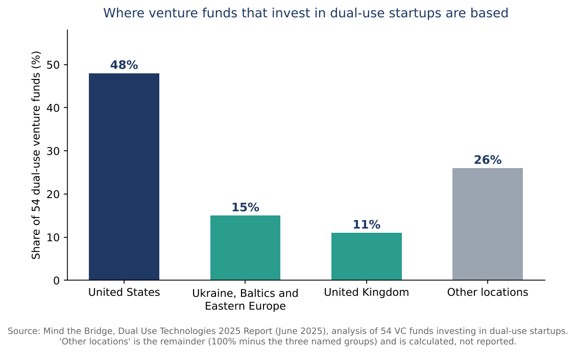
• Dual-use technology serves both civilian and defense customers, so a startup can build commercial revenue while it pursues slower government procurement. • Mind the Bridge identified 54 venture funds worldwide that invest in dual-use startups, with 48% based in the United States and 11% in the United Kingdom. • Most venture capital firms avoid direct weapons contracts but back sensors, software, AI and cybersecurity whose technology can serve both markets. • Foreign direct investment screening and government scrutiny shape how dual-use rounds are structured and how exits are planned. |
What counts as dual-use technology in venture capital?
Dual-use technology is technology with both civilian and military applications, which means a single product can serve commercial customers and defense buyers. A recent Mondaq analysis of dual-use investing describes the category as items designed for commercial use that can also serve battlefield, security or weapons purposes, with drones, artificial intelligence, cybersecurity systems and quantum technologies as typical examples.
The idea is older than the current investment cycle. GPS satellites are a widely cited example of military technology that was later repurposed for consumer use, and a perspective on why investors are funding dual-use companies notes that many venture capitalists now actively seek opportunities in this area. The same piece points to infrared sensors, originally designed to detect enemy presence from military vehicles, which now power night-vision systems in cars that help drivers spot people or animals up to about a hundred yards away.
For founders, the practical test is whether the underlying capability can be sold twice: once into a commercial market with its own revenue cycle, and once into defense or security programs. Investors reviewing an early-growth portfolio focused on deep and defense technology will recognize this pattern in artificial intelligence, quantum, robotics and security companies, where the same engineering work supports more than one buyer.
Why are venture investors paying more attention to dual-use companies now?
Rising defense budgets and geopolitical tension have made defense-adjacent technology a priority for governments, investors and startups at the same time. Mind the Bridge’s 2025 report names those drivers and adds that critical military capabilities, from AI-enabled surveillance to autonomous systems, will come not only from established primes but also from agile startups.
Public money is following the same logic. The Mind the Bridge Dual Use Technologies 2025 Report states that the European Union committed 1.5 billion euros to defense-related research and development in 2024 through initiatives such as EDIRPA and the European Defence Fund. It also reports a 400 million pound defense innovation pledge from the United Kingdom, a doubling of Germany’s military procurement budget, and a NATO Innovation Fund with 1 billion euros that has begun backing dual-use startups across member states.
Exit logic adds to the appeal. The Mondaq analysis observes that dual-use assets can interest both defense primes and private equity buyers, giving investors a wider set of exit options than a purely civilian or purely military company would offer.
The appeal is not limited to a single region. Mind the Bridge reports that 15% of the 54 funds it identified are located in Ukraine, the Baltics and Eastern Europe, particularly Poland and Czechia, reflecting a heightened regional focus on defense and security innovation. The same report describes Israel as a pioneer of the model, turning military-born innovation into a startup powerhouse, while the United States maintains programs such as DIU, AFWERX and NSIN to bring commercial technology into defense.
How do dual-use technologies differ from purely military ones?
Dual-use products have a civilian market and can be adapted for defense, while purely military products such as weapons and ammunition sit outside what most venture funds will back. As the perspective above explains, most venture capitalists avoid direct weapons contracts because that technology usually cannot be redeployed in civilian markets under security regulations.
The examples that tend to attract venture money are technologies that moved between the two worlds. The table below collects three cited in that discussion.
| Technology | Defense-related origin | Civilian use today |
| GPS satellites | Military technology | Consumer location applications |
| Infrared sensors | Detecting enemy presence from military vehicles | Night-vision systems in cars |
| Drones | Military buyers account for about half of one leading U.S. maker’s sales | Remaining sales go to non-military customers |
What risks do dual-use investors have to manage?
The main risks are government scrutiny, slow procurement and complicated ownership structures. Mondaq notes that dual-use companies stay subject to close government attention, including foreign direct investment screening, while Mind the Bridge describes a valley of death for startups after initial pilots because procurement still follows older models.
Deal terms reflect this. The Mondaq piece says investors in dual-use companies may negotiate board observer seats, information rights and rights over future use of the technology. It also describes private capital investors splitting some portfolio companies into separate military and non-military arms linked by licensing agreements, a structure designed to widen the pool of acquirers for the civilian business while keeping the higher-value military component for a targeted sale.
Adoption is the second hurdle. Mind the Bridge quotes an industry executive explaining that many armed forces are unaccustomed to working with startups at technology readiness level six, that startup fragility raises survivability concerns, and that scaling and field deployment remain bottlenecks.
Dual-use also reaches beyond hardware. Mondaq points out that sensitive personal data is now expressly treated as a dual-use asset with national security implications, which extends the category into data-heavy software companies. Diligence on such a company requires a detailed understanding of its financing structures, since some stakes come with extensive governance rights.
How do investors structure exposure to dual-use companies?
Investors can take minority stakes in early-growth rounds or acquire controlling stakes, and some combine both approaches. The choice matters because Mind the Bridge reports that most defense startups lack the infrastructure to scale hardware production on their own.
Elron Ventures describes a combination of this kind on its website: early-growth investments across cybersecurity, AI, deep tech and defense tech, alongside an M&A strategy aimed at acquiring controlling stakes in early-stage dual-use defense-tech companies. A control strategy gives the buyer direct responsibility for scaling, while the minority track keeps exposure to a wider set of young companies.
What should founders prepare before approaching dual-use investors?
Founders should be able to show commercial traction in a civilian market, a credible route to defense or security customers, and a financing plan that survives slow procurement. Each element answers a risk that investors already track.
Civilian revenue demonstrates that the technology works outside a single government program. A defined path to defense buyers, such as an existing pilot or a named program, shows that the second market is more than a slide in a deck. Financing needs to cover the gap between pilot and contract, which Mind the Bridge identifies as the point where many startups stall.
Ownership and governance deserve early attention too. Because foreign direct investment screening can apply, clean cap tables, clear intellectual property ownership and a view on which parts of the technology could be separated for a civilian sale all make diligence easier. Founders who can explain those points in plain terms tend to shorten the conversation, since the investor does not have to reconstruct the structure from scratch.
Finally, founders should expect questions about exit. Dual-use companies can attract defense primes and private equity, and a founder who understands both buyer types can present a more flexible story than one who assumes a single outcome.
Frequently Asked Questions
What is dual-use technology?
Dual-use technology is technology designed for commercial or civilian use that can also serve military, security or defense purposes. Drones, artificial intelligence, cybersecurity systems and quantum technologies are common examples.
Do venture capital firms invest in weapons?
Most venture capital firms avoid direct weapons contracts because that technology usually cannot be redeployed in civilian markets under security regulations. Many instead back startups whose technology can be repurposed for civilian use.
How many venture funds invest in dual-use startups?
Mind the Bridge identified 54 venture funds worldwide that invest in dual-use startups in its 2025 report. Nearly half, 48%, are based in the United States and 11% in the United Kingdom.
Why are dual-use companies attractive at exit?
Dual-use companies can interest both defense primes and private equity buyers, which gives investors a broader set of possible acquirers than a purely civilian or purely military business.
| Key Takeaways
• MIL-PRF-31032 qualifies a manufacturer’s process and quality plan through the Defense Logistics Agency’s Qualified Manufacturers List rather than approving individual part numbers. • IPC Class 3 defines high-reliability board performance, and IPC-6012DS adds requirements for rigid boards used in space and military avionics. • AS9100 is the aviation, space and defense quality management standard built on ISO 9001, and certified suppliers are listed in the IAQG’s OASIS database. • U.S. manufacturers of defense articles must register with the State Department’s Directorate of Defense Trade Controls under ITAR, even if they do not export. |
What makes a military PCB manufacturer different from a standard board shop?
A military PCB manufacturer is distinguished less by the boards it builds than by the evidence it can show: qualification against defense performance requirements, an aviation-grade quality system, and compliance with U.S. export controls. The boards themselves often overlap with commercial high-reliability designs, since the defense specification sheets cover rigid multilayer, single- and double-sided, flexible, rigid-flex and high-frequency constructions. What changes is the proof behind them. Buyers comparing suppliers for requirements that are specific to defense electronics usually end up checking four things: the military performance specification, the IPC class, the quality certification and the export registration.
What do IPC Class 3 and IPC-6012DS add to a military board specification?
IPC Class 3 is the high-reliability performance tier in IPC’s printed board standards, and IPC-6012DS is an addendum that adds requirements for rigid boards used in space and military avionics. The addendum is aimed at boards that must survive the vibration, ground testing and thermal cycling of those environments, and it supplements or replaces selected requirements in IPC-6012D. Thermal cycling is also why accelerated thermal testing is relevant to these boards, and one manufacturer describes an in-house accelerated thermal shock lab built to evaluate board survivability. For flexible boards, a trade-press column reports that IPC-6013 Class 3 is generally accepted by government agencies as the commercial equivalent of the military specification.
What does MIL-PRF-31032 actually qualify?
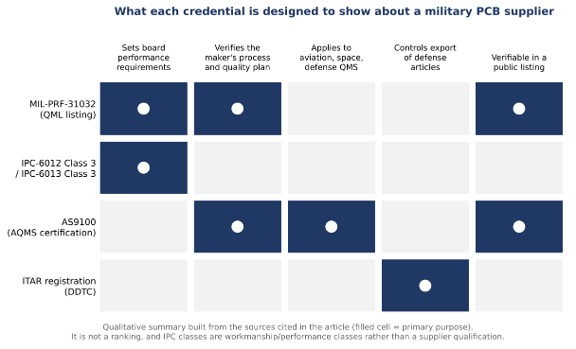
MIL-PRF-31032 is the Department of Defense performance specification for printed boards, and it qualifies the manufacturer’s process and quality plan rather than individual part numbers. Certification runs through the Defense Logistics Agency’s Qualified Manufacturers List program, which requires verification of the quality management plan by a Technical Review Board, demonstrated manufacturing capability and ongoing lot acceptance testing. Manufacturers that complete the process are listed on the QML, which defense contractors use when selecting suppliers for new programs.
DLA’s own certification language adds two cautions: a QML listing does not guarantee acceptance of a product in any future purchase, and it does not waive any requirement of the specification. The certification letter also details which technologies a manufacturer is approved for, so the listed scope matters as much as the listing itself.
What would a MIL-PRF-31032 cancellation change for buyers?
A cancellation would move board performance requirements toward IPC standards fairly directly, but it would not automatically replace the qualification system around them. An April 2026 column reported that a Defense Logistics Agency memorandum dated March 4, 2026 proposed cancelling MIL-PRF-31032 and its six specification sheets, with a short comment window and a path for another activity to accept management of the documents. The column describes both the proposal and the questions it raises about the QML. Its author notes that the IPC-6010 series already serves as the commercial counterpart, while the QML, the Technical Review Board model and the DLA oversight role would need deliberate redesign by whoever takes ownership.
The column also asks what happens to legacy programs that still cite MIL-PRF-31032 or the older MIL-PRF-55110, which remains in use on some older platforms. The final outcome was not confirmed in the sources reviewed for this article, so it should be checked with the qualifying activity or the contracting officer before a purchasing decision relies on it.
What does AS9100 certification tell a buyer?
AS9100 shows that a supplier operates a quality management system built for aviation, space and defense work, and it is based on ISO 9001 with additional industry requirements. The standards are published through the International Aerospace Quality Group, which also runs the certification scheme and maintains the Online Aerospace Supplier Information System, known as OASIS. That database holds certification status, auditor information and audit results, so a buyer can check a supplier’s claim directly rather than relying on a logo. Details of the scheme are on the IAQG certification overview.
Does a PCB manufacturer need ITAR registration?
Any U.S. company that manufactures defense articles must register with the State Department’s Directorate of Defense Trade Controls, even if it never exports. The registration form’s own instructions state that manufacturers who do not export must nevertheless register under ITAR section 122.1. The relevant instructions are in the State Department DS-2032 registration form. Registration is a legal requirement for certain work, not a quality credential, so it answers a different question from the other items on this list.
How do the main credentials compare side by side?
The table below summarizes what each item covers and where a buyer can check it. The checking column matters most, because each credential has its own source of truth.
| Credential | What it covers | Who administers it | Where to check |
| MIL-PRF-31032 | Performance and verification requirements for printed boards under a QML program | Defense Logistics Agency | DLA certification letter and QML listing; confirm current status |
| IPC-6012 / IPC-6013 Class 3 | Performance requirements for rigid and flexible boards at the high-reliability tier | IPC | Supplier conformance records and purchase documents |
| IPC-6012DS | Added requirements for rigid boards in space and military avionics | IPC | Called out in the drawing or purchase order |
| AS9100 | Quality management for aviation, space and defense organizations | IAQG scheme and certification bodies | IAQG OASIS database |
| ITAR registration | Registration of manufacturers of defense articles | State Department DDTC | Evidence of current registration from the supplier |
How should a buyer verify what a supplier claims?
A buyer should verify each credential at its source and treat a supplier’s published sector experience as context rather than proof. Some suppliers publish more than others. PCB Technologies, for example, describes defense experience that includes special antennas, seekers, night vision equipment, radios, data terminals, radiation detectors and range finders, which tells a buyer what kinds of programs a supplier has touched but not which certifications it holds.
- Ask for the DLA certification letter and the qualified technology scope, and compare it to the board being quoted.
- Look the supplier up in OASIS and confirm the certification body, scope and expiry.
- Confirm which IPC class and addendum the drawing actually requires, and ask for the matching test records.
- Ask for evidence of current ITAR registration if the work involves defense articles.
- Re-check the MIL-PRF-31032 status, since the specification was proposed for cancellation in 2026.
Frequently Asked Questions
What is a QML in military PCB sourcing?
A Qualified Manufacturers List is a Defense Logistics Agency listing of manufacturers whose processes and quality plans have been qualified under MIL-PRF-31032, which lets defense buyers source boards from verified suppliers.
Is IPC Class 3 the same as MIL-PRF-31032?
No. IPC Class 3 is a high-reliability performance tier, while MIL-PRF-31032 is tied to a government qualification program for the manufacturer, although a trade-press column notes that IPC-6013 Class 3 is generally accepted as the commercial equivalent for flexible boards.
Does a U.S. PCB manufacturer that does not export need ITAR registration?
Yes, if it manufactures defense articles, because the State Department’s registration instructions say manufacturers who do not export must still register.
How can a buyer check a supplier’s AS9100 certification?
A buyer can search the International Aerospace Quality Group’s OASIS database, which lists certification status, auditor information and audit results for certified suppliers.
Software
The AI Isn’t Wrong About Your Company. Your Sources Are
An interview with Aia Laser, founder of AlignTo AI.


Most companies now check what ChatGPT and Gemini say about them. Far fewer ask where the answer came from. The uncomfortable finding, for those who trace it, is that it usually came from them.
Ask an AI assistant to describe a company and it will answer with confidence: what the company makes, where it is based, who it competes with. For a growing number of brands, that answer is wrong in ways that cost real deals. A manufacturer is placed in the wrong country. A product that was discontinued three years ago is presented as the flagship. A company that merged, rebranded or moved upmarket is described as the company it used to be.
The standard response is to treat it as a content problem: publish more, add structured data, chase citations. Practitioners who have traced AI answers back to their origins say the error sits upstream of any single page.
“An AI engine is not inventing a story about your company,” says Aia Laser, founder of AlignTo AI, a Tel Aviv startup that helps brands take control of how and why AI systems represent them. “It is assembling one from three inputs: your own site, what third parties say about you, and what it has already learned from both. When those three disagree, the model averages them. Most brands have never checked whether they agree.”
Tracing the answer to its source
Laser’s claim rests on an audit of an industrial manufacturer, one of AlignTo AI’s first clients. Her team captured hundreds of AI answers about the brand across several engines and traced every claim in them to one of three places: the company’s own site, a third-party page, or no page at all.
The company’s site stated its headquarters and manufacturing locations correctly, but in a handful of places and not always where a machine would read them. Distributor listings and directory pages, written years earlier, described it as a US or European manufacturer. And in ChatGPT’s answers, the brand was named correctly in 88 percent of cases without any cited page carrying the information: the model had already learned the company from the whole corpus, and the corpus did not agree with itself.
“Your site is the one input you fully control, and it is upstream of everything else,” Laser says. “Third parties copy it, and the models learn from both. If your site says the right thing once, quietly, and twenty distributor pages say something else, the model will not side with you. It will side with the majority.”
“People hear that and conclude the site does not matter,” Laser says. “It is the opposite. The site is where the correct version has to live, stated clearly and in a form AI can read, because everything else is copied from it or compared against it. The mistake is thinking the site is where the work ends.”
The practical consequence is a familiar story in marketing departments this year. A team spends a quarter rewriting product pages, the dashboard shows citations climbing, and the AI assistant still tells prospects the company is headquartered in the wrong country, because the pages the engines trust most were never the company’s own.
The identity the machines already hold
Laser says the problem begins one step earlier than most people look. “Before a model decides what your company does, it has to decide which company you are. That step is called entity disambiguation, and nobody in marketing is watching it. If your name is common, or shared with a competitor, or also an ordinary word, the model may merge you with someone else’s facts, or split you into two half-entities that each carry part of your story. Everything it says afterward is built on that decision.”
The decision is not hidden, she argues, and that is the part the industry misses. “Google’s Knowledge Graph is a database with an API. Wikidata is open. You can query them for your own entity and see exactly what the machines hold: what name and type they have for you, the one-line description they attach, which aliases they recognize, what identifier they assigned, and how confident the match is. That is real knowledge-graph probing, and it takes minutes. I have never had a company do it before we did it for them.”
What comes back is frequently a shock. “We have seen companies that exist in the graph as the wrong type, or under a name they stopped using years ago, or not at all. When the record is missing or wrong, every engine that leans on it is guessing, and it will guess from whatever third-party page it finds. So when an AI answer has no cited page behind it, the first question is not what the site says. It is what the identity record says.”
Who the memory hurts
A startup founded last year has little to fear from this. There is not much for a model to remember. The companies most exposed are the ones with the longest histories and the most to lose from being described as their former selves.
Post-merger companies are the clearest case. The acquired brand still exists in years of press coverage, directory listings and old partner pages, and the model has absorbed all of it. Long-established firms carry a legacy perception that may be a decade out of date. International companies find that each market has told a slightly different story about them, and the model has averaged the stories together. Any company that repositioned, dropped a product line or moved into a new category is, in the model’s memory, still where it started.
“The companies that come to us are not companies with bad content,” Laser says. “They are companies with a past. The model is faithfully describing a version of them that is still live in a hundred places they do not control, and usually in a few places they do. Nobody ever went back and reconciled the story.”
The damage is quiet. Nobody sees the deal that was never opened because a buyer asked an assistant for a shortlist and the company appeared under the wrong description, or did not appear at all.
Three causes, one diagnosis
The deeper problem, Laser argues, is that an AI misrepresentation can have three different causes, and each demands a different response. The industry mostly treats them as one.
| Cause | What it looks like | What actually fixes it |
| Owned-source gap | The brand’s own site never states the fact, states it inconsistently, or states it where AI cannot read it | Content and structure changes on the site |
| Third-party gap | Distributors, directories, publishers and partner pages carry the old or wrong story | Outreach and correction of the sources AI reads, prioritized by which ones engines actually cite |
| Model memory | The engine states the error with no page to support it | Correcting the identity record in the knowledge graphs, and keeping the site and corpus consistent with it over time; a single page change will not reach it |
“Attribution is the whole game,” she says. “If you cannot say which bucket a mistake sits in, you will spend the content budget on an error that content cannot touch, and ignore a distributor page that is quietly teaching every engine the wrong headquarters.”
Monitoring tools, in her view, are good at the first half of the job. They show what the engines are saying. What they rarely do is explain why, because explaining why requires a confirmed record of what is actually true about the company, and most companies have never written one down.
Showing a brand what AI knows about it
AlignTo AI was built to answer the question most monitoring tools leave open: not only what the engines say about a brand, but where each claim came from and why. The startup shows companies what AI currently knows about them, traces every misrepresentation back to its root source, whether on the brand’s own site, on a third-party page, or in the model’s identity record, and gives the company a way to decide and control how it is represented from there.
Aia Laser, who also founded the Tel Aviv B2B tech digital marketing agency (Inter-Dev), spent over a decade in leading SEO strategies for renowned Israel’s tech companies, before AI answers became a channel, frames it in plainer terms. “Would you let a new salesperson go out and talk about your brand without handing them the updated, correct data first? That is what every company is doing with AI right now. The engines are the salespeople. They are out there describing you to buyers all day, and nobody at the company has checked what they were trained on or told them what changed.”
The argument is that representation in AI is a governance problem, not a content problem.
“Brands have been outsourcing their own definition to whoever wrote about them last,” she adds. “AI just made the cost of that visible.”
What to do before the next audit
Aia Laser’s advice to companies that suspect the model has them wrong is to stop optimizing and start diagnosing.
- Capture answers with their citations, then trace every claim: is it on your site, on a third-party page, or on neither? That tells you where the model learned it.
- Write down what is true. One confirmed record of the company’s facts, agreed internally, is the baseline every audit needs and almost no company has.
- Check your own site against that record first. Every fact should be stated, consistent across pages, and readable by a machine.
- Sort every remaining error by cause before spending on any of them, and treat a change that shipped and moved nothing as information about where the error really lives.
“Everyone is asking how to get the AI to notice them,” she says.
“The harder question is what the AI already thinks it knows, and whether anyone at the company has ever decided what the answer should be.”

Dual-Use Technology Investing: How Venture Capital Evaluates Civilian and Defense Startups

Kapia Pepper Explained: Sweetness, Roasting Quality and Where Mini-Kapia Types Fit

Inside an IRL Streaming Backpack: How It Works and Why It Uses Bonding

-

 Business Solutions2 years ago
Live Video Broadcasting with Bonded Transmission Technology
-

 Business Solutions2 years ago
2-Way Texting Solutions from Company Message Services
-

 Business Solutions2 years ago
The Future of Healthcare SMS and RCS Messaging
-

 Business Solutions2 years ago
Communication with Analog to Fiber Converters & RF Link Budgets
-

 DSRC Communication2 years ago
The Crossroads of Connectivity: DSRC vs. C-V2X Technologies in Automotive Communication
-

 Business Solutions2 years ago
Wholesale SMS Platforms with OTP Services
-

 Business Solutions2 years ago
Choosing the Right B2B Digital Marketing Agency: A Guide
-

 3D Technology2 years ago
How Multispectral Cameras Advance Book Scanning