


Business Solutions
From Cloud to Edge: Object Detection Gets an Upgrade
The evolution of AI Object Detection is here, shifting from cloud dependency to powerful edge computing. Experience the benefits of real-time processing, unmatched efficiency, and groundbreaking innovation, as systems become smarter, faster, and more responsive than ever before.


Cameras Are Watching—But Are They Thinking?
It’s one thing to record what’s happening. It’s another to understand it in real time. That’s the leap we’re witnessing as AI object detection shifts from centralized cloud systems to compact, high-performance edge devices.
In airports, on highways, in retail stores, and on factory floors, cameras are everywhere. But flooding the cloud with raw footage for analysis leads to latency, privacy concerns, and bandwidth costs. The solution? Push intelligence to the edge. AI object detection on edge processors is redefining how we approach computer vision: fast, local, efficient, and private.
The Invisible Genius: What Makes an Edge Processor Special
You won’t find edge processors grabbing headlines like GPUs or cloud AI clusters, but their influence is massive. These chips are designed for low-power, high-efficiency computation in constrained environments—often embedded directly into sensors, smart cameras, or microcontrollers.
What makes them special isn’t just performance—it’s purpose. Edge processors are tailored to execute AI inference tasks like object detection using optimized instructions and parallel data pipelines. While a general-purpose CPU might struggle with real-time image processing on a power budget, an edge processor excels.
Some processors, like Google’s Edge TPU or Hailo’s AI accelerator, handle billions of operations per second using mere watts of power. Others include integrated neural processing units (NPUs) or vision-specific architectures that offload tasks from CPUs entirely.
Detection Redefined: Smarter Algorithms Meet Smaller Devices
Running object detection models at the edge means balancing accuracy with efficiency. Large models like Faster R-CNN or YOLOv7 may offer high precision, but they’re too bulky for edge environments. That’s where smaller, faster versions come in.
Optimized models like YOLOv5-Nano, MobileNet SSD, or Tiny YOLO are built to deliver solid performance using fewer resources. They’re lightweight, compressed, and often quantized to 8-bit integer values—trading marginal accuracy for major speed gains.
What’s more impressive is that even with these limitations, many of these models still achieve real-time inference on low-cost edge processors. This democratizes access to AI for use cases where deploying a full GPU server would be impractical or too expensive.
The Edge Advantage: Why the Cloud Can’t Compete Here
There’s a growing realization that not everything belongs in the cloud. For AI object detection tasks, especially those requiring real-time decision-making, the edge is often a better fit.
First, there’s latency. When milliseconds count—as in autonomous vehicles or security systems—sending data to the cloud, waiting for analysis, and receiving a response just isn’t fast enough. Edge processors eliminate that round-trip.
Second, there’s privacy. Streaming raw video from sensitive locations raises obvious concerns. Keeping data on-device not only secures it but also reduces the risk of breaches and compliance violations.
Lastly, bandwidth costs matter. Continuous uploads to the cloud can eat up data plans and network capacity. Local inference means only relevant insights—like alerts or metadata—need to be transmitted.
Small But Mighty: How These Chips Handle Complex AI Tasks
Edge processors may be small, but they’re far from underpowered. Many are purpose-built to handle tensor operations, convolutional filters, and matrix multiplication—the building blocks of neural networks.
Some edge devices use a hybrid architecture combining CPU, GPU, and NPU elements to allocate tasks efficiently. Others include dedicated accelerators for vision workloads, enabling high frame-per-second processing with minimal energy draw.
For instance, devices used in drones or smart security cameras might run object detection at 30 to 60 FPS while using less than 5 watts of power. This makes them ideal for battery-powered and thermally constrained environments.
The real beauty lies in the scalability. From tiny chips embedded in IoT devices to more powerful edge servers at the edge of enterprise networks, the architecture can be tuned to meet the needs of nearly any object detection task.
Edge vs Cloud: It’s Not a War—It’s a Collaboration
While edge computing is gaining momentum, it’s not about replacing the cloud—it’s about distributing intelligence intelligently. The two should complement each other.
Edge processors handle inference and decision-making locally, while the cloud is ideal for long-term storage, training models, aggregating data across devices, and performing analytics. In many systems, detected objects and events are logged locally and then pushed to the cloud during low-traffic periods for archiving or deeper analysis.
This hybrid model improves efficiency and balances cost with capability. And with the advent of 5G and Multi-access Edge Computing (MEC), the boundary between edge and cloud is becoming increasingly flexible.
Software Eats Silicon: Frameworks Powering Edge AI
The best hardware still needs great software. A variety of frameworks exist to bring AI models to edge processors efficiently.
TensorFlow Lite, ONNX Runtime, and PyTorch Mobile allow developers to convert large AI models into edge-ready formats. Intel’s OpenVINO and NVIDIA’s TensorRT take things further by optimizing for specific chipsets. These tools also support quantization, pruning, and layer fusion—techniques that shrink models while preserving performance.
On the deployment side, containerization platforms like Docker and Kubernetes (yes, even on edge devices) allow developers to push updates, scale deployments, and maintain consistent environments across devices.
And because edge devices are often deployed in remote or inaccessible locations, over-the-air (OTA) update support is critical to keep AI models and firmware up to date.

What Slows It Down: Bottlenecks in Edge-Based Detection
Despite the advantages, edge deployments come with limitations. Processing power is finite. Memory is limited. Thermal headroom is tight. Pushing a model beyond what the hardware can handle results in frame drops, delayed inference, or complete system crashes.
A common issue is trying to run large models at high resolution. Downsampling inputs, using frame skipping, or focusing on regions of interest are some ways to optimize. Developers also use asynchronous inference—decoupling detection from camera input speed—to prevent bottlenecks.
Other challenges include managing multiple sensor streams, integrating audio or IMU data, and ensuring reliable performance in fluctuating environmental conditions.
Security Starts at the Silicon
With data and inference happening on-device, edge processors must also take on the role of digital sentinels. Secure boot ensures the device only runs signed firmware. Hardware-based key storage protects sensitive encryption credentials.
In environments like smart cities or healthcare, it’s critical that AI devices aren’t just intelligent—they must be trustworthy. Some edge platforms now include anomaly detection at the system level to flag unexpected behavior or unauthorized access attempts.
By pushing intelligence to the edge, systems also become more resilient. Even if a central server goes down or a network link fails, the edge device can continue operating autonomously.
What’s Next: The Future of AI Object Detection on the Edge
The edge is evolving fast. New chip designs are integrating AI cores directly into image sensors, enabling pre-processing and classification at the pixel level. This will dramatically speed up detection while reducing data flow.
We’re also seeing multimodal fusion—where AI combines visual data with sound, location, or environmental inputs. Edge processors will need to handle these blended streams in real time, opening the door to richer insights.
Another exciting development is edge federated learning. Instead of pushing data to the cloud, models are trained locally across devices and aggregated later, preserving privacy while improving performance.
And as edge AI standards mature, expect plug-and-play compatibility, AI app stores, and no-code deployment platforms to emerge—making it easier than ever to deploy and scale AI object detection at the edge.
AI object detection has moved beyond the server rack. With edge processors now capable of high-speed, low-power inference, the future of computer vision is hyperlocal, scalable, and responsive. From smart surveillance and autonomous vehicles to factory automation and retail analytics, the edge is where real-time intelligence happens.
By deploying purpose-built hardware and optimized AI models directly at the source of data, organizations gain speed, privacy, efficiency—and most importantly—control. As the gap between sensing and understanding continues to shrink, one thing is clear: object detection just got a major upgrade, and it’s happening at the edge.
FAQs: Edge Processors and AI Object Detection
- What is an edge processor in AI systems?
An edge processor is a specialized chip designed to run AI models locally on devices such as cameras, sensors, or gateways—without needing to send data to the cloud for processing.
- How does AI object detection work on the edge?
AI object detection on the edge involves running trained models directly on local hardware to identify and classify objects in images or video in real time, without relying on internet connectivity.
- Why is edge processing better than cloud for object detection?
Edge processing reduces latency, enhances privacy by keeping data local, lowers bandwidth costs, and allows for real-time decision-making—crucial for time-sensitive applications like surveillance or robotics.
- What are the benefits of using AI object detection at the edge?
Key benefits include faster response times, improved data privacy, offline functionality, and reduced reliance on network infrastructure or cloud services.
- What types of models are used for edge-based object detection?
Lightweight and optimized models such as YOLOv5-Nano, SSD-Lite, and MobileNet are commonly used for edge deployments due to their small size and fast inference capabilities.
- What hardware supports AI object detection at the edge?
Common hardware includes edge processors with NPUs (Neural Processing Units), AI accelerators like Google Edge TPU or NVIDIA Jetson, and embedded SoCs designed for AI inference.
- Are there any challenges in running object detection on edge processors?
Yes, limitations in processing power, memory, and thermal constraints can affect performance. Model optimization and efficient coding are essential to overcome these challenges.
- How do edge processors handle updates or model changes?
Many edge platforms support over-the-air (OTA) updates, allowing AI models and system firmware to be updated remotely without physical access to the device.
- What role does security play in edge-based AI systems?
Edge devices require robust security features like secure boot, encrypted storage, and device authentication to prevent tampering, especially when handling sensitive visual data.



| Key Takeaways
• Israeli tech companies raised roughly $3.1 billion across 98 rounds in Q1 2026, up 34% year over year, with foreign investors supplying 65.9% of that capital. • Cybersecurity accounted for about 40% of Israeli VC funding in Q1 2026, while defense-tech’s share fell from roughly 8% in 2025 to under 1% in the same period. • Some Israeli VC firms operate a standard direct-investment fund alongside a separate joint-venture or acquisition arm focused on a specific sector, such as defense technology. • Government co-investment programs dating back to the early 1990s helped seed Israel’s venture capital industry, contributing to a market that now supports many independently capitalized local funds. |
What makes Israeli venture capital firms operate differently from international investors?
Israeli venture capital firms tend to combine a deep local sourcing network in a small, densely connected tech ecosystem with an operating assumption that most portfolio companies will need to scale into markets, most commonly the US and Europe, from day one. That dual-market posture shows up structurally, not just in messaging. one firm’s public profile of its own history and philosophy describes decisions made “within days to a few weeks,” a pace that reflects how tightly connected the local investor and founder community is compared with larger, more geographically dispersed markets.
How large is Israel’s venture capital market right now?
Israeli tech companies raised about $3.1 billion across 98 funding rounds in the first quarter of 2026, a 34% increase year over year, with March 2026 alone accounting for roughly $1.2 billion of that total. Foreign investors supplied 65.9% of that capital, underscoring how dependent the local ecosystem is on international capital even as local firms do much of the early sourcing and structuring. Cybersecurity alone accounted for about 40% of funds raised in the quarter, while defense-tech’s share fell from roughly 8% in 2025 to under 1% in the same period, a reminder of how quickly sector allocation can shift.
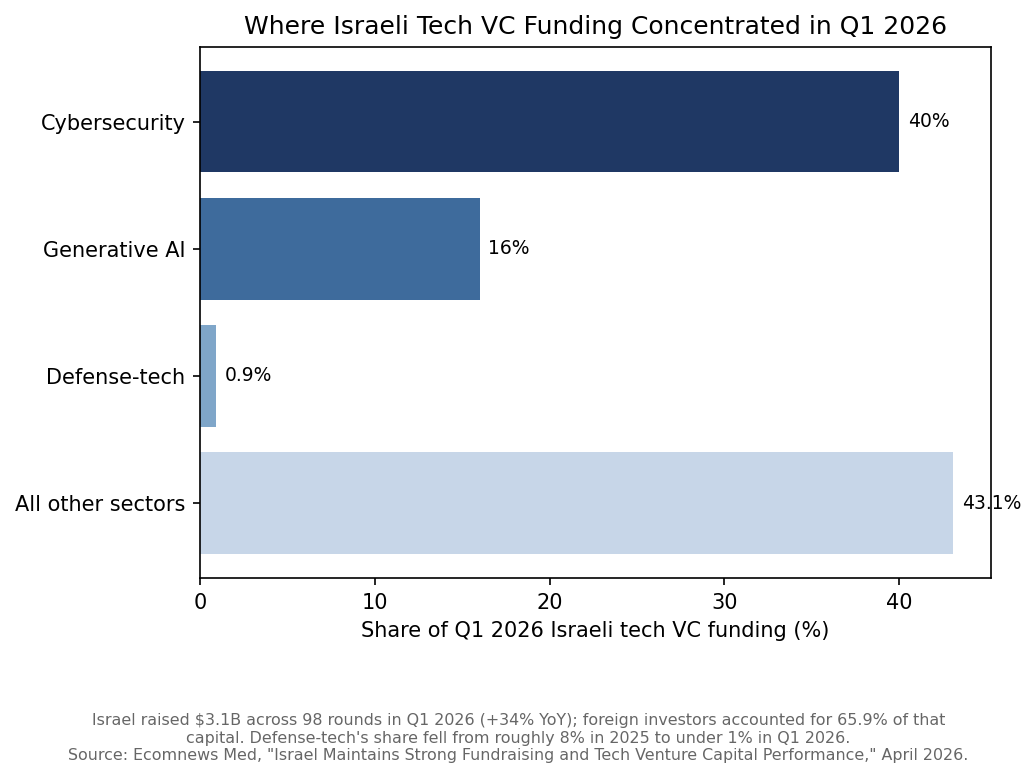
Sector breakdown of Israeli tech venture capital funding in Q1 2026, based on Ecomnews Med’s April 2026 reporting.
Why do some Israeli VC firms invest through more than one structure?
Some firms pair a standard direct-investment fund with a separate acquisition or joint-venture arm aimed at a specific sector, which lets them play both an early investor role and a strategic consolidator role in the same market. a portfolio spanning cybersecurity, deep and defense tech, medical devices, and enterprise software shows what that breadth looks like in practice, with more than 70 companies represented across active and exited positions. A defense-technology joint venture built with an established strategic partner is one example of this second structure, sitting alongside the firm’s conventional early-growth fund rather than replacing it.
How does sector specialization show up inside a single Israeli VC portfolio?
Sector specialization inside Israeli VC portfolios usually shows up as dedicated teams or sub-funds for a firm’s strongest local sourcing advantage, most often cybersecurity, layered underneath a broader generalist mandate. a dedicated cybersecurity portfolio segment and a medical-device investing track record spanning cardiovascular, orthopedic, and diagnostic devices illustrate two very different specializations coexisting inside the same firm, each drawing on a different regulatory and go-to-market path.
What role does government policy play in Israel’s VC ecosystem?
A government-funded program launched in 1993 played a documented role in seeding Israel’s venture capital industry by matching private investment at a set ratio, rather than by investing directly on its own. Under that program, the government allocated $100 million in total, $80 million of which matched foreign and domestic investment at roughly a 40% ratio so outside firms could establish their own funds inside Israel, with most of those funds later repurchasing the government’s stake within five years. See a historical summary of that matching-fund program and its transition to private ownership in 1997 for how that early policy groundwork is one reason the ecosystem now supports many independently capitalized local funds rather than depending on a handful of foreign offices, even though foreign capital still supplies the majority of dollars invested today.
Frequently Asked Questions
How much venture capital did Israeli tech companies raise in Q1 2026?
Israeli tech companies raised approximately $3.1 billion across 98 funding rounds in the first quarter of 2026, a 34% increase compared with the same period the year before.
What share of Israeli VC funding comes from foreign investors?
Foreign investors accounted for about 65.9% of total Israeli tech venture capital funding in Q1 2026, according to Ecomnews Med’s reporting.
Which sector attracted the most Israeli VC funding in early 2026?
Cybersecurity attracted the largest share, accounting for roughly 40% of total Israeli tech VC funding in the first quarter of 2026.
Do Israeli VC firms only invest in Israeli companies?
No, many Israeli VC firms invest with an explicit assumption that portfolio companies will expand into international markets, most commonly the United States and Europe, from an early stage.
מבוא
שוק הבנייה הישראלי עומד בפני שינוי מבני מואץ. לחצי עלות, מחסור בכוח אדם מיומן, עליות בחומרי גלם וגידול בביקוש לדיור – כל אלה מאלצים חברות בנייה לחפש יעילות מקומות שלא חיפשו קודם. הפתרון מגיע מהטכנולוגיה. בשנת 2025, חמש טכנולוגיות עומדות במרכז הטרנספורמציה הדיגיטלית של הענף – וחברות שמאמצות אותן מוקדם יותר יהנו מיתרון תחרותי משמעותי. ConWize היא דוגמה לפלטפורמה ישראלית שמשלבת כמה מהכלים הללו – אומדן, תמחור וניהול מכרזים – בפתרון אחד מאוחד, שנבנה על הצרכים הספציפיים של שוק הבנייה המקומי.
טכנולוגיה 1: BIM – מידול מידע לבניין
BIM (Building Information Modeling) אינה עוד חידוש – היא הופכת לסטנדרט עבודה. BIM מאפשרת יצירת מודל תלת-ממדי דיגיטלי של הבניין שכולל לא רק גיאומטריה אלא גם נתוני עלות, לוחות זמנים, מפרטים טכניים ותחזוקה עתידית.
אנגליה מחייבת BIM בכל מבנה ציבורי מ-2016
ישראל צפויה להרחיב דרישות BIM בפרויקטי תשתיות ממשלתיים ב-2025–2026
חיסכון ממוצע: 5–10% בעלויות בנייה, 20% בשגיאות תכנוני
טכנולוגיה 2: ניהול אומדן ותמחור בענן
גיליונות Excel אינם מספיקים יותר כשמנהלים מספר פרויקטים מורכבים בו-זמנית. פתרונות ענן לאומדן מאפשרים גישה בכל מקום, שיתוף פעולה בזמן אמת ועדכון מחירים אוטומטי. פלטפורמת ConWize לאומדן ותמחור מייצגת את הדור הבא של כלים אלה: ממשק עברי, כתב כמויות מובנה, ניהול מכרזים ושליטה בתקציב – הכל מקום אחד.
חיסכון ממוצע בזמן אומדן: 35–50%
ירידה בשגיאות תמחור: עד 70%
זמינות מהשטח: עדכון ומעקב ישירות מהסמארטפון
טכנולוגיה 3: פלטפורמות ניהול פרויקטים בענן
כלים כמו Procore, PlanGrid ומקבילות ישראליות מאפשרות ניהול לוחות זמנים, עבודות וחוזים מרכזי – עם ניראות מלאה לכל בעלי העניין בפרויקט. לפי Dodge Data & Analytics, חברות שמשתמשות בפלטפורמות ניהול פרויקטים מדווחות על עמידה בלוחות זמנים גבוהה ב-30% לעומת חברות שאינן משתמשות.
ניהול RFI ותוכניות ישירות מהאפליקציה
תיעוד אוטומטי של כל החלטה ואירוע בשטח
דשבורד סטטוס לכל קבלן ומשימה
טכנולוגיה 4: ניתוח נתוני שטח ו-IoT
חיישנים, מצלמות ומכשירי IoT שמוצבים באתר הבנייה מאפשרים מעקב בזמן אמת אחר התקדמות עבודות, שימוש בציוד ותנאי בטיחות. הנתונים מוזנים לפלטפורמות ניתוח שמאפשרות לזהות עיכובים, בזבוז ומפגעי בטיחות לפני שהם הופכים לבעיות.
ניטור ממשי של שעות עבודה ונוכחות
מעקב GPS אחר ציוד וכלי רכב
התראות בטיחות אוטומטיות
טכנולוגיה 5: בינה מלאכותית לתמחור ואומדן
הדור הבא של כלי האומדן משלב בינה מלאכותית שמנתחת פרויקטים קודמים ומחירי שוק כדי לייצר אומדנים מדויקים יותר. מערכות AI מסוגלות לזהות חריגות, להצביע על סיכוני עלות ולהציע חלופות תכנוניות זולות יותר – כל זאת בשבריר מהזמן שצוות אנושי היה זקוק לו.
לפי סקר Autodesk מ-2024, 68% ממנהלי הפרויקטים בעולם מאמינים ש-AI תהיה מרכזית בתמחור ואומדן תוך שלוש שנים.
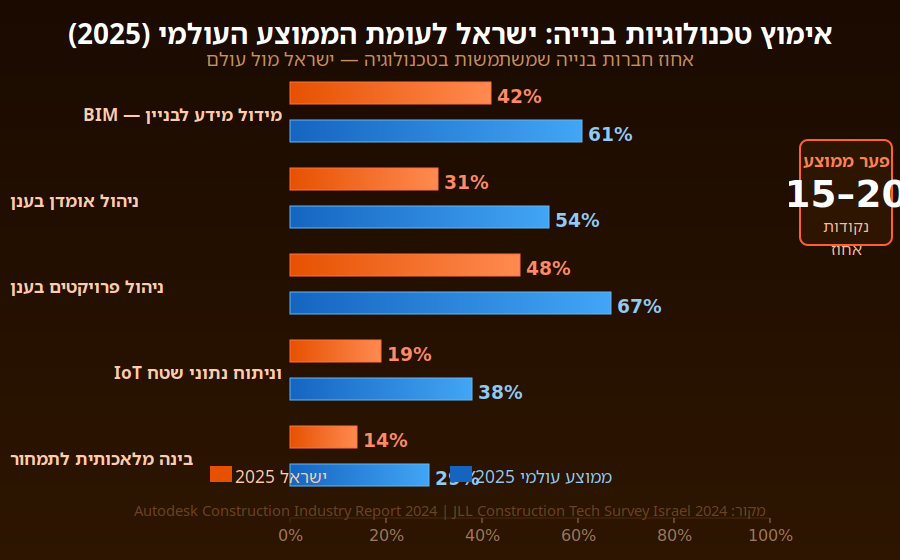
טבלת השוואה: שיעורי אימוץ טכנולוגיות בנייה בישראל (2025)
| טכנולוגיה | שיעור אימוץ (ישראל) | שיעור אימוץ (עולמי) |
| BIM | 42% | 61% |
| ניהול אומדן בענן | 31% | 54% |
| ניהול פרויקטים בענן | 48% | 67% |
| IoT וניתוח שטח | 19% | 38% |
| AI לתמחור ואומדן | 14% | 29% |
מקור: Autodesk Construction Industry Report 2024; JLL Construction Tech Survey Israel 2024
מה שוק הבנייה בישראלי צריך לדעת
ישראל מאמצת טכנולוגיות בנייה בקצב איטי יותר מהממוצע העולמי – אך הפער מצטמצם. הנהגת מחייבת BIM בפרויקטים ציבוריים, עלייה בהיקפי הבנייה ותחרות גוברת על כוח אדם מיומן יוצרים לחץ שמאיץ את קצב האימוץ. חברות שיתחילו את המעבר הדיגיטלי עכשיו ייהנו מיתרון ראשון-מגיע שיהיה קשה לשחזר בעוד שלוש שנים.
התחילו בכלי ה-ROI המהיר ביותר: ניהול אומדן ותמחור דיגיטלי
צרו מסד נתונים פנימי של עלויות מפרויקטים קודמים
השקיעו בהכשרת צוות – הטכנולוגיה טובה בדיוק כמו האנשים שמשתמשים בה
בחרו פלטפורמה עם תמיכה מקומית ותיעוד בעברית
סיכום
הטרנספורמציה הדיגיטלית של שוק הבנייה הישראלי אינה שאלה של ‘אם’ אלא של ‘מתי’. הכלים שפעם היו נחלת חברות הבנייה הגדולות ביותר בעולם הפכו נגישים, מותאמים מקומית ומוכחים בשטח. חברות שישכילו לאמץ טכנולוגיות אלה יוכלו לנהל פרויקטים מורכבים יותר, לשמור על שולי רווח בריאים ולספק ללקוחות שלהן רמת מקצועיות שהמתחרים לא יוכלו להציע. זהו הרגע לפעול
Business Solutions
Conwize: Quoting Software for Builders with Integrated Construction Bid Management

In competitive construction markets, how you quote is as important as what you quote. Builders and contractors that produce fast, accurate, professionally presented quotations – and that track their bidding activity systematically through a structured construction bid management software – consistently win more work at better margins than those who treat quoting as a reactive administrative task. Conwize is built on this insight, providing quoting software for builders that transforms pre-construction commercial operations from a pressure point into a competitive advantage.
The Commercial Cost of Inadequate Quoting Tools
The construction industry’s quoting and bidding function consumes a substantial proportion of a contracting business’s overhead – estimating teams, bid coordinators, quantity surveyors, and management time all contribute to the cost of pursuing work that may or may not be won. Industry benchmarks suggest that the estimating cost per bid ranges from 0.1% to 0.5% of project value for sophisticated estimating operations, and considerably more for businesses using manual, inefficient processes.
The opportunity cost of inadequate quoting software for builders is even larger. Teams hampered by slow, manual quoting processes cannot pursue as many tenders as the market makes available. Errors in manually assembled quotes – whether missed cost items, transposition errors, or outdated subcontractor prices — either cost margin when not caught before submission or cost the bid when detected by the client during evaluation. And the lack of systematic construction bid management means that business development intelligence – which project types are most winnable, which clients award most reliably, which geographies have the best margin potential – is never captured or analyzed.
Conwize addresses all three dimensions of this challenge: faster quoting through workflow automation, more accurate quotes through integrated subcontractor pricing, and richer bid intelligence through systematic pipeline management.
How Conwize’s Quoting Workflow Works for Builders
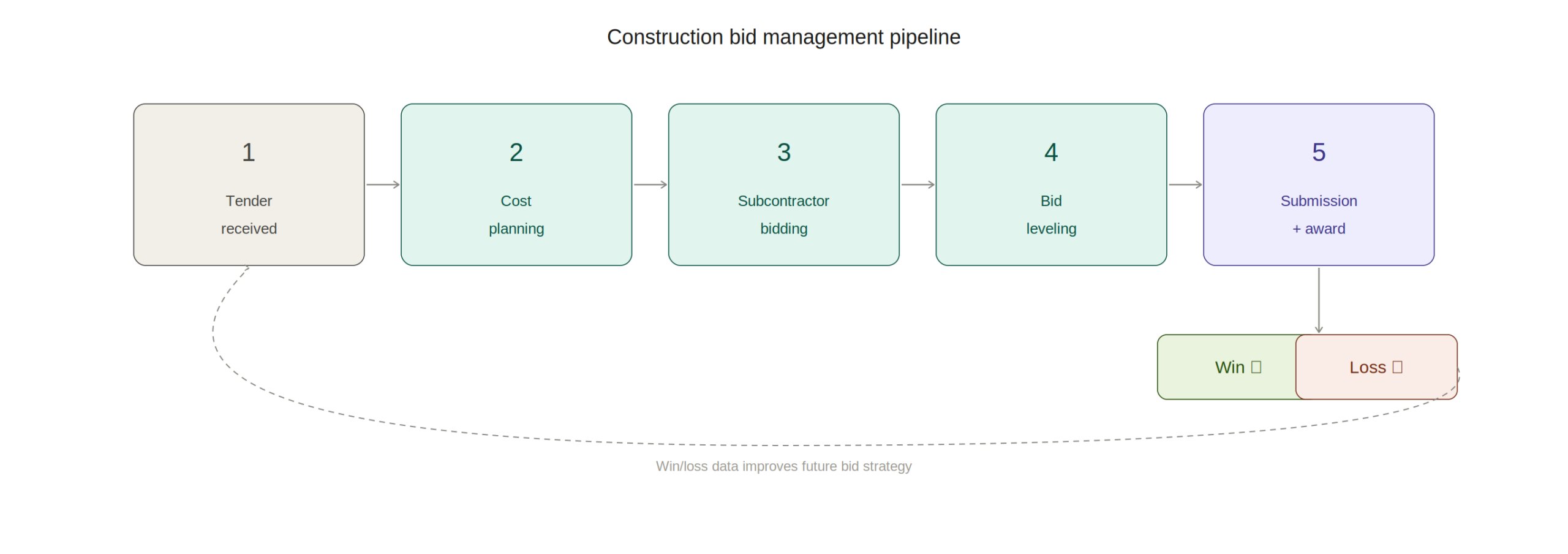
When a tender invitation arrives, Conwize’s quoting workflow begins with a single project setup action: the estimator creates a new project, loads the tender documents, and structures the scope into trade packages. From this point, the entire quoting process runs within Conwize – with no information escaping into external spreadsheets or email threads that cannot be tracked or controlled.
The subcontractor quotation process — typically the most time-consuming element of any builder’s quoting workflow – is where Conwize delivers its most immediate time savings. Scope packages are prepared within the platform and distributed to selected subcontractors in a single action. Subcontractors receive a structured invitation with all relevant documents attached. Response receipt is tracked automatically. Reminder notifications go out to non-responding subcontractors without manual chasing. And received quotations are loaded into Conwize’s bid comparison interface for structured analysis.
The bid comparison and leveling interface presents all received subcontractor quotations side by side against the scope items, automatically calculating adjusted totals that account for scope gaps, and flagging the most competitive compliant offer for each package. What takes a day or more of manual analysis in a spreadsheet is accomplished in Conwize in under an hour — with a complete, documented audit trail of the comparison.
Construction Bid Management: The Strategic Layer Above Quoting
Quoting individual tenders is a tactical activity; construction bid management is the strategic framework that ensures the quoting function serves the business’s commercial objectives. Effective bid management means having a clear, systematically applied bid/no-bid decision process, a structured pipeline of active tenders with visibility of deadlines and resource requirements, and a rigorous post-submission win/loss analysis process that feeds continuous improvement of the bidding strategy.
Conwize’s bid management capability provides all three elements. The pipeline dashboard gives construction directors and business development managers a real-time view of every active tender – project value, client, submission deadline, responsible estimator, and current status. This visibility enables informed bid/no-bid decisions on new opportunities and supports resource allocation decisions that ensure the most commercially important bids receive appropriate attention.
For a detailed breakdown of how systematic construction bid management transforms pre-construction commercial operations, Conwize’s dedicated article on construction bid management covers the key components — from pipeline design to win/loss analysis frameworks — in detail. The discipline of managing bids systematically rather than reactively is one of the most significant changes a construction business can make to its commercial performance.
Subcontractor Management Within the Quoting Platform
The quality of a builder’s subcontractor network is a direct determinant of the quality of their quotations – and managing that network effectively requires more than a contacts list. Conwize’s subcontractor database tracks each subcontractor’s trade coverage, geographic range, response rate, historical pricing competitiveness, and performance on awarded projects — providing the intelligence needed to assemble the best tender list for each trade package on each new project.
Over time, this intelligence compounds: estimators can see which subcontractors consistently respond with competitive prices for specific trade types, which tend to submit incomplete scope, and which have the highest award rates. This data-driven tender list selection is a significant quality improvement over the informal, relationship-based subcontractor selection that most builders currently practice.
The Conwize subcontractor portal – through which subcontractors receive invitations, submit quotations, and track their own bid history – is designed for ease of use from the subcontractor’s perspective, increasing response rates and improving the quality of received quotations.
Frequently Asked Questions
Q1: What is quoting software for builders and how does it differ from generic estimating tools?
A: Quoting software for builders is specifically designed for the construction quoting workflow – managing the complete process from scope definition through subcontractor bid management to submission document generation. Generic estimating tools focus on cost calculation; purpose-built quoting software manages the entire commercial workflow surrounding that calculation.
Q2: What is construction bid management and why is it important?
A: Construction bid management is the systematic process of tracking, coordinating, and analyzing the full bidding lifecycle – from tender identification and bid/no-bid decision through to submission, award, and win/loss review. Systematic bid management transforms bidding from a reactive activity into a managed commercial function with measurable performance improvement over time.
Q3: How does Conwize’s quoting workflow save time for builders?
A: Conwize automates the most time-consuming elements: subcontractor invitation and tracking (replacing manual email management), bid leveling (replacing manual spreadsheet comparison), and submission document generation (replacing manual reformatting). These automations typically reduce quoting time by 30-50% per tender.
Q4: Can Conwize track multiple simultaneous tenders in the bid pipeline?
A: Yes. Conwize’s pipeline dashboard displays all active tenders – value, deadline, client, status, and responsible estimator – in a single management view. This enables directors to allocate estimating resources, make bid/no-bid decisions, and track portfolio-level bidding activity in real time.
Q5: How does Conwize support post-bid win/loss analysis?
A: Conwize records bid outcomes — win/loss status, awarded value, client, project type, and geographic location – enabling systematic analysis of win rates by project type, client sector, tender value range, and other dimensions. This intelligence informs continuous improvement of bidding strategy and target market selection.
Q6: Does Conwize help with subcontractor response rates on quotation requests?
A: Yes. Conwize sends automated follow-up reminders to subcontractors who have not responded to quotation invitations, significantly improving response rates without manual chasing. The subcontractor portal provides a simple, accessible submission interface that further encourages response.
Q7: Is Conwize suitable for both residential builders and commercial contractors?
A: Conwize serves both residential builders managing volume quoting workflows and commercial contractors pursuing complex multi-trade tenders. The platform scales from straightforward residential quotations to sophisticated commercial BOQ-based estimates with comprehensive subcontractor bid management.

What to Look for in a Micro Coil Manufacturing Partner for Catheter-Based Devices

What It Actually Takes to Import IT and Telecom Equipment into Brazil

Shadow AI and the Enterprise Discovery Gap: What Security Teams Are Missing

-

 Business Solutions2 years ago
Live Video Broadcasting with Bonded Transmission Technology
-

 Business Solutions1 year ago
The Future of Healthcare SMS and RCS Messaging
-

 Business Solutions2 years ago
2-Way Texting Solutions from Company Message Services
-

 Business Solutions2 years ago
Communication with Analog to Fiber Converters & RF Link Budgets
-

 DSRC Communication1 year ago
The Crossroads of Connectivity: DSRC vs. C-V2X Technologies in Automotive Communication
-

 Business Solutions2 years ago
Wholesale SMS Platforms with OTP Services
-

 Business Solutions2 years ago
Choosing the Right B2B Digital Marketing Agency: A Guide
-

 3D Technology1 year ago
How Multispectral Cameras Advance Book Scanning