Tech
RF Over Fiber (RF Over Glass): Why Radio Frequency Signals Are Moving to Fiber

Key Takeaways
|
What is RF over fiber (RF over glass)?
RF over fiber and RF over glass refer to the same technology: a way of carrying a radio frequency signal across a site, a building, or a long outdoor run using optical fiber instead of coaxial cable. A transmitter (Tx) module at one end converts the incoming RF signal to a modulated optical signal, sends it down a single-mode fiber, and a receiver (Rx) module at the far end converts it back into an RF signal that is, in principle, identical to the original input. Both modules are typically compact enough to fit in the palm of a hand, and a link can be built as unidirectional or bidirectional depending on whether the application needs signal to travel one way or both.
Why does coax struggle where radio frequency over fiber doesn’t?
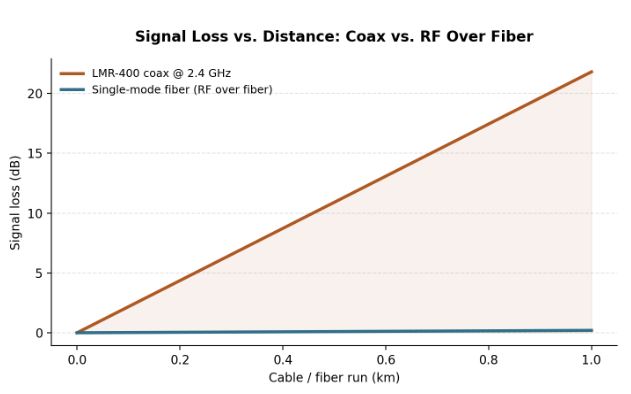
Coaxial cable loses signal strength as a function of both distance and frequency, and that loss compounds quickly. A widely used low-loss coax cable like LMR-400 loses about 6.65 dB per 100 feet at 2.4 GHz, which works out to roughly 22 dB per kilometer, a level of attenuation that can make a link unusable well before it reaches a full kilometer. Higher frequencies make the problem worse: the same cable loses even more per foot as the signal frequency climbs, which is why coax-based RF distribution tends to top out at fairly short, low-frequency runs.
Signal loss versus distance for LMR-400 coax at 2.4 GHz compared with single-mode fiber used in RF over fiber links.
Single-mode fiber, by contrast, loses only about 0.2 dB per kilometer at the wavelengths RF over fiber systems typically use, and that loss barely changes with the RF frequency being carried. A radio frequency over fiber link can therefore carry a clean signal for kilometers with a flat response across its whole operating bandwidth, which is simply not physically possible with coax once the frequency or the distance gets high enough.
How big is the demand for RF over fiber becoming?
Demand for RF over fiber has grown alongside the broader shift toward fiber-based infrastructure. Fortune Business Insights’ RF-over-fiber market report values the global market at $686.2 million in 2025, projected to grow to $745.8 million in 2026 and reach $1.44 billion by 2034, a compound annual growth rate of 8.60%. The report credits strong telecommunications infrastructure and early adoption of advanced fiber technologies in North America, which held a 37.8% share of the market in 2025, with applications spanning telecommunications, navigation, broadcasting, radar systems, and satellite communications.
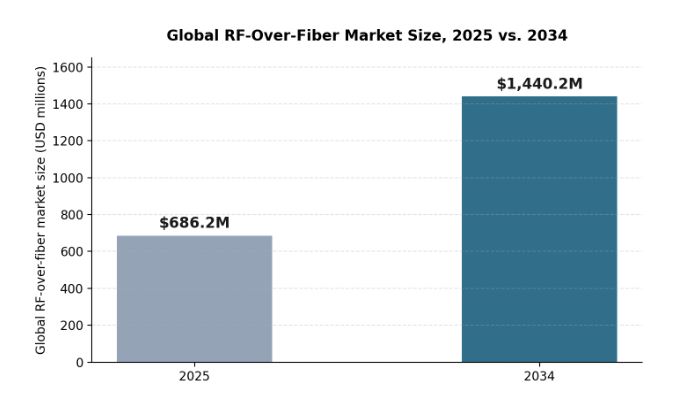


Global RF-over-fiber market size, 2025 versus 2034, according to Fortune Business Insights.
What’s actually inside a converter RF module?
Every RF over fiber link relies on a pair of converter RF modules, one acting as transmitter, one as receiver, and understanding what each does clarifies why the technology performs the way it does:
| Module | What it does |
|---|---|
| Transmitter (Tx) | Takes the incoming RF signal and modulates it onto a laser diode, converting it into an optical signal for transmission over fiber. |
| Receiver (Rx) | Uses a photodiode, typically paired with a low-noise amplifier, to convert the optical signal back into an RF signal matching the original input. |
| Single-mode fiber | Carries the modulated optical signal between Tx and Rx with minimal loss, largely independent of the RF frequency being carried. |
| Monitor & control interface | Lets an operator adjust gain, attenuation, and other parameters remotely over USB, Ethernet, or a web-based interface. |
A representative example is a 6.0GHz programmable RF over fiber converter, which pairs a Tx and Rx module covering 1 MHz to 6 GHz, supports both 50 and 75 ohm impedances, and can be monitored remotely through an SNMP, HTML, or REST interface once installed in an enclosure.
Where do coax vs. fiber tradeoffs matter most in practice?
The coax vs fiber question really comes down to distance and signal integrity. The coax vs. fiber decision comes up most often in applications where signal has to travel further than a short jumper cable, or where the frequency involved is high enough that coax loss becomes a real design constraint. RFOptic’s standard RF over fiber links are used across distributed antenna systems (DAS), GPS and timing signal distribution, radar and altimeter testing, and defense and satellite communications, environments where a coax run would either be impossible at the required distance or would introduce more loss than the application can tolerate.
In distributed antenna systems specifically, RF over fiber extends coverage from a central hub to remote antennas throughout a large building, stadium, or campus, something that would require running dozens of separate low-loss coax runs, each fighting the same distance and frequency limitations described above.
When does it make sense to switch from coax to RF over fiber?
- Distance: the cable run is longer than a coax link can support without unacceptable signal loss, often past a few hundred feet at higher frequencies.
- Frequency: the application operates at a frequency where coax attenuation per foot becomes steep, such as cellular, GPS/GNSS, or higher microwave bands.
- Electromagnetic interference: the signal path runs through an environment with heavy EMI, where fiber’s immunity to electromagnetic interference protects signal integrity in a way shielded coax cannot fully match.
- Multiple channels: several RF signals need to travel the same physical path, which wavelength-division multiplexing (WDM) can combine onto a single fiber rather than requiring a separate coax run for each.
Frequently Asked Questions
Is RF over fiber the same thing as RF over glass?
Yes. “RF over glass” and “RF over fiber” (often abbreviated RFoF) refer to the same underlying technology; the terms are used interchangeably in the industry.
Does RF over fiber change the RF signal in any way?
In principle, no. A well-designed RF over fiber link is transparent: the RF signal recovered at the receiver should match the original input, aside from small amounts of gain, noise, and distortion introduced by the conversion process itself.
Can RF over fiber carry more than one signal on the same fiber?
Yes. Using wavelength-division multiplexing (WDM), multiple RF signals can be carried simultaneously on a single fiber, each on its own optical wavelength, reducing the number of physical fiber runs needed.
Why is fiber loss so much less sensitive to frequency than coax loss?
Coax loss increases with frequency because of factors like the skin effect and dielectric loss in the cable’s insulation, both of which get worse at higher frequencies. Fiber carries the signal as modulated light rather than as an electrical signal traveling through a conductor, so its loss is governed by the optical properties of the glass itself, which stay essentially flat across the RF frequencies being carried.