Medical solutions
Medical Device Cases: What Healthcare Equipment Needs From a Carrying Case

| Key Takeaways
• A medical device case must protect the device, organize its accessories and allow fast access, often without removing the device from the case. • ISO 13485 is the international quality management standard for the design and manufacture of medical devices and can also benefit their suppliers. • CDC guidance groups patient-care items by contact with the patient, and items that touch only intact skin call for low-level disinfection. • EVA thermoforming, injection molding, vacuum forming, sewing and blow molding each suit different medical devices, so the production method should follow the device and its cleaning needs. |
What should a medical device case do?
A medical device case should protect the device from impact and contamination, keep every accessory in a fixed place and let a clinician reach and operate the equipment quickly, often without taking it out. Protection and usability have to work together, because a case that slows a responder down defeats its purpose.
The range of equipment is wide: defibrillators and AEDs, portable ultrasound units, diagnostic monitors, EEG systems, surgical headlights and EMS gear all travel in cases. Medical device carrying case design and production therefore varies from lightweight shells for handheld monitors to rigid plastic units for precision systems. Portable imaging adds its own needs, such as probe holders, cable management and a secure screen, which carrying cases for portable ultrasound and diagnostic equipment are built to handle.
Use-in-case designs let a device be operated, charged or ventilated while it stays inside the case, which keeps it protected during the moments when it is most likely to be bumped or set down.
Which standards and rules shape medical device case design?
Case manufacturers that supply medical device companies often work under ISO 13485, the international quality management standard for the design and manufacture of medical devices, and they select materials against chemical restrictions such as REACH and RoHS.
ISO 13485 provides a framework for consistent design, development, production and delivery of medical devices, and it is also intended to benefit suppliers and other external parties that provide product to those organizations. For a case supplier, certification signals documented processes for design control, validation and traceability. Shell-Case, for example, states that it is ISO 13485 certified for the design and manufacturing of medical device carrying cases.
Material compliance is the second layer. Chemical rules such as REACH and RoHS, California’s Prop 65 and biocompatibility requirements for parts that touch skin all influence which polymers, coatings and textiles can be used. Choosing compliant materials at the start of a project avoids having to redesign the case late in a program.
How are medical device cases cleaned and disinfected?
Healthcare facilities follow a tiered scheme: items that enter sterile tissue are sterilized, items that touch mucous membranes or nonintact skin receive at least high-level disinfection, and items that touch only intact skin receive low-level disinfection. This scheme, known as the Spaulding classification, underpins CDC guidance on disinfection and sterilization.
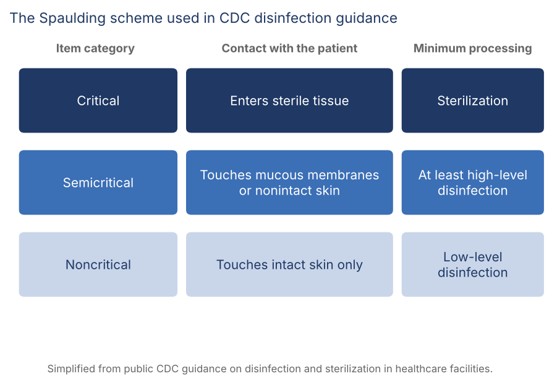

CDC describes noncritical patient-care items such as blood pressure cuffs and computers as candidates for low-level disinfection with registered disinfectants, and notes that most such products carry a 10-minute label claim. Which routine a particular case meets is a decision for each facility’s infection prevention team, but the practical design lesson is consistent: smooth, closed, coated surfaces and few crevices make repeated wiping faster and more reliable.
Cleaning also shapes material choice. Coated EVA shells, injection-molded plastics and blow-molded shells can be wiped down, while exposed textile and open foam are harder to keep clean.
Which materials and production methods suit medical device cases?
No single method fits every device. EVA thermoforming suits lightweight shock-absorbing cases, injection molding delivers rigid and cleanable plastic, vacuum forming produces large hard shells, sewing creates soft daily-carry bags and blow molding gives recyclable cases that are easy to sterilize.
| Production method | Common medical uses | Notable trait |
| EVA thermoforming | AEDs, portable ultrasound, diagnostic and rehabilitation devices, dental loupes | Lightweight and shock absorbing |
| Injection molding | EEG systems, surgical devices, video laryngoscopes, home-use devices | Precise, cleanable rigid plastic |
| Vacuum forming | Surgical headlights, eye-imaging devices, EMS backpacks, ambulance equipment systems | Large, durable hard shells |
| Sewing | Patient bags, portable ultrasound pouches, orthopedic equipment cases | Soft, flexible, suited to daily wear |
| Blow molding | Hospital-grade breast pumps and other durable device gear | Recyclable and easy to sterilize |
Methods can be combined. A Shell-Case AED case, for instance, pairs a thermoformed EVA shell coated with TPU with a magnetic closure that opens in about one second, showing how shell material and closure design together determine how fast a responder can reach the device.
Interiors deserve equal attention. Molded polyurethane foam trays, custom-cut foam, EPP interiors and printed organizing layers hold devices and accessories in fixed positions, which limits movement during transport and shortens the time needed to find a cable or electrode.
Which design details help clinicians in high-pressure moments?
Details that shorten the time to first use matter most: a pocket for every accessory, zippers that open in one motion and a layout that shows the device status at a glance. In emergency equipment, every feature has to work reliably when the user is stressed and the environment is unpredictable.
Cases for equipment that is used on the move add padded interiors, reinforced sections and options such as shoulder straps or carrying handles. Access to screens, buttons and ports without removing the device allows staff to operate it while it stays protected, and a transparent window can display an indicator light or status screen without opening the case.
Weight and ergonomics count as well. A responder who carries a defibrillator case up several flights of stairs, or a clinician who carries ultrasound equipment between rooms, benefits from a lightweight shell and a comfortable grip, which is why material choice and carrying features are specified together.
What should device makers ask a case supplier?
The most useful questions cover quality system, materials, cleaning and validation. Asking them early prevents a case from becoming a late-stage compliance problem.
- Quality system: is the supplier certified to ISO 13485 for the design and manufacture of medical device carrying cases?
- Materials: which polymers, coatings and textiles are used, and what compliance documents exist for REACH, RoHS and biocompatibility?
- Cleaning: which disinfectants have been tested against the finished surfaces, and how many cleaning cycles do they tolerate?
- Validation: was the case drop tested with the real device inside, and are the results documented?
- Supply: can the supplier support the volumes, regions and reorder schedule the program requires?
Answers to these five questions give a device maker a realistic picture of how a case will behave in clinical use, not only how it looks in a prototype.
Frequently Asked Questions
What is a medical device carrying case?
A medical device carrying case is a protective case designed around a specific device, such as an AED, ultrasound unit or monitor, that holds the device and its accessories securely and allows quick access in clinical or field settings.
Do medical device cases need ISO 13485 certification?
ISO 13485 applies to organizations involved in medical device design and production and can also benefit their suppliers, so it is a common checkpoint when device makers choose a case supplier.
How should a medical device case be cleaned?
Cleaning should follow the device manufacturer’s instructions and the facility’s infection prevention policy, which typically calls for low-level disinfection of surfaces that touch only intact skin.
Which production methods are used for medical device cases?
Common methods include EVA thermoforming, injection molding, vacuum forming, sewing, blow molding and advanced bonding, chosen according to the device’s weight, cleaning needs and volume.