Business Solutions
Long-Conical Peppers: How Heat-Tolerant Sweet Varieties Are Changing the Long Red Pepper

| Key Takeaways
• Long-conical peppers are slender, tapered sweet peppers (Capsicum annuum) usually sold fully red and positioned as a premium culinary format. • Very little pepper fruit set occurs above 90°F during the day or below 60°F at night, and fruit that sets above 85°F is often small and misshapen. • Parthenocarpy, fruit development without fertilization, helps some pepper lines keep setting fruit when heat reduces pollen viability. • Retail long red peppers are typically harvested at about 90% red color before noon and precooled to 10 to 12°C immediately after picking. |
What are long-conical peppers?
Long-conical peppers are sweet peppers (Capsicum annuum) with a slender, elongated fruit that tapers from a broad shoulder to a narrow point, usually harvested fully red. They belong to the same species as the bell pepper but carry no meaningful heat, so produce buyers place them with sweet red peppers rather than chiles. Their shape is the selling point: a long red pepper reads as premium on the shelf, slices into even rings, and roasts whole without collapsing. Breeders now position long-conical sweet peppers as a gourmet format. BreedX, a seed company specializing in pepper and tomato breeding, describes its long-conical line as sleek and red with intense sweetness, aimed at chefs and at retailers looking for a visual alternative to the standard blocky bell.
For growers the interest is less about looks and more about agronomy. Long peppers are being bred alongside snack and mini formats inside the same seedless sweet pepper programs, which means traits like heat tolerance, yield stability and disease resistance are moving into this shape class quickly. That is what makes the category worth a closer look in 2026, when hotter summers are putting pressure on every pepper crop that relies on reliable fruit set.
Why does heat stress matter so much for long red peppers?
Heat stress matters because pepper flowers fail to set fruit once daytime temperatures pass roughly 90°F (32°C), and fruits that do set above about 85°F tend to be small and poorly shaped. For an elongated pepper, misshapen fruit is a direct loss: a long-conical pepper that sets short, curved or uneven is downgraded even if the plant is healthy. Oklahoma State University’s extension fact sheet on pepper production puts the limits plainly: very little fruit set happens above 90°F during the day or below 60°F at night, and some small-fruited pungent peppers tolerate high-temperature fruit set better than bell types.
The cool end of the range is just as important. Michigan State University Extension notes that night temperatures below 60°F also cause blossom drop, and that a shortage of water at bloom time can produce the same failure. The University of Minnesota Extension gives the ideal window for vegetative growth as 77 to 80°F during the day and 64 to 68°F at night, with blossom and fruit drop appearing near 90°F once plants flower.
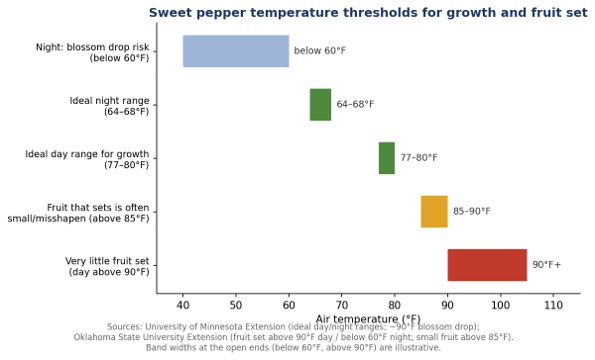

Research on Capsicum annuum confirms how narrow the margin is. A 2022 study in the SABRAO Journal of Breeding and Genetics reported that a threshold of about 32.9°C significantly reduced chili pepper production, with heat cutting pollen viability and increasing flower abortion. Pollen development is the weak link: when it fails, the flower drops or the fruit develops unevenly.
How do breeders build heat tolerance into sweet peppers?
Breeders build heat tolerance by selecting lines that keep setting fruit when pollen performance declines, and one of the most effective routes is parthenocarpy, the ability to develop fruit without fertilization. An older Taiwanese study on hot pepper lines found one line that kept a high fruit set at 35/30°C day/night despite low pollen viability, and the researchers suggested parthenocarpy as the likely reason. A plant that does not depend on viable pollen to form fruit is, almost by definition, less exposed to the heat-driven pollen failure described above.
This is the logic behind seedless sweet pepper programs. One breeder of seedless pepper lines bred for heat and cold tolerance says that without seeds inside the fruit, the plant’s energy is redirected to fruit setting, and that its varieties maintain production under high and low temperature extremes and high humidity. The same breeder says all its lines are developed through traditional, non-GMO breeding and supplied to growers as seed rather than seedlings. Those are breeder claims rather than independent trial results, so growers should still test any new long-conical variety in their own climate before scaling.
How do long-conical peppers compare with other sweet pepper formats?
Long-conical peppers sit at the premium, culinary end of the sweet pepper range, while blocky and snack formats cover stuffing, slicing and convenience snacking. The comparison below summarizes how the main formats are typically positioned. Size figures are only given where a breeder has published them.
| Format | Shape and size | Typical use |
| Long-conical | Slender, tapered, elongated red fruit | Gourmet dishes, roasting whole, plated presentation |
| Midi-blocky | Medium-sized, blocky | Stuffing and slicing |
| Mini-kapia | Snack-sized and elongated | Crunchy, sweet snacking |
| 1-bite | 4 to 7 cm, bite-sized | Lunchboxes and whole-fruit snacking |
Within a single seedless program, the long-conical type is often bred to the same standard as the snack types: high yield, tolerance to extreme temperatures and resistance to key plant diseases. The difference is the market it serves. A buyer for a food-service distributor will judge a long pepper on length, straightness and wall color; a snack buyer will judge a mini pepper on crunch, uniformity and pack-out.
When should long-conical peppers be harvested?
Long-conical peppers grown for retail are usually picked at about 90% red color in the morning, or at around 50% color when extra shelf life matters more than full ripeness. That guidance comes from a five-step harvest and post-harvest protocol published for sweet and seedless peppers, which recommends harvesting before 12:00 PM, precooling fruit immediately to 10 to 12°C, and packing into macro- or micro-perforated plastic bags that keep air moving and prevent condensation.
After packing, the same protocol calls for bringing fruit back down to 10°C before transport and keeping an unbroken cool chain to avoid dehydration. Michigan State University Extension gives a similar storage target for peppers: 45 to 50°F with 85 to 90% relative humidity. For an elongated fruit, careful handling also prevents tip breakage and bruising along the narrow end, which shows quickly on a red skin.
Are long red peppers nutritionally different from bell peppers?
Long red peppers are fully ripe sweet peppers, so their nutrition tracks that of ripe red bell peppers, which USDA data puts at 127.7 mg of vitamin C per 100 g raw. Ripening is the main driver: red sweet peppers are ripened green peppers and carry more sugar, which is why long red types taste noticeably sweeter than green ones. Shape itself does not change nutritional value in any documented way, but the long format encourages raw use in salads and as crudités, where vitamin C is preserved because no cooking is involved.
What should growers look for when choosing a long-conical variety?
Growers should prioritize consistent fruit set under their local temperature extremes, uniform length and straightness, and documented disease resistance, in that order. Heat is the most common reason long peppers fail commercially, so a variety’s record in hot-season trials matters more than its appearance in a catalog photo. The University of Minnesota Extension notes that heat-related blossom drop shows up as soon as plants flower in hot weather, which means the first set is where weak varieties are exposed.
Beyond genetics, the same basics apply as for any sweet pepper: steady irrigation through bloom, shade or ventilation to keep canopy temperatures below the 90°F danger zone, and harvest timing matched to the market. A long-conical pepper that is bred to set fruit under stress, picked at the right color and cooled quickly is the format’s best case: a premium red pepper that holds its shape from the greenhouse to the plate.
Frequently Asked Questions
Are long-conical peppers spicy?
No, long-conical peppers are sweet peppers in the species Capsicum annuum and are bred for sweetness rather than heat.
What temperature stops pepper plants from setting fruit?
Pepper fruit set drops sharply when daytime temperatures exceed about 90°F (32°C) or night temperatures fall below 60°F (16°C).
How should long red peppers be stored after harvest?
Long red peppers keep best when cooled quickly after picking and stored at about 45 to 50°F (7 to 10°C) with 85 to 90% relative humidity.
Why are some sweet peppers bred to be seedless?
Seedless sweet peppers are bred for convenience and, according to breeders, because a plant that does not invest energy in seeds can direct more of it to setting fruit.