Cybersecurity
Israeli VC in Cybersecurity, Deep Tech and Defense: A Deep Dive

| Key Takeaways
• Israeli cybersecurity companies raised $4.1 billion in private funding in 2025, with a median round of $20 million, double the business software median. • About 1,500 deep-tech companies operate in Israel and have raised $28.6 billion since 2019, roughly 35% of all capital raised by Israeli high-tech. • Israeli companies raised more than 20% of all deep-tech capital invested in the cyber sector worldwide, according to the Israel Innovation Authority. • Google’s $32 billion acquisition of Wiz and Palo Alto Networks’ $25 billion purchase of CyberArk led a record $74.3 billion in Israeli tech M&A in 2025. |
Why do Israeli VCs concentrate on cybersecurity?
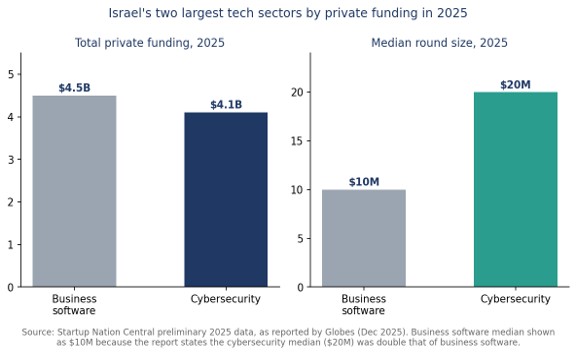
Israeli VCs concentrate on cybersecurity because it is the sector where Israel commands the largest share of global capital and produces the largest rounds. Israeli cybersecurity companies raised $4.1 billion in private funding in 2025, according to preliminary Startup Nation Central data, and their median round reached $20 million, double the median in business software.
The concentration is not only a local story. The Israel Innovation Authority reports that Israeli companies raised more than 20% of all deep-tech capital invested in the cyber sector worldwide. For an investor, that combination of a dense founder pool, repeat entrepreneurs and an established buyer base among global security vendors creates a deal flow that is difficult to replicate in most other markets.
This is why a typical Israeli VC with a security thesis now positions cyber alongside AI, deep tech and defense tech rather than as a standalone category. Security problems increasingly sit inside AI systems, cloud infrastructure and physical networks, so the investment thesis has widened with them.

How does deep tech change the Israeli VC model?
Deep tech changes the Israeli VC model by requiring more capital, longer holding periods and deeper technical diligence than software investing. The Israel Innovation Authority defines deep tech by high technological risk and a long time to market, conditions it notes can make it harder for these companies to raise money.
The sector has nonetheless become one of the country’s strongest. Joint research by the Israel Innovation Authority and Dealroom counts about 1,500 active deep-tech companies in Israel that have raised $28.6 billion since 2019, roughly 35% of all capital raised by Israeli high-tech over that period. The cumulative valuation of private Israeli deep-tech companies has passed $177 billion, about 15 times higher than a decade earlier, and the report places Israel as the leading deep-tech fundraising hub in the Western world outside the United States. The full findings are summarized in the Israel Innovation Authority’s 2025 status report.
For investors, the practical consequence is that a deep-tech round is rarely judged on revenue alone. Diligence turns to physics, materials, manufacturing readiness and certification paths, and the investor needs reserves to support the company through a longer development cycle before commercial scale.
What is driving investor interest in defense and dual-use technology?
Rising defense budgets are the main driver of investor interest in defense and dual-use technology, because they create large, durable demand for capabilities that often transfer later into civilian markets. Global military spending reached about $2.7 trillion in 2025, and roughly $19 billion flowed into aerospace and defense startups that year, nearly double the $10 billion raised in 2024, according to figures compiled in an analysis of defense spending as a deep tech catalyst.
That same analysis argues that technologies such as AI, quantum sensing and advanced robotics are often tested and hardened in defense environments before moving into commercial use. It also notes that hardware-heavy companies need larger upfront capital and closer coordination with industrial and government partners than software startups, which is pushing venture investors to work more closely with private equity as companies move toward production.
The same piece flags post-quantum security as an emerging area, pointing to the risk that data encrypted today can be harvested now and decrypted later once quantum computing matures, and to a quantum security market projected to grow at nearly 45% a year through 2029. For an Israeli VC with roots in both cyber and defense, post-quantum work sits directly at the intersection of its two strongest fields.
Dual-use positioning matters to an Israeli VC because it widens the exit map. A company whose technology serves both defense buyers and commercial customers can be acquired by a defense prime, a civilian technology company or an industrial group, rather than depending on a single type of acquirer.
How do CISO networks give Israeli cyber investors an edge?
CISO networks give Israeli cyber investors an edge by putting the eventual buyers of a security product into the room before the product is finished. A chief information security officer can tell a founder within one meeting whether a problem is urgent, whether it already has a budget line, and which existing tools the new product would need to replace.
Some Israeli investors have formalized this into a structure. One example is a CISO-led investment alliance that operates as a cybersecurity micro fund and brings together security leaders from large global organizations to validate, guide and support early-stage companies. Investors with this kind of network typically build a cybersecurity portfolio spanning cloud, identity and threat detection, along with data, endpoint and network security, because practitioner feedback points them toward the categories where enterprise demand is forming.
What do recent exits reveal about Israeli VC returns in cyber?
Recent exits show that Israeli cybersecurity companies can command some of the largest acquisition prices in global technology. Google’s $32 billion acquisition of Wiz and Palo Alto Networks’ $25 billion purchase of CyberArk led a record $74.3 billion in M&A involving Israeli tech companies in 2025, across 150 transactions.
Exits of that size reset expectations for the entire funding chain. Limited partners see proof that capital can come back at scale, later-stage investors become more willing to pay up for category leaders, and early-stage investors can justify larger seed and Series A checks. Earlier coverage of early-stage defense innovation in cybersecurity venture capital looks at how this dynamic plays out for younger security companies.
What should founders look for in an Israeli VC in these sectors?
Founders in cyber, deep tech and defense tech should look for an Israeli VC with domain-specific partners, reserves for a longer development cycle and access to real customers or test environments. Generalist capital can fund a round, but it rarely shortens the time it takes to reach a credible first deployment.
Useful questions include whether the partners have operated inside security teams or defense R&D organizations, how much the fund typically reserves for follow-on rounds, and whether its strategic partners can provide pilots with real data in live environments. For dual-use companies, it also helps to ask how the investor approaches export controls and government procurement cycles, since both affect timelines and valuation.
Frequently Asked Questions
Why is Israel so strong in cybersecurity startups?
Israel has a dense pool of experienced security founders and a strong buyer base among global vendors, and Israeli companies raised more than 20% of all deep-tech capital invested in the cyber sector worldwide, according to the Israel Innovation Authority.
How much do Israeli cybersecurity startups raise per round?
The median private funding round for Israeli cybersecurity companies was $20 million in 2025, double the median for business software companies, according to preliminary Startup Nation Central data.
What counts as deep tech in Israel?
The Israel Innovation Authority describes deep-tech companies as those developing complex technology with high technological risk and a long time to market; about 1,500 such companies operate in Israel.
Do Israeli VCs invest in defense technology?
A growing number of Israeli VCs invest in defense and dual-use technology, focusing on companies whose products can serve both defense and civilian markets as global defense budgets rise.