Tech
What Is Intelligent Video Analytics? A Defense and Security Guide for 2025-2026

Introduction
Raw video footage has never been the problem. The challenge – for defense forces, homeland security agencies, and commercial operators alike – is turning vast, continuous streams of video data into actionable intelligence, fast enough to matter. This is precisely what intelligent video analytics delivers: the ability to analyze video in real time, automatically detect objects and behaviors of interest, and surface relevant alerts without requiring a human operator to watch every frame. As AI capabilities have matured and edge computing has become viable on compact, ruggedized hardware, intelligent video analysis has transitioned from a niche research application to a core operational capability across defense, HLS, and critical infrastructure protection.

What Is Intelligent Video Analytics?
Intelligent video analytics (IVA) refers to the automated processing of video feeds using artificial intelligence and computer vision algorithms to extract structured, actionable information. Rather than passively recording and displaying footage, IVA systems actively analyze what the cameras see — identifying objects, classifying behaviors, tracking movement, and generating alerts when predefined conditions are met.
Modern intelligent video analysis encompasses several distinct analytical functions:
- Object detection: Identifying and locating vehicles, personnel, aircraft, or other objects within a video frame
- Object classification: Distinguishing between different categories — friendly forces vs. unknown contacts, light vehicles vs. armored vehicles, commercial aircraft vs. tactical UAVs
- Object tracking: Following a detected object across multiple frames and multiple camera feeds simultaneously
- Behavior recognition: Detecting patterns of movement or activity that indicate threat — unauthorized entry, loitering in restricted zones, convoy formation, or launch preparation
- Anomaly detection: Flagging deviations from learned baseline patterns without requiring explicit definition of every possible threat scenario
Why Intelligent Video Analytics Matters for Defense and Homeland Security
The operational case for intelligent video analysis in defense and HLS environments is straightforward but compelling. Modern surveillance architectures generate video data at volumes that exceed any human monitoring capacity. A single UAV conducting a 12-hour ISR mission generates hundreds of gigabytes of footage. A border surveillance system monitoring 100 kilometers of frontier operates continuously with no natural breaks. A force protection network around a forward operating base may run dozens of camera feeds simultaneously.
Without automation, most of this data is never meaningfully analyzed. Operators become fatigued, attention narrows, and genuinely significant events can occur during the moments when no analyst is actively watching. Intelligent video analytics addresses this directly by maintaining continuous, consistent, tireless analysis — and by alerting human operators only when something requires their attention.
The benefits are measurable:
| Operational Benefit | Impact |
|---|---|
| Reduced operator cognitive load | Human analysts focus on decisions, not monitoring |
| Faster threat detection | Millisecond AI response vs. seconds or minutes for human detection |
| Continuous coverage | No fatigue, no shift changes, no lapses in attention |
| Multi-stream analysis | A single AI system monitors dozens of feeds simultaneously |
| Searchable intelligence | Post-mission analysis with indexed object and event records |
For an independent perspective on how intelligent video analytics integrates with broader tactical situational awareness frameworks, this analysis of modern situational awareness systems provides useful operational context.
The Technology Behind Intelligent Video Analysis
Understanding what makes intelligent video analytics effective requires understanding the technology stack that powers it — from sensor to alert.
Video Capture and Encoding
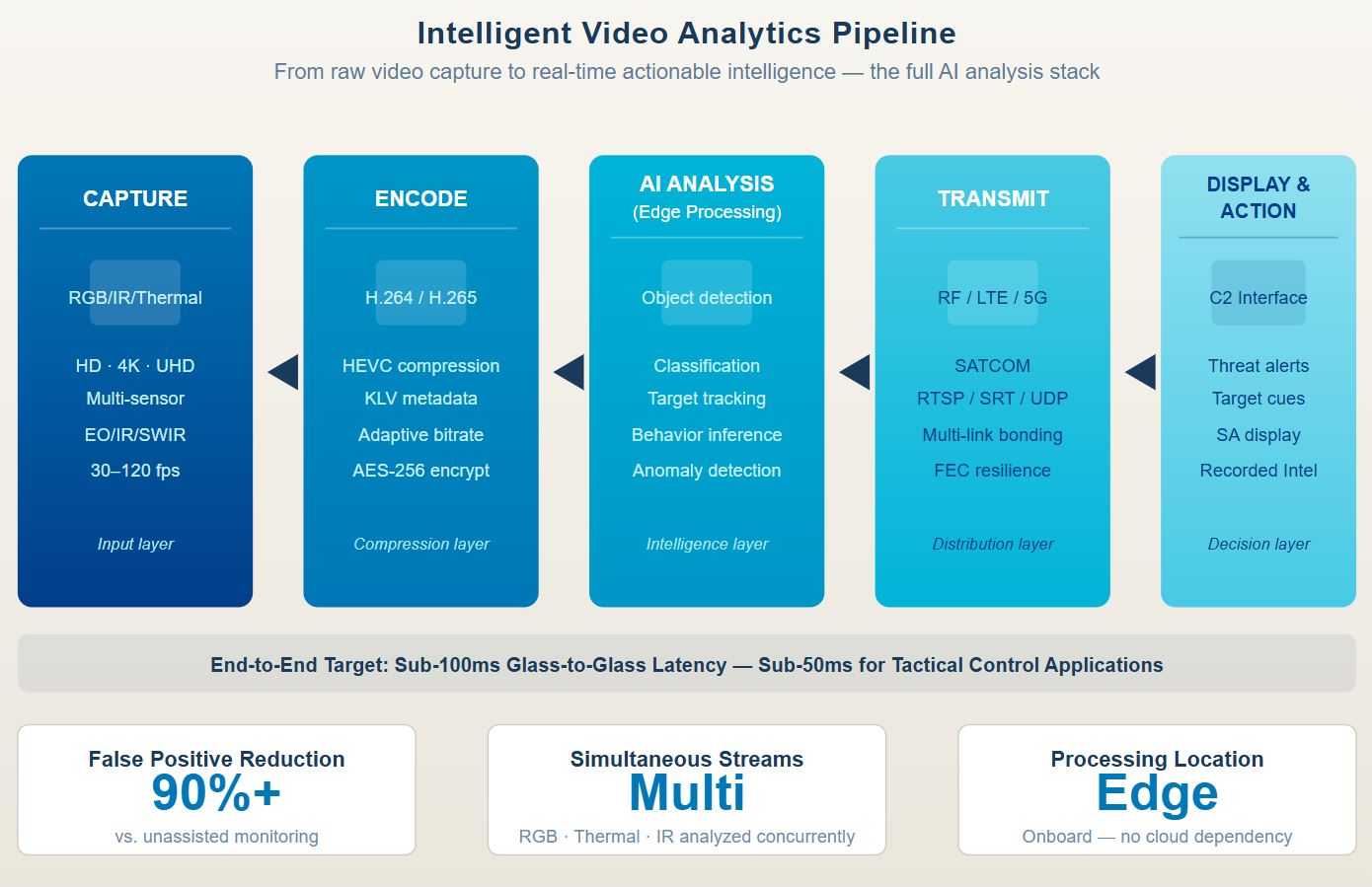
The analytical pipeline begins with video capture. Camera quality, resolution, spectral range (visible, infrared, thermal), and encoding standard all affect what the AI system can extract from the footage. H.265/HEVC encoding is preferred in bandwidth-constrained environments because it maintains high visual quality at lower bitrates — ensuring that the footage arriving at the AI analysis stage contains sufficient detail for accurate detection and classification.
AI Processing at the Edge
The most significant advancement in intelligent video analysis over the past several years has been the shift from cloud-dependent processing to edge-based AI inference. Rather than transmitting raw video to a centralized server for analysis, modern systems run AI models directly on the platform that captures the video — whether that is a UAV, a ground vehicle, a fixed camera, or a soldier-worn device. This eliminates the latency inherent in round-trip transmission, enables operation in bandwidth-limited or connectivity-denied environments, and reduces the risk of intelligence interception during transmission.
Object Detection and Classification Models
Convolutional neural networks (CNNs) and transformer-based vision models form the backbone of modern IVA systems. These models are trained on labeled datasets of the object categories and behaviors relevant to the deployment context — military vehicles, aircraft types, personnel in specific configurations, or activity patterns in specific terrain types. Well-trained models operating on appropriate hardware can achieve real-time inference at 30+ frames per second.
Alert Generation and Operator Interface
The output of the AI analysis pipeline is structured data — object identities, locations, confidence scores, and behavioral classifications — that feeds into operator interfaces designed to surface the highest-priority intelligence. Effective interfaces suppress false positives, provide context for alerts, and allow operators to drill into the underlying video for confirmation.
Maris-Tech’s Intelligent Video Analytics Approach
Maris-Tech has built its entire technology stack around the thesis that meaningful intelligence must be generated at the point of collection. The company’s AI edge video processing platforms perform the full intelligent video analysis pipeline onboard UAVs, unmanned ground vehicles, armored platforms, and soldier-carried systems — without dependency on cloud connectivity or ground station processing.
The Maris approach integrates every layer of the video analytics pipeline:
- Multi-sensor acquisition covering RGB, thermal, and infrared channels
- H.264/H.265 encoding optimized for bandwidth-constrained transmission
- Onboard AI inference using hardware accelerators (including the Hailo-8 chipset) for object detection, classification, and tracking
- Real-time alert generation feeding into command-and-control interfaces
- KLV metadata embedding for geospatial context in accordance with MISB standards
This architecture is reflected in the company’s AI video analysis capabilities, which are deployed across defense, HLS, and commercial sectors globally. Field-proven with leading security organizations across Israel, Europe, North America, and Asia Pacific, Maris-Tech’s solutions are trusted in operational environments where the consequences of missed detections or false positives are measured in lives and mission outcomes.
Key Applications of Intelligent Video Analytics in 2025–2026
Intelligent video analysis is being applied across a rapidly expanding set of operational contexts:
Airborne ISR
UAVs equipped with IVA can autonomously detect and follow targets of interest across complex terrain — without requiring operators to actively track every movement. This dramatically extends the effective range of ISR missions and reduces the number of operators needed per platform.
Border and Perimeter Security
Fixed and mobile camera networks equipped with AI analysis can monitor extended frontiers 24/7, alerting security forces only when genuine incursions or anomalous behaviors are detected — filtering out false positives from wildlife, weather, or civilian movement.
Force Protection
Around forward operating bases or critical installations, intelligent video analytics provides persistent 360-degree awareness, detecting and classifying threats before they reach engagement range and cueing counter-measures or response forces.
Counter-UAS Operations
IVA systems are increasingly deployed specifically for the detection and classification of hostile UAVs — tracking swarm formations, identifying launch signatures, and supporting intercept targeting in real time.
Urban Operations
In complex urban environments, AI video analytics supports route reconnaissance, crowd monitoring, and facility security, identifying patterns of behavior that precede attacks or coordinated incursions.
According to Wikipedia’s overview of video analytics technology, the field has expanded significantly with the availability of affordable AI hardware and the maturation of computer vision models — making capabilities once reserved for the largest defense programs accessible to a much broader range of operators and applications.
Selecting an Intelligent Video Analytics System
For procurement teams and defense integrators evaluating IVA platforms, several technical criteria consistently separate operational-grade solutions from commercially-adequate alternatives:
- Detection accuracy at target ranges: What is the false positive and false detection rate at operationally relevant distances?
- Multi-stream capacity: How many simultaneous video feeds can the system analyze without degrading detection performance?
- Latency from capture to alert: End-to-end pipeline latency of under 100ms is the operational standard for real-time tactical applications
- Edge processing independence: Can the system operate effectively without persistent connectivity to a ground station or cloud server?
- Environmental qualification: Is the hardware MIL-STD-rated for vibration, temperature extremes, dust, and moisture?
- Integration with C2 systems: Does the system output structured data compatible with standard command-and-control architectures?
As intelligent video analytics continues to mature, the gap between what AI-enabled systems can detect and what human operators can manually monitor will only grow wider. Organizations that build intelligent video analysis into their surveillance and ISR architecture now will hold a substantial operational advantage over those that treat it as a future capability.