Tech
WiFi HaLow vs LoRaWAN: Which Long-Range IoT Standard Actually Wins in the Field

The IoT market is not slowing down. Industry estimates project the global installed base of connected devices will roughly double over the course of this decade, and most of that growth depends on wireless links that were not part of the conversation ten years ago. LoRaWAN has been the default choice for long range, low power sensor networks for years. WiFi HaLow, the sub-GHz IEEE 802.11ah standard, is now being positioned as a serious alternative. Neither one is a universal answer. The right choice depends on how far your devices are spread out, how much data they need to move, and how much power they have to spend doing it.
Range and Coverage
LoRaWAN was purpose built for long range communication at very low power. Its creator, Semtech, states that LoRa can reach up to five kilometers in urban environments and as far as fifteen kilometers in rural, low interference settings. That makes it a strong fit for widely dispersed devices such as agricultural sensors, environmental monitors, and supply chain trackers where a handful of gateways need to cover a large geographic footprint.
WiFi HaLow trades some of that maximum range for higher throughput. Operating in the unlicensed 900 MHz band rather than the crowded 2.4, 5, or 6 GHz bands used by conventional WiFi, it delivers meaningfully better penetration through walls and obstacles than standard WiFi, and covers a campus or building footprint rather than a multi-kilometer radius. For deployments where devices are dense but confined to a site, that tradeoff tends to work in HaLow’s favor.
Data Rates: Where the Two Standards Diverge Most
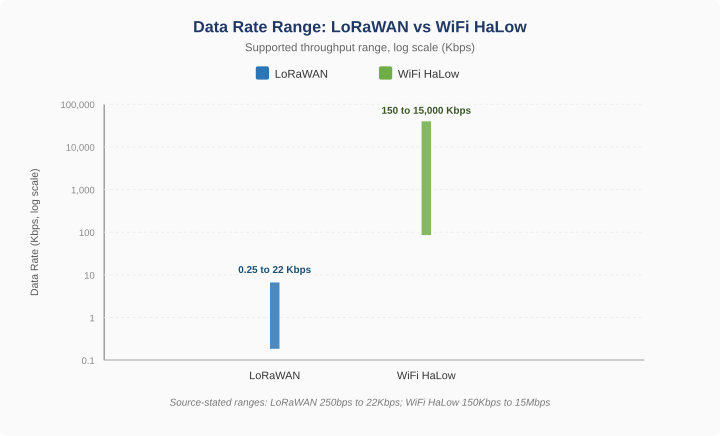
This is the single biggest difference between the two technologies. LoRaWAN’s supported data rates run from roughly 250 bits per second up to about 22 kilobits per second, a range built for short, infrequent sensor readings rather than continuous data streams. WiFi HaLow supports 150 kilobits per second up to 15 megabits per second, roughly 600 times the ceiling LoRaWAN offers. The chart below shows both ranges on a log scale, since the gap is too large to read clearly on a linear axis.

Security Posture
WiFi HaLow inherits its security model from the broader WiFi Alliance ecosystem. It supports WPA3 and Enhanced Open, based on Opportunistic Wireless Encryption, along with AES encryption for over the air traffic and secure firmware upgrade paths. That gives it a standardized, actively maintained security baseline. LoRaWAN’s security story is less uniform. The LoRa Alliance itself has acknowledged that implementation gaps, such as mishandled encryption keys or reused sequence numbers, can leave networks and devices vulnerable, and there is no equivalent guarantee that every deployment has been reviewed by independent security specialists.
Power Consumption
LoRaWAN remains the stronger option for battery powered devices that need to last months or years without a service visit, largely because its transmission pattern is intermittent and scheduled rather than continuous. WiFi HaLow strikes a different balance: it draws more power than LoRaWAN but far less than conventional WiFi, which makes it workable for battery powered sensors that also need to move meaningfully more data. Choosing between them often comes down to whether a deployment is bandwidth constrained or battery constrained first. For teams weighing this tradeoff against a broader industrial IoT gateway selection, power budget is usually the deciding factor before range or throughput.
Side by Side Comparison
| Factor | LoRaWAN | WiFi HaLow |
| Typical range | Up to 5 km urban, 15 km rural | Building or campus scale, longer than standard WiFi |
| Data rate | 250 bps to 22 Kbps | 150 Kbps to 15 Mbps |
| Power draw | Very low, optimized for battery life | Moderate, balances power and throughput |
| Security standard | Varies by implementation | WPA3, Enhanced Open (OWE), AES encryption |
| Best fit | Agriculture, environmental monitoring, wide-area sensors | Telecom, energy, water, healthcare, dense industrial IoT |
Where Each One Actually Wins
LoRaWAN is the better fit when devices are spread across a wide area, power budgets are extremely tight, and the data being sent is small and infrequent, think soil moisture readings or asset location pings. WiFi HaLow wins when a site has a dense population of IoT devices that need to move more data than LoRaWAN can realistically handle, such as remote IoT asset monitoring across a utility substation, an industrial campus, or a smart building. Neither standard makes the other obsolete. Many deployments end up running both, using LoRaWAN for the long tail of low bandwidth sensors and HaLow for the subset of devices that need more throughput within a confined footprint.
How 802.11ah Changed the Calculation
WiFi HaLow’s arrival is not an incremental tweak to existing WiFi, it is a different physical layer built around a different set of tradeoffs. By operating in the sub-GHz band instead of the 2.4, 5, or 6 GHz bands used by conventional WiFi, HaLow gets both range and penetration benefits that standard access points cannot match, while still using a MAC and PHY certification process governed by the WiFi Alliance rather than a separate industry consortium. That matters for procurement and long-term support, since it puts HaLow devices on a more familiar certification and interoperability path than some IoT-specific radio standards. For organizations already standardized on WiFi Alliance certified equipment elsewhere in their network, that continuity can simplify vendor management even as the underlying radio technology changes.
Choosing a Gateway That Supports Both
Because most real deployments end up mixing connectivity types rather than standardizing on one, the more practical question is often not which standard to pick but which gateway platform can support LoRaWAN, WiFi HaLow, and cellular options such as private cellular connectivity for utilities side by side, so the network can evolve as device density and data needs change without a forklift replacement of the gateway layer.