Tech
Why Cameras Built for Space Have to Survive Where Nothing Else Can

A camera that fails on a mountain shoot is an inconvenience. A camera that fails in orbit is unrecoverable. That single fact shapes almost every decision that goes into building a space imaging camera, and it explains why hardware that looks similar to a high-end aerial or studio camera on a spec sheet is, underneath, a substantially different engineering project once it is destined for Low Earth Orbit.
What actually breaks a camera in orbit?
Low Earth Orbit sits below the densest part of the Van Allen radiation belts, but it is far from radiation-free. Spacecraft there are exposed to energetic protons and electrons, with particular hotspots such as the South Atlantic Anomaly, where the inner radiation belt dips closer to the planet’s surface. Over time, this radiation can degrade semiconductor components or cause sudden single-event upsets, momentary glitches in memory or logic that, left unhandled, can corrupt data or crash a system entirely. A ground-based camera has no reason to defend against any of this. A space-qualified one has no choice.
How do you actually engineer around that?
The common approach mixes radiation-hardened components with careful selection of commercial off-the-shelf parts, combined with a real-time fault detection, isolation, and recovery system running onboard. That system’s job is to catch a single-event upset as it happens and recover from it automatically, without needing a ground operator to intervene. Because a satellite in Low Earth Orbit cannot be serviced by a technician, this kind of self-healing behavior is not a convenience feature; it is what allows a five-year mission to actually last five years instead of ending the first time cosmic radiation flips a bit at the wrong moment.
What about the temperature swings?
Orbit brings extreme thermal cycling as a spacecraft repeatedly moves in and out of the Earth’s shadow, and a camera built for this environment is typically rated across two distinct ranges: the temperatures it needs to keep operating within, and the wider range it needs to simply survive without permanent damage even if it is not actively capturing images at that moment. A representative current design is rated to operate between roughly minus 10 and plus 40 degrees Celsius, while being built to survive swings from minus 30 up to 70 degrees Celsius. That gap between operating range and survival range is deliberate headroom, a buffer against the reality that space does not always cooperate with a mission plan.
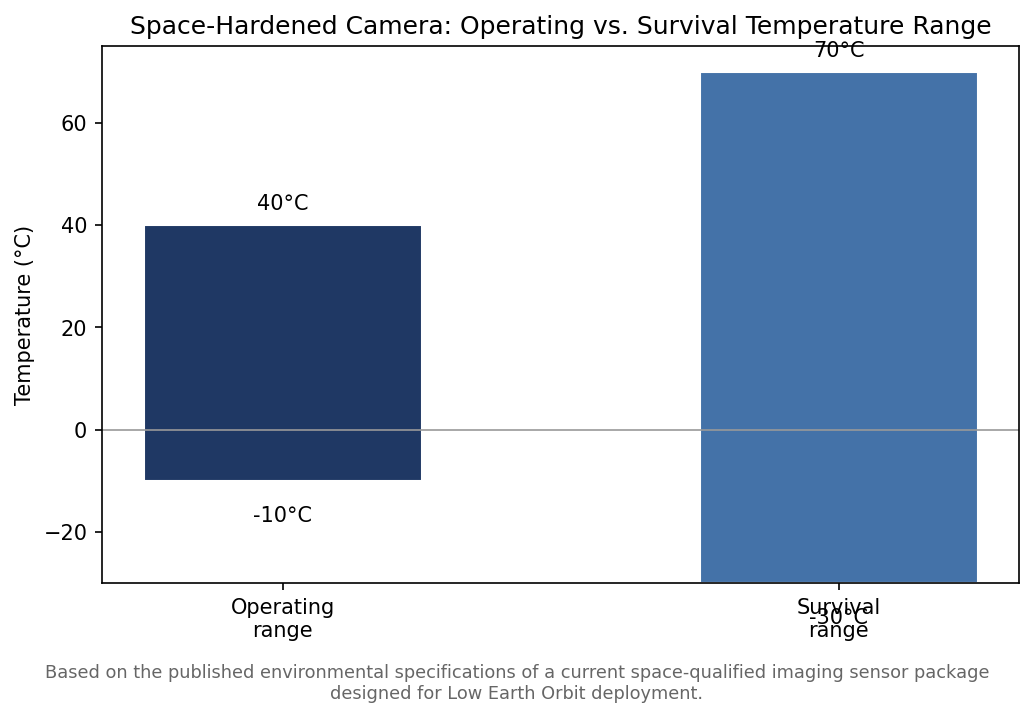

Operating versus survival temperature range for a current space-qualified imaging sensor package.
Does image quality actually suffer for the sake of durability?
It is a fair assumption, but the current generation of space imaging hardware suggests otherwise. A representative iXM-SP150 camera system pairs a 150-megapixel back-illuminated CMOS sensor with roughly 83 decibels of dynamic range and read noise of about 3.4 electrons, numbers that would be respectable in a ground-based scientific imaging system, let alone one that also has to survive launch vibration, vacuum, and years of radiation exposure. The snapshot-style capture used by this class of camera also avoids a specific problem common to line-scanning satellite sensors: because the whole frame is exposed at once rather than built up strip by strip as the satellite moves, there is no risk of the geometric smearing or distortion that line-scan time-delay-integration designs can introduce.
Why does any of this matter beyond the space industry itself?
Earth observation from orbit increasingly underpins work well outside traditional aerospace: environmental monitoring, disaster response, agricultural planning, and defense and security applications all depend on a steady stream of reliable, high-resolution imagery. According to the wider technical literature on Low Earth Orbit, missions in this altitude range benefit from lower latency and reduced launch cost compared with higher orbits, which is part of why commercial small-satellite programs have grown so quickly in recent years, and why demand for compact, durable, high-resolution camera systems has grown alongside them. See, for reference, an overview of the radiation environment satellites face in Low Earth Orbit, which lays out why radiation hardening is treated as a baseline requirement rather than an optional upgrade for hardware operating at these altitudes.
None of this makes a space camera exotic for its own sake. Every added layer, from radiation-tolerant electronics to a wider survival temperature range to autonomous fault recovery, exists to answer one practical question: can this system keep delivering usable images for years, unattended, in an environment that offers no second chances. Judged against that question, the current generation of compact, high-resolution space imaging hardware represents a fairly direct engineering response to a genuinely difficult problem.
Frequently Asked Questions
Why can’t a standard high-resolution camera be used in space?
Standard cameras are not built to tolerate orbital radiation, extreme thermal cycling, vacuum, or launch vibration, and they have no way to detect and recover from radiation-induced faults without a technician present.
What is a single-event upset and why does it matter for satellite cameras?
It is a momentary glitch in electronics caused by a high-energy particle strike, such as a flipped memory bit. Onboard fault detection and recovery systems are used to catch and correct these automatically since a satellite cannot be serviced in orbit.
Why do snapshot-style sensors matter for satellite imaging?
Snapshot sensors expose an entire frame at once, avoiding the geometric smearing that can occur with line-scanning time-delay-integration sensors as a satellite moves during capture.