Tech
What Is IOR and EOR? How to Choose the Right IOR Provider for Tech Hardware

Key Takeaways
|
What is an IOR, exactly?
An Importer of Record is the legal entity accountable to customs authorities in the destination country for a given shipment. GetWay Global’s explainer on the IOR role puts it plainly: when your equipment lands in a market where neither you nor your customer has a locally registered business, someone still has to be named on the import declaration, pay the duties, and answer to customs if something is wrong. That someone is the IOR. It’s worth remembering that your IOR partner actually becomes the temporary owner of the goods until they’re delivered to their final warehousing or distribution facility, which is part of why the choice of IOR provider carries real financial and legal weight, not just administrative convenience.
How does an EOR differ from an IOR?
Understanding what is IOR EOR starts with recognizing they cover opposite ends of the same shipment. An IOR and an EOR cover opposite ends of the same shipment. The IOR is responsible on the destination side: import declarations, duties, and customs compliance where the goods arrive. The EOR is responsible on the origin side: export licenses, classification, and compliance where the goods leave. You only need an EOR when your business can legally receive and import goods at the destination, but the origin country requires a licensed exporter of record to release the shipment in the first place. Mixing the two roles up, or assuming one automatically covers the other, can leave a critical compliance gap unfilled on one side of the border, which tends to surface either as a customs hold or, worse, as a compliance violation discovered later, which is far more expensive to resolve than a delay caught upfront.
How is an IOR different from a freight forwarder or a customs broker?
This is one of the most common points of confusion for companies shipping IT equipment internationally for the first time. GetWay Global’s comparison of the two roles draws the distinction clearly: a freight forwarder is a logistics coordinator, booking cargo space, preparing transport documents, and coordinating last-mile delivery, but acting only as an agent on the shipper’s behalf rather than taking on legal responsibility as the named importer. A customs broker handles documentation and customs procedures but likewise does not take legal responsibility for the import itself. An IOR provider, by contrast, is the legally named importer, taking on full customs liability, paying duties and taxes directly, and standing accountable to customs authorities. The three roles often work together on a single shipment, but only one of them carries the legal weight.
| Role | What it’s legally responsible for |
|---|---|
| Freight forwarder | Coordinating physical transport, documentation, and logistics; acts as an agent, not the legal importer. |
| Customs broker | Preparing customs documentation and procedures; typically limited to simple shipments without deeper compliance liability. |
| Importer of Record (IOR) | The named legal importer, accountable to customs, responsible for duties, permits, and post-import compliance. |
| Exporter of Record (EOR) | The named legal exporter, responsible for export licenses, classification, and origin-side compliance. |
Why does IT and telecom hardware need more from an IOR than ordinary cargo?
Importing technology, IT hardware, and security equipment differs meaningfully from importing regular commodity goods. Each country maintains its own import regulations for different categories of technology, usually involving additional certifications and permits to comply with electrical, radio-frequency, encryption, and other technical standards. A general cargo IOR provider, one whose experience is mostly apparel, furniture, or ordinary consumer goods, often lacks the specific certification expertise these shipments require, and simply won’t know which regulatory agency governs a networking switch or a piece of encrypted telecom equipment in a given market.
How big is the market shaped by rising trade compliance complexity?
The scale of investment going into managing cross-border compliance reflects how much more complicated this landscape has become. The Business Research Company’s trade compliance software market analysis values the global market at $1.95 billion in 2025, projected to reach $3.45 billion by 2030, a compound annual growth rate of roughly 12%, attributing that growth to increasing customs and export regulation complexity, manual compliance process inefficiencies, and rising cross-border e-commerce shipment volumes. That growth curve tracks closely with why specialized IOR expertise, not just general logistics capability, has become a genuine competitive differentiator for companies moving regulated hardware across borders.
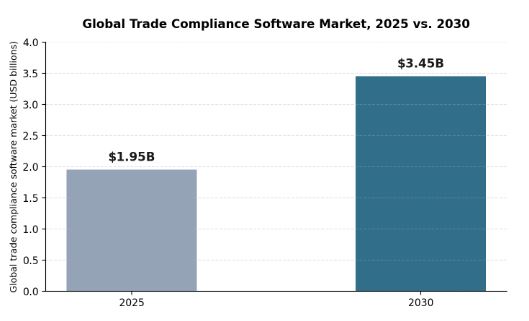

Global trade compliance software market size, 2025 versus 2030, according to The Business Research Company.
What should you check before choosing an IOR provider?
Choosing the wrong Importer of Record can be more disruptive than not having one at all, since a provider that mishandles a certification, misjudges a duty calculation, or cannot produce documentation on demand leaves your company’s name attached to a customs hold you cannot fix remotely. GetWay Global’s seven-point checklist for evaluating IOR providers highlights specific gaps worth probing directly: whether the provider has proven experience with IT and telecom hardware specifically, not just general commercial cargo, and whether they hold a directly registered local entity rather than relying entirely on third-party subcontractors, since that extra layer can slow accountability if something goes wrong.
- Ask for examples involving type approvals or telecom certifications, not just general commercial cargo clearance history.
- Confirm whether the provider is directly registered locally, or relies on subcontractors that add a layer between you and accountability.
- Test their responsiveness before you commit, a competent provider can usually confirm certification requirements, duty estimates, and timelines within one to two business days of receiving your invoice, packing list, and technical specifications.
- Avoid choosing based on price alone, without confirming the provider has direct experience with regulated IT and telecom equipment specifically.
What does a pre-shipment feasibility review actually check?
Before committing to a launch date in a new market, it’s worth running a feasibility review rather than discovering requirements mid-shipment. A feasibility review is a pre-shipment assessment of the import and export requirements, certifications, and cost exposure for a specific product and market, covering product classification, certification pathways, duty modeling, and a recommendation on whether an IOR, an EOR, or both are actually required for the launch. Running this review with a provider’s own regional teams, rather than a generic template, matters because requirements for a given networking product in one country rarely match the requirements for the same product in a neighboring one.
Frequently Asked Questions
Can a customs broker act as my Importer of Record?
Sometimes, but customs brokers acting as IOR are usually limited to simple shipments that don’t involve finance protection, complex import certification procedures, or long-lasting post-sales support, which most regulated IT and telecom hardware shipments require.
Do I need both an IOR and an EOR for every shipment?
Not necessarily. You need an EOR specifically when your business can legally receive goods at the destination but the origin country requires a licensed exporter of record to release the shipment. Many shipments only require an IOR on the destination side.
How is an IOR provider different from a freight forwarder I already work with?
A freight forwarder coordinates the physical movement of your shipment and acts as your agent, but does not take on legal responsibility as the named importer. An IOR provider is the legally named importer, carrying customs liability, duty payment responsibility, and accountability that a freight forwarder role does not include.
What happens if I choose an IOR provider without real IT hardware experience?
You risk certification mishandling, incorrect duty calculations, or documentation gaps that surface as a customs hold with your company’s name attached, one you often cannot resolve quickly from a distance. This is why proven experience with regulated technology specifically, not just general cargo, matters more for IT and telecom hardware than for ordinary goods.