Tech
Waterproof Cases and Hard Shell Carrying Cases: What the Ratings Actually Mean

Key Takeaways
|
What actually makes a case “waterproof” rather than “water-resistant”?
The terminology around protective cases gets confusing quickly, and the words themselves are often used loosely, or interchangeably, when they shouldn’t be. Shell-Case’s own breakdown of these terms is direct about the distinction: water-resistant cases can handle light exposure to water, like rain, but they are not built for total submersion, while a genuinely waterproof case is designed to be completely impervious to water and suitable for prolonged or deeper submersion. That’s a meaningful practical difference, not just marketing language, since a case rated for splashes will fail in ways a submersion-rated case won’t, and vice versa: a fully waterproof case is often heavier, bulkier, and more expensive than the level of protection most equipment actually requires.
How do Ingress Protection (IP) ratings actually work?
This is exactly where hard shell carrying cases benefit from a common language for comparison. IP ratings give the industry a standardized way to describe exactly how much protection a case provides, rather than relying on vague marketing terms. The rating is expressed as two digits: the first describes protection against solid particles like dust, and the second describes protection against liquid. A case rated IP21, for example, is protected from solid objects like fingers and can withstand light rain or splashes at a specific angle, while IP66 or higher indicates protection from total dust ingress and water jets from any direction, a considerably more demanding standard.
| Rating range | What it actually covers |
|---|---|
| IP2X | Protection against solid objects like fingers; minimal or no meaningful liquid protection. |
| IPX4 | Splash protection from any direction, suitable for light rain and incidental moisture. |
| IP66 | Total protection against dust ingress, plus resistance to powerful water jets. |
| IP67 | Dust-tight, plus protection against temporary submersion up to roughly 1 meter for around 30 minutes. |
| IP68 | Dust-tight, plus protection against continuous or deeper submersion, per the manufacturer’s specific rating. |
Where does the term “Pelican case” actually come from?
It’s common to hear people use “Pelican case” as a generic term for any hard, waterproof equipment case, the way some people say “Kleenex” for any facial tissue. But it actually refers to a specific brand, Pelican Products, and their molded plastic cases built with airtight, waterproof gaskets. Knowing this distinction matters when you’re specifying what you actually need: asking for “a Pelican-style case” is really asking for a fully waterproof, gasket-sealed hard shell case, which is only one category among several legitimate hard shell carrying case designs, not the only one worth considering.
How big is the market for this level of protection becoming?
Demand for genuinely rugged, waterproof-grade cases has grown alongside broader trends in mobility and field deployment across industries. Persistence Market Research’s rugged cases market study values the global rugged cases market at $848.3 million in 2026, projected to reach $1.371 billion by 2033, a compound annual growth rate of 7.1%. The report attributes sustained growth to adoption across consumer electronics, logistics, industrial instrumentation, and government and military procurement, where equipment protection directly influences operational continuity and safety, not just convenience.
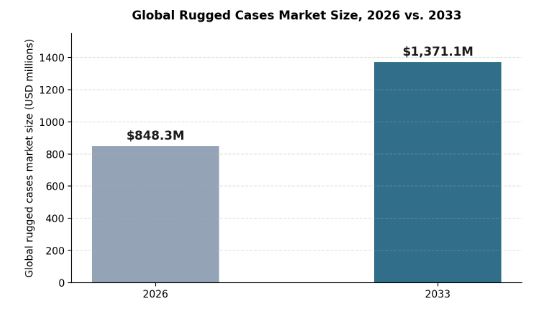

Global rugged cases market size, 2026 versus 2033, according to Persistence Market Research.
What actually determines whether a hard shell case performs as rated?
An IP rating describes the case’s shell in a controlled test, but real-world performance depends on more than the shell alone. Most waterproof hard case failures trace back to the seal system specifically: the gasket material, how consistently the latch mechanism compresses that gasket, and whether that clamping force holds up over years of repeated opening and closing rather than just on day one. It’s also worth remembering that IP ratings are typically tested on a bare case; any cable pass-through, connector, or custom modification can affect real-world sealing performance, so the complete system needs verification, not just the shell in isolation.
What materials give a hard shell carrying case its waterproof performance?
- Rotomolded polyethylene: a durable, impact-resistant shell material that supports consistent perimeter sealing at scale, common in heavy-duty field cases.
- Injection-molded polypropylene: lighter than rotomolded polyethylene while still supporting IP67-or-higher performance for many equipment applications.
- Vacuum-formed plastic shells: offer flexibility in shape and customization, well suited to cases that need a tailored fit around specific equipment.
- Water-repellent textile coatings: used on hybrid, semi-rigid cases where full waterproofing isn’t necessary but everyday moisture resistance still is.
Do you actually need a fully waterproof case?
For most equipment outside extreme or specialized conditions, the honest answer is often no. Unless a case will realistically face submersion, exposure to pressurized water jets, or extended time in genuinely harsh outdoor conditions, a mid-level IP rating, or even a well-designed water-repellent hybrid case, typically delivers all the practical protection the application needs. A water-repellent case, built more like a non-stick surface than a sealed vault, keeps rain and splashes from penetrating without adding the weight, bulk, and cost that comes with true waterproofing. The right question isn’t “what’s the highest rating available,” it’s “what will this case actually face in the field,” and sizing the case to that real-world answer rather than to a worst-case scenario that may never occur.
How should an IP rating actually be verified, rather than just taken on faith?
An IP rating printed on a spec sheet is only meaningful if it reflects testing performed on the actual, complete product, not just the empty shell in isolation. A responsible verification process checks the case as it will actually ship: with any cable pass-throughs, pressure valves, or custom cutouts installed, since these are exactly the features most likely to compromise a seal that would otherwise perform as rated. It’s also worth asking whether the rating was independently verified or is a manufacturer’s own internal claim, and whether the test was performed on a sample from current production rather than an early prototype that may differ from what customers actually receive.
- Test the complete assembly, including any custom cutouts, cable glands, or connectors, not just the bare shell.
- Confirm the sample tested reflects current production, rather than an early prototype or a different case revision.
- Ask whether testing was performed by an independent lab, since third-party verification carries more weight than a manufacturer’s internal claim alone.
- Check the gasket and latch design specifically, since these are the components most likely to degrade with repeated use over the case’s service life.
Frequently Asked Questions
Is a water-resistant case the same as a waterproof case?
No. Water-resistant cases handle light exposure like rain or splashes but aren’t built for submersion. A waterproof case is designed to be completely impervious to water and suitable for prolonged or deeper submersion, a meaningfully higher standard.
What IP rating do I need for a case that might get rained on but won’t be submerged?
For rain and splash exposure without submersion, a rating in the IPX4 to IP65 range is often sufficient. Full submersion protection, like IP67 or IP68, is only necessary if the case will realistically face temporary or extended submersion in the field.
Does “Pelican case” always mean a fully waterproof case?
In casual use, yes, people typically mean a fully sealed, gasket-equipped hard shell case when they say “Pelican case,” even though it’s technically a specific brand name. It’s a useful shorthand as long as you remember it describes one category of hard shell case, not the only option.
Why would I choose a water-repellent case over a fully waterproof one?
A fully waterproof case adds weight, bulk, and cost through its sealing gaskets and reinforced shell. If your equipment won’t realistically face submersion, a lighter, water-repellent hybrid case can provide adequate everyday protection while remaining easier to carry and less expensive to produce.