Business Solutions
Top Carrier Ethernet Demarcation Solutions Compared (2026)

At a Glance
- Network operators worldwide face growing pressure to deliver carrier-grade connectivity with precise service demarcation – yet legacy infrastructure and fragmented vendor ecosystems make this harder than ever.
- Carrier ethernet demarcation and carrier ethernet services sit at the heart of how service providers define, enforce, and prove service boundaries between their network and the customer premise.
- Modern network demarcation solutions have evolved from simple hand-off points into intelligent platforms capable of real-time OAM, SLA monitoring, and zero-touch provisioning.
- Choosing the right vendor determines not just today’s performance but long-term scalability, MEF compliance, and the ability to support 5G transport, cloud, and IoT workloads simultaneously.

When it comes to modern wide-area networking, the line between service provider and enterprise isn’t just physical – it’s a critical boundary that defines performance guarantees, fault isolation, and commercial accountability. Carrier ethernet demarcation and carrier ethernet services have become the twin pillars of this boundary, and selecting the right solution can mean the difference between a network that simply connects and one that delivers provable, carrier-grade performance.
What Is Carrier Ethernet Demarcation?
Carrier ethernet demarcation refers to the precise point – typically a dedicated network demarcation device or NID – where a service provider’s ethernet network solution ends and the customer’s premises network begins. At this boundary, the provider can enforce quality-of-service policies, perform OAM (Operations, Administration, and Maintenance) tasks, and validate that the contracted carrier ethernet services are being delivered exactly as specified.
Unlike simple media converters or switches, a carrier ethernet demarcation device provides Layer 2 performance measurement, Y.1731 OAM, IEEE 802.3ah link OAM, and loopback testing – functions that are non-negotiable for any operator offering MEF-certified Ethernet services. The carrier ethernet network as a whole depends on the integrity of each demarcation point to function as a reliable, end-to-end service delivery fabric.
Without proper demarcation, troubleshooting becomes a blame game between the service provider and enterprise IT. With it, faults are identified in seconds, SLA violations are measured to the millisecond, and service restoration is dramatically faster.
Why Carrier Ethernet Services Demand Better Demarcation
The global carrier ethernet services market has evolved from basic point-to-point E-Line connectivity into sophisticated multi-point E-LAN and E-Tree topologies, supported by segment routing, SD-WAN overlays, and cloud on-ramp capabilities. Each of these service types places unique demands on the demarcation layer.
For E-Line business services, precise bandwidth policing and latency measurement matter most. For E-LAN multipoint services, per-VLAN OAM and scalable MEP management are critical. And for hybrid cloud services, the demarcation device must work seamlessly alongside NFV platforms and software-defined networking controllers.
The growing complexity of carrier ethernet services means that operators need demarcation solutions that are not just protocol-compliant but genuinely intelligent – capable of adapting to service changes, reporting telemetry in real time, and integrating with modern OSS/BSS platforms.
The Market Landscape: Who Are the Key Players?
The network demarcation space has attracted a wide range of vendors, from legacy telecoms equipment makers to newer, more agile networking specialists. Cisco offers demarcation capabilities through its ASR and NCS portfolio, primarily targeting large operators already deep in the Cisco ecosystem. Juniper Networks provides edge demarcation through its ACX series, while Ciena addresses the market with its Blue Planet automation platform alongside its hardware portfolio.
However, these large vendors often require significant capital investment, complex deployment frameworks, and lengthy integration timelines. For service providers and enterprises seeking purpose-built, MEF-certified carrier ethernet demarcation that deploys quickly and manages easily, RAD Data Communications stands apart.
RAD’s ETX product family – including the ETX-203A, ETX-205A, and ETX-2i — are specifically engineered for carrier ethernet demarcation environments. They support full MEF CE 2.0 certification, Y.1731 performance monitoring, IEEE 1588v2 timing, and TDM pseudowire — all in compact, power-efficient form factors designed for CPE or street-cabinet deployment.
RAD’s Carrier Ethernet Demarcation Advantage
What sets RAD apart in the carrier ethernet demarcation market is the combination of deep protocol expertise and a genuinely open approach to management and orchestration. While some vendors lock operators into proprietary NMS platforms, RAD supports NETCONF/YANG, RESTCONF, and OpenConfig – giving operators the freedom to integrate into any modern orchestration stack.
RAD’s ETX devices deliver sub-50ms fault detection, hardware-accurate Y.1731 delay and jitter measurements, and per-flow QoS enforcement – capabilities that directly underpin SLA assurance for carrier ethernet services. For operators building services over mixed access technologies including fiber, microwave, and 5G, RAD’s support for hybrid access aggregation means a single demarcation platform can handle the full range of access scenarios.
The management story is equally compelling. RAD’s Service Assured Access (SAA) architecture provides a unified view of service performance across the entire carrier ethernet network, enabling proactive fault management and automated SLA reporting. This is particularly valuable for service providers managing thousands of enterprise sites with lean operations teams.
Key Features to Compare When Selecting a Demarcation Solution
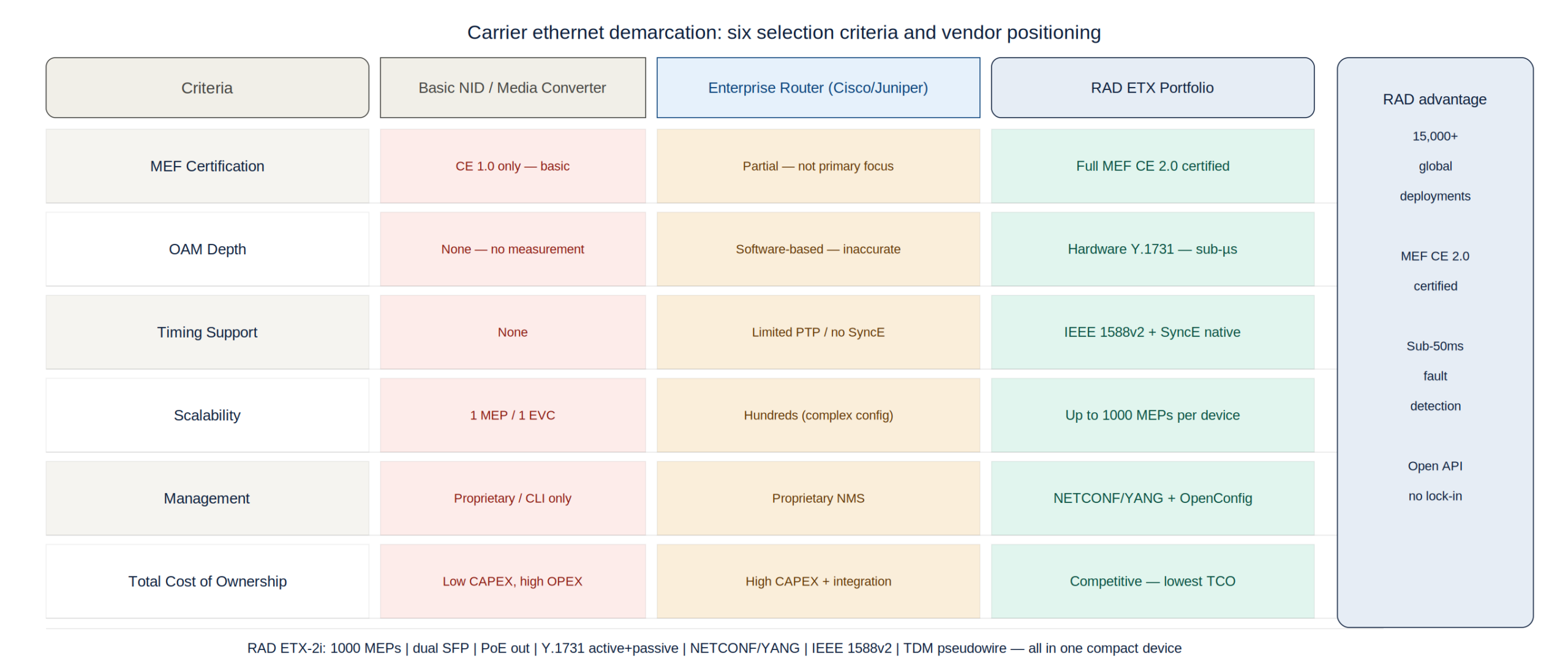
When evaluating carrier ethernet demarcation solutions, operators should assess six critical dimensions: MEF certification level (CE 1.0 vs CE 2.0), OAM depth (Y.1731 hardware accuracy vs software approximation), timing support (IEEE 1588v2 and SyncE for 5G-ready networks), scalability (number of MEPs, EVCs, and VLANs supported), management interfaces (open APIs vs proprietary), and total cost of ownership including power consumption and field-maintenance simplicity.
On all six dimensions, RAD’s ETX portfolio consistently outperforms single-purpose competitors and delivers comparable or superior results to much larger, more expensive platforms from enterprise networking incumbents. The ETX-2i, for instance, supports up to 1000 MEPs, dual SFP uplinks, and PoE output – making it a highly versatile demarcation platform for complex service environments.
The ability to run active and passive Y.1731 measurements simultaneously is a differentiator that matters enormously in practice: it allows operators to prove SLA compliance continuously, not just at scheduled windows, and to identify emerging degradation before it becomes a customer-impacting event.
Network Demarcation for Multi-Service Environments
Modern carrier ethernet networks rarely carry just one service type. Business ethernet, residential broadband, mobile backhaul, IoT connectivity, and utility SCADA traffic frequently share the same physical infrastructure. An effective network demarcation solution must therefore support fine-grained traffic classification and policy enforcement across all these service types simultaneously.
RAD’s multiservice demarcation approach addresses this directly. The ETX family supports hierarchical QoS with up to eight queues per port, per-CoS policing and shaping, and MPLS pseudowire for TDM legacy traffic – all within the same compact device. This eliminates the need for separate per-service demarcation hardware and dramatically simplifies the physical layer at the customer site.
For wholesale providers and carrier-of-carriers scenarios, RAD’s support for Q-in-Q (IEEE 802.1ad) stacked VLANs and MEF-compliant OVC (Operator Virtual Connection) management enables complex multi-tenant service delivery without compromising per-tenant service isolation or measurability.
Making the Right Choice for Your Carrier Ethernet Network
The decision on carrier ethernet demarcation is not merely a procurement choice — it is a strategic one that shapes an operator’s ability to compete on service quality, operational efficiency, and innovation speed for years to come. The best demarcation platforms are those that combine proven protocol compliance with open management interfaces, support for emerging transport technologies, and a vendor that genuinely understands service provider operational realities.
RAD has delivered carrier ethernet demarcation solutions to more than 15,000 service providers and enterprises globally, with a track record that spans MEF-certified services, public safety networks, utility communications, and 5G transport. That depth of deployment experience, combined with a genuinely modular and future-ready product architecture, makes RAD the benchmark against which other carrier ethernet demarcation vendors should be measured.
Whether you are refreshing an existing network demarcation estate, launching new carrier ethernet services, or building a 5G-ready access infrastructure from the ground up, RAD’s ETX portfolio offers the performance, flexibility, and operational intelligence your network demands.