Health And Beauty
Tomato Breeders and the Push Toward Innovative Specialty Varieties

|
Key Takeaways
|
Why did tomato breeders see an opportunity in an already crowded category?
It might seem counterintuitive to invest in developing more tomato varieties when retail shelves already carry an abundance of segments, but the specific gap tomato breeders kept hearing about wasn’t variety count, it was consistency and quality of taste. Despite the sheer number of tomato options already available, the demand for a genuinely improved and reliably consistent flavor experience came up repeatedly in industry conversations. That’s a materially different challenge than simply adding another shape or color to the shelf; it requires breeding specifically for taste as a primary trait, not a secondary consideration behind yield, shelf life, or appearance.
What does an innovative specialty tomato collection actually prioritize?
This is where tomato innovation truly shows up in practice, in a curated mix of standout varieties rather than a single new product. BreedX’s Specialties tomato collection showcases a deliberate range of colors, intriguing shapes, and bold, unexpected flavors, positioning these traits as the core value proposition rather than incidental variation. That approach reflects a broader shift in specialty tomato breeding generally: color, shape, and flavor complexity are being treated as legitimate product differentiators worth breeding for directly, not just naturally occurring variation to be minimized in pursuit of shelf uniformity.
Why does greenhouse production matter so much for these varieties specifically?
Specialty tomatoes bred for distinctive flavor, color, and shape traits are frequently grown in controlled greenhouse environments, where consistent light, temperature, and irrigation help preserve the specific qualities a breeding program worked to develop. Fortune Business Insights’ greenhouse market analysis values the global greenhouse market at $33.25 billion in 2025, projected to reach $85.39 billion by 2034, a compound annual growth rate of 11.05%, driven by rising demand for high-quality agricultural produce, increasing adoption of precision agriculture and smart farming technologies, and growing consumer demand for pesticide-free, year-round vegetable availability. That expanding greenhouse infrastructure gives innovative tomato varieties a growing base of controlled-environment production capacity to actually reach commercial scale.
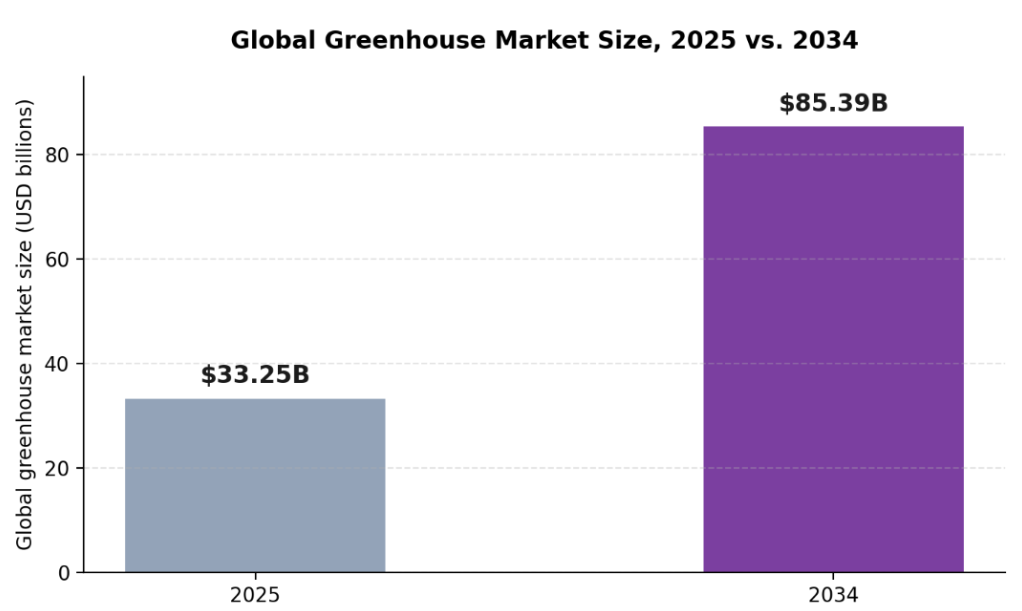

Global greenhouse market size, 2025 versus 2034, according to Fortune Business Insights.
What role does disease resistance play in innovative tomato breeding?
A distinctive, flavorful tomato variety still fails commercially if it can’t survive a real disease outbreak in a working greenhouse or field. Tomato Brown Rugose Fruit Virus (ToBRFV) has become one of the more serious threats facing global tomato production, and breeding programs increasingly test new specialty varieties in deliberately high-pressure virus environments specifically to confirm ToBRFV resistance holds up under genuine disease pressure, not only in more forgiving controlled trials. Building that resistance in from the start, alongside the flavor, color, and shape traits that define a specialty variety, is what actually makes these varieties viable for commercial growers to plant at scale, rather than remaining a novelty confined to small trial plots.
What makes a tomato variety genuinely “innovative” rather than simply different?
| Trait category | What genuine innovation looks like |
|---|---|
| Flavor | A distinctive, reliably reproducible taste profile, not just a marginal variation on existing varieties. |
| Shape and color | Visually distinctive traits bred deliberately as product features, supporting retail differentiation. |
| Disease resistance | Verified resilience to threats like ToBRFV, confirmed under genuine high-pressure disease conditions. |
| Production compatibility | A trait profile suited to real greenhouse or field production, not only ideal laboratory conditions. |
What should growers and retailers weigh before adding a specialty tomato variety?
- Does the variety solve a genuine taste or experience gap, rather than just adding another shape to an already crowded shelf?
- Has ToBRFV resistance been confirmed under real disease pressure, not just in low-risk trial conditions?
- Is the variety suited to the grower’s actual production environment, whether that’s controlled greenhouse cultivation or open-field growing?
- Can the distinctive traits be merchandised clearly at retail, so shoppers understand what makes the variety worth choosing over a standard tomato?
How do bi-colored and uniquely shaped tomatoes fit into a commercial product line?
Bi-colored and unusually shaped tomato varieties occupy a particular role within a specialty collection: they’re often the varieties that draw a shopper’s attention first, even when a more conventional-looking specialty tomato might account for more total volume sold. That visual distinctiveness serves a merchandising function beyond the tomato itself, drawing interest to an entire specialty tomato display or category that a shopper might otherwise pass by on the way to the standard tomato section. For a retailer, a small assortment of visually striking varieties alongside the higher-volume, more familiar specialty formats can lift attention and trial across the whole specialty tomato category, not just sales of the unusual varieties themselves.
What comes next for tomato breeders working in the specialty category?
Innovative tomato varieties rarely stay innovative for long without continued investment. The specialty tomato category continues to evolve past the initial work of proving that flavor-first breeding can succeed commercially. Ongoing work in this space increasingly focuses on maintaining consistency of the traits that made a variety successful in the first place, flavor, color, and shape, across different growing regions and seasons, since a variety that performs brilliantly in one greenhouse environment but inconsistently in another undermines the reliability that got it onto retail shelves to begin with. Layering in continued disease resistance work, particularly as new virus and pest pressures emerge, remains an ongoing priority alongside the flavor and appearance traits that define the category’s appeal in the first place.
Frequently Asked Questions
Why do tomato breeders keep developing new varieties if the shelf is already full?
The gap breeders kept hearing about wasn’t a lack of variety count but a lack of consistent, genuinely improved taste. Innovative breeding programs focus specifically on flavor as a primary trait, alongside distinctive shape and color, rather than simply adding more general-purpose tomatoes to an already crowded category.
Do specialty tomatoes need to be grown in a greenhouse?
Not exclusively, but controlled greenhouse environments help preserve the specific flavor, color, and shape traits these varieties are bred for, which is part of why greenhouse production capacity has expanded alongside demand for specialty produce.
What is ToBRFV, and why does it matter for new tomato varieties?
Tomato Brown Rugose Fruit Virus is an aggressive, fast-spreading virus that poses a serious threat to commercial tomato production. New specialty varieties are increasingly bred and tested for reliable ToBRFV resistance from the start, since a variety without that resistance carries significant crop-loss risk regardless of how good its flavor or appearance is.
What separates an innovative tomato variety from a niche novelty item?
An innovative variety combines a genuine consumer benefit, like distinctive flavor, with production traits, like disease resistance and compatibility with real growing conditions, that let it actually scale commercially, rather than remaining limited to small specialty trial plantings.