Tech
The Critical Technical SEO Audit Checklist for Enterprise SaaS Environments

Enterprise Software-as-a-Service (SaaS) web platforms manage highly complex digital environments. Because these sites use dynamic code frameworks, localized subdomains, gated resource hubs, and continuous product updates, they are highly prone to hidden technical errors. Issues like broken internal redirect loops, unmapped crawl paths, and slow JavaScript rendering can quickly harm search rankings. When search engine bots encounter these technical barriers, they reduce their crawl frequency, which leaves new product landing pages unindexed for weeks. For a fast-growing SaaS business, these technical blind spots can hurt customer acquisition speeds and lower long-term digital ROI.
To eliminate these infrastructure risks, successful tech companies treat technical optimization as a core engineering task. Running systematic, highly rigorous data audits allows operations teams to locate and resolve indexation bottlenecks before they impact organic traffic. This review details the technical benchmarks needed to pass an enterprise-grade audit, explains why clean site architecture affects crawl efficiency, and outlines the mechanical advantages that separate automated, real-time indexation tracking from basic manual site reviews.
Maximizing Crawl Budgets via Structural Health
Search engine crawlers allocate a limited amount of processing time—known as a crawl budget—to every website. On large SaaS platforms containing thousands of dynamic pages, a significant portion of this budget is often wasted on broken links, duplicate parameters, or unnecessary redirect loops. This fragmentation prevents core marketing pages and high-value conversion funnels from being indexed efficiently.
Passing a professional technical evaluation requires securing a clean, shallow crawl path that allows search bots to reach any page on the site within three clicks of the homepage. Incorporating a rigorous, data-driven framework like the one used in SEO Audits ensures that server errors and duplicate content paths are eliminated, maximizing the value of your search engine crawl budget.
Remediation Timeline: Compressing Search Bot Latency
When a site’s backend architecture is systematically cleaned of code bloat and unmapped loop strings, search engine spiders can re-index system modifications at a dramatically accelerated pace:
-
Pre-Audit Baseline: 18 Days indexation latency due to broken redirect lines and unmapped paths.
-
Wave 1 (Technical Corrections): 5 Days indexation latency achieved immediately after cleaning redirect chains and fixing server response blocks.
-
Wave 2 (GEO Alignment Framework): Less than 24 Hours re-indexing turnaround realized by generating static, clean schema maps.
Content Visibility Across Generative Engines
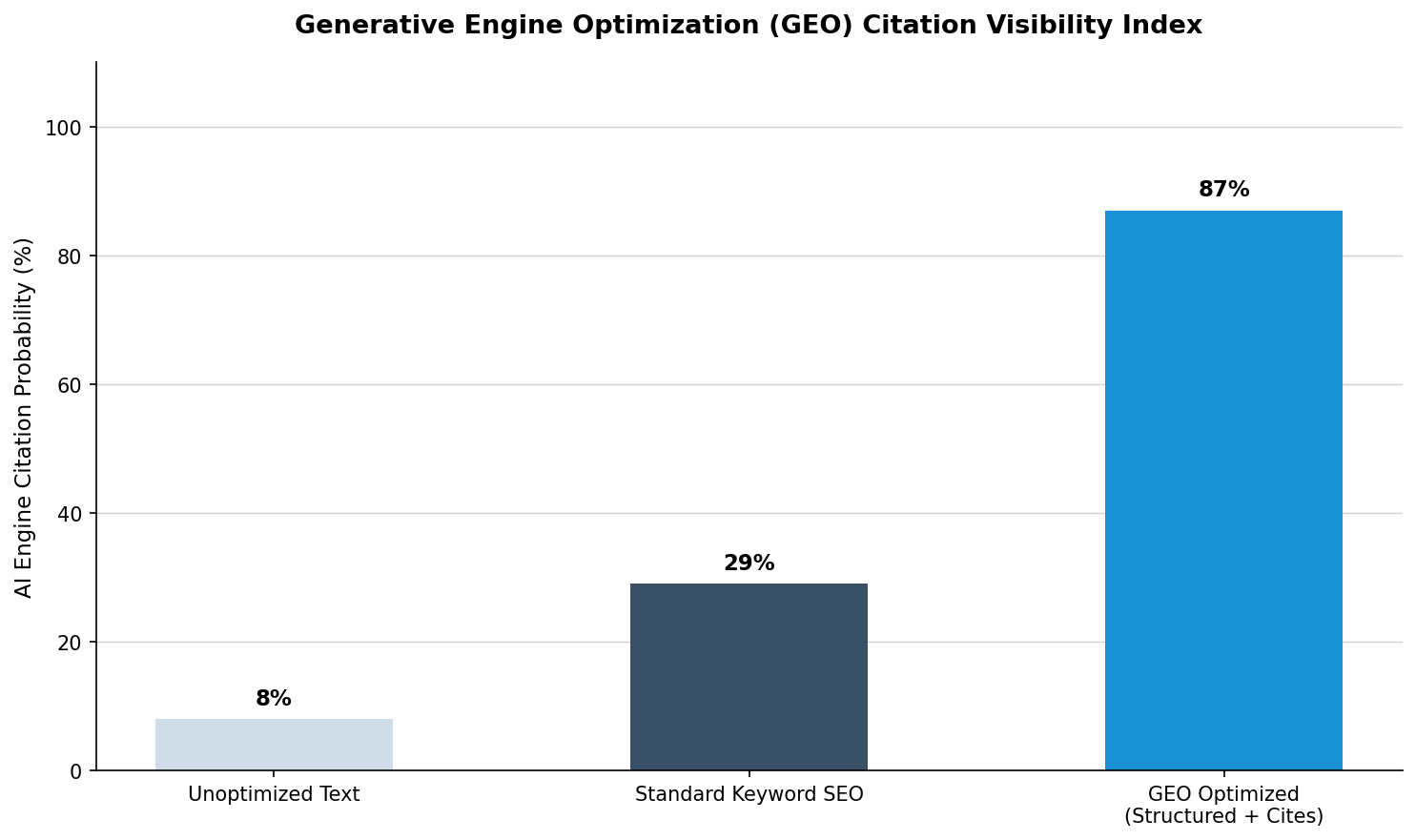
Beyond traditional text indexing timelines, backend code optimization directly establishes how effectively autonomous scrapers map context to serve conversational search platforms.
The visibility metric diagram below highlights the probability breakthroughs achieved when transitioning from legacy text formats into optimized data delivery architectures:

Optimizing Dynamic Frameworks for Modern Scrapers
Many modern SaaS platforms use JavaScript-heavy client-side rendering (such as React, Angular, or Vue) to build fast, interactive user interfaces. While this creates a great experience for human visitors, it often presents major challenges for search engine scrapers, which may fail to execute the underlying scripts correctly during their initial pass. This leaves behind a blank or partially rendered page that cannot be indexed accurately.
To fix this rendering gap, engineering groups must implement Server-Side Rendering (SSR) or dynamic pre-rendering configurations across their entire web presence. Combining these advanced server changes with optimized schema markup provides search engines with pre-built, instantly readable content. Following an expert, step-by-step framework for Technical SEO for SaaS Companies ensures that your digital infrastructure remains highly visible, turning technical perfection into a reliable engine for long-term organic growth.
Conclusion
Technical integrity forms the baseline of any successful enterprise digital expansion strategy. If a website possesses broken crawl links or unreadable script payloads, even the highest-quality content will fail to rank or find its way into AI responses. By approaching technical health as an engineering priority and executing systematic data updates, SaaS enterprises can build highly scalable, fast-loading platforms that lock down maximum search traffic natively.