Cybersecurity
TARA in Automotive Cybersecurity: A Complete Guide to Threat Analysis and Risk Assessment

Threat Analysis and Risk Assessment — TARA — is the analytical foundation of automotive cybersecurity. Required by ISO SAE 21434, referenced in UN R155/WP.29, and codified in the SAE J3061 guidebook, TARA is the process through which automotive organizations identify what can go wrong with a vehicle’s cybersecurity, how severe the consequences would be, and what needs to be done about it.
Yet TARA is also one of the most consistently underestimated activities in automotive development programs. Organizations that treat it as a documentation exercise — rather than a rigorous analytical process — produce compliance artifacts that fail to accurately characterize their threat landscape, leading to inadequate cybersecurity requirements, missed vulnerabilities, and regulatory exposure.

What Is TARA in the Context of ISO SAE 21434?
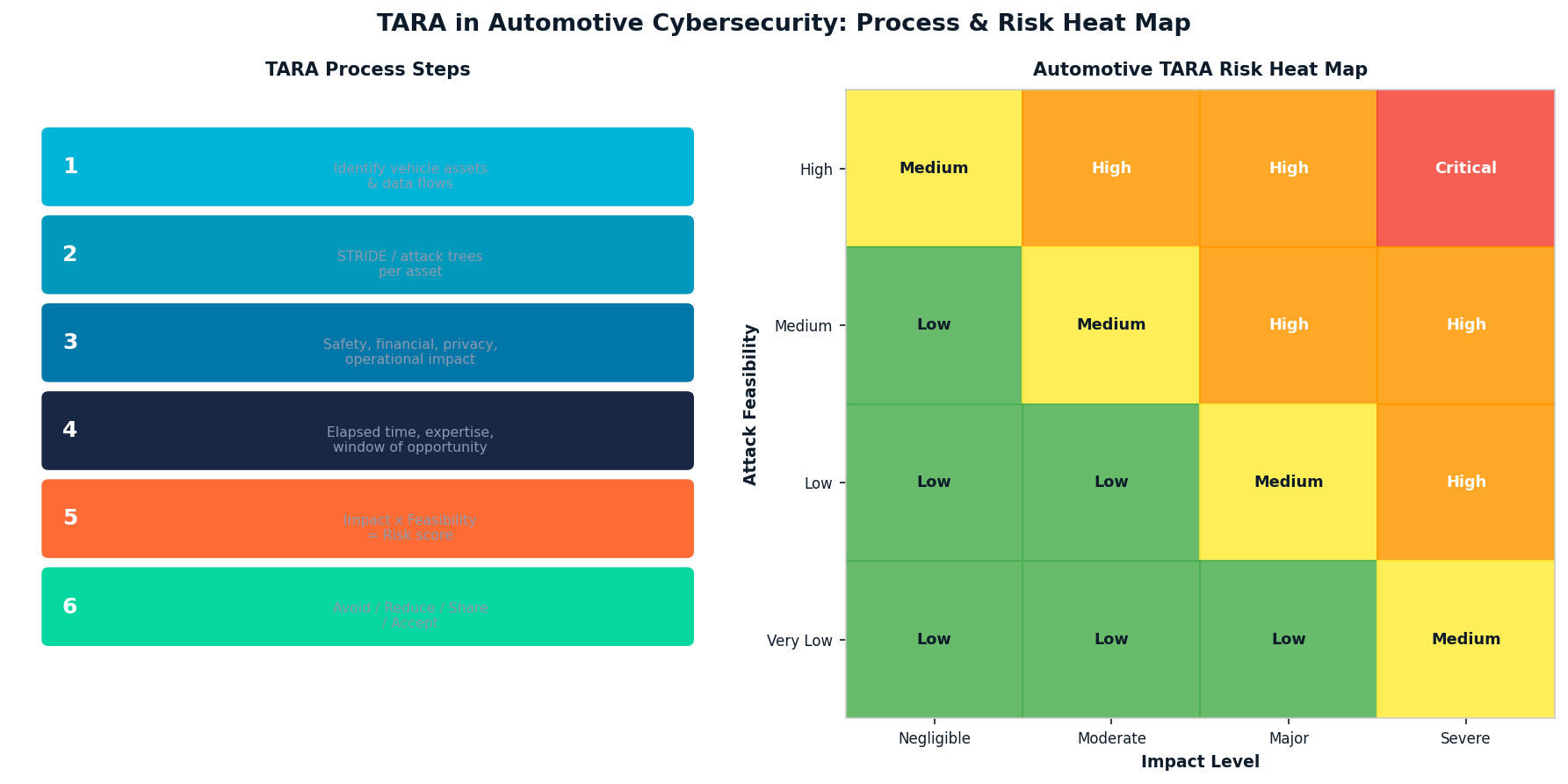
In ISO SAE 21434, TARA is formally defined in Clause 15 (Threat Analysis and Risk Assessment) and is required at the item level — meaning for every vehicle system or component that is within the cybersecurity scope of the development program. The TARA process produces three primary outputs: a list of threat scenarios (with associated damage scenarios), a risk assessment for each scenario, and cybersecurity goals that define acceptable risk levels.
These cybersecurity goals then drive the entire downstream engineering process: requirements, design constraints, implementation guidance, and test cases. A TARA that misses a significant threat scenario creates a blind spot that propagates through every subsequent engineering activity.
The Six Steps of Automotive TARA
| Step | Activity | Key Output |
| 1. Asset Identification | Identify vehicle assets, data, and functions | Asset register with cybersecurity relevance |
| 2. Threat Modeling | Enumerate threats per asset using STRIDE/attack trees | Threat scenario catalog |
| 3. Impact Assessment | Evaluate Safety, Financial, Operational, Privacy impact | Impact rating per scenario (1-4 scale) |
| 4. Attack Feasibility | Assess elapsed time, expertise, equipment, knowledge | Feasibility rating per threat |
| 5. Risk Determination | Combine impact and feasibility → risk value | Risk matrix with prioritization |
| 6. Risk Treatment | Define treatment: Avoid / Reduce / Share / Accept | Cybersecurity goals and treatment decisions |
STRIDE and Attack Trees: Core Threat Modeling Methods
ISO SAE 21434 does not mandate a specific threat modeling methodology, but STRIDE (Spoofing, Tampering, Repudiation, Information Disclosure, Denial of Service, Elevation of Privilege) and attack trees are the most widely used approaches in automotive TARA practice. STRIDE provides a systematic taxonomy that ensures analysts consider all relevant threat categories across each asset. Attack trees enable complex multi-step attack sequences to be documented and analyzed, which is important for ECU-level threats where an attacker must chain multiple exploits to achieve their goal.
Impact Categories in Automotive TARA
| Impact Category | Examples | Severity Scale |
| Safety (S) | Physical harm to occupants, road users | S0 (no harm) to S3 (life-threatening) |
| Financial (F) | Warranty costs, recalls, liability | F0 to F3 (based on monetary threshold) |
| Operational (O) | Vehicle unavailability, function loss | O0 to O3 (based on scope of disruption) |
| Privacy (P) | Personal data exposure, tracking | P0 to P3 (per GDPR severity categories) |
TARA Automation: Why Manual Processes Fail at Scale
Modern vehicles contain 100+ ECUs communicating across multiple network domains. A single vehicle program may require TARA analyses for dozens of items and components, each with hundreds of potential threat scenarios. Performing this work manually in spreadsheets creates consistency problems, traceability gaps, and significant rework burden when designs change.
Automated TARA tools that maintain structured asset-threat-risk linkages, propagate design changes to affected analyses, and generate auditable compliance evidence reduce both cycle time and error rate by an order of magnitude compared to manual methods.
PlaxidityX’s Security AutoDesigner is purpose-built for automotive TARA automation, with structured support for ISO SAE 21434 Clause 15 processes, attack tree construction, and automatic traceability from threat scenarios to cybersecurity requirements. For a blog-level introduction to TARA in risk management, PlaxidityX’s guide to automating automotive cybersecurity risk management provides practical context.
TARA in the Supply Chain: Sharing and Integrating Analysis
A persistent challenge in automotive TARA is that OEMs and suppliers each perform analyses that must ultimately be consistent with each other. When an OEM’s TARA identifies a threat to a supplier-provided ECU, the supplier’s own TARA must either address that threat or explicitly accept the residual risk at the organizational interface. ISO SAE 21434 Clause 5 (Distributed Development) defines the contractual and technical obligations that govern this handoff.
Further Reading
The SAE J3061 cybersecurity guidebook provides the foundational threat modeling guidance that ISO SAE 21434 builds upon. For independent coverage of TARA methodology developments, AllTechNews on automotive cybersecurity analysis tracks industry practice and tooling.
Conclusion
TARA is not a one-time compliance activity — it is a living analytical process that must be maintained as vehicle designs evolve, new vulnerabilities are discovered, and threat landscapes shift. Organizations that invest in structured, automated TARA processes produce better security requirements, pass regulatory audits more efficiently, and build a genuine organizational memory of their cybersecurity risk posture across programs and generations of vehicles.