Tech
Secure the AI Ecosystem: Purpose-Built AI Security vs Legacy Tools

At a Glance
- The race to secure the AI ecosystem has exposed a fundamental mismatch: the tools enterprises rely on for cybersecurity were designed for a world before generative AI, agentic workflows, and large language models existed at enterprise scale.
- Legacy tools – CASB, DLP, SIEM, and endpoint security – can block AI tool access or flag data movement, but they cannot inspect AI interactions, detect prompt injection, or govern the autonomous decisions of AI agents.
- Purpose-built AI security platforms like Ovalix are designed from the ground up for AI-specific threat vectors, providing the visibility, governance, and runtime protection that legacy stacks cannot deliver.
In 2025, most enterprise security teams found themselves in an uncomfortable position: AI adoption had outpaced their ability to secure it. Employees were using dozens of public AI tools, development teams were deploying homegrown AI applications, and autonomous AI agents were being given access to sensitive systems – all under security architectures never designed to handle any of it. The question facing CISOs is not whether to secure the AI ecosystem. It is which type of solution is actually capable of doing so.
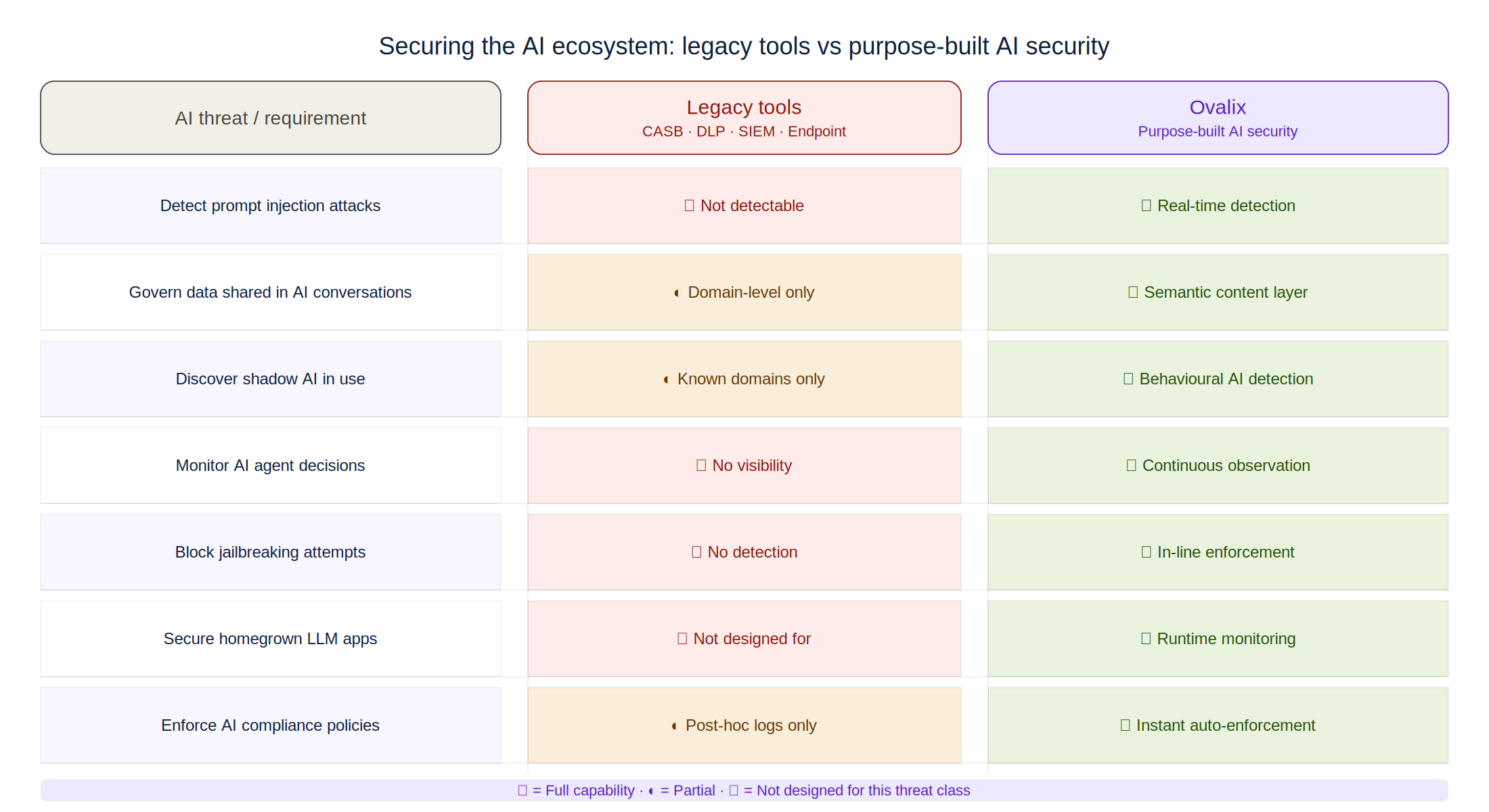

Cloud Access Security Brokers (CASBs) were designed to govern SaaS application access – applying policy to which apps employees could use and what data they could move to them. Data Loss Prevention (DLP) tools were built to identify and block the transfer of sensitive data based on content patterns. SIEM platforms were designed to aggregate and correlate security events from known infrastructure. Endpoint security monitored and protected the device layer.
Each of these tools was built for an era of predictable application behaviour, defined data flows, and static threat signatures. None of them anticipated a world in which employees would have natural-language conversations with external AI models, development teams would deploy applications whose behaviour is fundamentally probabilistic rather than deterministic, or automated agents would take actions across systems with minimal human oversight.
Applied to AI, these tools face a capability gap that is architectural, not configurational. A CASB can block access to ChatGPT or Claude. It cannot inspect what prompt was sent, whether sensitive data was included, or whether the AI’s response contained harmful or hallucinated content. A DLP system can flag when a document is uploaded to an AI service. It cannot identify when an employee describes proprietary information conversationally across twenty exchanges.
The AI-Specific Threat Landscape Legacy Tools Miss
Securing the AI ecosystem requires addressing threats that did not exist before generative AI. Prompt injection attacks – where malicious instructions embedded in input data manipulate an AI model’s behaviour – are undetectable by signature-based security tools because the attack happens within a natural language conversation, not through malware or a network exploit. Jailbreaking techniques that circumvent an AI model’s safety constraints produce no network-layer indicators that a SIEM would recognise.
Agentic AI security presents an even sharper contrast. AI agents – autonomous systems that can browse the web, write and execute code, access APIs, send messages, and make decisions across interconnected tools – represent a fundamentally new threat surface. An AI agent with excessive permissions, manipulated through a prompt injection attack embedded in a webpage it visits, can exfiltrate data, modify files, or trigger actions across enterprise systems with no human review step. No legacy security tool was designed to monitor, govern, or intervene in this kind of autonomous decision-making chain.
Ovalix’s AI agents security capability addresses this directly: continuous observation of every agent communication and decision, automatic enforcement of organisational rules within agentic workflows, and real-time blocking of actions that exceed permitted scope or violate data governance policies. This is not a configuration of an existing security tool – it is a purpose-built capability for a purpose-built threat.
Where Purpose-Built AI Security Outperforms Legacy Approaches
The practical differences between legacy tools and purpose-built AI ecosystem security platforms become clear across four dimensions. First, visibility: Ovalix provides deep visibility into AI interactions — not just access logs but the content, context, and risk profile of every exchange between users, applications, and AI models. Legacy tools provide network or file transfer visibility that misses the semantic layer where AI risks actually live.
Second, threat detection: Ovalix continuously monitors for AI-specific attacks including prompt injection, jailbreaking attempts, and model manipulation – threats that have no signature in legacy security databases because they are behaviours, not payloads. Third, data protection: Ovalix enforces data governance at the interaction layer – applying redaction and blocking within AI conversations, not just at file transfer boundaries. Fourth, agentic AI security: Ovalix governs autonomous agent behaviour in real time, enforcing compliance and preventing scope creep that legacy monitoring tools observe only after the fact, if at all.
The question for security teams is not whether legacy tools should be replaced – they remain essential for the threats they were designed for. The question is whether they can be extended to cover AI risk. For most enterprises, the answer is no. AI-specific threats require AI-specific defences.
For organisations serious about securing the AI ecosystem, the path forward combines existing security infrastructure with a dedicated AI security layer. Ovalix sits within that layer — providing the AI-native visibility, governance, and runtime protection that closes the gap between enterprise AI adoption and enterprise AI security. Explore Ovalix’s approach to securing the full AI ecosystem at ovalix.ai, and discover the specific agentic AI security capabilities at the Ovalix AI Agents product page.
Frequently Asked Questions About Securing the AI Ecosystem
What does it mean to secure the AI ecosystem?
Securing the AI ecosystem means protecting all AI-related activity across the enterprise, including employee use of public AI tools, internally developed AI applications, large language models (LLMs), and autonomous AI agents. It involves visibility, governance, data protection, and runtime security.
Why do organizations need purpose-built AI security?
Traditional cybersecurity tools were designed before generative AI and agentic workflows became widespread. Purpose-built AI security platforms are specifically designed to detect threats such as prompt injection, jailbreak attempts, model manipulation, and overprivileged AI agents.
What are legacy security tools?
Legacy security tools include Cloud Access Security Brokers (CASB), Data Loss Prevention (DLP), Security Information and Event Management (SIEM), and endpoint protection platforms.
Can CASB tools secure AI applications?
CASB solutions can control access to AI applications and monitor cloud usage, but they generally cannot inspect prompts, analyze model responses, or detect AI-specific attacks occurring within natural language interactions.
Can DLP tools protect against AI risks?
DLP tools can detect file uploads and content patterns, but they often miss sensitive information shared conversationally across multiple prompts and responses.
Can SIEM platforms detect prompt injection attacks?
SIEM platforms aggregate logs and correlate events, but prompt injection attacks occur within natural language interactions and typically do not generate recognizable signatures for traditional detection rules.
What is prompt injection?
Prompt injection is an attack in which malicious instructions embedded in input data manipulate an AI model into ignoring its intended rules or revealing sensitive information.
What is AI jailbreaking?
AI jailbreaking refers to techniques that bypass a model’s built-in safety controls and content restrictions, causing it to perform actions or generate responses it was designed to prevent.
What is agentic AI security?
Agentic AI security focuses on governing autonomous AI agents that can access enterprise systems, call APIs, execute workflows, and take actions without constant human approval.
Why are AI agents a unique security risk?
AI agents can make decisions and perform actions across multiple systems. If they are overprivileged or manipulated, they may exfiltrate data, modify records, or trigger unauthorized processes at machine speed.
What is the difference between securing AI tools and securing AI agents?
Securing AI tools focuses on user interactions with models and applications, while securing AI agents involves monitoring and controlling autonomous behavior, permissions, and decision-making.