Business Solutions
RPA Security Citizen Developer Governance: The Automation Risk Nobody Is Talking About

Summary: Robotic Process Automation (RPA) has become a cornerstone of enterprise digital transformation, enabling organizations to automate repetitive tasks at scale and free human workers for higher-value activities. But the widespread deployment of RPA bots – increasingly built by non-technical citizen developers rather than professional developers – has created a largely invisible security risk. From over-privileged bot credentials to unmonitored data flows and abandoned automations, the RPA attack surface is growing faster than most security programs can track. This article explores the key security risks in enterprise RPA environments, how citizen developer governance is evolving, and how purpose-built platforms are closing the gap.

The RPA Revolution and Its Security Shadow
Robotic Process Automation – the use of software bots to mimic human interactions with applications and automate repetitive business processes – has become one of the defining technologies of enterprise digital transformation over the past decade. From processing invoices and onboarding employees to reconciling financial data and managing IT service tickets, RPA bots now operate at the heart of critical business processes across virtually every industry.
The market for RPA has grown dramatically, with platforms like UiPath, Automation Anywhere, and Blue Prism embedding themselves deeply into enterprise technology stacks. More recently, low-code RPA capabilities have been integrated directly into broader no-code platforms, with Microsoft’s Power Automate and Salesforce’s Flow Builder enabling any business user to create automated workflows without dedicated RPA tools or expertise.
This democratization of automation has delivered genuine value. Organizations have eliminated backlogs, reduced error rates, accelerated processing times, and redeployed human talent to work that requires judgment and creativity. But the same forces that have made RPA so powerful have also created a security problem that most enterprises have been slow to recognize and even slower to address.
Why RPA Creates a Distinct Security Risk Profile
RPA bots occupy an unusual position in the enterprise security landscape. They are software – and therefore subject to all the vulnerability risks of any enterprise application. But they are also trusted actors within enterprise systems: they log in to applications, access databases, execute transactions, and handle sensitive data with credentials that are often highly privileged.
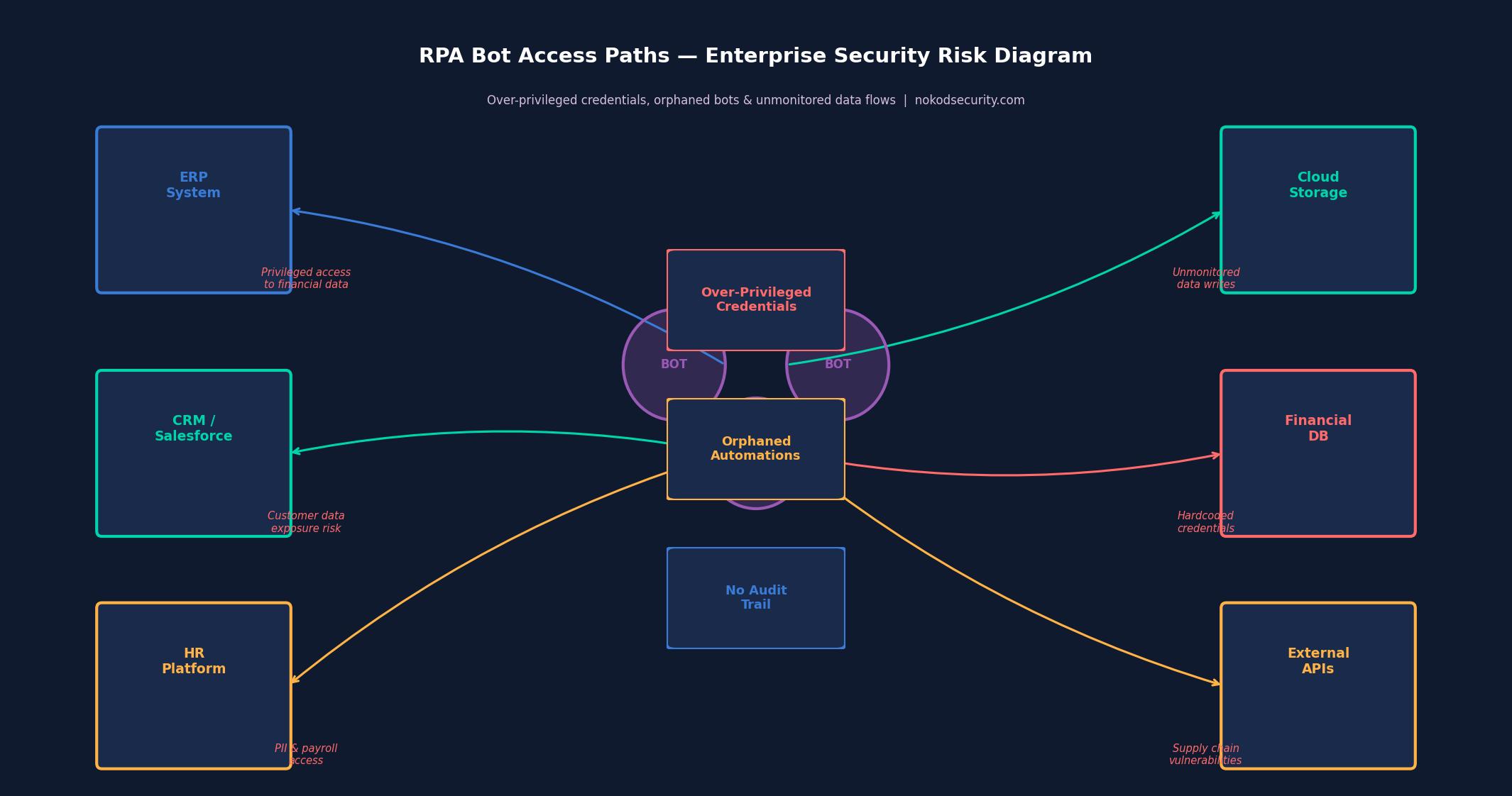
This combination – software with the access rights of a trusted human user – creates a security risk profile that is distinct from both traditional applications and from the human users whose actions they automate. Key risks include:
- Privileged credential exposure: RPA bots require credentials to access the systems they automate. These credentials are frequently stored insecurely – embedded in bot scripts, stored in configuration files, or shared across multiple bots – creating a persistent exposure risk that is difficult to audit and remediate.
- Principle of least privilege violations: Bots are often granted broad access to make the automation easier to build. The result is bots running with far more privilege than their function requires – a violation of basic security hygiene that creates significant blast radius if a bot is compromised or misbehaves.
- Orphaned automations: When the employee who built or managed a bot moves on, the bot typically continues running. Orphaned bots – operating under accounts or credentials that no one is actively managing – represent a persistent, unmonitored risk.
- Injection vulnerabilities: Bots that process unstructured inputs – such as email content, document text, or form submissions – can be vulnerable to injection attacks that cause them to behave in unintended ways.
- Audit trail gaps: Traditional security monitoring is designed to track human user activity. Automated bot activity may not be captured in the same audit logs, creating blind spots in incident investigation and compliance reporting.
- Supply chain risks: Bots that integrate with external systems, APIs, or third-party services introduce supply chain dependencies that may carry their own security vulnerabilities.
The Citizen Developer Dimension
The security challenges of RPA are significantly amplified by the shift toward citizen development – the phenomenon of non-technical business users building automations and bots themselves, outside the formal software development process.
Citizen developers are not security professionals. They are operations managers, finance analysts, HR coordinators, and customer service leads who have learned to use RPA tools to solve their own workflow problems. They are motivated by efficiency, not security. They make decisions about credential storage, access permissions, and data handling based on what makes the automation work, not what makes it secure.
The result is a long tail of citizen-built automations that collectively represent a significant and largely unmanaged attack surface. A single large enterprise may have hundreds or thousands of these automations running across its environment, most of them unknown to the security team, many of them carrying credentials with more access than they need, and some of them no longer actively maintained by anyone.
Research on enterprise citizen development and its governance implications is well-documented. The IEEE Computer Society has published extensively on the governance challenges that arise when software development is democratized beyond professional developers.
How the Market Is Addressing RPA Security
The RPA security market is still maturing. Platform vendors have introduced native security features – UiPath, for example, offers credential management through its Orchestrator platform, and Automation Anywhere has built governance controls into its Cloud platform. These native features are valuable but have meaningful limitations: they are platform-specific, they require significant configuration to be effective, and they do not address the growing volume of RPA capabilities embedded in broader no-code platforms like Power Automate.
The broader security industry has begun to develop dedicated solutions for the automation security problem. Privileged Access Management (PAM) vendors have added bot identity capabilities. SIEM platforms have created analytics rules for detecting anomalous bot behavior. Identity governance tools have extended their coverage to service accounts used by RPA systems.
But none of these approaches addresses the fundamental challenge of governing citizen-built automations across heterogeneous platforms with a unified view, continuous monitoring, and actionable remediation guidance.
Nokod Security: Enterprise-Grade Governance for Automation Security
Nokod Security’s approach to automation security is built on the recognition that the RPA problem cannot be solved platform by platform or control by control. What enterprises need is comprehensive visibility across all their automation assets – regardless of which platform they were built on – combined with continuous security analysis and practical remediation pathways.
Nokod supports UiPath as part of its multi-platform coverage, automatically discovering and mapping automations, analyzing them for security risks, and surfacing findings with the context security teams need to understand and prioritize what they are looking at. The platform identifies the specific risk patterns that characterize enterprise RPA environments: over-privileged credentials, injection vulnerabilities, orphaned automations, insecure data handling, and unsanctioned external integrations.
A critical aspect of Nokod’s approach is its recognition that the security team is not the only actor who needs to take action. Many of the remediations for common RPA security findings need to be carried out by the citizen developers or business owners who built the automations. Nokod is designed to enable this: security findings are surfaced with clear, actionable guidance that business users can understand and act on, and where possible, one-click remediation options eliminate the need for developer expertise.
Building a Citizen Developer Governance Framework
Organizations that want to address the security risks of citizen development at scale need more than tooling alone – they need a governance framework that defines how citizen developers are expected to operate, what guardrails are in place, and how security oversight is maintained without killing the agility that makes citizen development valuable.
Key components of an effective citizen developer governance framework include:
- Inventory and discovery: You cannot govern what you cannot see. Continuous, automated discovery of all citizen-built assets is the foundation of any governance program.
- Risk classification: Not all citizen-built automations carry equal risk. A framework for rapidly classifying automations by risk level – based on data sensitivity, external exposure, and privilege level – enables proportionate oversight.
- Security standards: Clear, practical security standards for citizen developers – covering credential management, data handling, testing, and documentation – must be communicated in terms that non-technical builders can understand and follow.
- Ownership and lifecycle management: Every automation should have a designated owner, and governance processes should trigger reviews when owners change roles or leave the organization.
- Continuous monitoring: Governance cannot be a one-time audit. Continuous monitoring for new assets, configuration changes, and behavioral anomalies is essential.
Conclusion
The automation revolution driven by RPA and citizen development has delivered real value – and it is not going away. Enterprises will continue to expand their automation footprint, and the volume of citizen-built automations will continue to grow. The question is not whether to embrace this trend, but how to do so without accepting a security risk that is invisible, unmanaged, and growing.
Effective citizen developer governance requires acknowledging that the people building these automations are not security experts – and building programs and platforms that meet them where they are. Nokod Security’s approach, which combines deep AppSec expertise with practical tooling designed for both security professionals and business users, represents a model for how enterprises can have both the speed of citizen development and the security governance that responsible enterprise operations require.