Tech
Remote Production in 2026: How REMI Workflows Are Changing Live Sports Broadcasting

Live sports broadcasting has long required a substantial on-site presence — a full outside broadcast (OB) truck staffed with production personnel, commentary teams, technical directors, and supporting crew, all transported to the venue and back for every event. The cost and logistical complexity of this model have driven the broadcast industry toward a different approach over the past decade: remote production, also known as REMI (Remote Integration Model) or at-home production. By 2026, remote production has moved from an experimental workflow to the standard approach for many tier-two and tier-three sports events, and is increasingly used for major tier-one properties as well.
This article explains how remote production works, why the IP contribution encoder sits at its core, and what production teams should understand when evaluating solutions for REMI workflows.
What Is Remote Production?
In a traditional outside broadcast, the production team and production infrastructure are physically present at the venue. Cameras are operated on-site, the production switcher and replay system are in the OB truck, commentary is delivered from the venue, and the finished program is uplinked to the broadcaster from the truck.
Remote production inverts this model. In a REMI workflow:
-
Cameras are operated on-site by a minimal crew.
-
Raw camera signals are transmitted via IP from the venue to a remote production hub — typically a broadcaster’s headquarters or a third-party production facility.
-
Production switching, replay, graphics, and audio mixing all occur at the remote hub.
-
Commentary may be delivered from the hub using low-latency return video feeds to monitor on-site action.
-
The finished program is distributed directly from the centralized hub.
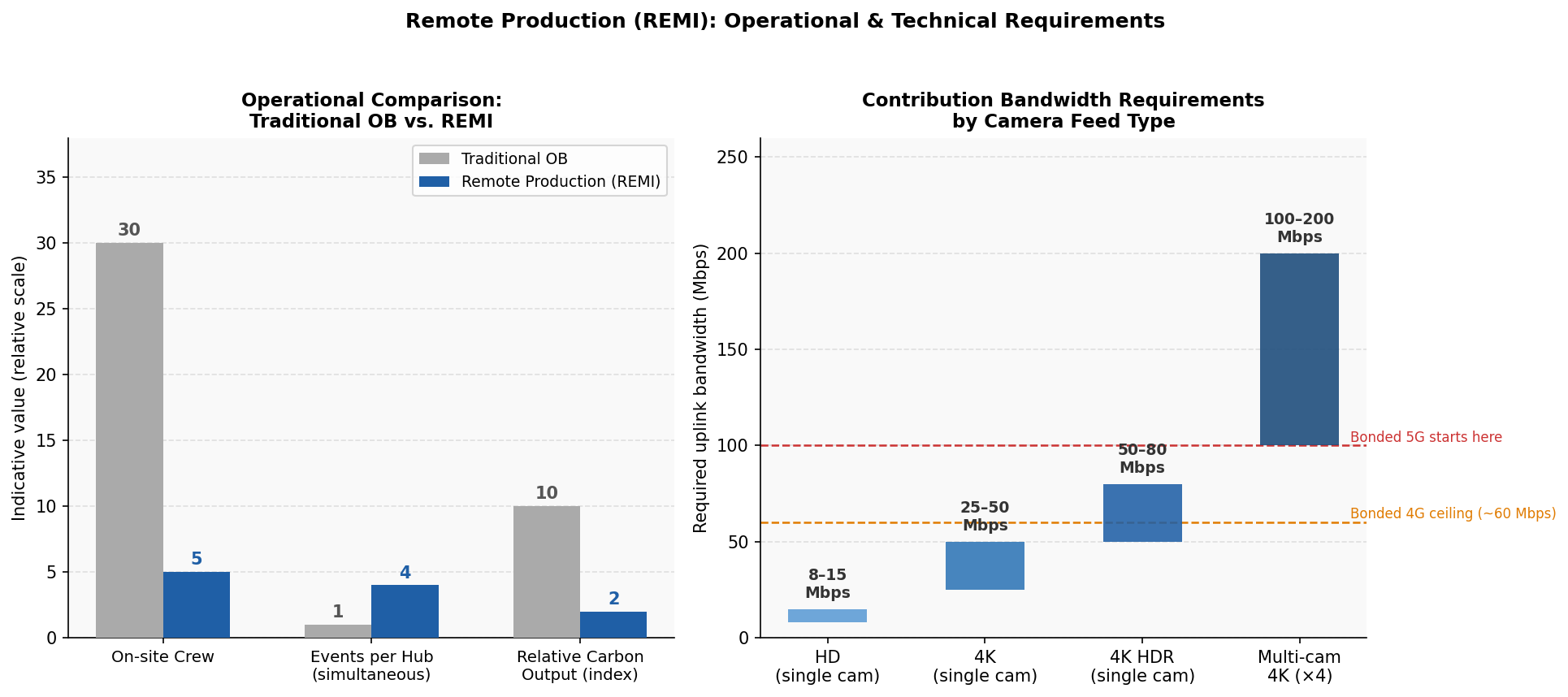
The result is a significantly smaller on-site footprint — sometimes as few as three or four crew members rather than 30 or more — with corresponding reductions in travel, accommodation, equipment transport, and local infrastructure costs.
The Role of the IP Contribution Encoder
The contribution encoder is the device that bridges the on-site cameras and the remote production hub. It receives camera signals at the venue, compresses them to a transmissible bitrate, and sends them over IP — whether that IP path is fiber, Ethernet, bonded cellular, or a combination — to the hub. LiveU’s remote production solutions are designed specifically for this workflow, enabling multi-camera feeds to be sent from sports venues over bonded cellular or fixed IP connections with the low latency and high reliability that live production requires.
The contribution encoder’s performance characteristics — latency, video quality, network resilience, and management capability — directly determine the quality and reliability of the remote production workflow. A production team that cannot trust the stability of their contribution link cannot trust their remote production workflow.
REMI vs. Traditional Outside Broadcast: A Cost and Logistics Comparison
| Operational Factor | Traditional Outside Broadcast (OB) | Remote Production (REMI) |
| On-site crew size | Large team (20–40+ personnel required on-site) | Minimal team (3–8 personnel required at the venue) |
| Transport cost | High logistical spend (heavy OB truck + massive crew travel) | Low logistical spend (minimal crew travel and gear transport) |
| Production equipment | Dispatched and maintained entirely on-site | Centralized, secure, and permanent at the main hub |
| Scalability | Linear limitations (one dedicated truck needed per event) | Highly scalable (one hub can simultaneously serve multiple events) |
| Network dependency | Low reliance on local external network uplinks | High reliance (stable, high-bandwidth contribution link is critical) |
| Carbon footprint | Elevated due to vehicle emissions and power generators | Substantially lower environmental impact across production loops |
Technical Requirements for Reliable REMI
The shift in operational efficiency that remote production enables comes with a corresponding shift in technical dependency. In a traditional OB, the production infrastructure is physically co-located with the cameras — if a cable goes bad, a technician is on-site to fix it. In a REMI workflow, the contribution link becomes the single most critical dependency.
Requirements for reliable REMI transmission include:
-
Low latency: Glass-to-glass latency below 200 milliseconds is typically required for director communication and replay decisions; sub-100ms is preferred for live commentary workflows.
-
High reliability: The contribution link must maintain stability across an entire broadcast window, including during the peak network congestion that often coincides with major live match moments.
-
Sufficient bandwidth: Multiple simultaneous 4K or HD camera feeds require 30–100 Mbps per camera of reliable uplink capacity.
-
Redundant paths: Production-grade REMI workflows use bonded cellular arrays as primary or backup connections, with fiber or satellite providing additional layered redundancy.
-
Remote monitoring: Production teams at the hub need real-time visibility into contribution link quality, with active alerting on any signal degradation.

5G and the Next Phase of Remote Production
The arrival of 5G networks is accelerating remote production adoption. LiveU’s sports broadcasting solutions demonstrate how bonded 5G enables the bandwidth and latency characteristics required for multi-camera REMI from sports venues that previously required dedicated fiber infrastructure for contribution. A bonded 5G unit can deliver multiple simultaneous 4K camera feeds from a venue without any local fiber — a practical option that dramatically reduces the infrastructure cost of remote production from smaller venues.
For broadcasters covering a large portfolio of sports events — including lower-tier leagues, regional competitions, and international fixtures — the combination of 5G connectivity and remote production infrastructure makes economically viable coverage of events that would otherwise be impractical to broadcast.
REMI in Practice: What Has Been Deployed
Remote production has been used for major international sports events including UEFA Champions League matches, Olympic Games coverage by multiple broadcasters, domestic football leagues across Europe and North America, and motorsport coverage across multiple series. According to the Sports Video Group (SVG), remote production now accounts for a significant and growing proportion of sports broadcast output globally, with adoption accelerating since 2020.
The workflow is no longer experimental — it is a production-proven approach with a growing body of documented deployments across sports broadcasters, rights holders, and production companies.
Conclusion
Remote production and REMI workflows represent a structural shift in how live sports broadcasting is produced. The operational and economic case — smaller on-site footprint, centralized production hub, scalability across multiple simultaneous events — is sufficiently well-established that it is now the default planning assumption for many broadcasters covering sports at regional and national levels.
The IP contribution encoder sits at the heart of this workflow, and its reliability under real-world venue conditions determines the viability of the remote production model. Solutions that combine bonded cellular resilience, low-latency transmission, and robust management platforms address the core technical requirement. LiveU’s remote production portfolio, with deployments documented across major sports events globally, represents one of the established options in this space.