Industrial Solutions
Remote Asset Monitoring: Choosing the Right IoT Architecture and Connectivity

| Key Takeaways
• Remote asset monitoring uses sensors and network links to report the condition of distant equipment without a site visit. • A monitoring system has four layers: sensors, a site gateway, a backhaul link and a platform for analytics, alarms and sensor management. • LoRaWAN suits small, infrequent messages over long distances, with a range of up to about 15 km in rural areas according to the LoRa Alliance. • Resilient designs pair a primary backhaul such as fiber with a mobile backup and queue sensor data during outages. |
What is remote asset monitoring?
Remote asset monitoring is the practice of collecting condition data from distant equipment with sensors and sending it over a network to a central platform, so problems can be spotted without sending a technician to site. The assets can be anything that is costly to inspect in person, from power transmission towers to mobile cell sites.
For a cell site, typical readings include equipment run times, device temperatures, battery and voltage levels, utility power status, CO2 levels and smoke detection. For a transmission tower, the sensors watch the structure itself and its surroundings. In both cases the network is what turns isolated sensors into a monitoring system, which is why connectivity choices shape the whole design.
Why are operators replacing site inspections with remote monitoring?
Operators are moving to remote monitoring because scheduled visits are expensive, slow and only capture a moment in time, while continuous sensing can flag a fault as it develops. Data from remote devices can also feed KPI reporting, giving managers a basis for maintenance and investment decisions.
Power transmission is a clear example. High-voltage towers span long distances and rough terrain, and the most advanced inspection method in common use relies on aerial images collected from helicopters. As one application brief explains, visual aerial inspection by helicopter is costly and time-consuming and does not provide up-to-date information between flights. The same brief points to extreme weather, transformer vandalism and fiber or copper theft as threats that make continuous monitoring more valuable. A related overview covers how IoT sensors support power line and tower monitoring, including the structural effects of corrosion and shifting soil. Higher temperatures and heavier rainfall over time can corrode a pylon and affect the soil around its foundations, and an unnoticed shift can eventually lead to a fall. Sensors that report early signs give maintenance teams time to act before a small problem becomes an outage.
What are the main parts of a remote monitoring architecture?
A remote monitoring system has four layers: sensors that measure conditions, a gateway at the site that collects the data, a backhaul link that carries it onward, and a platform that handles analytics, alarms and sensor management. Designs differ mainly in how much intelligence sits at the site and how the backhaul is protected.
In a tower-monitoring design described by RAD, a ruggedized gateway is installed on each pylon and acts as an all-in-one connectivity and edge computing unit. It supports WAN and sensor connectivity over LoRa, fiber, LTE radio and Wi-Fi HaLow, hosts a Docker-based IoT agent and can run from a solar-based battery pack. Fiber serves as the primary backhaul with mobile as backup, and if the unit reboots, it resumes communication and sends any queued sensor data. That last behavior matters in practice, because remote sites lose power and coverage more often than offices do.
How do connectivity options compare for remote monitoring?
The right link depends on how much data each sensor sends, how long its battery must last and who owns the network. LoRaWAN suits small, infrequent messages from battery devices, cellular suits higher data rates, and the in-between options trade one against the other.
| Criterion | LoRaWAN | NB-IoT / LTE-M | Cellular (4G/5G) | Wi-Fi |
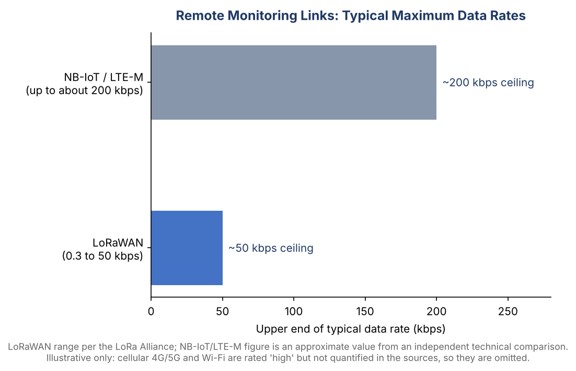
| Data rate | Very low (about 0.3 to 50 kbps) | Low to medium (up to about 200 kbps) | High | High |
| Power use | Very low (years on a battery) | Low (2 to 5 years) | High | High |
| Own private network | Yes, self-hosted is possible | No | No | Yes |

When does LoRaWAN make sense for asset monitoring?
LoRaWAN makes sense when sensors send small amounts of data infrequently over long distances and need to run for years on a battery. The LoRa Alliance, which maintains the standard, describes it as operating in unlicensed spectrum with ranges of up to 15 km in rural areas and low power consumption, with many devices connecting to a single network.
The alliance positions LoRaWAN as complementary to 5G rather than a rival. 5G excels at high-speed, low-latency work such as real-time video, while LoRaWAN is better suited to low-bandwidth, infrequent transmissions such as environmental monitoring and asset tracking, particularly in rural or remote areas where 5G coverage may be limited. The specification also defines device classes, and Class A devices use the least power by sleeping until they have something to send.
The alliance also compares LoRaWAN with NB-IoT directly. It argues that LoRaWAN is the more flexible and cost-effective option for utilities and industry because it allows private network deployments and runs on unlicensed spectrum, while acknowledging that NB-IoT may offer higher data rates and lower latency. For a utility that owns remote sites and wants control of its own network, that private-network option can matter as much as raw performance.
How does remote monitoring apply to mobile cell sites?
For mobile operators, remote monitoring reduces the need to travel to distant cell sites by reporting power, environmental and security conditions to a central team. Managing a large number of sites spread across long distances is intricate, and on-site maintenance costs time, money and staff.
The monitored conditions mirror the list above: run times, temperatures, batteries, voltage, utility power, CO2 and smoke. What changes is scale. An operator may need to connect thousands of remote IoT assets, so the cost of each connection and the consistency of the design become central questions. Edge computing at the site can help by processing readings locally before they are forwarded to the central platform.
What mistakes make remote monitoring harder than it needs to be?
The most common mistake is building a fragmented system in which each domain, such as power, environment and security, has its own tools and its own link. A unified end-to-end design is easier to run, and gateway-based designs aim for exactly that. Vendors such as RAD frame this as moving from disaggregated monitoring toward aggregated monitoring over cellular or fiber, public or private, while integrating with the sensors, backend servers and dashboards an operator already has.
Three other points are worth checking before a rollout:
- Security: a gateway at an unattended site is part of the attack surface, so authentication and encryption should be planned from the start.
- Backhaul resilience: a primary link with a mobile backup keeps data flowing when fiber is cut.
- Store-and-forward behavior: sites should queue data during outages and send it when the link returns.
Getting those basics right usually matters more than the choice of any single radio technology.
Frequently Asked Questions
What sensors are used in remote asset monitoring?
Sensors vary by asset, but cell sites commonly track run times, temperatures, battery and voltage levels, utility power, CO2 levels and smoke, while tower systems track structural and weather conditions.
How far can LoRaWAN transmit?
According to the LoRa Alliance, LoRaWAN can reach up to about 15 km in rural areas, using unlicensed radio spectrum and very little power.
Is LoRaWAN a replacement for 5G?
No, LoRaWAN complements 5G. It suits small, infrequent messages from battery devices, while 5G suits high-speed, low-latency applications.
Why use a gateway at the monitored site?
A site gateway aggregates sensor data, can process it locally at the edge, and forwards it over fiber or mobile links to a central platform.