Tech
Quantum Key Distribution vs. Post-Quantum Cryptography: What’s the Difference?


| Key Takeaways
• Quantum key distribution (QKD) encodes cryptographic keys onto physical properties of photons, and physical QKD requires a dedicated point-to-point fiber link whose range is limited by fiber distance. • Newer “digital QKD” approaches aim to deliver similar key-distribution security properties without requiring a direct photonic link, making the technology easier to deploy over standard optical or IP infrastructure. • QKD is one input into a broader quantum-safe strategy that also includes NIST’s post-quantum cryptography (PQC) algorithms and strong symmetric encryption such as AES-256-GCM. • Estimates for when a quantum computer capable of breaking today’s public-key encryption could exist range from roughly 2030 in aggressive projections to several decades out, which is why hybrid classical/quantum-safe key exchange is being built now rather than later. |
What is quantum key distribution?
Quantum key distribution (QKD) is a method of generating and sharing an encryption key by encoding it onto the physical properties of individual photons, so that any attempt to intercept the key introduces a detectable disturbance. Physical QKD does this over a dedicated point-to-point photonic link, which means its usable range is limited by fiber distance and by how much signal loss the link can tolerate before the quantum states become unreadable.
What’s the difference between quantum key distribution and post-quantum cryptography?
Quantum key distribution physically distributes a key using quantum mechanics and dedicated hardware, while post-quantum cryptography (PQC) is a set of classical mathematical algorithms, such as NIST’s ML-KEM, designed to resist quantum attacks without needing any special optical hardware at all. The two are often paired together, hybridized with a network’s existing high-speed symmetric encryption, rather than treated as competing choices, since they protect against the quantum threat in different ways. NIST finalized ML-KEM as FIPS 203 in August 2024 alongside two signature standards, FIPS 204 (ML-DSA) and FIPS 205 (SLH-DSA), giving PQC a firm, government-endorsed specification to implement against; QKD, by contrast, has no single equivalent global standard yet, in part because physical and digital QKD implementations still vary meaningfully by vendor and deployment model.
| Approach | How it distributes the key | Hardware needed | Distance / range constraint |
| Physical QKD | Encoded onto individual photons over a dedicated optical link | Dedicated point-to-point photonic hardware | Limited by fiber distance and signal loss |
| Digital QKD | Aims for similar key-distribution security properties without a direct photonic link | Standard optical/IP transport, no dedicated photonic link required | Not limited the same way as physical QKD |
| Post-quantum cryptography (PQC) | Classical mathematical algorithms (e.g. NIST ML-KEM) | Runs on standard computing/networking hardware | No physical distance constraint |
How does digital QKD get around the distance limits of physical QKD?
Digital QKD aims to deliver key-distribution security properties similar to physical QKD without requiring a direct photonic link between endpoints, which in principle removes the fiber-distance ceiling that limits physical QKD deployments. a resource comparing physical and digital approaches to quantum-safe key generation lays out how carriers are evaluating both approaches alongside post-quantum algorithms as part of a broader quantum-safe strategy rather than picking a single method exclusively. That distinction matters operationally: a carrier that needs to protect a link between two facilities separated by a distance or fiber path that a dedicated photonic connection can’t practically reach still has a path to quantum-safe key generation through digital QKD or PQC, rather than being limited to sites within physical QKD’s usable range.
Why are carriers building hybrid quantum-safe key exchange now instead of waiting for one clear winner?
Carriers are moving now because regulatory and standards pressure has been building steadily rather than arriving all at once: a series of U.S. government directives since 2022 has progressively tightened cryptographic-inventory and migration requirements for both national-security and non-national-security systems, culminating in a June 2026 executive order that set binding migration deadlines for high-value federal assets. Executives involved in one recent telecom-focused quantum-safe partnership framed the underlying motivation in direct terms: one partner’s CEO called the need to address public-key weaknesses and harvest-now-decrypt-later exposure “beyond dispute,” while the networking vendor’s own product leadership described the approach as hybridizing third-party quantum-safe key generation with post-quantum algorithms and existing high-speed encryption capabilities, rather than betting on a single mechanism. That hybrid framing is also a practical hedge: since no regulator, standards body, or vendor can say with certainty which combination of QKD and PQC will dominate in five years, building carrier-grade hardware that supports several approaches at once reduces the risk of standardizing early on the wrong one. It also gives network operators room to phase their own rollout: a carrier can enable the post-quantum algorithm layer immediately, since it runs on standard hardware and requires no new physical infrastructure, and add physical or digital QKD support later on specific high-value links where the additional cost and complexity are easiest to justify.
When might a quantum computer actually be able to break today’s keys?
Expert estimates for when a cryptographically relevant quantum computer (CRQC) could emerge span a wide range, from around 2030 in the most aggressive near-term projections to several decades out in more conservative long-term estimates. That uncertainty is itself a reason many carriers are building quantum-safe key exchange into new hardware now rather than waiting for a firmer date, since the risk profile doesn’t require certainty to justify early action. The wide spread between the near-term and long-term estimates also reflects genuine, ongoing scientific disagreement about how quickly the error-correction and qubit-scaling challenges standing between today’s quantum computers and a fault-tolerant, cryptographically relevant machine will actually be solved, not just differing levels of caution among the people making the estimates.
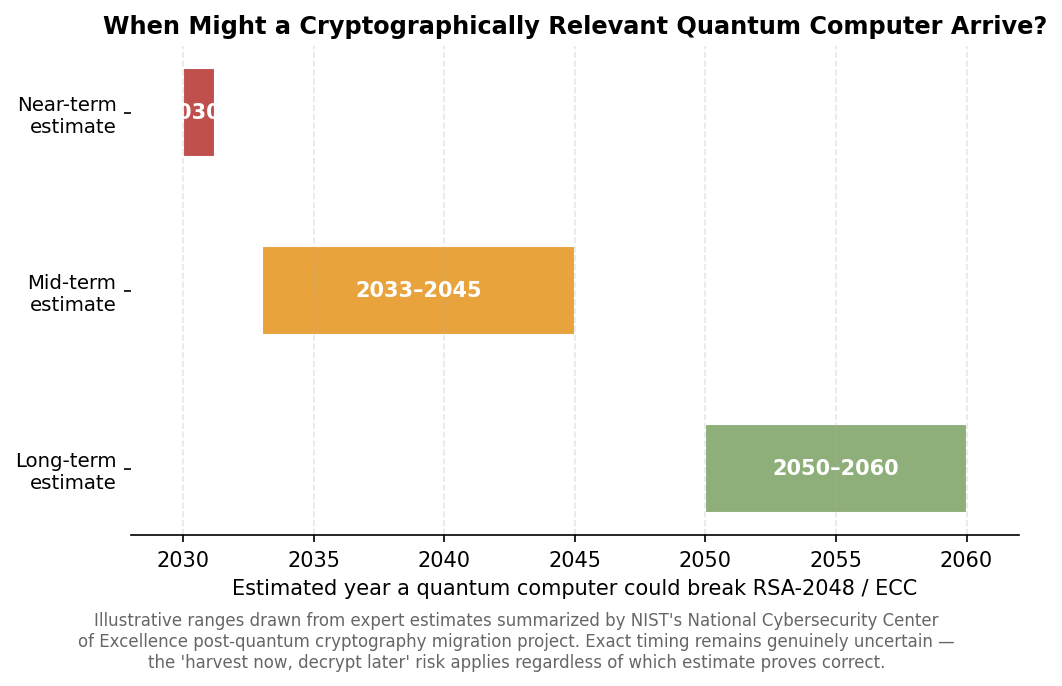

Expert estimates for when a quantum computer capable of breaking today’s public-key encryption could emerge span roughly three decades of uncertainty.
How does a real network deployment combine QKD with post-quantum algorithms?
A real deployment typically hybridizes several layers at once: a quantum-safe key-generation method (physical or digital QKD), a post-quantum algorithm for key exchange, and a high-speed symmetric cipher such as AES-256-GCM for the actual bulk encryption of network traffic. the carrier-grade launch announcement supporting programmable quantum-safe key exchange describes hardware built specifically to run this kind of hybrid key exchange at full 400G line rate rather than as a separate, bolt-on appliance. a hardware resource covering demarcation and aggregation for AI-era interconnect traffic goes into more detail on how that kind of platform fits into a broader data center interconnect deployment.
Why not just wait for one single standard to settle before deploying anything?
Waiting for a single settled standard carries its own risk, because published national migration roadmaps already assume multi-year, phased rollouts rather than a single future cutover date. the UK’s national cyber security agency’s phased migration timeline lays out a three-phase plan running from 2025 through 2035, which means networks that start hybridizing quantum-safe key exchange earlier have more runway to work out interoperability issues before later, harder deadlines arrive.
Frequently Asked Questions
Is quantum key distribution the same as post-quantum cryptography?
No. Quantum key distribution physically generates and shares a key using quantum mechanics, while post-quantum cryptography is a set of classical algorithms designed to resist quantum attacks without special optical hardware; the two are often combined rather than used as substitutes for each other.
Does quantum key distribution require special hardware?
Physical quantum key distribution requires a dedicated point-to-point photonic link, while digital QKD approaches aim to deliver similar security properties over standard optical or IP infrastructure without that dedicated photonic hardware.
Can quantum key distribution be used over standard fiber networks today?
Physical QKD is constrained to dedicated links with fiber-distance limits, but digital QKD and post-quantum cryptography are both designed to run over standard network infrastructure without that same constraint.
Why combine QKD with post-quantum algorithms instead of choosing just one?
Combining them creates a hybrid approach where a network stays protected under one method even if a weakness is later found in the other, which is why carrier-grade hardware increasingly supports both at once rather than relying on a single quantum-safe mechanism.