Tech
Disease Resistance in Commercial Pepper Varieties: Why Tobamovirus Protection Has Become the Industry’s Non-Negotiable Trait

Introduction
No single agronomic factor has greater influence on commercial pepper profitability than disease management – and no single category of disease has created more disruption in recent years than tobamoviruses. Tomato Brown Rugose Fruit Virus (ToBRFV) and its relatives ha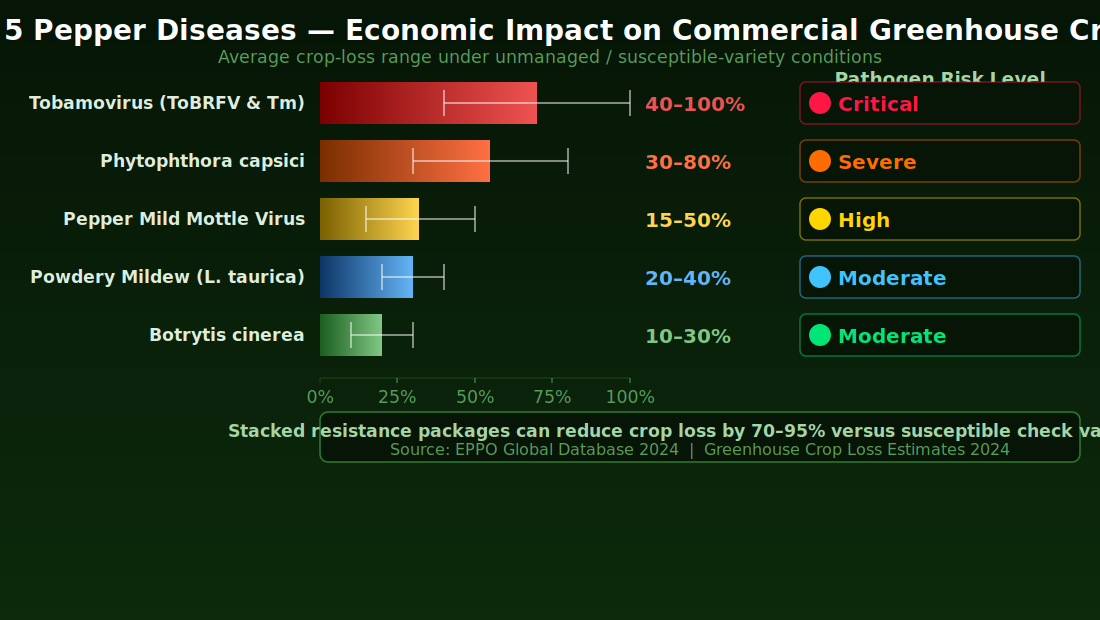

Understanding the Pathogen Landscape in Commercial Pepper Production
Commercial pepper crops – particularly those grown in high-density greenhouse environments – face a range of economically significant diseases. Each pathogen operates differently and requires different resistance mechanisms in the variety:
| Pathogen | Type | Avg. Crop Loss (unmanaged) | Primary Impact |
| Tobamovirus (ToBRFV & Tm variants) | Virus | 40–100% | Fruit deformation, mosaic, full crop failure |
| Powdery Mildew (Leveillula taurica) | Fungal | 20–40% | Leaf necrosis, reduced photosynthesis, defoliation |
| Phytophthora capsici | Oomycete | 30–80% | Root and crown rot; damping off in warm/wet conditions |
| Botrytis cinerea (Grey Mould) | Fungal | 10–30% | Post-harvest fruit rot; major pack-out losses |
| Pepper Mild Mottle Virus (PMMoV) | Virus | 15–50% | Fruit discoloration, mosaic; major in greenhouse pepper |
Source: European and Mediterranean Plant Protection Organization (EPPO) Disease Data; USDA AMS Crop Report Estimates 2024
The ToBRFV Crisis: A Case Study in Resistance Urgency
Tomato Brown Rugose Fruit Virus emerged as a significant threat to greenhouse pepper and tomato production beginning in the mid-2010s. By 2023, it had been confirmed in over 40 countries across Europe, North America, the Middle East, and Asia. Unlike earlier tobamovirus strains, ToBRFV overcomes the Tm-2² resistance gene that had been standard protection in commercial varieties for decades – rendering existing resistant material vulnerable.
The consequences for unprotected growers have been severe:
- Complete crop losses reported in affected greenhouse compartments, particularly in Netherlands, Spain, and Israel
- Export restrictions imposed by multiple national authorities on peppers and tomatoes from ToBRFV-positive zones
- Quarantine protocols requiring destruction of infected plant material and full greenhouse sanitation between cycles
- Significant insurance and financial exposure for operations without documented resistance deployment
The response from leading seed breeding companies has been to fast-track the development of new resistance sources. BreedX pepper breeding programs prioritize disease resistance packaging that addresses current and emerging pathogen threats – ensuring that commercial growers are not caught exposed by a resistance-breaking strain event.
How Conventional Breeding Delivers Durable Resistance
Resistance breeding in conventional (non-GMO) seed development relies on identifying natural resistance genes present in wild pepper species or landraces, then systematically introgressing those genes into elite commercial backgrounds through carefully managed crossing and selection programs. The key principles:
- Resistance gene identification: Wild Capsicum species harbor resistance mechanisms against virtually every major pepper pathogen. Breeders systematically screen wild germplasm under controlled disease challenge conditions to identify useful resistance sources
- Backcross introgression: Once a resistance donor is identified, breeders execute multi-generation backcross programs to transfer the resistance gene into elite commercial backgrounds while recovering yield, quality, and adaptation traits
- Marker-assisted selection: Modern conventional breeding programs use molecular markers linked to resistance genes to accelerate selection and confirm resistance gene presence in breeding lines – reducing the reliance on disease challenge screens at every generation
- Stacking: The most durable commercial varieties stack multiple independent resistance genes against the same pathogen, reducing the probability of resistance breaking by a mutation in the pathogen population
- Commercial trait balance: Resistance must be delivered in a variety that also meets commercial requirements for yield, fruit quality, uniformity, and shelf life – the resistance is only valuable if the variety is commercially competitive in all other dimensions
What Growers Should Ask Before Selecting a Pepper Variety
Given the economic stakes, variety selection decisions in commercial pepper production deserve rigorous evaluation. The right questions to ask a seed company or sales representative:
- Which tobamovirus strains does the variety carry resistance against — specifically Tm, Tm-2, Tm-2², and ToBRFV resistance sources?
- Is the resistance HR (High Resistance) or IR (Intermediate Resistance) — and under what conditions was it evaluated?
- Has the variety been tested under commercial disease pressure in the specific region and production system where I will be growing?
- What is the company’s protocol for monitoring resistance durability and communicating new pathogen variants to customers?
- Is the resistance package documented and verifiable — or reliant on marketing claims?
Resistance as Commercial Infrastructure
The shift in how the fresh pepper industry views disease resistance is profound. What was once considered an agronomic advantage has become the minimum viable product specification for commercial variety adoption. Retailers and packers increasingly require documented disease resistance programs as a prerequisite for grower partnerships – because a disease outbreak in a supplier’s operation directly affects the buyer’s supply continuity and food safety exposure.
For seed companies, this creates both a responsibility and an opportunity. Those that invest in comprehensive, validated resistance programs – and communicate them transparently – are building the kind of commercial trust that drives long-term grower loyalty. In a market where the next pathogen event could arrive in any growing season, resistance breeding is not just an agronomic service – it is risk management infrastructure for the entire fresh pepper supply chain.
Conclusion
Disease resistance in commercial pepper varieties is the defining technical challenge – and commercial differentiator – of the 2025 seed market. Tobamovirus, powdery mildew, and Phytophthora collectively represent billions of dollars in potential crop exposure for unprotected growing operations. The seed companies and varieties that provide validated, durable, stacked resistance while maintaining commercial productivity are providing genuine value to an industry that cannot afford the alternative.