Health And Beauty
Pepper Breeding and the Kapia Pepper: What Makes This Variety Different

Key Takeaways
|
Why did pepper breeding pursue a seedless trait in the first place?
Pepper breeding has always followed consumer demand rather than leading it. The push toward seedless peppers grew out of a fairly simple observation: with tomatoes already crowded by dozens of segments on retail shelves, industry conversations kept circling back to peppers as the next real opportunity in fresh vegetables, provided a seedless trait could be made completely reliable. Not lower in seed count, not mostly seedless, but 100% seed-free fruit that a retailer or consumer could depend on every time. That bar turned out to be a multi-decade breeding challenge, moving from an initial industry inquiry roughly two decades ago through sustained varietal breeding work before seed-based seedless varieties became commercially viable.
What is a Kapia pepper, and what makes the mini-Kapia distinct?
The Kapia pepper is traditionally known as an elongated, sweet pepper variety, and the mini-Kapia segment specifically refers to snack-sized peppers with a fruit length between 8 and 15 centimeters. BreedX’s own Mini Kapia pepper page describes the variety as snack-sized and elongated, with exceptional crunch and sweetness, and notes that different varieties within the segment are bred for different growing conditions, some optimized for spring and summer crops, others bred specifically to perform well in winter or cooler climates. That climate-specific breeding matters practically: a variety that thrives in a summer greenhouse cycle won’t necessarily perform the same way through a cooler winter growing season, so having distinct varieties tuned to each condition keeps yield and quality consistent year-round.
How does mini-Kapia compare to the other core seedless pepper segment?
| Segment | Typical fruit length | Best suited for |
|---|---|---|
| 1-Bite | Up to 6 cm | Single-bite snacking, minimal preparation needed |
| Mini-Kapia | 8 to 15 cm | Snacking, stuffing, and light cooking, with more substantial bite size |
Both segments share the core seedless trait, but the difference in fruit length changes how each is actually used and marketed. The shorter 1-Bite format leans entirely into grab-and-go snacking, while the longer mini-Kapia format holds up better for stuffing or being sliced into a dish, giving retailers and consumers a genuine choice rather than a single one-size-fits-all seedless pepper.
Where can you find pictures of pepper varieties before deciding what to grow?
Choosing between pepper segments is considerably easier with a clear visual reference, since fruit length, color, and shape differences are hard to judge from a written description alone. BreedX’s own variety gallery organizes pictures of pepper varieties by segment, including 1-Bite, 2-Bite, Mini Kapia, Midi-Blocky, and Long Conical types, alongside a parallel gallery of tomato varieties. Reviewing pictures across the full range of pepper segments side by side is a practical first step for growers and retailers trying to decide which shape, size, and color best fits a specific market or use case, before committing to seed for a full growing season.
How fast is demand for pepper seed varieties actually growing?
The broader market for pepper seeds gives a sense of how much breeding investment this category continues to attract. Value Market Research’s pepper seeds market analysis values the global market at $3.39 billion in 2025, projected to reach $6.07 billion by 2034, a compound annual growth rate of 6.67%, attributing that growth to rising consumer and culinary demand for diverse, flavorful pepper varieties, including bell peppers, chili peppers, and increasingly, specialty types bred for specific eating experiences rather than general-purpose cooking use.
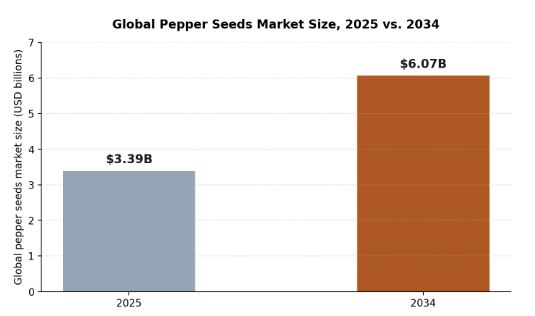

Global pepper seeds market size, 2025 versus 2034, according to Value Market Research.
What does natural fruit setting without fertilization actually mean for growers?
Seedless sweet pepper varieties bred for natural fruit setting produce fruit without requiring fertilization or pollination assistance, a trait known as parthenocarpy. For greenhouse growers specifically, this matters operationally: fruit set becomes more consistent and less dependent on pollinator activity or manual pollination labor, which can otherwise introduce variability into yield planning. Combined with the seedless trait itself, this makes these varieties particularly well suited to controlled greenhouse environments, where consistency and predictability of output are often as commercially important as the eating quality of the fruit itself.
What should a grower or retailer weigh when choosing a pepper segment?
- Target use case: single-bite snacking favors 1-Bite, while stuffing or light cooking favors the longer mini-Kapia format.
- Growing season and climate: some varieties within a segment are specifically bred for spring and summer performance, others for winter or cooler conditions.
- Color range needed: seedless pepper lines are typically available across red, orange, and yellow, giving retailers a way to merchandise variety within the same segment.
- Greenhouse versus open-field production: varieties bred for natural fruit setting are particularly well suited to controlled greenhouse conditions.
How does climate-specific breeding actually change what a grower can plant?
A single seedless pepper variety rarely performs equally well across an entire year-round production calendar, which is exactly why breeding programs develop separate variants tuned for different seasonal conditions rather than pushing one universal variety into every planting window. A variety optimized for long summer daylight and warmer temperatures may set fruit inconsistently when planted into a cooler winter cycle, while a winter-adapted variety may not deliver its full yield potential during peak summer conditions. For growers running multiple planting cycles through the year, having climate-specific options within the same snack segment means yield and fruit quality can stay consistent across the calendar, rather than accepting a seasonal dip every time conditions shift outside a single variety’s ideal range.
How do retailers actually use pepper variety pictures in practice?
A visual gallery organized by segment serves a more concrete purpose than simple product marketing. Retail buyers deciding which pepper formats to carry, and in what colors, benefit from seeing the actual size and shape differences between segments side by side, since written specifications alone can undersell how different an 8-centimeter mini-Kapia looks on shelf compared to a shorter 1-Bite format. Growers evaluating which variety to plant for an upcoming season use the same reference to confirm fruit characteristics match what a specific buyer or market segment is expecting, reducing the chance of a mismatch between what’s grown and what a retail partner actually wants to stock.
Frequently Asked Questions
Is a Kapia pepper the same as a mini-Kapia pepper?
The traditional Kapia pepper is a long-established elongated sweet pepper type. The mini-Kapia specifically refers to a snack-sized breeding segment within the broader Kapia shape category, defined by a fruit length between 8 and 15 centimeters and bred to be seedless.
How long did it take to develop a reliably seedless pepper?
Roughly two decades from initial industry inquiries to commercially reliable seed-based seedless varieties, since the trait needed to be 100% seed-free every time to be genuinely useful to retailers and consumers.
Why does fruit length matter so much between pepper segments?
Fruit length directly shapes how a pepper gets used and marketed. Shorter formats like 1-Bite suit pure grab-and-go snacking, while longer formats like mini-Kapia hold up better for stuffing or being sliced into cooked dishes.
Where can I compare pictures of different pepper varieties side by side?
A dedicated variety gallery organized by segment, showing 1-Bite, 2-Bite, Mini Kapia, Midi-Blocky, and Long Conical types together, gives growers and retailers a practical visual reference before committing to a specific variety for a growing season.