Tech
Outside Broadcast Production: What Has Changed in the Field

TL;DR: Outside broadcast has traditionally meant RF trucks, cabling, and hours of setup. Cloud linked field units and mobile receivers now let crews go live from a truck, a stadium corner, or a moving vehicle in minutes, with far less equipment on site.
Anyone who has stood next to an OB truck during load-in knows the routine: cable runs, line-of-sight checks, a fixed internet connection to source, and a crew large enough to manage all of it. Outside broadcast work has depended on that routine for decades, and for good reason. RF and microwave links deliver low latency and have earned their place in premium sports coverage. What has changed recently is not the need for reliable transmission, it is how many different ways a crew now has to get there.
Why has on-site production started replacing some RF setups?
RF and microwave systems require line-of-sight and pre-planned frequencies, both of which get harder to secure at crowded venues. A newer class of on-site production tools takes a different approach: a portable field unit at the camera position, paired with a mobile receiver back at the truck, connected over bonded wireless links instead of cable or a fixed line. That swap removes the two most time-consuming parts of setup, sourcing a stable internet connection and running physical cable, and it means camera positions that were previously ruled out by terrain or access can now be used.
Does this replace the truck entirely?
Not for every production. RF and microwave still win on raw latency where a fixed line of sight is available and reliable, which is why they remain standard for some cycling, motorsport, and golf coverage. What on-site production tools add is optionality: a wireless camera in the stands, a position deep inside a stadium where RF struggles, or a last-minute angle that would have been too costly to cable in. The truck stays the hub; the constraint on where a camera can physically go loosens.
What happens when there is no truck at all?
That is where remote production comes in. Instead of sending a full production crew and truck to the venue, camera feeds are sent back to a centralized control room, and the director, replay operators, and technical staff never leave the studio. This model has grown fastest in sports where the venue schedule does not justify a full on-site crew for every game, letting one control room support several events across a week instead of one truck per event.
Setup time is where the difference between these three approaches shows up most clearly.
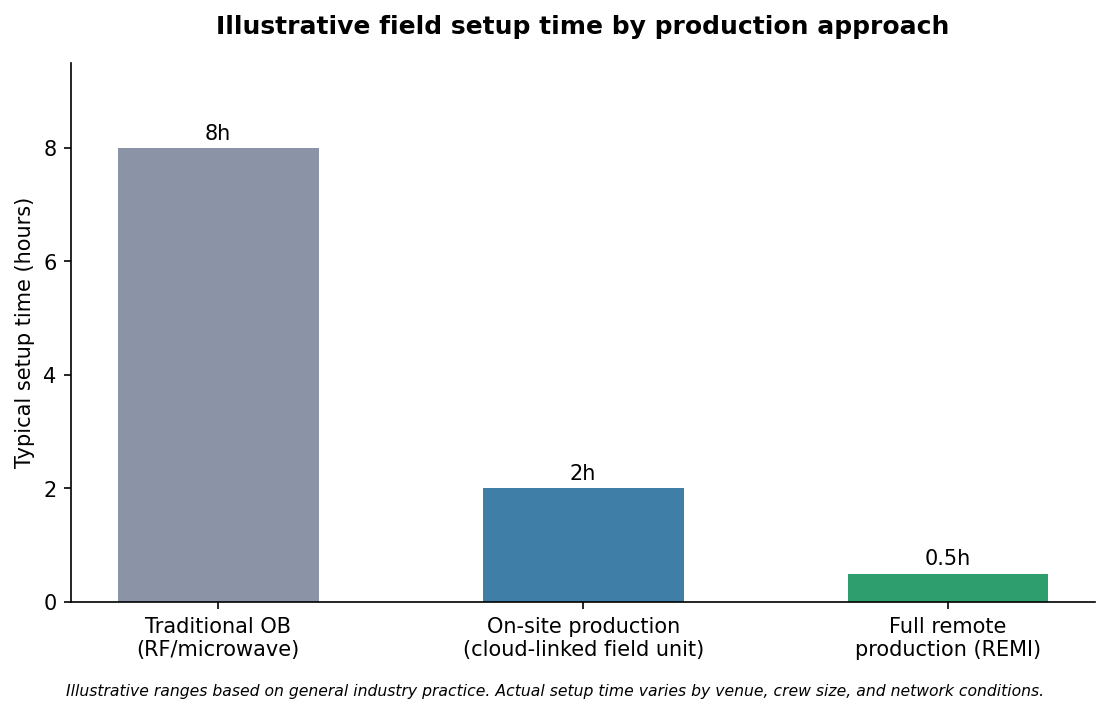

Illustrative field setup time by production approach. Ranges based on general industry practice; actual setup time varies by venue, crew size, and network conditions.
Is one approach simply better than the others?
Not in any absolute sense. A championship motor race with a fixed camera plan and guaranteed line of sight still favors RF. A weekly regional sports broadcast with a tight budget and a need for extra angles is a much better fit for on-site or remote tools. The honest answer is that most serious broadcast operations now run some blend of the three, choosing per event rather than committing to one method for everything.
What should a production team weigh before choosing?
Three questions tend to decide it: how much lead time exists before the event, whether a fixed internet connection can realistically be sourced at the venue, and how many angles the story actually needs versus how many the current setup can afford. Outside broadcast has always been a cost and complexity trade-off. What has shifted is that a wireless, cloud linked alternative now exists at nearly every point on that trade-off curve, not just at the high end.
None of these tools eliminate the judgment calls that come with live production. What they have done is widen the range of venues, angles, and budgets where a genuinely professional broadcast is possible.
Frequently Asked Questions
What is outside broadcast production?
Outside broadcast refers to producing and transmitting a live video program from a location outside a fixed studio, traditionally using RF or microwave links back to a production truck or control room.
How is on-site production different from traditional OB?
On-site production replaces cable and fixed internet dependency with bonded wireless field units and a mobile receiver, cutting setup time while keeping camera positions physically on location.
What is remote production (REMI)?
Remote production sends camera feeds from a venue back to a centralized control room, so the core production crew and equipment stay off site while still delivering a fully produced broadcast.