Electronics
Military PCB Manufacturer Checklist: What Each Credential Actually Verifies

| Key Takeaways
• MIL-PRF-31032 qualifies a manufacturer’s process and quality plan through the Defense Logistics Agency’s Qualified Manufacturers List rather than approving individual part numbers. • IPC Class 3 defines high-reliability board performance, and IPC-6012DS adds requirements for rigid boards used in space and military avionics. • AS9100 is the aviation, space and defense quality management standard built on ISO 9001, and certified suppliers are listed in the IAQG’s OASIS database. • U.S. manufacturers of defense articles must register with the State Department’s Directorate of Defense Trade Controls under ITAR, even if they do not export. |
What makes a military PCB manufacturer different from a standard board shop?
A military PCB manufacturer is distinguished less by the boards it builds than by the evidence it can show: qualification against defense performance requirements, an aviation-grade quality system, and compliance with U.S. export controls. The boards themselves often overlap with commercial high-reliability designs, since the defense specification sheets cover rigid multilayer, single- and double-sided, flexible, rigid-flex and high-frequency constructions. What changes is the proof behind them. Buyers comparing suppliers for requirements that are specific to defense electronics usually end up checking four things: the military performance specification, the IPC class, the quality certification and the export registration.
What do IPC Class 3 and IPC-6012DS add to a military board specification?
IPC Class 3 is the high-reliability performance tier in IPC’s printed board standards, and IPC-6012DS is an addendum that adds requirements for rigid boards used in space and military avionics. The addendum is aimed at boards that must survive the vibration, ground testing and thermal cycling of those environments, and it supplements or replaces selected requirements in IPC-6012D. Thermal cycling is also why accelerated thermal testing is relevant to these boards, and one manufacturer describes an in-house accelerated thermal shock lab built to evaluate board survivability. For flexible boards, a trade-press column reports that IPC-6013 Class 3 is generally accepted by government agencies as the commercial equivalent of the military specification.
What does MIL-PRF-31032 actually qualify?
MIL-PRF-31032 is the Department of Defense performance specification for printed boards, and it qualifies the manufacturer’s process and quality plan rather than individual part numbers. Certification runs through the Defense Logistics Agency’s Qualified Manufacturers List program, which requires verification of the quality management plan by a Technical Review Board, demonstrated manufacturing capability and ongoing lot acceptance testing. Manufacturers that complete the process are listed on the QML, which defense contractors use when selecting suppliers for new programs.
DLA’s own certification language adds two cautions: a QML listing does not guarantee acceptance of a product in any future purchase, and it does not waive any requirement of the specification. The certification letter also details which technologies a manufacturer is approved for, so the listed scope matters as much as the listing itself.
What would a MIL-PRF-31032 cancellation change for buyers?
A cancellation would move board performance requirements toward IPC standards fairly directly, but it would not automatically replace the qualification system around them. An April 2026 column reported that a Defense Logistics Agency memorandum dated March 4, 2026 proposed cancelling MIL-PRF-31032 and its six specification sheets, with a short comment window and a path for another activity to accept management of the documents. The column describes both the proposal and the questions it raises about the QML. Its author notes that the IPC-6010 series already serves as the commercial counterpart, while the QML, the Technical Review Board model and the DLA oversight role would need deliberate redesign by whoever takes ownership.
The column also asks what happens to legacy programs that still cite MIL-PRF-31032 or the older MIL-PRF-55110, which remains in use on some older platforms. The final outcome was not confirmed in the sources reviewed for this article, so it should be checked with the qualifying activity or the contracting officer before a purchasing decision relies on it.

What does AS9100 certification tell a buyer?
AS9100 shows that a supplier operates a quality management system built for aviation, space and defense work, and it is based on ISO 9001 with additional industry requirements. The standards are published through the International Aerospace Quality Group, which also runs the certification scheme and maintains the Online Aerospace Supplier Information System, known as OASIS. That database holds certification status, auditor information and audit results, so a buyer can check a supplier’s claim directly rather than relying on a logo. Details of the scheme are on the IAQG certification overview.
Does a PCB manufacturer need ITAR registration?
Any U.S. company that manufactures defense articles must register with the State Department’s Directorate of Defense Trade Controls, even if it never exports. The registration form’s own instructions state that manufacturers who do not export must nevertheless register under ITAR section 122.1. The relevant instructions are in the State Department DS-2032 registration form. Registration is a legal requirement for certain work, not a quality credential, so it answers a different question from the other items on this list.
How do the main credentials compare side by side?
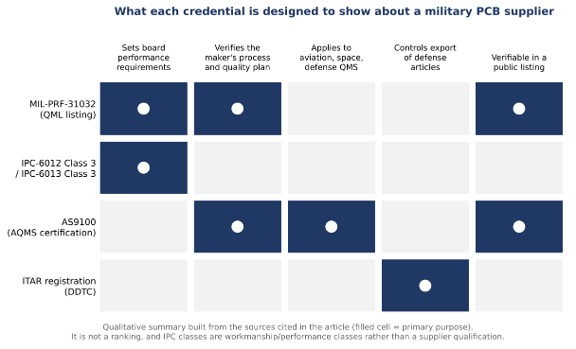
The table below summarizes what each item covers and where a buyer can check it. The checking column matters most, because each credential has its own source of truth.
| Credential | What it covers | Who administers it | Where to check |
| MIL-PRF-31032 | Performance and verification requirements for printed boards under a QML program | Defense Logistics Agency | DLA certification letter and QML listing; confirm current status |
| IPC-6012 / IPC-6013 Class 3 | Performance requirements for rigid and flexible boards at the high-reliability tier | IPC | Supplier conformance records and purchase documents |
| IPC-6012DS | Added requirements for rigid boards in space and military avionics | IPC | Called out in the drawing or purchase order |
| AS9100 | Quality management for aviation, space and defense organizations | IAQG scheme and certification bodies | IAQG OASIS database |
| ITAR registration | Registration of manufacturers of defense articles | State Department DDTC | Evidence of current registration from the supplier |
How should a buyer verify what a supplier claims?
A buyer should verify each credential at its source and treat a supplier’s published sector experience as context rather than proof. Some suppliers publish more than others. PCB Technologies, for example, describes defense experience that includes special antennas, seekers, night vision equipment, radios, data terminals, radiation detectors and range finders, which tells a buyer what kinds of programs a supplier has touched but not which certifications it holds.
- Ask for the DLA certification letter and the qualified technology scope, and compare it to the board being quoted.
- Look the supplier up in OASIS and confirm the certification body, scope and expiry.
- Confirm which IPC class and addendum the drawing actually requires, and ask for the matching test records.
- Ask for evidence of current ITAR registration if the work involves defense articles.
- Re-check the MIL-PRF-31032 status, since the specification was proposed for cancellation in 2026.
Frequently Asked Questions
What is a QML in military PCB sourcing?
A Qualified Manufacturers List is a Defense Logistics Agency listing of manufacturers whose processes and quality plans have been qualified under MIL-PRF-31032, which lets defense buyers source boards from verified suppliers.
Is IPC Class 3 the same as MIL-PRF-31032?
No. IPC Class 3 is a high-reliability performance tier, while MIL-PRF-31032 is tied to a government qualification program for the manufacturer, although a trade-press column notes that IPC-6013 Class 3 is generally accepted as the commercial equivalent for flexible boards.
Does a U.S. PCB manufacturer that does not export need ITAR registration?
Yes, if it manufactures defense articles, because the State Department’s registration instructions say manufacturers who do not export must still register.
How can a buyer check a supplier’s AS9100 certification?
A buyer can search the International Aerospace Quality Group’s OASIS database, which lists certification status, auditor information and audit results for certified suppliers.