Photography
Medium Format Camera vs. Full Frame: Why the Sensor Size Difference Still Matters

The debate between medium format and full frame cameras has intensified as full-frame sensors have become increasingly capable. Today’s top full-frame cameras offer 60MP, 14-stop dynamic range, and ISO performance that would have seemed extraordinary a decade ago. So is medium format still worth the investment?
For photographers working in commercial still life, architecture, beauty, and fine art — where the output will be scrutinized at large reproduction sizes or by trained editorial eyes — the answer is yes, and the reasons are more nuanced than a simple megapixel comparison. This article explains the technical differences that make medium format cameras the choice of demanding professionals, and the specific applications where those differences are most visible.

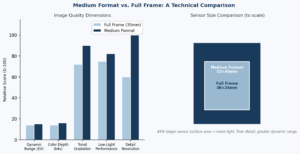
Figure 1: Medium format vs. full frame — image quality dimension comparison and sensor size difference to scale. The 44% larger sensor surface translates directly to improved dynamic range, color depth, and tonal gradation.
The Physics of Sensor Size: Why It Matters
The fundamental advantage of a larger sensor is photon collection. A medium-format sensor — typically 53×40mm versus the 36×24mm full-frame standard — has approximately 44% more surface area. With equal pixel pitch, that larger surface collects more light per exposure, translating to:
- Greater dynamic range: The ability to capture detail simultaneously in deep shadows and bright highlights.
- Lower base ISO noise: Less amplification needed to reach a usable exposure.
- Smoother tonal gradations: More discrete tonal steps between pure white and pure black.
- Richer color depth: More bit-depth per color channel, enabling finer color distinctions in post-processing.
These advantages compound in practical use. A studio fashion photographer working with both shadow detail in dark fabric and highlight retention in bright backgrounds benefits from every extra stop of dynamic range. A still life photographer spending hours on a single setup — where the final image may be reproduced at billboard scale — notices the difference in micro-contrast and tonal smoothness that a medium-format sensor delivers.
Medium Format vs. Full Frame: A Technical Comparison
| Image Quality Dimension | Full Frame (35mm) | Medium Format | Practical Impact |
|---|---|---|---|
| Sensor size | 36×24mm | 53×40mm (typical) | 44% more surface area |
| Max resolution | Up to ~61MP | Up to 150MP | More detail at large print sizes |
| Dynamic range | ~13–14 EV | ~15 EV+ | 1–2 extra stops of DR |
| Color bit depth | 14-bit RAW | 16-bit RAW | 4× more tonal steps per channel |
| Pixel size (typical) | ~4–7µm | ~5–6µm at 100MP | Larger pixels = better per-pixel IQ |
| Crop factor | 1× (reference) | ~0.8× (slight enlargement) | Shallower DoF at equivalent FoV |
The Digital Back Advantage: Modularity and Longevity
One of the structural advantages of medium-format systems built around modular digital backs is the ability to upgrade the sensor without replacing the entire camera system. The Phase One IQ4 digital back attaches to Phase One XF and XT camera bodies, and can also be mounted on a range of technical cameras and view cameras via adapters.
For commercial photographers with significant investments in camera bodies, lenses, and accessories, the modular approach means sensor technology can advance — from 100MP to 150MP, or from a conventional Bayer sensor to a trichromatic or achromatic variant — without retiring the rest of the system.
Trichromatic and Achromatic Sensors: Beyond Standard Color
Phase One’s medium-format lineup includes two specialist sensor variants that have no full-frame equivalent:
Trichromatic sensor: Designed for maximum color accuracy, the trichromatic sensor uses a modified color filter array with narrower, better-separated color band peaks. The result is more accurate color rendering straight from RAW — particularly in skin tones, textiles, and fine art reproduction where color fidelity is the primary deliverable.
Achromatic sensor: The IQ4 150MP Achromatic is a monochrome sensor with no color filter array — delivering maximum resolution, maximum sensitivity, and a tonal rendering that is simply not achievable with a conventional Bayer sensor. Used by architectural photographers, fine art black-and-white practitioners, and scientific imaging specialists.
Bespoke Photography: Where Medium Format Is the Standard
In high-end commercial photography — product, beauty, fashion, food, and architectural work — the medium format system has become the studio standard precisely because the technical quality ceiling is high enough that no client brief exceeds it. The Phase One XF IQ4 camera system is designed for exactly this environment: studio-ready, tethered shooting with a direct pipeline into Capture One software for real-time image review and color grading.
For advertising and editorial commissions where the final image may be reproduced at poster, billboard, or high-resolution screen sizes, the 150MP sensor delivers file sizes with enough data that creative retouching, cropping, and output scaling do not compromise the final result.
Lens System: The Other Half of the Equation
A medium-format sensor is only as good as the optics in front of it. Phase One’s lens lineup for the XF system includes a range of focal lengths from 23mm to 150mm, all designed and optimized for the large image circle of the medium-format sensor. These are not adapted full-frame lenses; they are purpose-built for the sensor and deliver consistent sharpness from edge to edge — a requirement that is particularly visible at 100MP+ resolution where full-frame lens coverage limitations become apparent.
Is Medium Format Right for You?
Medium format is the right choice when:
- Output will be reproduced at large scale (print or screen) where pixel-level sharpness and tonal quality are visible
- Color accuracy is a primary deliverable — fashion, fine art reproduction, product photography
- Monochrome quality is paramount — achromatic sensors deliver results unmatched by any other format
- Tethered studio workflows benefit from the integration between camera and editing software
- Longevity of the system investment is important — modular digital backs allow sensor upgrades
For a comprehensive overview of medium format digital camera options and technical specifications, alltechnews.medium.com provides independent analysis of professional camera systems and imaging technology.
Conclusion
Medium format cameras remain the benchmark for professional studio and commercial photography not out of tradition, but because the physics of a larger sensor continue to deliver measurable, visible differences in dynamic range, color depth, and tonal rendering. The gap has narrowed, but it has not closed.
For photographers whose clients demand the absolute best — and whose work will be evaluated frame by frame, tone by tone — the Phase One IQ4 digital back system represents the current state of the art in digital capture.