Cybersecurity
Low-Code Security Risks: What Enterprise Teams Need to Know

| Key Takeaways
• The OWASP Low-Code/No-Code Top 10 names ten risk categories, including account impersonation, authorization misuse, data leakage and asset management failures. • Gartner predicted in 2021 that 70% of new applications would use low-code or no-code technologies by 2025, up from less than 25% in 2020. • Vendor security guidance covers the platform itself, while app-level permissions, connectors and data handling remain the responsibility of the organization. • A practical review starts with an inventory of apps and owners before moving on to connector permissions, secrets and logging. |
What are the main security risks of low-code platforms?
The most widely referenced answer is the OWASP Low-Code/No-Code Top 10, which groups the risks into ten categories, from account impersonation and authorization misuse to asset management and logging failures. The list was written for organizations adopting platforms where applications are assembled through a graphical interface instead of hand-written code, and it focuses on the weaknesses those platforms make easy to create at scale. Security teams that want to see how these categories play out in one widely used environment can start with this review of security risks in Power Platform environments, which walks through the same themes in a Microsoft context.
OWASP itself describes the project as an education effort and says it is still asking organizations for vulnerability prevalence data, so the list works best as a checklist of areas to examine, not as a guarantee of which category will cause the next incident.
Why are low-code apps spreading faster than security teams can review them?
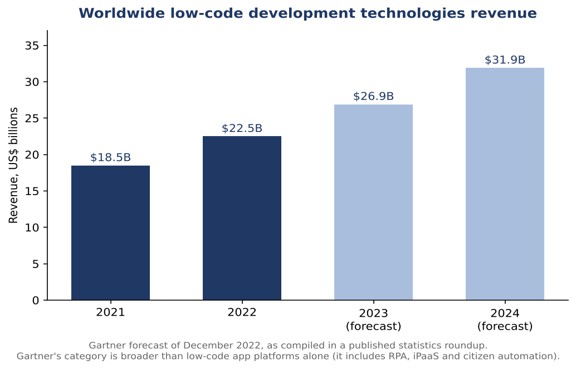
Low-code platforms let business users build and connect applications without waiting for a central development queue, so the number of apps grows faster than a manual review process can follow. Gartner predicted in 2021 that 70% of new applications developed by organizations would use low-code or no-code technologies by 2025, up from less than 25% in 2020. Its December 2022 forecast put worldwide revenue for low-code development technologies at $18.5 billion in 2021 and $22.5 billion in 2022, with $31.9 billion projected for 2024, according to a published roundup of the Gartner low-code figures.

Growth of this kind changes the security problem from reviewing a handful of projects to tracking a population. Governance questions such as who owns an app, which data it touches and when it should be retired become operational, and approval and ownership rules for business-built applications are usually the first controls organizations try to put in place.
How do the OWASP risk categories show up in everyday low-code projects?
Most of the categories trace back to three habits: embedding a shared account in an app, connecting apps to each other and to data sources with broad permissions, and building faster than anyone inventories. The table below translates six of the categories into plain language and pairs each with a question a reviewer can ask.
| OWASP category | What it means in practice | Question for a reviewer |
| LCNC-SEC-01 Account Impersonation | An account embedded in an app does not match the user running it, which can allow access beyond what that user should have. | Whose identity does each app act as? |
| LCNC-SEC-02 Authorization Misuse | Interconnected apps let people reach information or services they were never meant to reach. | Which connections can pass data between apps? |
| LCNC-SEC-03 Data Leakage and Unexpected Consequences | Data ends up in locations that were not intended and are often outside the organization’s control. | Where can this app send or store data? |
| LCNC-SEC-08 Data and Secret Handling Failures | Confidential data or credentials are stored on shared systems without adequate protection. | Are secrets kept out of the app itself? |
| LCNC-SEC-09 Asset Management Failures | Apps multiply quickly and are not tracked or managed. | Is there a current inventory with a named owner? |
| LCNC-SEC-10 Security Logging and Monitoring Failures | Logs and audit trails are too thin to trace what happened after a problem. | Could an investigator reconstruct an incident? |
Do platform vendors already cover these risks?
Platform vendors secure their own service, but they also publish guidance that places part of the work with the teams building on it. Microsoft’s Power Platform security FAQ describes how the platform addresses the OWASP Top 10 and the OWASP Low-Code/No-Code Top 10, and its separate security posture management guidance describes a tenant security score on a low, medium or high scale, along with recommendations an administrator can act on. Its Well-Architected material for workload owners adds that every component of a workload, whether low-code or code-first, has to be free of security defects. The practical reading is that vendor controls are a foundation, while app-level configuration, connectors and data handling remain the customer’s responsibility.
What does a practical low-code security review start with?
A practical review starts with an inventory, because every other control depends on knowing which apps, flows and automations exist and who owns them. After that come permissions on connectors, the paths data can take out of an app, handling of secrets, and whether logging is detailed enough to support an investigation. Kanopy Security, for example, describes its platform as connecting to enterprise environments and surfacing the agents, workflows, automations and applications running in them, including assets that security teams did not know existed. Whatever the tooling, the output a reviewer should expect is the same: a current list, a named owner for each item, and a short list of items that need remediation first.
Reviewers can also use the OWASP list as the backbone of the process. Scoring each category per platform, and revisiting it when a new connector or AI feature is switched on, keeps the review tied to a recognized standard instead of an internal opinion. The OWASP project page lists the ten categories and links to the detailed documents for each one.
Environment hygiene belongs on the same list. Microsoft’s guidance for Power Platform includes securing the default environment, which is the place many first-time builders start, and separating environments by purpose so that apps handling sensitive data do not share space with personal productivity experiments. Small structural choices like these reduce the number of apps that need individual review.
How should security and business teams share the work?
Security teams set the guardrails and business builders operate inside them, which only works if the guardrails are easy to follow. That usually means separating environments by data sensitivity, defining which connectors are approved, requiring an owner on every app, and reviewing apps that touch sensitive data before they are widely shared. Staff turnover is a frequently overlooked gap in this model: when an app’s creator leaves, nobody maintains it, and an unmaintained app with live connections is exactly the kind of asset the asset management and monitoring categories describe.
Measuring the program also helps. Counting apps with a named owner, apps reviewed in the last quarter, and connectors outside the approved list gives leadership a small set of numbers that move in the right direction when governance is working. Those same counts give auditors something concrete to examine when they ask how business-built apps are controlled.
Frequently Asked Questions
What are the OWASP Low-Code/No-Code Top 10 risks?
The ten risks are account impersonation, authorization misuse, data leakage and unexpected consequences, authentication and secure communication failures, security misconfiguration, injection handling failures, vulnerable and untrusted components, data and secret handling failures, asset management failures, and security logging and monitoring failures.
Is low-code development less secure than traditional coding?
Not by definition, but the risks differ. Low-code platforms add categories such as connector permissions, shared accounts and app sprawl, and many apps are built by business users outside central IT review.
Who is responsible for the security of a low-code app?
The platform vendor secures the underlying service, while the organization remains responsible for how its apps, connectors, permissions and data are configured and used.
How can a security team find low-code apps it does not know about?
Start from the platform’s administration data to build an inventory of apps, flows and connectors, then assign a named owner to each one and review anything that touches sensitive data.