Tech
Loitering Munitions Explained: How Kamikaze Drones Find, Track and Strike Targets

Key Takeaways
- A loitering munition is an unmanned aircraft with an integrated warhead that can wait over a target area before striking.
- Loitering munitions originated in the 1980s as a tool for suppressing enemy air defenses, with Israel’s Harpy the first operational system.
- Typical loitering munitions range from about 5 kg to 300 kg at takeoff, with operational ranges from 5 km to 2,500 km.
- Electro-optical-guided loitering munitions depend on a video data link until target lock-on, which makes onboard video processing a critical subsystem.
What is a loitering munition?
A loitering munition is an unmanned aerial vehicle that carries its own warhead, flies to a target area, waits there while it searches, and then strikes a target selected before launch or in real time by an operator. The design sits in the niche between a cruise missile and an armed combat drone, borrowing the precision and expendability of the first and the persistence and onboard sensors of the second. The category goes by several names, including suicide drone, loitering missile, loitering drone and, in Israeli media, explosive UAV.
The defining trait is the loiter itself. Instead of flying a fixed path to a fixed coordinate, a loitering munition can stay airborne over an area, use its seeker or camera to look for something worth engaging, and commit only when the target is confirmed. For readers who want the broader background on how this weapon class is employed, a full primer on explosive UAVs and how they are used covers the history and operational roles in more depth.
How did loitering munitions evolve?
Loitering munitions began in the 1980s as a tool for suppressing enemy air defenses (SEAD), hunting mobile radar and surface-to-air missile systems that would not stay switched on long enough to be targeted conventionally. According to a 2025 threat assessment from Israel’s Institute for National Security Studies, the United States and Germany pioneered the idea and then abandoned it, while Israel and Iran kept developing it, producing the Harpy and the Ababil during the 1980s.
From the 2000s onward the concept spread into new roles, from long-range strikes and fire support down to backpack-sized tactical systems. The Center for the Study of the Drone at Bard College describes how many current designs are marketed to infantry as a guided precision munition that offers ground forces more precision than a mortar. The scale of use has grown just as fast: on April 14, 2024, about 170 Iranian loitering munitions, most likely Shahed-136 models, were launched toward Israel, and they failed to reach Israel because of interception by the Israeli Air Force and its allies.
What are the main components of a loitering munition system?
A loitering munition weapon system has five core parts: a launcher, the munitions themselves stored in canisters, a command and control (C2) station, a radio data link, and a power supply. The canister doubles as long-term storage, and the launcher can be anything from a single disposable tube carried by one soldier to a multi-canister vehicle mount.
The C2 element scales with the mission. For a small number of GPS-guided munitions, it can be as simple as a laptop; for mass launches, it typically becomes a shelter full of computers and displays managing multiple launches at once. The data link is only mandatory in systems that use an electro-optical seeker, because that is the configuration in which a human operator needs to see what the munition sees.
How big, fast and far-reaching are loitering munitions?
Loitering munitions span an unusually wide performance envelope, from man-portable rounds weighing about 5 kg to 300 kg platforms with ranges of up to 2,500 km. The INSS profile lists typical warhead weights of 0.5 to 50 kg, cruising speeds of 150 to 600 km/h, wingspans and fuselage lengths of 0.5 to 4 m, and a practical limit of roughly 200 km for systems that rely on ground communication.
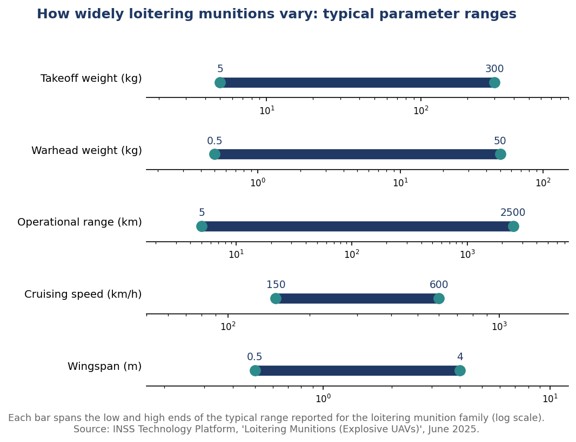

That spread matters for anyone designing subsystems. A component that fits comfortably inside a 300 kg long-range airframe may be impossible to integrate into a tube-launched round where every gram and every watt is already committed.
How do loitering munitions find and guide onto a target?
A loitering munition flies in two phases: midcourse navigation to the target area, usually by GNSS, and terminal guidance onto the specific target using GNSS or an onboard seeker. The seeker type determines how much autonomy the munition has and how much video it needs to move.
| Seeker type | How it works | Human involvement |
| Passive radar (anti-radiation) | Detects, locks onto and tracks emitting targets such as radar transmitters | Fully autonomous |
| Electro-optical (EO) | Detects and tracks a target against its background using a camera | Operator needed until lock-on, via a point-to-point data link |
| Semi-active laser (SAL) | Homes on a laser spot designated from the ground or air | Requires a designator; no known operational loitering munition uses it |
| GNSS only | Flies to pre-set coordinates | Autonomous after launch |
The EO seeker is where video becomes mission-critical. Because the operator has to see the scene and confirm the target before lock-on, the quality, delay and reliability of the digital video and data link directly shape what the operator can decide. INSS notes that cheaper loitering munitions often rely on basic observation cameras, sometimes day-only cameras, paired with a tracking system.
Why is onboard video processing becoming central to loitering munitions?
Onboard video processing matters because loitering munitions increasingly have to operate with limited bandwidth, intermittent connectivity and strict size, weight and power limits, so they cannot depend on streaming every frame back to an operator. Rising use in recent conflicts has pushed demand for processors that can handle video feeds, navigation data and targeting functions without a constant communications link.
The INSS analysis expects that improvements in automatic target recognition will eventually let even EO-guided loitering munitions operate with full autonomy, at which point the data link becomes optional rather than mandatory. Until then, the practical engineering challenge is compressing and transmitting usable video over a fragile link while running analytics on the airframe itself. That challenge has created a supply chain of specialist components, including compact video modules designed for small unmanned airframes, that handle encoding and AI processing inside the tight power envelope of a small drone.
How are militaries countering loitering munitions?
The most effective countermeasure observed so far has been electronic warfare that jams GNSS navigation and the command-and-control data link, rather than shooting each munition down. Ukrainian forces have claimed they neutralized 70 to 80 percent of the Russian loitering munitions launched against them, mainly Shahed-131 and Shahed-136, largely through electronic warfare.
Kinetic defenses remain part of the picture. Options in use or under consideration include fighter jets and attack helicopters, surface-to-air missile batteries, revived gun-based air defense, and dedicated interceptor systems. INSS stresses that countering the threat gets more expensive the later in the chain it happens: destroying a swarm already in the air is far harder and costlier than disrupting production, storage or launch.
What does the swarm threat mean for the next generation of systems?
Swarms of dozens or hundreds of loitering munitions launched together are the scenario defense planners now treat as the central challenge, because they can saturate air defenses built to handle individual threats. INSS calculates that coordinating 10 to 50 standard five-round Shahed-136 launchers could produce a swarm of 50 to 250 munitions, enough to assign 10 to 20 to each high-value target.
For both attackers and defenders, that shifts the emphasis toward autonomy, onboard intelligence and resilient links. Systems that can see, decide and stay connected under jamming will define the next phase of this weapon class, which is why video and edge-processing subsystems are attracting the same attention as airframes and warheads.
Frequently Asked Questions
What is the difference between a loitering munition and a drone?
A loitering munition is a drone that carries its own warhead and is generally not meant to be recovered, although some designs can return to the operator if they are not used in an attack.
Why are loitering munitions called kamikaze drones?
Loitering munitions are called kamikaze or suicide drones because the aircraft itself detonates on the target instead of releasing a separate weapon.
What was the first operational loitering munition?
The Harpy, developed by Israel Aerospace Industries, was the first operational loitering munition system and was originally designed to attack enemy radar installations.
How far can a loitering munition fly?
Loitering munition ranges vary from about 5 km for tactical man-portable models to roughly 2,500 km for long-range strike variants.