Business Solutions
Kapia Pepper Explained: Sweetness, Roasting Quality and Where Mini-Kapia Types Fit

| Key Takeaways
• A kapia pepper, also spelled capia or kapya, is a sweet, elongated Capsicum annuum type that is harvested ripe and red rather than green. • In a 2018 to 2020 Bulgarian field study, kapia genotypes held 4.90% to 5.48% total sugars, roughly twice the level found in conical and blocky or bell types harvested green. • Kapia peppers are most often judged roasted, and genotype explained 37.73% of the variation in their overall sensory score. • Mini-kapia types keep the elongated kapia shape in a snack format, with trade press describing fruit 8 to 15 cm long. |
What is a kapia pepper?
A kapia pepper is a sweet, elongated type of Capsicum annuum that is picked ripe, usually red, instead of green. It is also spelled capia or kapya, and it is most often roasted before eating. A 2025 Bulgarian field study of 29 pepper genotypes from the Maritsa Vegetable Crops Research Institute groups kapia with ratund (pumpkin) peppers as types eaten at full maturity, while conical, blocky and bell peppers are usually eaten at an intermediate green or pale yellow stage. You can read the full paper in the Journal of BioScience and Biotechnology. The authors describe sweet pepper as one of the most important vegetable crops of the Balkan region, where fruit shape, colour and culinary use differ from one local type to the next.
The kapia shape has since been adapted for snacking. BreedX, an Israeli breeder established in 2017, lists seedless Mini-Kapia types as a snack-sized take on the kapia shape, described as elongated, crunchy and sweet, and bred to perform in different seasons and climates. It sits within a wider seedless sweet pepper range that grows from seed rather than from cuttings, which matters for growers because seedless fruit were long propagated vegetatively.
How sweet is a kapia pepper compared with other sweet pepper types?
Kapia peppers were the sweetest group in the Bulgarian study: nine kapia genotypes ranged from 4.90% to 5.48% total sugars, against 2.46% to 3.24% for conical types and 2.57% to 3.03% for blocky and bell types harvested green. The comparison is not perfectly like for like, because kapia fruit were harvested red and the green types at technical maturity, and sugars generally rise as a pepper ripens. Even so, the gap is wide. Ratund types, the other red-harvested group, sat in between at 4.44% to 4.88%.
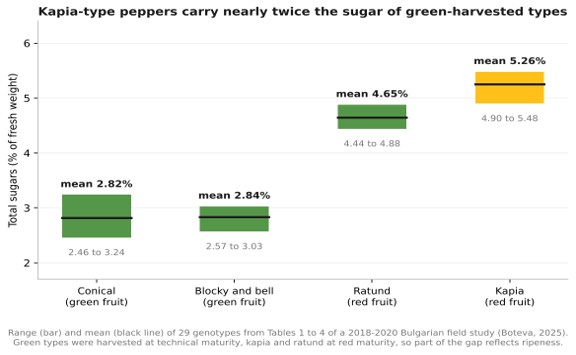

| Pepper type (harvest stage) | Total sugars (%) | Dry matter (%) | Ascorbic acid (mg per 100 g) |
| Conical (green) | 2.46 to 3.24 | 7.38 to 9.14 | 100.7 to 118.5 |
| Blocky and bell (green) | 2.57 to 3.03 | 7.41 to 8.17 | 104.2 to 144.2 |
| Ratund (red) | 4.44 to 4.88 | 9.18 to 10.29 | 180.7 to 207.7 |
| Kapia (red) | 4.90 to 5.48 | 9.43 to 10.76 | 149.7 to 179.5 |
Dry matter followed the same pattern. All kapia genotypes but one exceeded 10% dry matter, while no green-harvested group averaged above 9.2%.
Why are kapia peppers usually roasted?
Kapia peppers are usually roasted because the type is bred and judged for roasted eating quality. In the Bulgarian study the sensory panel scored kapia genotypes after roasting, while the green types were scored fresh. One cultivar, Ivaylovska kapia, earned good sensory scores for easily peeled fruit and a thick pericarp after roasting. Genotype explained 37.73% of the variation in overall sensory score among kapia types, far more than the growing year at 3.06%, so variety choice matters far more than season for roasted eating quality in this dataset. No notable correlation appeared between sensory score and sugars or dry matter in the red-fruited types, so sugar alone does not predict the best roasted flavour in this dataset.
How much vitamin C does a kapia pepper contain?
In the same study, kapia genotypes contained 149.7 to 179.5 mg of ascorbic acid per 100 g of fresh fruit, above the 100 mg daily reference dose for adults that the authors cite. The red-harvested types led the field: the best ratund line reached 207.7 mg, while green conical types held 100.7 to 118.5 mg. The paper notes that sugars and vitamin C generally increase until a pepper reaches optimum ripeness, which is one reason a type harvested at full colour tends to rank higher. Growing conditions matter too. Genotype explained 28.40% of the variation in ascorbic acid among kapia types and the year of cultivation explained a further 25.73%, so the same variety can test differently from one season to the next.
What is a mini-kapia pepper?
A mini-kapia is a kapia-type pepper bred to a snack-friendly size. Trade press describes a Mini-Kapia type with fruit 8 to 15 cm long, compared with a 1-Bite type of up to 6 cm, in Eurofruit coverage of seedless pepper breeding. The same report says seedless peppers of this kind are grown commercially in Spain for European markets, in Mexico and Canada for North American markets, and in South Africa and Israel for local markets. Elongated sweet types face their own agronomic questions, such as how they cope with heat during fruit set. That topic is covered in a guide to heat tolerance in long red sweet peppers.
Are capia, kapia and kapya the same pepper?
Yes. Capia, kapia and kapya are spelling variants of one pepper type. Trade press often writes capia or mini-capia, as in Greenhouse Grower coverage of seedless pepper segments that run from small one-bite fruit to mini-capia, while Bulgarian research papers refer to kapia or kapya types. The variation matters for anyone researching the type, because buyers, growers and cooks search under all three spellings, and each can surface a different set of recipes, seed listings and trial data.
How reliable is the kapia comparison?
The data come from a single institute in one region, so they describe Bulgarian cultivars and breeding lines rather than every kapia pepper grown worldwide. The 29 genotypes were grown in an open field in Plovdiv over three consecutive seasons from 2018 to 2020, using a randomized complete block design with three replicates and 20 plants per replicate. Fifteen fruit per replicate went to the laboratory for dry matter, ascorbic acid, total sugars and pigment analysis, and a trained panel of four people scored sensory traits on a five-point scale. A small panel means the sensory results are best read as a guide to relative differences between genotypes, not as a consumer preference survey. The chemical measurements, by contrast, are replicated across three years, and the sugar and vitamin C ranges sit inside the ranges that the authors cite from earlier studies of sweet pepper.
What affects kapia pepper quality most?
Genotype and growing conditions both shape kapia quality, but genotype leads on the traits growers can select for. Among kapia types, genotype explained 41.41% of the variation in dry matter and 43.10% of the variation in total pigment, measured in ASTA units, while the growing year explained 17.52% of pigment. Line 717/16 reached 16 ASTA units, the highest pigment value recorded, and line 597/17 combined relatively high values across the measured components, which the authors flag as suitable for future hybridization programs. For buyers, the practical reading is that colour depth, dry matter and sugar can all be selected for, but ripeness at harvest and season will still move the numbers.
Frequently Asked Questions
What is a kapia pepper?
A kapia pepper is a sweet, elongated Capsicum annuum type that is harvested ripe, usually red, and is most often eaten roasted. It is also spelled capia or kapya.
Are kapia peppers hot or sweet?
Kapia peppers are sweet. In a Bulgarian field study, red kapia fruit contained 4.90% to 5.48% total sugars, roughly twice the level found in conical and blocky or bell types harvested green.
How long is a mini-kapia pepper?
Trade press describes a Mini-Kapia type with fruit 8 to 15 cm long, compared with up to 6 cm for a 1-Bite snack pepper.
Can a kapia pepper be seedless?
Yes. Seedless sweet pepper breeders market Mini-Kapia types that are grown from seed and produce fruit without a seed cavity, and these are grown commercially in several countries.