Industrial Solutions
7 Signs Your IT Hardware Warehousing and RMA Partner Isn’t Built for Compliance

IT equipment warehousing and distribution means storing server, telecom, and data center hardware in strategically located facilities and distributing it as customers need it, instead of shipping every unit individually from origin. It sounds like a straightforward storage function until a shipment gets held at customs because the warehouse partner had no certification knowledge, or a next business day replacement misses its window because the spare part was never pre cleared. The seven signs below separate a partner actually built for regulated hardware from a generic storage vendor.
1. No Bonded Storage Capability
Bonded storage lets imported goods sit in a warehouse without paying duties or taxes until they are actually sold, distributed, or re-exported. For hardware held on a shelf awaiting deployment, that means capital is not tied up in duty payments on units that have not moved yet. A partner without bonded storage forces duty payment up front regardless of how long the equipment sits in inventory.
2. No In House IOR or EOR Capability
A compliance ready warehouse pairs physical storage with customs capability under the same relationship, since the same provider is usually already handling clearance. When warehousing and customs sit with two separate vendors, every shipment needs coordination between them, and that gap is where delays and miscommunication show up.
3. No Certification Knowledge for Regulated Hardware
Importing technology, IT hardware, and security equipment differs from importing ordinary commodity goods. Each country applies its own rules for electrical, radio frequency, encryption, and other technical standards, and a generic 3PL rarely has that knowledge built in. A partner that cannot speak to product certification requirements is guessing at exactly the point where guessing is most expensive.
4. A Single Warehouse Instead of Regional Coverage
Serving multiple countries from one distant facility means every shipment, even a small urgent order, crosses a border and a customs process. Regional coverage puts inventory closer to where it is actually needed, which matters most for time sensitive replacement parts.
- A single regional hub can often serve several neighboring markets without a dedicated facility in each one
- Not every country requires its own warehouse, but every shipment from a distant single site does require its own clearance
5. RMA Is Handled by a Separate Vendor
Warehousing is not just about the initial deployment. Regional inventory positioned under an existing import relationship is what makes fast RMA turnaround possible, since a replacement unit can ship from nearby stock instead of waiting on a fresh customs clearance from origin. When warehousing and RMA sit with two different vendors, that speed advantage disappears.
6. No Pre Cleared Spare Parts Inventory
A 24 hour or next business day support commitment sounds simple until it has to survive an international border. Meeting it requires pre-cleared spare parts inventory staged in the region, an active import relationship so replacements do not wait on paperwork, and a courier network that does not add its own delay on top of an already tight window. Without pre cleared inventory, the tightest SLA tiers are not realistic no matter what a vendor promises on paper.
7. Outbound and Inbound Flows Run Through Separate Facilities
Returns can be received, inspected, and redistributed from the same facility handling outbound distribution, or they can bounce between two disconnected operations. One provider covering both directions is generally more efficient than coordinating a warehousing vendor and a separate reverse logistics vendor for the same regional footprint.
Compliance Ready Warehousing vs a Generic 3PL
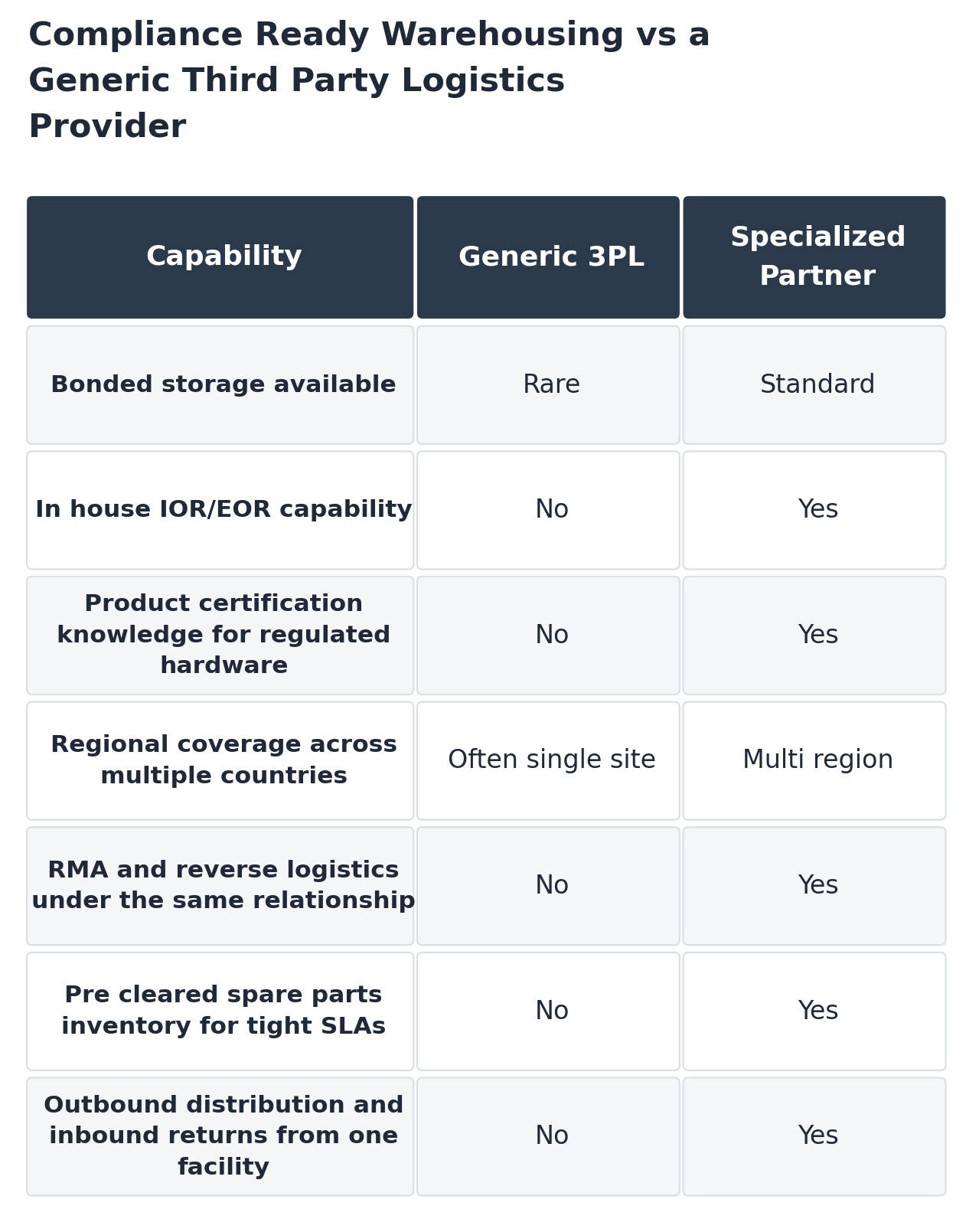

Compliance ready warehousing versus a generic third party logistics provider for IT and data center hardware
Where This Shows Up Most
Regional distribution matters most where customs and telecom certification regimes are heaviest. Warehousing built around IT equipment warehousing and distribution needs, rather than generic storage, tends to make the biggest difference in markets with layered certification requirements, and the same logic extends directly into RMA and post sales logistics, since a return shipment carries the same compliance questions as the original import in reverse.
Regional hubs also matter for broader IT hardware logistics planning, since the choice of where to stage inventory affects both initial deployment speed and how quickly a failed unit can be replaced later.
A useful outside reference here is the concept of a bonded warehouse, a facility authorized to store imported dutiable goods without immediate payment of duty, which are then either withdrawn for domestic use with duty paid, or re-exported without ever triggering that duty at all.
The Cost Side of Getting This Wrong
None of these seven signs show up as a line item on a warehousing quote, which is exactly why they get missed during vendor selection. A generic 3PL often looks cheaper on paper because bonded storage, in house certification knowledge, and integrated RMA all cost money to maintain. That gap tends to show up later instead, as duty paid on inventory that never should have needed it, as a shipment held at customs because no one on the warehousing side knew the certification requirement existed, or as a support ticket that misses its SLA because the replacement part had to clear customs from origin instead of shipping from regional stock already on hand.
Frequently Asked Questions
Do I need a warehouse in every country I sell into?
Not necessarily. Regional hubs can often serve several neighboring countries, which reduces the need for a dedicated facility in every single market.
How does warehousing actually affect RMA response times?
Pre cleared regional inventory is what makes tight SLA windows like 24 hour or next business day support realistic, since a replacement does not need fresh customs clearance from origin.