Streaming Solutions
Inside an IRL Streaming Backpack: How It Works and Why It Uses Bonding

| Key Takeaways
• An IRL streaming backpack is a wearable kit that sends camera video over several bonded cellular connections so a creator can broadcast while moving. • The core components are a camera with HDMI output, a bonding encoder, 4G or 5G modems with SIM plans, a power source and a carrying pack. • If one modem drops during a bonded stream, the bitrate falls but the stream continues over the remaining connections. • A 1080p stream at 30 frames per second commonly needs about 4.5 to 6 megabits per second, well within reach of a bonded setup. |
What is an IRL streaming backpack?
An IRL streaming backpack is a wearable kit built around a bonding encoder that sends video from a camera over several cellular connections, so a streamer can broadcast while walking, riding or travelling. IRL stands for “in real life,” and the backpack is what lets a creator move through the world without losing the stream.
The format has deep roots in Twitch history. Twitch was split off from Justin.tv in 2011 after gaming became its main traffic source, and the return of IRL content harks back to that origin, as this history of IRL streaming on Twitch explains. Mobile video companies that had long served sports and news customers then turned their attention to these creators, and the backpack format followed. SlashGear’s explainer on how IRL streaming backpacks work covers the same lineage from a consumer technology angle.
What components go into an IRL streaming backpack?
An IRL streaming backpack contains five core components: a camera, a bonding encoder, cellular modems with SIM plans, a power source and a carrying system. Each has a specific job in keeping the stream stable.
- Camera: Any camera with an HDMI output can feed the encoder, from an action camera on the shoulder to a mirrorless body on a gimbal.
- Bonding encoder: This device takes the camera signal and encodes it in H.264 or HEVC at up to 4K, with a maximum video bitrate of 20 megabits per second.
- Modems and SIMs: The encoder can bond up to four external 4G or 5G modems alongside Wi-Fi and Ethernet. Using SIMs from different carriers spreads the risk of a single network failing.
- Power: The encoder’s internal battery runs for about three hours, and USB-C input with at least 45 watts of power delivery allows a power bank to extend that time.
- Pack and mounting: Professional cross-shoulder and belt packs keep a unit of roughly 912 grams secure while the streamer moves.
Sourcing modems and data plans separately can be fiddly, so some services bundle them. The bundled modem and data plan kits such as LiveU’s Solo Connect option pair the encoder with modems, data plans and bonding service, which removes one variable from the setup.
Why do IRL streamers use cellular bonding instead of a phone hotspot?
IRL streamers use cellular bonding because a phone hotspot relies on one modem, and one modem limits both bandwidth and resilience. Bonding splits the stream across several connections so a weak signal on one carrier does not decide the quality of the whole broadcast.
The failure behavior is also different. If a USB modem disconnects during a bonded stream, the encoder loses that link’s share of capacity and the overall bitrate drops, but the stream continues over the remaining connections. For a streamer walking from a street into a crowded plaza, that gradual change is far better than a stream that simply ends.
How much bandwidth does an IRL stream need?
An IRL stream at 1080p and 30 frames per second commonly needs roughly 4.5 to 6 megabits per second, and 1080p at 60 frames per second needs about 6 to 9. Higher frame rates add roughly 50 to 60 percent more bitrate for equivalent quality, which is why many mobile streamers choose 30 frames per second as a default.
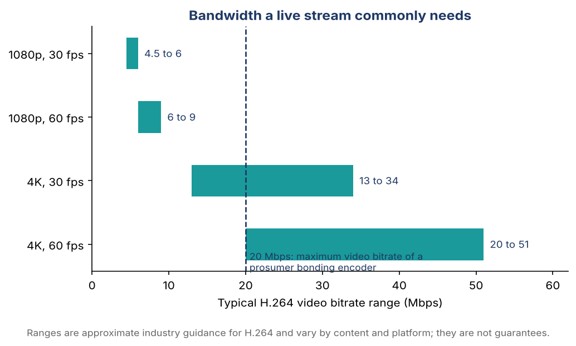

The chart shows why 4K at 60 frames per second sits at the edge of what a 20 megabit encoder can carry. For most walking streams, 1080p leaves comfortable headroom, which matters because the combined capacity of several cellular links can swing from minute to minute.
What should an IRL streamer plan before leaving home?
An IRL streamer should plan for power, data coverage and the destination platform before leaving home. Battery life sets the length of the walk, while data plans and carrier choice set where the stream is likely to hold up.
Coverage abroad deserves particular attention. Listings for one bundled service describe embedded SIM cards ready for local use in Europe, the United States and Canada, so streamers travelling elsewhere should check regional coverage before departure. They should also confirm the platform’s recommended ingest settings and run a short test stream along the planned route, because dead spots show up on foot far more than they do on a map.
What does the signal path look like from camera to viewer?
The signal path runs from the camera’s HDMI output into the encoder, across the bonded connections to a cloud service, and from there to the streaming platform. The encoder compresses the video, the bonding layer spreads it over every available link, and the cloud side reassembles it before delivery to destinations such as Twitch, YouTube or Facebook over RTMP.
Because the cloud service sits between the backpack and the platform, it can also send the same stream to several destinations at once. Streamers who simulcast to more than one platform should check whether that feature is included in their service plan, and whether the encoder shows per-connection status so a failing link is easy to spot while walking.
Should you build an IRL backpack or buy a complete one?
Building an IRL backpack from separate parts is a budget-friendly alternative to buying an all-in-one package, while a complete kit saves time and removes compatibility guesswork. The right choice depends on how much setup the streamer is willing to do and how critical stability is to the channel.
A custom build lets the streamer choose the camera, modem models and pack, and it makes sense for people who enjoy tuning gear. A turnkey package ships with tested components and, in some cases, a data plan. Either route benefits from HEVC support in the encoder, because HEVC can carry similar quality in fewer bits, which stretches limited cellular capacity further. Whichever route is chosen, a rehearsal walk along the planned route is the best way to catch weak coverage, loose cables and battery surprises before they happen on air.
Frequently Asked Questions
What is an IRL streaming backpack?
An IRL streaming backpack is a wearable kit that combines a camera, a bonding encoder, cellular modems and batteries so a creator can livestream while moving through the real world.
How many cellular modems can an IRL backpack use?
Many bonding encoders support up to four external 4G or 5G modems, and some also add Wi-Fi and Ethernet for a total of six bonded connections.
How long does an IRL streaming backpack run on battery?
A bonding encoder with an internal battery typically runs for about three hours, and USB-C power input from a power bank can extend that time.
Is 1080p or 4K better for IRL streaming?
1080p is usually the better choice for walking streams because it needs far less bandwidth than 4K, leaving headroom when cellular capacity fluctuates.