Tech
Inspecting Wind Turbine Blades While They Are Still Rotating


| Key Takeaways
• A documented in-motion aerial inspection deployment can photograph a wind turbine blade clearly from about 60 meters away while it continues rotating, versus the 3-5 meter range typical of close-range manual inspection. • The U.S. Department of Energy notes that traditional visual inspection methods are reliable for surface damage but currently cannot detect early, hidden subsurface damage caused by impact or overstress. • Inspecting blades in motion has been reported to avoid up to 6,000 euros in lost energy production per inspection that would otherwise require stopping the turbine. • A documented deployment reported needing only the drone pilot on site, rather than a full rope-access or engineering crew, to complete an inspection. |
How close does a drone need to fly to photograph a rotating wind turbine blade without motion blur?
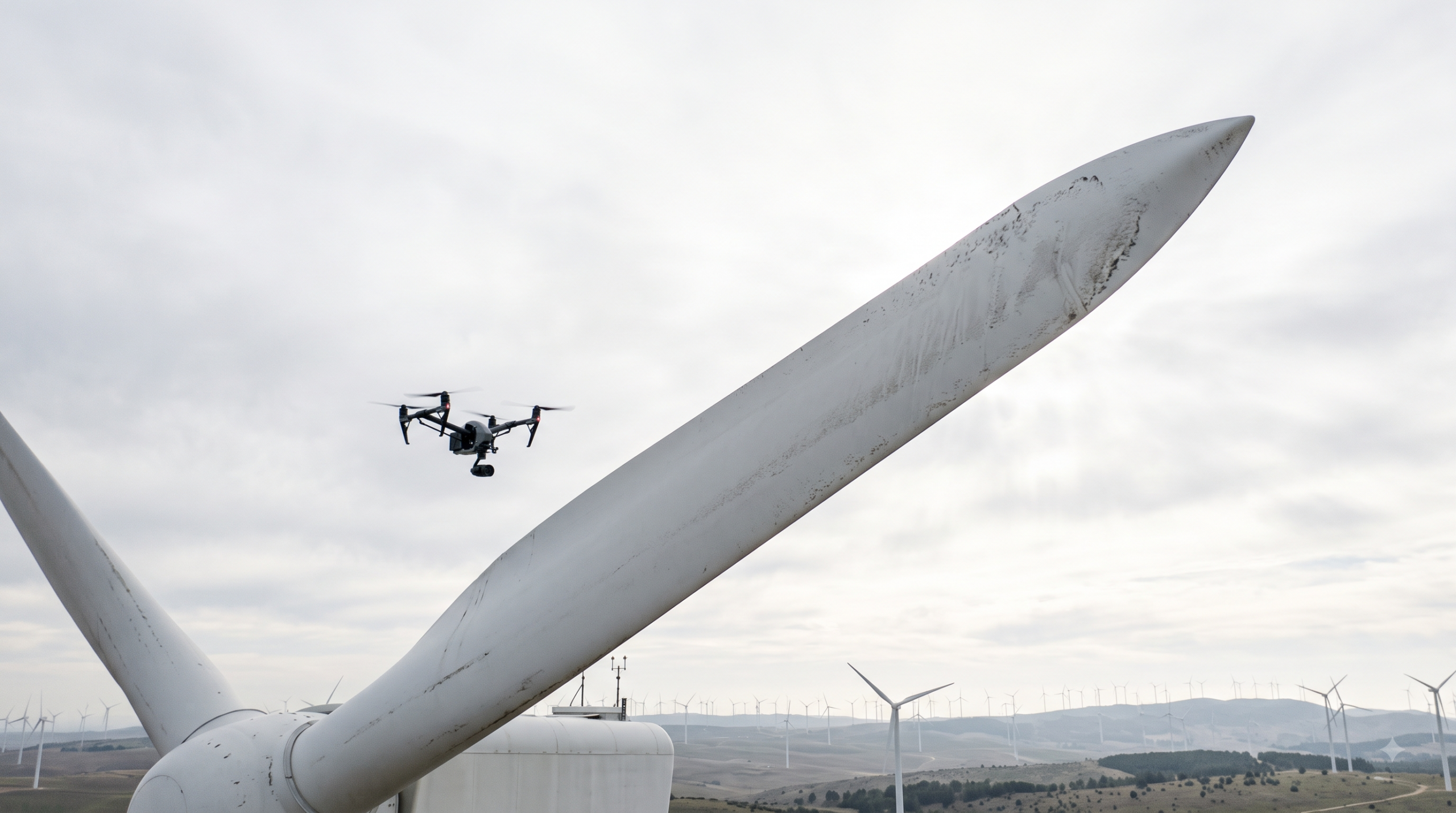
A documented in-motion aerial inspection setup can photograph a wind turbine blade clearly from roughly 60 meters away while the rotor keeps turning, versus the 3 to 5 meter range typically required for close-range rope-access or handheld telephoto inspection. That standoff distance is achieved by pairing a dedicated aerial inspection camera and lens with a UAV platform such as a DJI Matrice 350, using either a semi-automated or fully automated flight pattern that can capture around 12 images per blade side and, with a fully automated setup, cover all three blades in a single session. a documented case study of photographing turbine blades while they continue rotating describes how the camera and flight pattern were configured to keep imagery blur-free even in windy conditions.
What is the difference between a semi-automated and a fully automated inspection flight?
A semi-automated inspection flight still relies on a pilot to position the aircraft near each blade while the camera handles triggering and exposure automatically, whereas a fully automated flight plans the entire route in advance so a single mission can cover all three blades without the pilot repositioning manually between them. The choice between the two is largely about throughput: a fully automated setup capturing roughly 12 images per blade side across three blades in one session covers an entire turbine’s visible surface faster than repeating a semi-automated approach blade by blade, though both rely on the same underlying camera and standoff distance to keep the images usable.
Why does image stability matter more for in-motion blade inspection than for a stationary object?
Image stability matters more here because the blade itself is moving through the frame at a fixed rotor speed while the aircraft holding the camera is also being pushed around by wind, so any uncorrected motion on either side of that equation shows up directly as blur in the final image. A documented in-motion aerial inspection deployment specifically reported excellent stability in windy conditions and consistently blur-free imagery, which is what allows the approach to substitute for a stationary or near-contact inspection method in the first place; a blurred frame is simply a missed inspection point that has to be recaptured.
Why do wind turbine blades need routine inspection in the first place?
Modern wind turbine blades need routine inspection because they are, in the words of the U.S. Department of Energy, among the largest single-piece composite structures in the world, often exceeding the length of a football field, and they endure hundreds of millions of fatigue cycles over their operating life. Many turbines also sit in locations that make manual inspection logistically difficult, including exposed ridgelines and offshore platforms many miles from the coast, which is part of why remote aerial capture has become a practical alternative to sending a technician up the tower or out on a boat for every check. A composite structure that size accumulates stress unevenly across its length, so an inspection program generally needs to cover the full blade on a recurring basis rather than checking only the points that failed on a previous turbine, which is part of why inspection frequency and coverage both matter as much as detection sensitivity.
What can, and can’t, a routine visual aerial inspection actually detect?
A routine visual aerial inspection is reliable at finding visible surface damage such as cracks, erosion, or lightning-strike marks, but U.S. Department of Energy research into blade damage and inspection limitations notes that traditional visual methods, including telephoto cameras and aerial drones, currently lack the ability to detect early, hidden damage beneath the blade surface. As DOE researcher Dennis Roach explains, impact or overstress from turbulence can create subsurface damage that is not visually evident, which is why some programs pair visual aerial capture with separate subsurface techniques such as phased-array ultrasonic imaging rather than relying on cameras alone.
| Inspection method | Typical standoff / access | On-site personnel | What it primarily detects |
| Rope-access / close-range manual | 3-5 m (direct or near-contact) | Rope-access technicians plus ground support | Visible surface damage, inspected point by point |
| In-motion aerial capture (documented deployment) | About 60 m, blade in motion | Drone pilot only | Visible surface damage across all three blades in one session |
| Subsurface robotic/ultrasonic (DOE-documented research) | Direct contact, crawls blade surface | Specialist operator | Subsurface damage from impact or overstress, not visible at the surface |
A comparison of documented wind turbine blade inspection approaches; each method targets a different combination of access, crew size, and damage type.
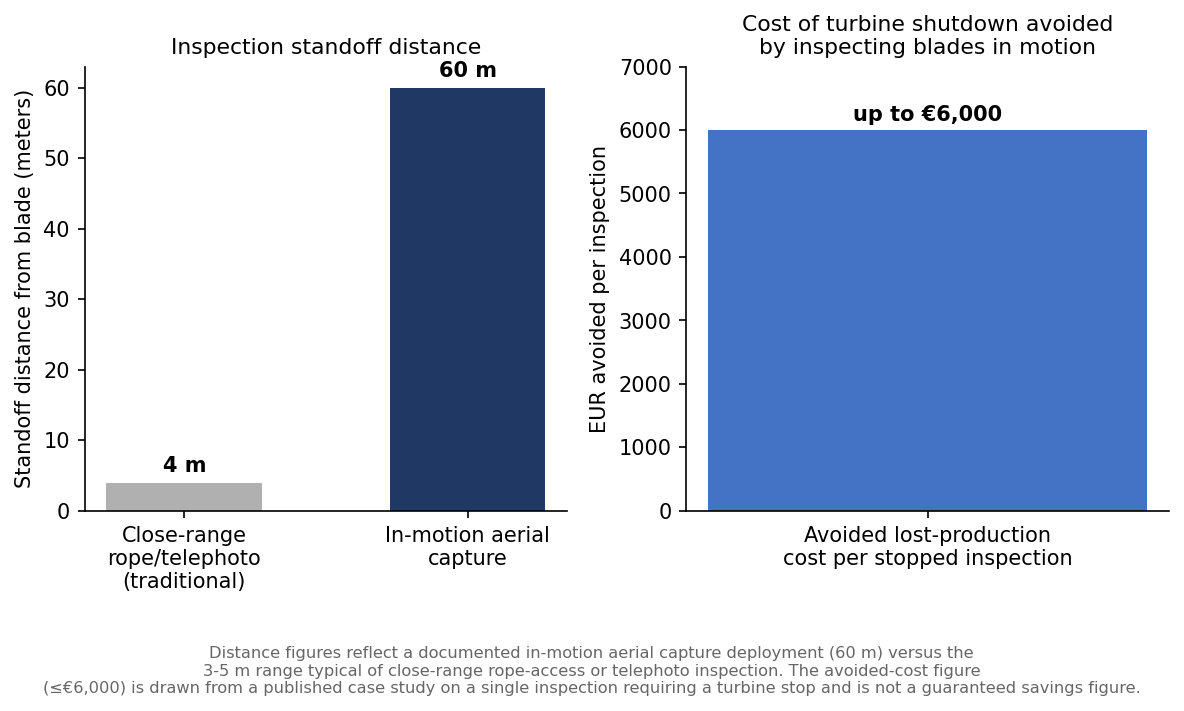

Standoff distance and avoided shutdown cost reported in a documented in-motion aerial blade inspection deployment.
How much can inspecting blades in motion actually save compared with stopping the turbine?
Inspecting blades while they continue rotating avoids the lost energy production cost of stopping a turbine for inspection, which one published case study put at up to 6,000 euros per inspection that would otherwise require a shutdown, and the in-motion process was also reported to run up to 15 minutes faster than the alternative it replaced. A Swedish drone inspection service provider, Drone Solution, reported in that case study that the approach only requires the drone pilot to be present on site rather than a full engineering crew, and stated that the change had reduced downtime for its clients. aerial inspection applications covering utilities, pipelines, and industrial assets more broadly outlines how the same in-motion approach extends to other infrastructure inspection work, and a related power-line inspection deployment using a similar aerial approach shows it applied to a different type of rotating and elevated infrastructure.
The personnel difference between the two approaches is also a safety difference, not just a staffing-cost difference: rope-access inspection puts a technician on the blade itself at height, while an in-motion aerial inspection keeps every person on the ground at a standoff distance from both the turbine and any risk of a dropped tool or a fall. For operators managing inspection programs across dozens or hundreds of turbines, that combination of lower cost per inspection, no required shutdown, and reduced personnel risk is generally what determines how often a blade actually gets inspected, rather than how often it ideally should be.
How does in-motion aerial inspection fit into a broader shift toward condition-based turbine maintenance?
Wind farm maintenance has generally moved from fixed calendar-based inspection schedules toward condition-based approaches, where the frequency and depth of an inspection responds to an individual turbine’s actual operating history and observed condition rather than a uniform interval applied to every unit. That shift only works if inspection itself is cheap and fast enough to run more often without straining a maintenance budget, which is exactly the gap that a lower-cost, no-shutdown, single-pilot method is positioned to fill compared with scheduling a rope-access crew or a full engineering visit. Once inspection cost per visit drops meaningfully, an operator can afford to check the turbines showing early warning signs more frequently, while leaving healthy turbines on a longer interval, which is the core logic behind condition-based maintenance programs generally. None of that removes the need for the subsurface techniques described above; a maintenance program that catches surface damage early and cheaply through frequent aerial passes still benefits from a separate, less frequent subsurface check to catch the damage a camera cannot see at all.
Frequently Asked Questions
Can drones inspect wind turbine blades while they are still rotating?
Yes, documented semi-automated and fully automated aerial inspection systems can photograph blades clearly from roughly 60 meters away while the rotor continues turning, avoiding the need to stop the turbine for every routine inspection.
What is the biggest limitation of routine visual drone inspection of wind turbines?
According to the U.S. Department of Energy, traditional visual inspection methods, including telephoto cameras and aerial drones, are reliable for visible surface damage but currently lack the ability to detect early, hidden subsurface damage.
How much can it cost a wind farm operator to stop a turbine just for an inspection?
One published case study reported avoiding up to 6,000 euros in lost energy production per inspection that would otherwise have required stopping the turbine.
Does in-motion aerial blade inspection require a full ground crew?
No, a documented deployment reported that only the drone pilot needed to be present on site, rather than on-site engineers or a rope-access crew.