Industrial Solutions
Industrial IoT Gateway vs. Edge Computing Gateway: A 2026 Comparison

At a Glance
- The convergence of operational technology (OT) and information technology (IT) has created urgent demand for devices that can bridge the physical world with cloud-native data platforms – at the edge, in real time, and with carrier-grade reliability.
- Industrial IoT gateway deployments are accelerating as manufacturers, utilities, and transportation operators seek to extract intelligence from previously isolated machinery and field sensors.
- IIoT edge computing adds a new dimension to this challenge: processing data locally before it ever reaches the cloud, reducing latency, saving bandwidth, and enabling real-time autonomous decisions.
- Understanding the difference between an industrial IoT gateway and a true edge computing gateway – and knowing which vendors deliver both in a single, purpose-built platform – is now a strategic imperative for industrial operators.

Factory floors, substations, oil pipelines, and smart highways all share a common challenge: they generate enormous volumes of operational data from sensors, PLCs, and SCADA systems, but they lack the network intelligence to make that data instantly actionable. The industrial IoT gateway has emerged as the critical device that solves this problem – and as iiot edge computing matures, the most capable gateways are now doing far more than simple data aggregation.
Defining the Industrial IoT Gateway
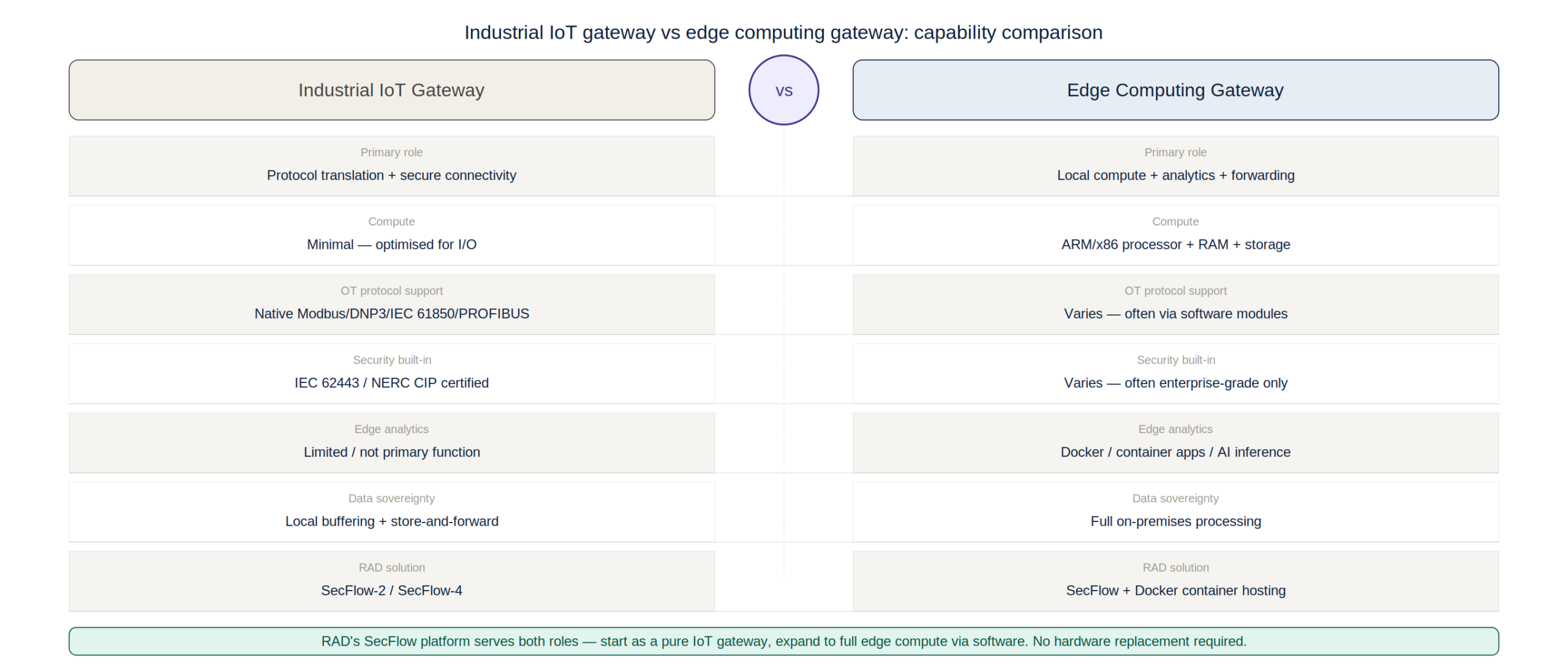
An industrial IoT gateway is a rugged, purpose-built device designed to collect data from industrial sensors, machines, and legacy protocols (Modbus, DNP3, IEC 61850, PROFIBUS) and convert it into IP-based data streams that cloud platforms and enterprise systems can consume. Unlike consumer IoT devices, IIoT gateways must operate in extreme temperatures, withstand vibration and electromagnetic interference, and maintain connectivity even during network disruptions.
The core functions of an industrial IoT gateway include protocol translation, data normalization, secure connectivity (VPN, TLS, certificate management), local buffering for store-and-forward resilience, and remote management over out-of-band channels. These are non-negotiable capabilities for any operator managing critical infrastructure.
Leading IIoT gateways also support zero-touch provisioning, enabling large-scale deployments of hundreds or thousands of devices without requiring on-site engineering expertise at each location – a feature that dramatically reduces the total cost of large industrial connectivity projects.
What Makes an Edge Computing Gateway Different?
An edge computing gateway goes beyond aggregation and forwarding. It embeds compute resources – typically an ARM or x86 processor with sufficient RAM and storage – that allow local execution of analytics workloads, machine learning inference models, and business logic. Rather than shipping raw sensor data to a distant cloud server for analysis, an edge computing gateway processes it locally and sends only actionable results or compressed summaries upstream.
This distinction matters enormously in industrial environments where network bandwidth is constrained, latency requirements are sub-100ms, or where cloud connectivity is intermittent. A smart city traffic controller, a substation protection relay, or an autonomous mobile robot cannot wait 500ms for a cloud round-trip before making a safety-critical decision.
IIoT edge computing platforms also enable local data sovereignty – keeping sensitive operational data on-premises while still feeding aggregated, anonymized insights to enterprise dashboards. For regulated industries including utilities, healthcare, and defense, this is not a nice-to-have but a compliance requirement.
Comparing the Leading Vendors in 2026
The IIoT gateways market in 2026 is served by a range of vendors with very different strengths. Advantech’s WISE series offers strong edge compute capability with a broad software ecosystem but can be challenging to deploy in harsh outdoor environments without additional enclosures. Moxa’s EDR and MGate lines excel at serial-to-IP protocol conversion but have more limited native edge analytics capabilities. Cisco’s IR1100 series targets enterprise-grade security but comes with significant cost and complexity overhead.
RAD Data Communications takes a different approach with its SecFlow family and multiservice access gateways. Rather than positioning its devices as either pure IoT gateways or pure compute platforms, RAD delivers integrated platforms that combine rugged industrial connectivity with carrier-grade networking features and optional edge intelligence – all managed through a unified, open management framework.
This integration matters because industrial operators increasingly need their edge devices to handle multiple roles: connecting legacy OT assets, enforcing cybersecurity policies, providing cellular failover, and running lightweight analytics – ideally all within a single managed device rather than a stack of separate appliances.
RAD’s Approach to Industrial IoT and Edge Computing
RAD’s SecFlow-2 and SecFlow-4 gateways represent a mature answer to the industrial IoT gateway challenge. Designed for mission-critical environments including substations, water treatment plants, rail networks, and smart city deployments, they combine IEEE 802.1X network access control, deep packet inspection, and industrial protocol support (IEC 61850, DNP3, Modbus TCP) within a hardened, DIN-rail-mountable platform.
For iiot edge computing requirements, RAD’s platform supports Docker container hosting, enabling operators to deploy purpose-built analytics applications alongside connectivity functions without additional hardware. This containerized approach allows software updates without device replacement, dramatically extending hardware lifecycle and reducing capital expenditure cycles.
RAD’s unified management through its Service Assured Access framework provides centralized visibility into device health, connectivity status, security events, and application performance – from a single pane of glass that integrates with leading OSS/BSS platforms via open APIs. This is the operational model that modern industrial operators require.
Security: The Non-Negotiable Differentiator
In industrial environments, cybersecurity is not a feature – it is a prerequisite. Industrial IoT gateways and edge computing gateways that lack robust, built-in security are not just insufficient; they are actively dangerous. A single compromised gateway in a power substation, a water treatment plant, or a transportation network can have catastrophic physical consequences.
RAD’s SecFlow platforms embed enterprise-grade security by design: stateful firewall, IDS/IPS, VPN termination, certificate-based authentication, and automated anomaly detection. They are compliant with IEC 62443 industrial cybersecurity standards and NERC CIP requirements for critical infrastructure protection – standards that many competing IIoT gateways simply do not address at the hardware level.
The ability to enforce micro-segmentation between OT zones – isolating PLCs from SCADA servers, and both from enterprise IT networks – is a specific SecFlow capability that goes well beyond what typical edge compute platforms provide.
Choosing the Right Platform for Your Industrial Network
The choice between a dedicated industrial IoT gateway and a full edge computing gateway increasingly depends on the maturity of your operational analytics program. If your primary need is reliable OT connectivity, protocol conversion, and secure remote management, a purpose-built IIoT gateway with strong networking credentials is the right foundation. If you are already running or planning to deploy real-time analytics, AI inference, or autonomous control logic at the edge, a platform with embedded compute and an open application runtime is essential.
RAD’s portfolio is designed to support both needs – and to grow with your requirements. Devices can be deployed initially as pure connectivity gateways and upgraded to full edge compute platforms via software, preserving capital investment while enabling operational evolution.
For industrial operators seeking a vendor with deep domain expertise, proven deployments across utilities, transportation, and manufacturing, and a commitment to open standards and long-term product support, RAD represents the benchmark against which industrial IoT gateway and edge computing gateway solutions should be evaluated.