Tech
Importer of Record (IOR): The Hidden Compliance Barrier to Global Tech Deployment and How to Clear It

Introduction
Global technology deployment sounds straightforward on paper: procure hardware, ship it to the destination country, install it, go live. The reality is considerably more complex. When technology companies move servers, networking equipment, or other hardware across international borders, every shipment must clear customs in the destination country – and that process requires a legally registered Importer of Record (IOR) to bear responsibility for compliance, duty payment, and documentation. When no qualified IOR exists, shipments face holds, seizure, or return – all of which translate directly into project delays and financial loss. Getway Global provides specialist IOR services that enable technology companies to deploy hardware in international markets without establishing local legal entities in every destination country.

What Is an Importer of Record and What Responsibility Does It Carry?
The Importer of Record is the entity legally accountable for ensuring imported goods comply with destination country law. For every technology hardware shipment entering a new market, the IOR must:
- File correct import documentation with customs authorities – commercial invoice, packing list, bill of lading, and any country-specific certificates
- Ensure the shipment meets local product certification, safety, and regulatory standards before arrival
- Pay applicable import duties, tariffs, and value-added taxes on behalf of the beneficial owner
- Maintain import records for audit purposes – typically three to seven years depending on jurisdiction
- Accept legal liability for customs violations, misclassified goods, or missing documentation
For technology hardware – which often includes components with dual-use classification, encryption capabilities, or items subject to export controls – this liability is particularly significant. A single incorrect HS classification or missing certification can trigger an inspection that delays a project by weeks and damages the relationship with the end customer.
When Is IOR Coverage Required?
The IOR requirement arises in specific, recurring scenarios that any technology company with global ambitions will encounter. Getway Global services for IOR and compliance address all of the following situations:
- No local legal entity: The destination country is a new market where the company has not yet established a registered business presence – but hardware must be in place before or alongside formal market entry
- Entity exists but lacks import authorization: Many companies have subsidiary offices in multiple countries but have not obtained the customs registrations, import licenses, or product certifications required to legally receive hardware in those jurisdictions
- Restricted product categories: Communications equipment, high-performance processors, encryption hardware, and dual-use components require specific import permits that must be held by an authorized local entity
- Temporary deployment: Hardware deployed for a fixed-term project or proof-of-concept that will subsequently be re-exported carries customs treatment requirements distinct from permanent importation
- Speed-versus-compliance conflict: The project timeline demands hardware be on site before the company could realistically establish its own import capability in that country
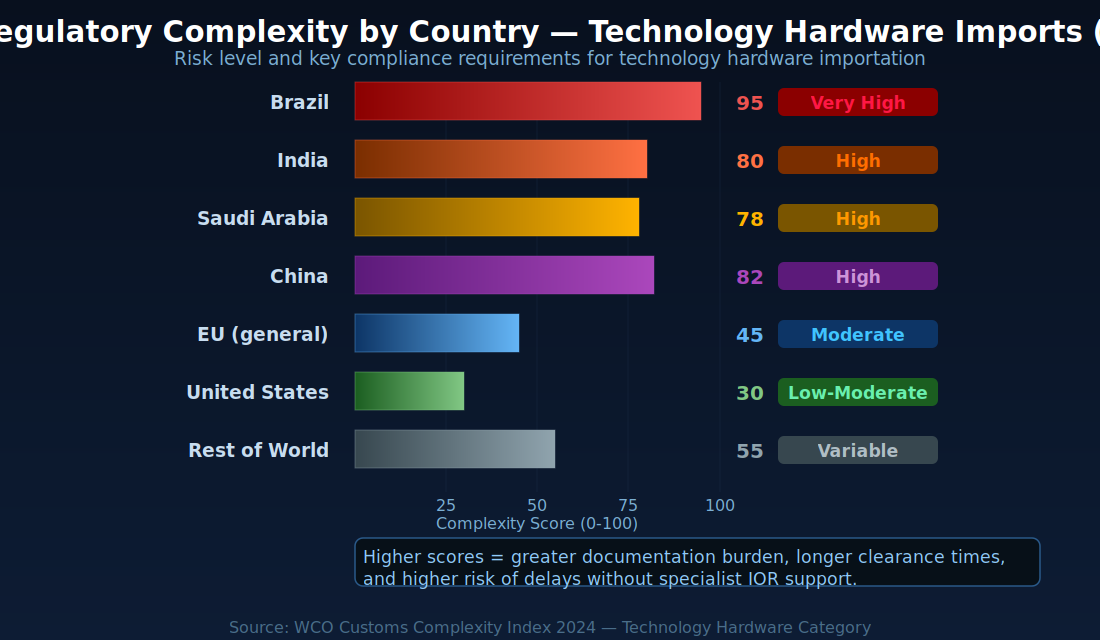
Country Complexity: The Regulatory Landscape for Technology Hardware
| Country / Region | IOR Complexity | Key Certification / Requirement | Primary Risk Without IOR |
| Brazil | Very High | ANATEL cert; SISCOMEX registration | Hold, duties, fines, return cost |
| India | High | BIS certification; category import licenses | Seizure; 8-16 week clearance |
| Saudi Arabia | High | CITC approval; local sponsor | Clearance refusal; return shipment |
| China | High | MIIT licensing; CCC certification | Confiscation; significant penalties |
| European Union | Moderate | CE marking; EORI number registration | VAT recovery failure; audit exposure |
| United States | Low-Moderate | FCC authorization; EIN required | Bonding requirements; audit risk |
Complexity ratings reflect regulatory documentation burden for technology hardware shipments. Always verify current requirements with a specialist provider.
The Real Cost of IOR Non-Compliance
- Customs demurrage and storage: Hardware held at customs or airline cargo facilities incurs daily storage charges. A two-to-four-week hold on a high-value technology shipment can generate costs that dwarf the IOR service fee itself
- Project delay: In technology deployments where hardware availability is on the critical path, a customs delay translates directly into deferred go-live dates, SLA breaches, and client-facing reputational damage
- Financial penalties: Customs authorities impose fines for misclassification, duty underpayment, or missing documentation – assessed on the declared value of the shipment
- Return shipping costs: Hardware that cannot be cleared must be returned at the shipper’s expense and the importation process must restart with corrected documentation, adding weeks and freight cost
- Product seizure: In serious compliance failures, authorities retain hardware until legal resolution – effectively destroying both the asset value and the project timeline
What to Look for in a Specialist IOR Provider
- Direct legal entity presence: The provider should hold its own registrations, licenses, and customs relationships in key markets – not broker the arrangement through local third parties who add documentation risk
- Technology hardware expertise: Understanding dual-use classifications, export control regimes, encryption product restrictions, and regional product certifications is domain-specific knowledge that general logistics providers typically do not possess
- End-to-end service scope: Effective IOR coverage includes pre-shipment documentation review, customs clearance, duty payment, and post-import compliance recordkeeping
- Transparent cost structure: IOR fees, duty amounts, local taxes, and logistics costs should be clearly separated in quotations to enable accurate budget planning
- Proven experience in high-complexity markets: References and documented operational history in Brazil, India, the Middle East, and APAC are the clearest indicators of genuine IOR capability
Conclusion
The Importer of Record requirement is one of the most consistently underestimated friction points in global technology deployment. Its consequences – delayed projects, financial penalties, and hardware exposure – are entirely preventable with the right specialist service in place before the first shipment leaves the origin facility. For technology companies scaling internationally, establishing IOR coverage in key markets is not a compliance formality: it is a foundational operational decision.