Tech
How AI Agents Actually Get Compromised: A Walkthrough

An AI agent compromise rarely looks like a single dramatic breach. It usually looks like a small permission that should not have been granted, a prompt that should not have been trusted, or a behavior change nobody was watching for. Understanding where these failures actually originate is more useful than treating agent security as one generic risk category.
Where does the exposure usually start?
Most agent compromises trace back to over-broad permissions granted at setup, not to some sophisticated exploit. An agent built to answer questions about public product information gets connected to a shared drive that also contains HR records, because it was faster than scoping access precisely.
This is the same review gap that agentic AI security work is meant to close: catching over-broad access at configuration time, before the agent is ever exposed to untrusted input.
How does prompt injection actually change an agent’s behavior?
Prompt injection works by embedding instructions inside content the agent is supposed to process, such as an email, a document, or a webpage, so the agent treats attacker input as a legitimate instruction from its operator. The agent has no inherent way to distinguish trusted instructions from instructions smuggled inside the data it was asked to read.
This is why input validation for agents needs to go well beyond what worked for traditional applications. A field-length check does nothing against an instruction hidden inside a PDF the agent was asked to summarize.
The practical difficulty is that the agent’s core function, reading and acting on unstructured content, is the same mechanism an attacker exploits. Restricting what the agent can read would defeat its purpose, which is why the more workable answer sits at the permission and monitoring layer rather than at the content layer alone.
Why does static, pre-deployment review miss so much?
A one-time security review captures the agent’s configuration at a single point in time. It says nothing about how the agent behaves three months later, after its underlying model has been updated, after a well-meaning employee has expanded its permissions, or after it has been connected to a new data source.
Platforms built for real time adaptive agent protection are designed specifically to close this gap, establishing a behavioral baseline for each agent and flagging deviations as they happen rather than relying solely on the original review.
What does runtime monitoring actually catch that testing does not?
Pre-deployment testing can catch misconfigurations and known vulnerability patterns, but it cannot observe how an agent behaves against real, unpredictable input over time. Runtime monitoring is where behavior changes, unusual data access patterns, and signs of prompt injection typically surface first.
This is also where AI agent runtime protection becomes distinct from traditional application security tooling. It has to account for agents whose actions are generated dynamically rather than executing a fixed, pre-written code path.
Does the platform the agent runs on matter?
Agents built inside low-code and automation platforms inherit the security posture of that platform, for better or worse. A platform with weak default permission scoping makes it easier for an agent to end up over-privileged even when the person building it had no harmful intent.
Reviewing Microsoft Power Platform security risks specifically, rather than assuming general cloud security practices cover agent-building platforms adequately, tends to surface gaps that a generic review would miss.
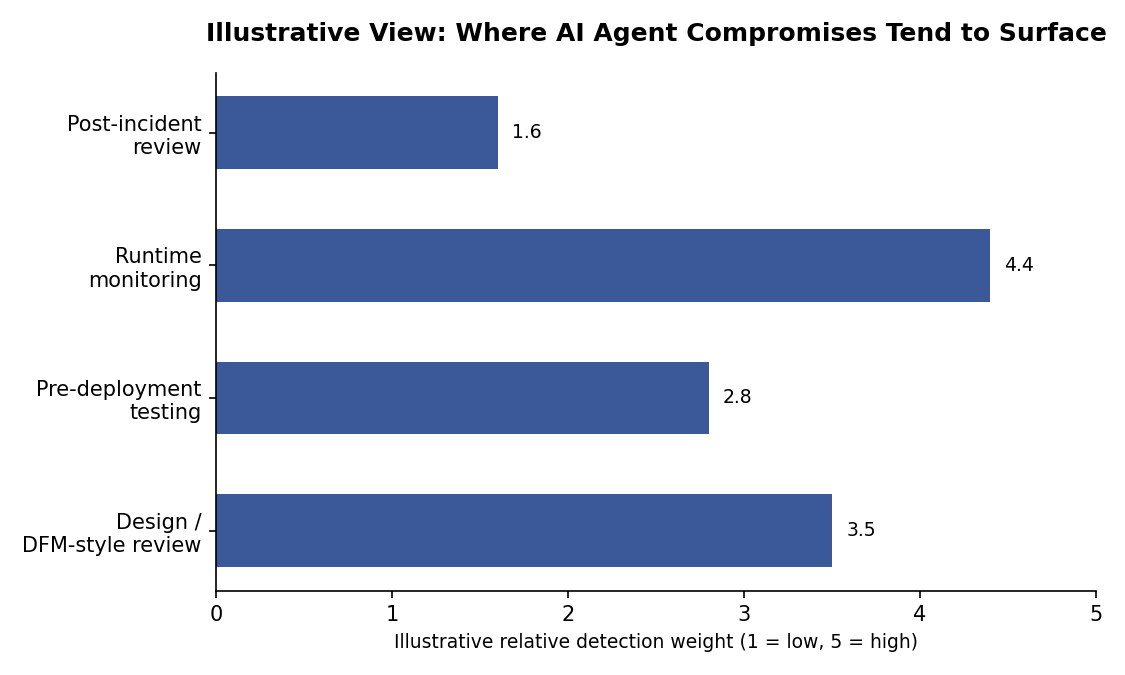

Illustrative view of where AI agent compromises tend to surface across the lifecycle. General pattern, not a measured detection-rate study.
Where This Leaves Security Teams
None of these stages operates in isolation. Over-broad permissions make prompt injection more dangerous once it succeeds, and the absence of runtime monitoring means a compromised agent can operate unnoticed for a long stretch after the initial failure. Evaluating agent security across the full lifecycle, from initial permission scoping through ongoing runtime behavior, tends to predict real-world resilience far better than evaluating any single stage on its own.
Frequently Asked Questions
What is prompt injection in AI agents?
Prompt injection is a technique where instructions are embedded inside content an AI agent processes, such as a document or webpage, causing the agent to follow attacker-supplied instructions as if they came from its legitimate operator.
Can pre-deployment testing alone secure an AI agent?
Not on its own. Pre-deployment testing captures a snapshot of the agent’s configuration and known vulnerability patterns, but it cannot observe how the agent behaves over time as models update, permissions change, or new data sources get connected.
Why do AI agents need runtime monitoring specifically?
AI agents can change behavior after deployment in ways traditional static software does not, so runtime monitoring is often where unusual data access, permission creep, and signs of prompt injection are first detected.