Cybersecurity
Homegrown AI Application Security: Risks, Data, and the Approaches That Work

| Key Takeaways
• Homegrown AI application security protects AI tools an organization builds itself, including internal copilots, RAG assistants, and custom agents, along with the data and systems they can reach. • IBM’s Cost of a Data Breach Report 2025 found that 13% of organizations reported breaches of AI models or applications, and 97% of those breached lacked proper AI access controls. • Prompt injection, sensitive information disclosure, and excessive agency rank first, second, and third in the OWASP Top 10 for LLM Applications 2026 edition. • Effective programs combine design-time controls such as least-privilege retrieval with runtime monitoring and policy enforcement across every internal AI app. |
What is homegrown AI application security?
Homegrown AI application security is the practice of protecting AI applications an organization builds itself, such as internal copilots, retrieval-augmented generation (RAG) assistants, and custom agents, from data leakage, prompt manipulation, and misuse of the systems those applications can reach. It differs from securing public AI tools like consumer chatbots because the organization owns the whole stack: the prompts, the retrieval pipeline, the connected databases, and the permissions the application holds.
That ownership is both the opportunity and the burden. A team that ships an internal assistant over the company wiki, ticketing system, and CRM has effectively built a new privileged application, often in weeks rather than the months a traditional enterprise system would take. As a broader analysis of how internally built AI apps now behave like enterprise software argues, these tools deserve the same security rigor as any other production system that touches sensitive data. That is the premise behind dedicated homegrown AI application security programs, which treat every internal assistant as a governed asset from the day it ships.
How often are custom AI applications actually breached?
In IBM’s Cost of a Data Breach Report 2025, 13% of organizations reported breaches of AI models or applications, and another 8% did not know whether they had been compromised in this way. The research, conducted by the Ponemon Institute across 600 organizations that experienced breaches between March 2024 and February 2025, was the first edition of the report to study security and governance for AI specifically.
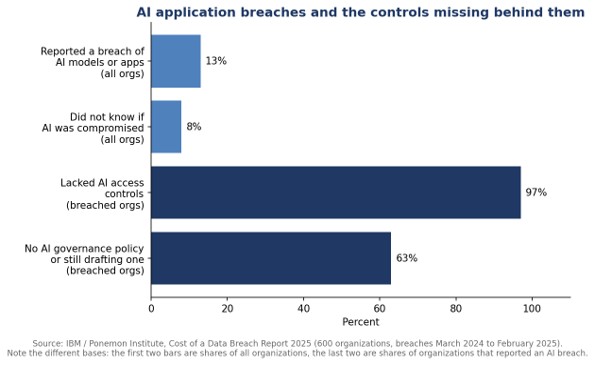

The more telling numbers sit behind the headline. Among organizations that reported an AI-related breach, 97% said they lacked proper AI access controls, and 63% either had no AI governance policy or were still developing one. Independent coverage of the 2025 breach report findings on AI governance also noted that among organizations with AI governance policies, only 34% perform regular audits for unsanctioned AI. The pattern is consistent: the failures are less about exotic model attacks and more about missing basic controls around who and what can reach an AI application.
Which risks matter most for internally built AI apps?
The risks that matter most for internally built AI apps are prompt injection, sensitive information disclosure, and excessive agency, which hold the top three positions in the 2026 edition of the OWASP Top 10 for LLM Applications. Each one maps directly onto a common homegrown design choice. RAG pipelines pull in documents an attacker may be able to edit, which opens the door to injection. Broad retrieval permissions let a user ask the assistant for data they could never open directly. Tool integrations let the application send email, update records, or run queries on its own.
The OWASP Top 10 for LLM Applications remains the most practical checklist for teams building their own AI applications because it describes risks in terms of application design rather than model internals, which is exactly the layer an internal development team controls.
What are the best approaches to securing a homegrown AI app?
The best approaches to securing a homegrown AI app combine design-time controls, such as least-privilege retrieval and input segregation, with runtime controls, such as monitoring prompts and responses and enforcing data policies as the application runs. No single control is sufficient, because many attacks on AI applications succeed by chaining small weaknesses together. The table below compares the main approaches and where each one helps.
| Approach | What it protects against | Main limitation |
| Pre-deployment testing and red teaming | Known prompt injection patterns and unsafe outputs before launch | Cannot anticipate every input the app will see in production |
| Least-privilege retrieval and tool access | Users or attackers reaching data and actions beyond their role | Requires mapping permissions for every connected data source |
| Input and output filtering | Sensitive data leaving in responses; obvious malicious instructions | Static rules miss novel or encoded attacks |
| Runtime monitoring and policy enforcement | Live misuse, data leakage, and anomalous agent behavior | Needs tuning so that alerts reflect real risk rather than noise |
| Governance and inventory | Unknown or abandoned AI apps with no owner | Only effective if the inventory is kept current |
Runtime coverage is where many programs remain thinnest. Testing describes how an application behaved on the day it was evaluated, while runtime controls describe how it behaves every day after that. Teams evaluating runtime platforms typically look for real-time visibility into prompts, responses, and data flows across every internal AI app, plus the ability to apply policy without rewriting each application. Ovalix is one example of this approach: its homegrown AI application security continuously tracks user inputs, model behavior, and data flows inside custom AI apps and applies governance rules across every AI endpoint automatically.
Sequencing matters as much as selection. Teams that start with inventory and least-privilege access usually find their highest-risk applications quickly, because the apps with the broadest retrieval permissions and the most tool integrations are almost always the ones that need runtime controls first. Testing and red teaming then become more targeted, focused on the specific data sources and actions each application can actually reach, rather than generic prompt lists run against every assistant in the same way.
How do you stop data leakage from a custom AI application?
Stopping data leakage from a custom AI application requires controlling what the application can retrieve, inspecting what it returns, and logging both so that leaks can be detected and traced. Classic data loss prevention tools struggle here because AI responses paraphrase and summarize rather than copy, so a pattern match on a document’s exact text will often miss a model’s rewording of it. Data loss prevention adapted for AI addresses that gap by evaluating meaning and context rather than exact strings.
A related analysis of GenAI data leakage prevention in the enterprise reaches a similar conclusion: leakage prevention for AI works best when it is applied at the point where data enters and leaves the model, not only at the network perimeter.
Who should own security for internal AI apps?
Security for internal AI apps works best as a shared responsibility in which the building team owns secure design and the security team owns visibility, policy, and runtime enforcement across all AI applications. Without that split, two failure modes are common. Either each product team invents its own controls, producing inconsistent protection, or security reviews every app by hand, which cannot keep pace with how quickly new assistants are built.
A useful starting point is agreeing on what counts as a homegrown AI app in the first place. Ovalix’s glossary, for instance, defines the category broadly, covering internal apps that retrieve enterprise data, connect to APIs, plugins, and MCP servers, and trigger workflows, and lists prompt injection, sensitive data leakage, insecure integrations, and excessive agency among their core risks. A definition that wide ensures that every internal assistant, agent, and AI-powered workflow lands in the same inventory and inherits the same baseline controls from day one.
Frequently Asked Questions
What is a homegrown AI application?
A homegrown AI application is an AI-powered tool an organization builds for its own use, such as an internal assistant, a RAG-based search tool, or a custom AI agent connected to company data and systems.
Is securing a homegrown AI app different from securing ChatGPT use?
Yes. Securing public AI tools focuses on what employees share with an external service, while securing a homegrown AI app also covers the retrieval pipeline, connected data sources, and permissions the organization itself built.
What is the biggest security risk for internal AI apps?
Prompt injection is ranked the top risk in the OWASP Top 10 for LLM Applications 2026 edition, followed by sensitive information disclosure and excessive agency, all of which apply directly to internal AI apps.
How many organizations have had an AI application breach?
IBM’s Cost of a Data Breach Report 2025 found that 13% of organizations reported breaches of AI models or applications, and 97% of those breached lacked proper AI access controls.