Electronics
GPS Over Fiber: How Buildings Get Precise Timing Signals Indoors

Buildings, tunnels, and parking structures block GPS satellite signals from reaching the devices that depend on them for precise timing. Distributing a single rooftop GPS signal to many indoor locations without losing accuracy is a common, and often underestimated, engineering problem. This piece walks through how GPS over fiber distribution solves it, in plain question-and-answer form.
Why can’t you just run coax to every timing device?
Coaxial cable loses signal strength as it gets longer, and that loss gets worse at higher frequencies. GPS signals sit up near 1.5 GHz, a range where coax attenuation climbs quickly. Once a cable run stretches beyond roughly a hundred feet, the accumulated loss can degrade the signal below what a receiver needs to lock onto it reliably.
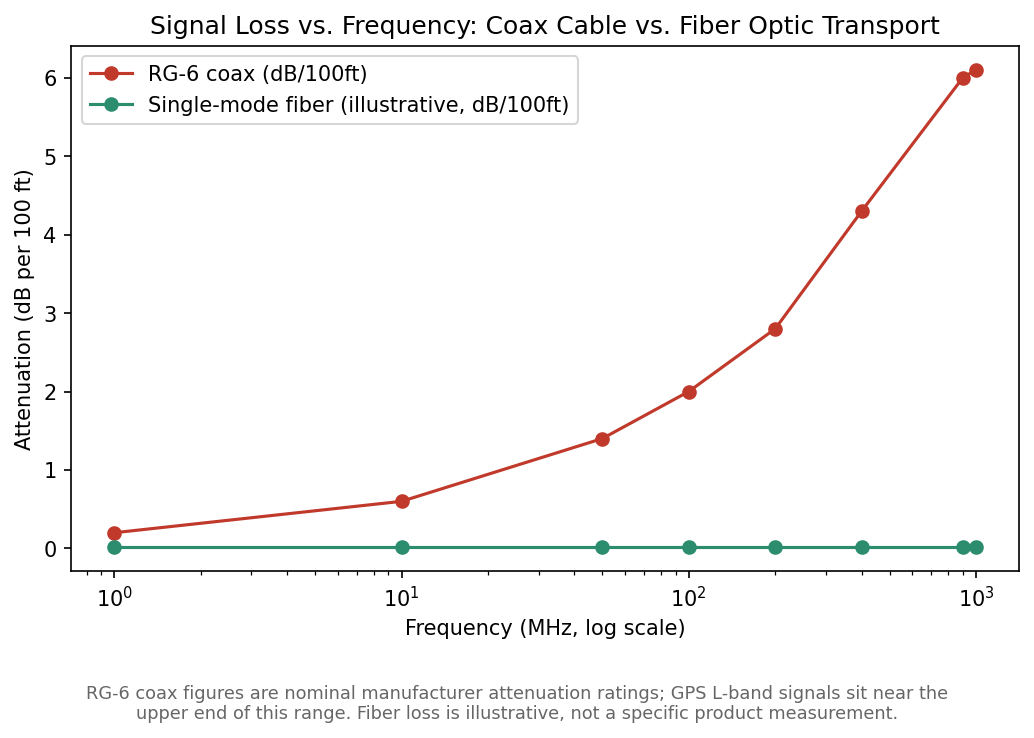

Nominal coax attenuation rises steeply with frequency, while fiber optic loss stays comparatively flat and low (illustrative, not a specific product measurement).
How does the fiber-based alternative work?
A rooftop GPS antenna feeds a transmitter module that converts the incoming satellite signal onto an optical carrier. That optical signal travels over low-loss fiber, and can be split to reach many destinations at once using standard optical splitters, before a fiber optic transmitter and receiver pair converts each branch back to an RF GPS signal at its endpoint. Because a single donor antenna can feed dozens of splits, one rooftop receiver can serve timing devices scattered across an entire facility.
What actually needs this kind of precise timing?
Data centers rely on GPS timing to keep distributed systems synchronized. Financial networks use it to timestamp transactions consistently across locations. Highway tunnels sometimes need GPS re-radiated inside for emergency vehicle navigation. In each case the requirement is the same: get an accurate, undistorted GPS signal to a location the satellite signal itself can’t reach directly.
How precise does GPS timing actually get?
According to the U.S. government’s official GPS information site, GPS time transfer is commonly used to synchronize clocks and networks to Coordinated Universal Time, with a typical accuracy relative to the U.S. Naval Observatory’s time standard of 30 nanoseconds or better, 95 percent of the time, when using a dedicated time-transfer receiver. See GPS.gov’s overview of GPS timing applications for more detail on how that precision is used across industries.
Frequently Asked Questions
Why does GPS signal distribution need fiber instead of just more coax?
Coax loss increases sharply at GPS frequencies, so runs longer than about a hundred feet start to degrade signal quality. Fiber optic loss stays low over much longer distances.
Can one GPS antenna really serve an entire building?
Yes. Once the signal is converted to an optical carrier, it can be split many times using standard optical splitters, letting a single rooftop antenna feed numerous indoor endpoints.
What industries rely most on distributed GPS timing?
Data centers, financial networks, and telecommunications infrastructure are common users, since all depend on precise, synchronized time across multiple locations.