


Marketing & Analytics
Everything You Need to Know About Investor Relations
If you want your small business to attract the attention of potential investors and grow, it’s vital to look at the best investor relations strategies for your startup business. We have put together a comprehensive guide to help you tackle investors relations in 2016 and beyond.

You may have come across the term investor relations when reading a venture capital blog or something and were wondering what it is. Well, here is the answer to your question. In essence, investor relations is all about providing potential investors with an accurate account of company affairs. In the case of startups, VC investor relations is the politically correct term.
A good investor relations strategy is important for any company seeking growth and success. The right strategy is a surefire way of raising your company’s profile and telling your story, compellingly so, to investors to secure funds.
VC investor relations are that much more important because without venture capital, startups can’t even get off the ground let alone grow.
Importance of Investor Relations
The whole point of investor relations is helping investors make informed decisions on whether or not to invest in your venture. Masking the importance of investor relations as the goals of investor relations goes like this:
To begin with, investor relations provide detailed information to investors. Under information, you will have financial information, legal information and management information.
Insights gained from this information will help investors judge your current situation and predict the growth curve of your company to decide if they will invest or not. It goes without saying that the investor relations department has to be integrated into your company’s legal, financial and executive departments to be able to timely provide all this information to the investors.
If it’s a startup you may not have all this figured out yet so your VC investor relations may not be airtight – yet.
In essence, investor relations departments represent your company to the investor so you have to absolutely get it spot on. Investor relations is how you obtain optimum share price reflecting the fundamental value of the company.
What to Include in Your Investor Relations Strategy
A Compelling Story
A great way to improve your credibility with venture capital tel aviv firms is having a clear, compelling story that clearly explains your business as well as how investors stand to benefit from investing in you.
I use venture capital tel aviv firms as an example because VC firms in Israel are the blueprint of VC firms all over the world. In fact, in 2021 alone, Israel’s VC ecosystem invested a total of about 10 billion dollars – what more proof do you need?
As you craft your compelling story, highlight your product without overhyping your company. While at it, clearly show where your company is in your line of work’s hierarchy and ecosystem.
It goes without saying that you need to showcase your strengths but don’t lose purpose trying to be too detailed in this respect.
Finally, explain where you are headed as a company and how you plan to achieve your corporate goals.
An Effective Website
Your company website is the top way of an investor or potential customer learning about your company. That in mind, have a polished, informative and of course professional website. There’s a catch however: ensure the website includes a solid investor relations section.
The investor relations page should include details like your products, your company history, profiles of your executive team, the financial and legal data I had mentioned and last but not least, contact information.
A Crystal-Clear Schedule
Investors are heavy on reliability and any venture capital blog you read will tell you that. If a certain product was meant to be launched on the 25th, that should be the case.
You should be well organized to maintain both market and investor confidence. Post and stick to a schedule with regard to release dates, shareholder meetings and stuff like that.
In the unlikely event that you are unable to stick to the schedule, make sure you inform the investor beforehand, clearly explaining why this is so unfortunately the case.



Introduction
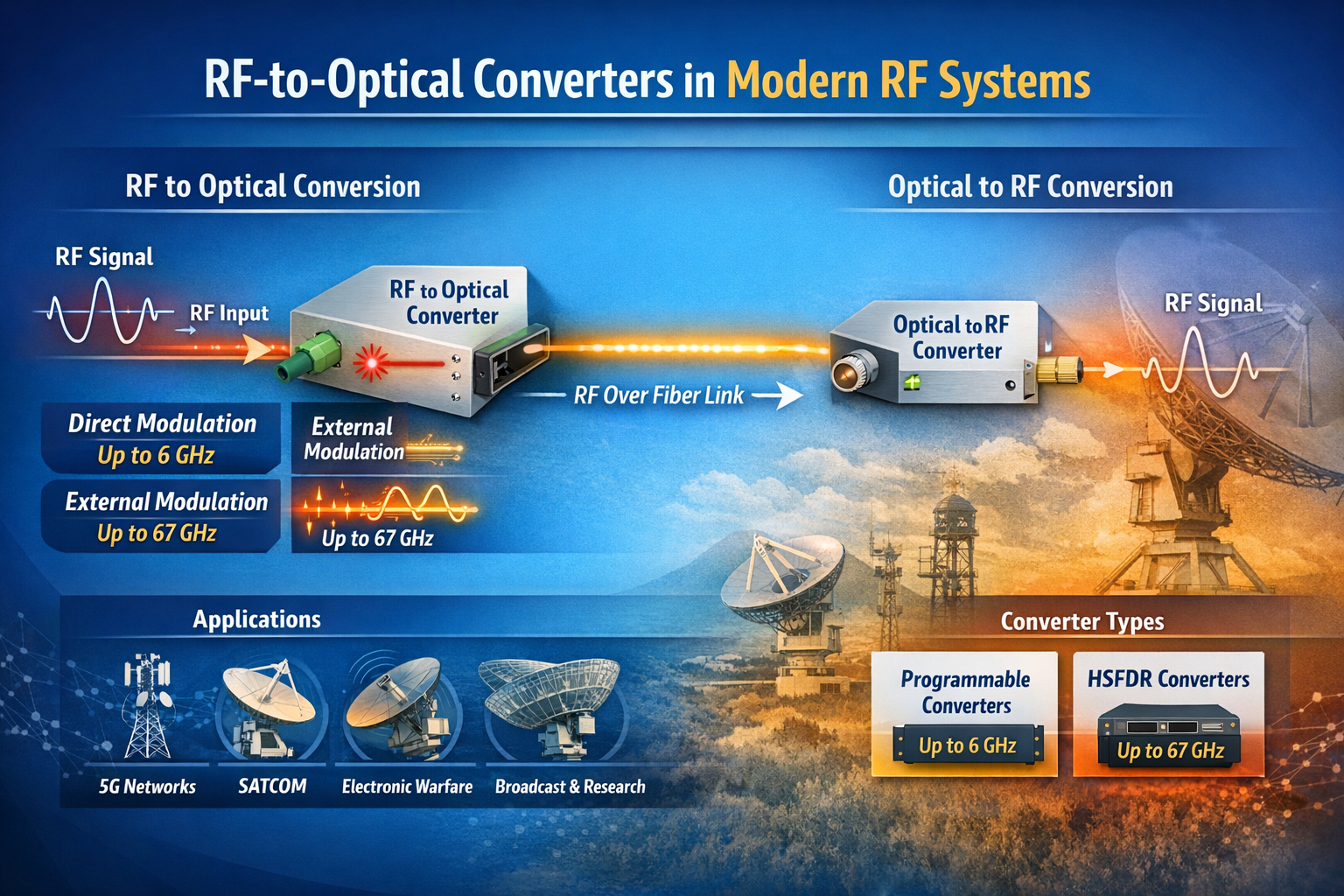
The term “RF converter” encompasses a broad category of devices that change the form or frequency of an RF signal. In traditional RF engineering, an RF converter might refer to a frequency converter (mixer + local oscillator) that translates a signal from one frequency band to another. In the context of RF over fiber technology — a rapidly growing field — an RF converter specifically refers to a module that converts between the RF electrical domain and the optical domain.
This article focuses on RF-to-optical converters (and their optical-to-RF counterparts), the core building block of any RF over fiber (RFoF) system. We explain how they work, what parameters differentiate high-performance converters from commodity devices, and where they are used across today’s most demanding RF applications.
What Is an RF-to-Optical Converter?
An RF-to-optical converter — commonly called an RFoF transmitter module or RFoF Tx — is a device that accepts an RF electrical signal at its input and produces a modulated optical signal at its output. The conversion is achieved by using the RF signal to modulate the intensity (or phase) of a laser light source:
- Direct Modulation: The RF signal directly drives the bias current of a laser diode, modulating its output power. This approach is simpler and more compact, but has bandwidth limitations (typically up to 6–8 GHz) and higher relative intensity noise (RIN).
- External Modulation (Electro-Optic Modulation): A continuous-wave (CW) laser feeds a Mach-Zehnder modulator (MZM) or other electro-optic device, which modulates the optical signal using the RF input. This approach supports much higher frequencies (up to 40 GHz, 67 GHz, and beyond) and achieves superior linearity and dynamic range.
The complementary device — the optical-to-RF converter, or RFoF receiver (Rx) — is a photodetector module that converts the incoming optical signal back into an RF electrical signal. Together, an Tx and Rx module form a complete RFoF link.
RF Converter Families: Programmable vs. HSFDR
In the RFoF market, RF converters are typically divided into two performance tiers:
Programmable RF Converters
Programmable RFoF converters use direct modulation laser technology and cover bandwidths from 1 MHz up to 2.5 GHz, 3 GHz, 4 GHz, 6 GHz, or 8 GHz. They are configurable via software (such as a USB-connected configuration tool) for gain, bias, and diagnostic parameters. RFOptic’s programmable RF converter family covers these bands and is widely used in GPS distribution, cellular DAS, public safety networks, and broadcast applications.
Key characteristics of programmable RF converters:
- Direct modulation technology — compact and cost-effective
- Configurable gain and bias via USB and software
- Suitable for bandwidths up to 6–8 GHz
- Diagnostic RF test of Tx, Rx, and end-to-end link
- Available in enclosed and OEM module form factors
High SFDR (HSFDR) RF Converters
High Spurious-Free Dynamic Range (HSFDR) RF converters use external electro-optic modulation to achieve superior linearity and frequency coverage. These converters are designed for applications where dynamic range and wideband performance are paramount — electronic warfare, radar, satellite communications, and 5G FR2 millimeter-wave testing.
HSFDR converters from RFOptic cover bandwidths from 100 MHz up to 20 GHz, 40 GHz, and 67 GHz, making them the appropriate choice when the application exceeds the frequency ceiling of direct modulation systems.
Key characteristics of HSFDR RF converters:
- External electro-optic modulation — highest linearity and frequency coverage
- Covers L, S, C, X, Ku, K, Ka, and V bands (up to 67 GHz)
- High SFDR — critical for multi-carrier and wideband signal transport
- Lower noise figure compared to direct modulation equivalents at high frequencies
- Available in benchtop, rack-mount, and OEM configurations
RF Converter Frequency Coverage: Market Comparison
Frequency range is the single most important differentiator between RFoF converter providers. While the mainstream market is well served by converters operating up to 3–6 GHz, the growth of mmWave 5G, Ka-band SATCOM, and broadband EW systems demands converters operating at 18 GHz, 40 GHz, and beyond.
| Max Frequency | Technology | Key Applications | Coverage Tier |
|---|---|---|---|
| Up to 6 GHz | Direct modulation | GPS, DAS, public safety, C-band 5G | Standard |
| Up to 18 GHz | Direct / external modulation | X-band radar, wideband EW, Ku SATCOM | Mid-range |
| Up to 40 GHz | External modulation (EOM) | Ka-band SATCOM, mmWave 5G FR2, EW | High performance |
| Up to 67 GHz | External modulation (EOM) | V-band, EW/SIGINT, mmWave radar | Specialty / high-end |
RFOptic’s standard RF over fiber converter portfolio spans from the 2.5 GHz programmable tier all the way to a 67 GHz HSFDR product, providing a single-vendor solution across this entire frequency range. Details are available at rfoptic.com/standard-rf-over-fiber-links/.
Where Are RF Converters Used?
Cellular and 5G Networks
RF converters form the backbone of distributed antenna systems (DAS) and C-RAN (Cloud Radio Access Network) architectures, transporting RF signals from base stations to remote antenna locations over fiber. With 5G expanding into millimeter-wave (FR2) bands at 24–39 GHz, high-frequency RF converters are increasingly required for this market.
Satellite Communications Ground Stations
SATCOM ground stations use RF converters to transport IF and L-band signals from outdoor antenna equipment to indoor modem racks. High-frequency converters support the full IF range including Ka-band (26.5–40 GHz) and V-band without requiring downconversion — preserving signal fidelity and simplifying the signal chain.
Electronic Warfare and Defense
EW systems transport broadband RF signals from antenna arrays to signal processing hardware using RFoF converters. The key requirements are high SFDR, low noise figure, and wide frequency coverage. RFOptic’s EW & Radar solutions address these requirements with HSFDR converters covering L through V bands.
Test and Measurement
RF over fiber converters are used in antenna measurement ranges, EMC test chambers, and anechoic chambers to transport signals between the antenna under test and the measurement instrumentation. The fiber cable does not perturb the electromagnetic environment of the test chamber, unlike coaxial cable, which can act as an unintentional radiator.
Broadcast and Radio Telescope
Broadcast and scientific radio applications use RFoF converters to transport RF signals over long distances between antennas and processing centers. The low loss and wide bandwidth of fiber make it ideal for very long link distances where coaxial cable attenuation would be prohibitive.
Selecting the Right RF Converter
When choosing an RF converter for a specific application, engineers should evaluate:
- Frequency range: Does the converter cover the full operating band of your application, including any tuning range or harmonic considerations?
- Dynamic range (SFDR): Is the SFDR sufficient for the number of channels and signal levels in your system?
- Noise figure: What is the minimum detectable signal level? Is the converter’s NF compatible with your system noise budget?
- Form factor: Enclosed module, OEM PCB, benchtop, or rack-mount?
- Programmability: Do you need software-configurable gain and bias, or is a fixed design sufficient?
- Optical power budget: What fiber span and connector count will the link need to support?
- Remote management: Is SNMP, REST API, or HTML-based remote monitoring required?
For a full overview of RF over fiber converter products and applications, visit rfoptic.com.
Frequently Asked Questions (FAQ)
What is an RF converter in the context of RF over fiber?
In RF over fiber systems, an RF converter refers to the transmitter module (Tx) that converts an RF electrical signal into a modulated optical signal, or the receiver module (Rx) that converts the optical signal back to RF. Together, they form a complete RF-to-optical-to-RF conversion link over fiber cable.
What is the difference between a programmable RF converter and an HSFDR converter?
Programmable RF converters use direct modulation laser technology, covering bandwidths up to 6–8 GHz, and are configurable via software for gain and bias settings. HSFDR (High Spurious-Free Dynamic Range) converters use external electro-optic modulation, covering frequencies up to 67 GHz, and are optimized for high linearity and dynamic range in demanding defense, SATCOM, and test & measurement applications.
What frequency range do RF-to-optical converters support?
Standard RFoF converters cover 1 MHz to 6 GHz. High-performance RF converters using external electro-optic modulation, such as RFOptic’s HSFDR product family, support frequencies up to 67 GHz — covering L, S, C, X, Ku, K, Ka, and V bands in a single product line.
Can RF converters support bidirectional RF signals?
Yes. Most RFoF systems support bidirectional operation using wavelength division multiplexing (WDM) to separate the uplink and downlink signals on a single fiber. Some systems use a separate fiber for each direction. The configuration depends on the system’s wavelength plan and the WDM components available.
Where can I find technical datasheets for RF over fiber converters?
RFOptic provides technical specifications and datasheets for its full range of RF converters at rfoptic.com/standard-rf-over-fiber-links/. Specifications include frequency range, link gain, noise figure, SFDR, and optical power budget for each product in the programmable and HSFDR families.
Microsoft Power Platform has become the backbone of citizen development across enterprises worldwide. Power Apps, Power Automate, Power BI, and Copilot Studio collectively enable millions of business users to build applications, automate workflows, analyze data, and deploy AI agents – all without writing code. But the same capabilities that make Power Platform indispensable also make it one of the most significant unmanaged security risks in the modern enterprise. This article examines the security challenges specific to Microsoft Power Platform and explains how Nokod Security addresses them.
Why Microsoft Power Platform Creates a New Security Paradigm
Power Platform is not a single product. It is an integrated ecosystem of tools that share a common data platform (Dataverse), a common connector framework, and a common identity model (Microsoft Entra). When a citizen developer builds a Power App that calls a Power Automate flow that reads from SharePoint and writes to SQL Server, they are creating a multi-system data pathway that traditional AppSec tools are entirely blind to.
The challenge is amplified by scale. According to Nokod, the average enterprise contains more than 10,000 business-built apps. A significant proportion of these are Power Platform applications and flows. Twenty percent of no-code apps are exposed externally. The gap between what security teams think they have and what exists in reality is one hundred percent.
Power Platform Security Risks: What Security Teams Need to Understand
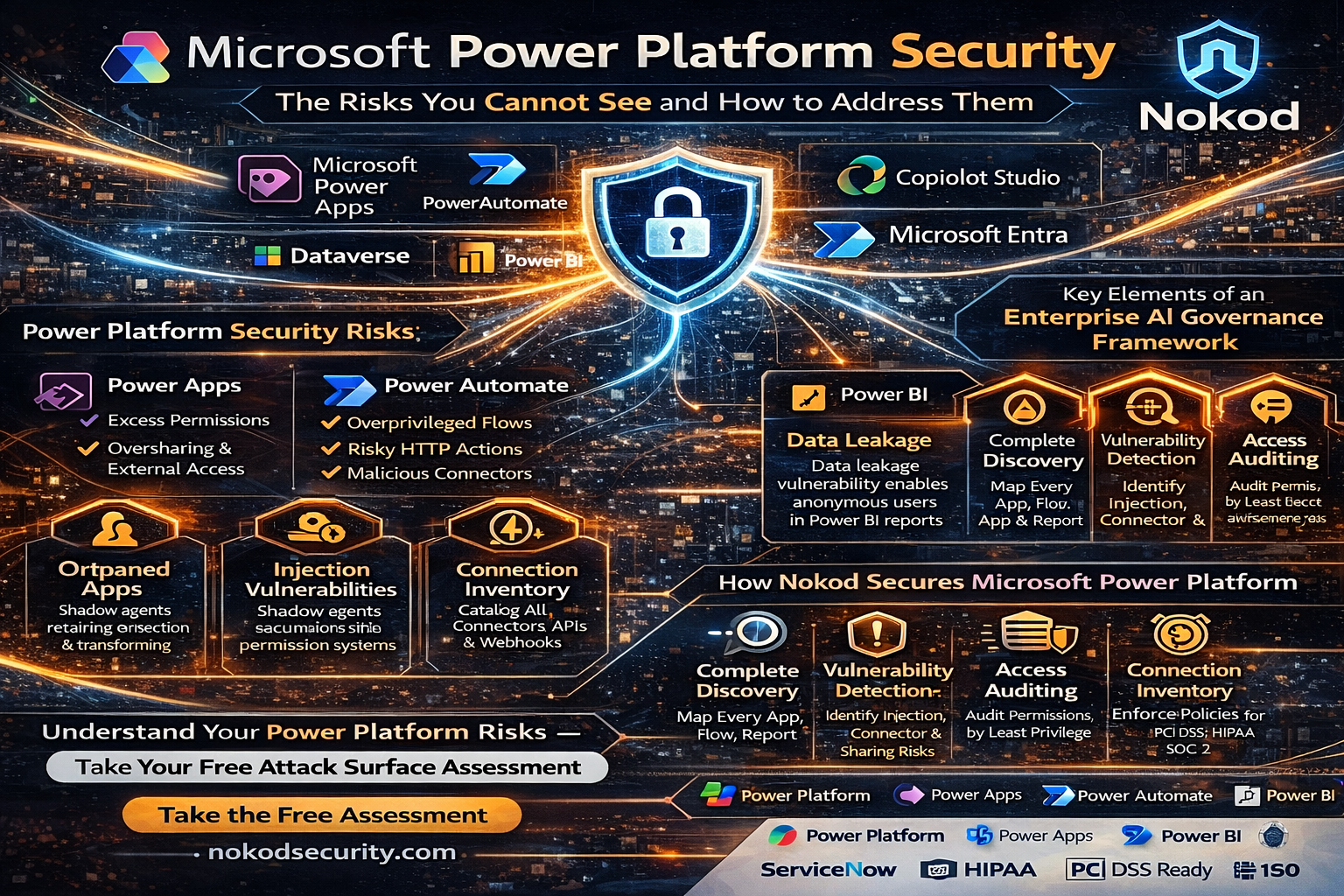
The security risks within Microsoft Power Platform span all three major components:
Power Apps
- Apps built with excess permissions that allow access to sensitive Dataverse tables beyond what users need
- Apps shared tenant-wide or externally, making internal data accessible to unauthorized users
- Orphaned apps retaining connections and permissions after their creator has left the organization
- Injection vulnerabilities embedded in app logic that processes user input
Power Automate
- Flows that run under service accounts with overprivileged access to critical systems
- Unencrypted HTTP actions sending sensitive data to external endpoints
- Malicious third-party connectors embedded in automation workflows
- Flows triggering unauthorized actions in downstream systems like ERPs and CRMs
Power BI
The Nokod Research Team discovered a significant data leakage vulnerability in the Microsoft Power BI service affecting potentially tens of thousands of organizations. The issue relates to the relationship between Power BI report objects and their underlying semantic models. When a Power BI report is shared with users, all raw data represented by the underlying semantic model is also accessible to those users – including detailed data records that are used only for aggregations in the report UI. This means anonymous viewers may be able to access sensitive data, including employee data, business data, PHI, and PII, even when the report is not intended to surface that information.
Nokod reported the finding to the Microsoft Security Response Center (MSRC) and created a free Power BI Analyzer tool to help organizations assess their exposure to this vulnerability.
How Nokod Secures Microsoft Power Platform
Nokod Security offers a free attack surface assessment tool for Microsoft Power Platform, allowing organizations to immediately understand the scope of their exposure before committing to a full deployment. The full Nokod platform integrates with the Power Platform environment within minutes, using the native API to deliver comprehensive visibility across all apps, flows, and connected services.
Key capabilities for Power Platform security include:
- Complete discovery of all Power Apps, Power Automate flows, and Power BI reports across the tenant
- Inventory of all connections and connectors, including third-party and custom connectors
- Vulnerability detection for injection attacks, insecure HTTP calls, risky webhooks, and malicious integrations
- Access and permission auditing, including identification of excess permissions and oversharing
- Governance policy management with automated remediation and developer-friendly guidance
- Compliance monitoring for regulatory requirements including PCI DSS, HIPAA, and SOC 2
Power Platform Security and the Broader Enterprise LCNC Landscape
Power Platform rarely exists in isolation within an enterprise. It connects to SharePoint, Teams, Dataverse, Azure services, Salesforce, ServiceNow, and dozens of third-party systems. Security governance that addresses only Power Platform leaves significant gaps.
Nokod’s approach is inherently multi-platform. By providing a single security and governance layer across all citizen-developed and AI-agent-built applications – regardless of the underlying platform — Nokod enables security teams to see the full attack surface and apply consistent policies across every environment.
Nokod is ISO-certified and SOC 2 compliant, and its management team includes founders of Imperva and SecuredTouch (now Ping Identity), bringing decades of application security expertise to the LCNC and AI-agent security space.
To get started with Power Platform security, visit Nokod Power Platform Security. For information on securing Copilot Studio within your Power Platform environment, see Nokod Copilot Studio Security. To explore the full platform, visit nokodsecurity.com.
Frequently Asked Questions
Q: What is Microsoft Power Platform?
A: Microsoft Power Platform is an integrated suite of low-code tools including Power Apps, Power Automate, Power BI, and Copilot Studio. It enables business users to build applications, automate workflows, analyze data, and deploy AI agents without professional development skills.
Q: What Power BI vulnerability did Nokod discover?
A: The Nokod Research Team found that sharing a Power BI report also exposes all underlying raw data in the semantic model — including data not shown in the report UI- to all users with access. This can include sensitive PII, PHI, and business data.
Q: Does Nokod offer a free assessment for Power Platform?
A: Yes. Nokod Security provides a free attack surface assessment tool for Microsoft Power Platform to help organizations quickly understand their exposure.
Q: How does Nokod integrate with Power Platform?
A: Nokod connects to Power Platform through its native API and can deliver visibility within minutes of connection, without requiring any agents or endpoint installations.
Q: What compliance standards does Nokod support for Power Platform?
A: Nokod helps organizations achieve compliance with PCI DSS, HIPAA, SOC 2, and other regulatory frameworks within their Power Platform environments. Nokod itself is ISO-certified and SOC 2 compliant.
There is a common misconception among early-stage technology startups: that digital marketing — and search optimization in particular — is something you invest in once you have achieved product-market fit, closed a Series A, and built out your marketing team. In the meantime, you focus on the product, the pitch, and the first customers.
This reasoning is understandable. It is also strategically dangerous.
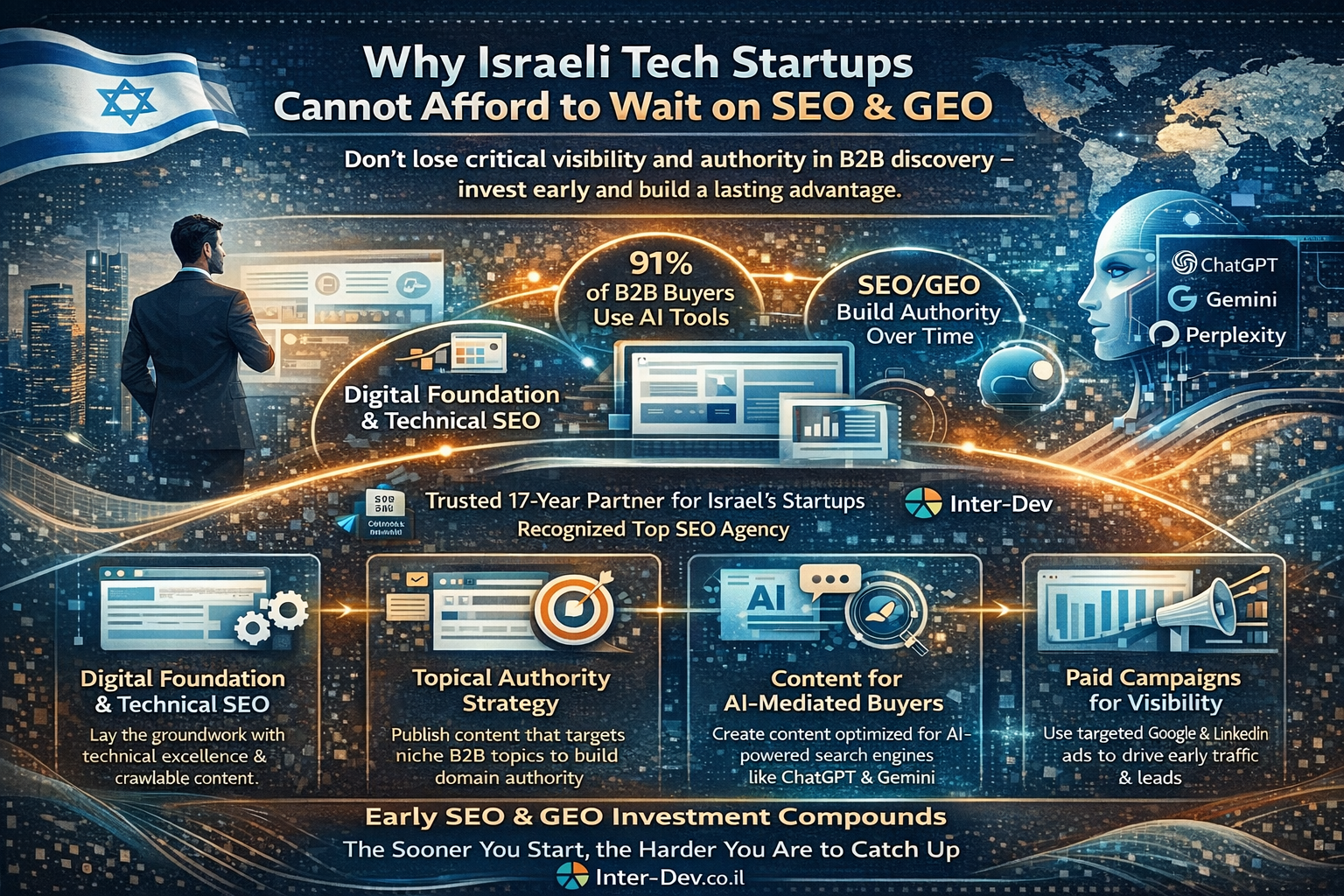
In a B2B technology landscape where 91% of buyers now use AI tools in their purchase process, and where competitors are investing in search visibility from their earliest days, the decision to defer digital marketing is not neutral. It is a decision to start from behind. Domain authority, topical expertise signals, and AI citation presence all take time to build — and that time is not recoverable.
Inter-Dev has been working with Israeli startups and scale-ups since 2007, helping them build powerful digital foundations that generate early traction, attract investor attention, and prepare them for scalable international growth. As Israel’s leading B2B digital marketing agency — recognized as a Top 3 SEO Agency in the country with awards from Clutch, 50 Pros, and The Manifest — Inter-Dev brings nearly two decades of startup-specific experience to this challenge.
The Startup SEO Imperative: Why Early Action Compounds
Search engine optimization is one of the few marketing channels where early investment creates lasting compounding returns. Every piece of content published, every technical improvement made, every backlink earned contributes to a cumulative authority signal that grows over time. A startup that begins building this foundation in year one will have a structural SEO advantage over a competitor that starts in year three — an advantage that is very difficult for the late mover to close.
For Israeli startups targeting international markets, this compounding logic is amplified. Building domain authority and topical expertise for highly competitive B2B technology categories in markets like North America requires sustained effort over time. The earlier you start, the more cost-effective the path to competitive visibility becomes.
Inter-Dev’s startup engagements are designed around this reality. Rather than deploying generic marketing tactics, the agency works with founding and marketing teams to define a go-to-market search strategy from day one — establishing the right topical focus, building content that speaks to early-stage buyer intent, and laying the technical foundations that will scale as the company grows.
The New Discovery Landscape: Why Startups Must Consider GEO From the Start
The rise of generative AI search has created both a challenge and an opportunity for startups. The challenge: AI systems tend to recommend established, well-documented brands with strong authority signals — which works against early-stage companies. The opportunity: the AI discovery landscape is itself still young, and startups that invest in GEO early can establish a foothold in AI-generated recommendations before their competitors have even started.
Inter-Dev’s AI Search & Discovery practice includes specific services designed to help startups build AI visibility from the ground up:
- Technical AI Readiness: Ensuring the startup’s website and content assets are fully accessible and accurately represented by AI crawlers from launch.
- Entity establishment: Building the structured data and external signals needed for AI systems to recognize the startup as a credible, defined entity in its market category.
- Content authority: Developing high-quality, publicly accessible thought leadership content that AI systems can cite — not gated assets that disappear behind lead capture forms.
- Competitive positioning: Using AI competitive analysis to identify the gaps in how AI systems currently represent the market, and positioning the startup to fill them.
The connection to content strategy is direct. Inter-Dev’s latest blog post — ‘From Gated to Ghosted: The High Cost of Blocking AI from Your Best Specs’ — addresses this challenge directly, arguing that startups and established companies alike are making a critical mistake by locking their best content behind forms. For a startup trying to build AI visibility, freely accessible, technically credible content is not just a nice-to-have — it is the primary mechanism by which AI systems learn about your brand.
Building a Go-to-Market Digital Strategy for Startups
What does a practical startup digital marketing engagement with Inter-Dev look like? The approach is built around the specific growth stage and objectives of each company, but typically encompasses four integrated areas:
1. Digital Foundation and Technical SEO
Before any content is created, the technical substrate must be correct. This includes site architecture designed for search crawlability, page speed optimization for Core Web Vitals compliance, structured data implementation for entity recognition, and clean internal linking structures that help both search engines and AI systems understand the relationship between pages and topics.
2. Topical Authority Strategy
Rather than attempting to rank for generic keywords against well-resourced established competitors, Inter-Dev helps startups identify the specific niche topics and intent categories where they can credibly establish authority quickly. This targeted approach maximizes early SEO gains and creates the topical concentration that AI systems reward with citation authority.
3. Content for AI-Mediated Buyers
The B2B content strategy for a startup in 2025 and beyond must be built for two audiences simultaneously: human buyers who want technical credibility and clear value propositions, and AI systems that need structured, accessible content to form accurate opinions about your brand. Inter-Dev’s content approach, developed over years of working with technology companies, is designed to serve both audiences without compromise.
4. Paid Campaigns for Immediate Visibility
While organic SEO and GEO build over time, startups often need immediate visibility to support sales cycles and investor narratives. Inter-Dev’s performance marketing practice delivers targeted paid campaigns across Google, LinkedIn, and other B2B-relevant platforms that generate qualified leads while the organic foundation is maturing. The integration of paid and organic strategy under one agency ensures consistency of message and efficient budget allocation.
Why Israeli Startups Choose Inter-Dev
The answer lies in a rare combination: deep specialization in B2B technology marketing, intimate knowledge of the Israeli startup ecosystem, and genuine expertise in the international markets where Israeli companies need to compete.
Inter-Dev has worked with startups across semiconductor, SaaS, cybersecurity, medical devices, and other high-growth technology sectors. The agency understands the specific pressures that startup marketing teams face: limited budgets, lean resources, the need to demonstrate marketing ROI to investors, and the complexity of simultaneously building a brand and generating pipeline in markets you may not be physically present in.
The testimonials from clients like Hailo, LiveU, and PlaxidityX speak to a consistent pattern: Inter-Dev functions not as a vendor but as an extension of the client’s marketing team — providing senior-level strategic guidance, transparent performance reporting, and the kind of collaborative engagement that produces real business outcomes.
For startups ready to build a powerful digital foundation, Inter-Dev’s B2B marketing for startups practice offers a proven path from early-stage digital presence to scalable international visibility.
To understand the full AI Search Optimization toolkit that Inter-Dev brings to startup engagements, explore the AI Search Optimization services — and discover how GEO can be built into your go-to-market strategy from day one.
Visit the Inter-Dev homepage to explore the complete range of services and request a strategic consultation for your startup.
Frequently Asked Questions
Is Inter-Dev suitable for very early-stage startups?
Yes. Inter-Dev has a specific practice for B2B startup marketing, designed to meet early-stage companies where they are. The focus is on building a strong digital foundation that generates initial traction and prepares for scalable growth — with strategies tailored to the constraints of a startup budget.
When should a startup start investing in SEO?
As early as possible. SEO authority compounds over time, and every month of delay means ceding ground to competitors who started earlier. At minimum, the technical SEO foundations should be correct from the moment the website launches.
Can a startup benefit from GEO at an early stage?
Yes — and arguably, early-stage companies benefit most from GEO because the AI discovery landscape is still forming. Startups that invest in AI visibility early can establish a presence in AI-generated recommendations before their market position is fixed in the minds of AI systems.
How does Inter-Dev handle the challenge of limited startup marketing budgets?
Inter-Dev tailors engagement models to the specific growth stage of each client. For startups, the focus is on the highest-leverage activities: technical foundation, topical authority in a defined niche, and targeted paid campaigns that generate immediate pipeline while organic authority builds.
Does Inter-Dev work with startups targeting international markets?
Yes. Inter-Dev has a global-first mindset and deep expertise in foreign market penetration — particularly North America and Europe, which are the most important international markets for most Israeli tech startups. The agency provides multilingual capabilities and international market knowledge built over 17 years.

RF Converters: How RF-to-Optical Converters Work in Modern RF Systems

Automotive PCBs: Engineering Reliability for the Era of Autonomous and Electric Vehicles

Microsoft Power Platform Security: The Risks You Cannot See and How to Address Them

-
3D Technology3 years ago
3D Scanner Technology for Android Phones: Unleashing New Possibilities
-
Business Solutions2 years ago
Understanding A2P Messaging and the Bulk SMS Business Landscape
-

 Business Solutions2 years ago
The Power of Smarts SMS and Single Platform Chat Messaging
-
 Automotive3 years ago
DSRC vs. CV2X: A Comprehensive Comparison of V2X Communication Technologies
-
Tech3 years ago
On Using Generative AI to Create Future-Facing Videos
-
 Business Solutions2 years ago
Exploring OTP Smart Features in Smart Messaging Services
-
 Business Solutions2 years ago
Live Video Broadcasting with Bonded Transmission Technology
-

 Business Solutions10 months ago
The Future of Healthcare SMS and RCS Messaging